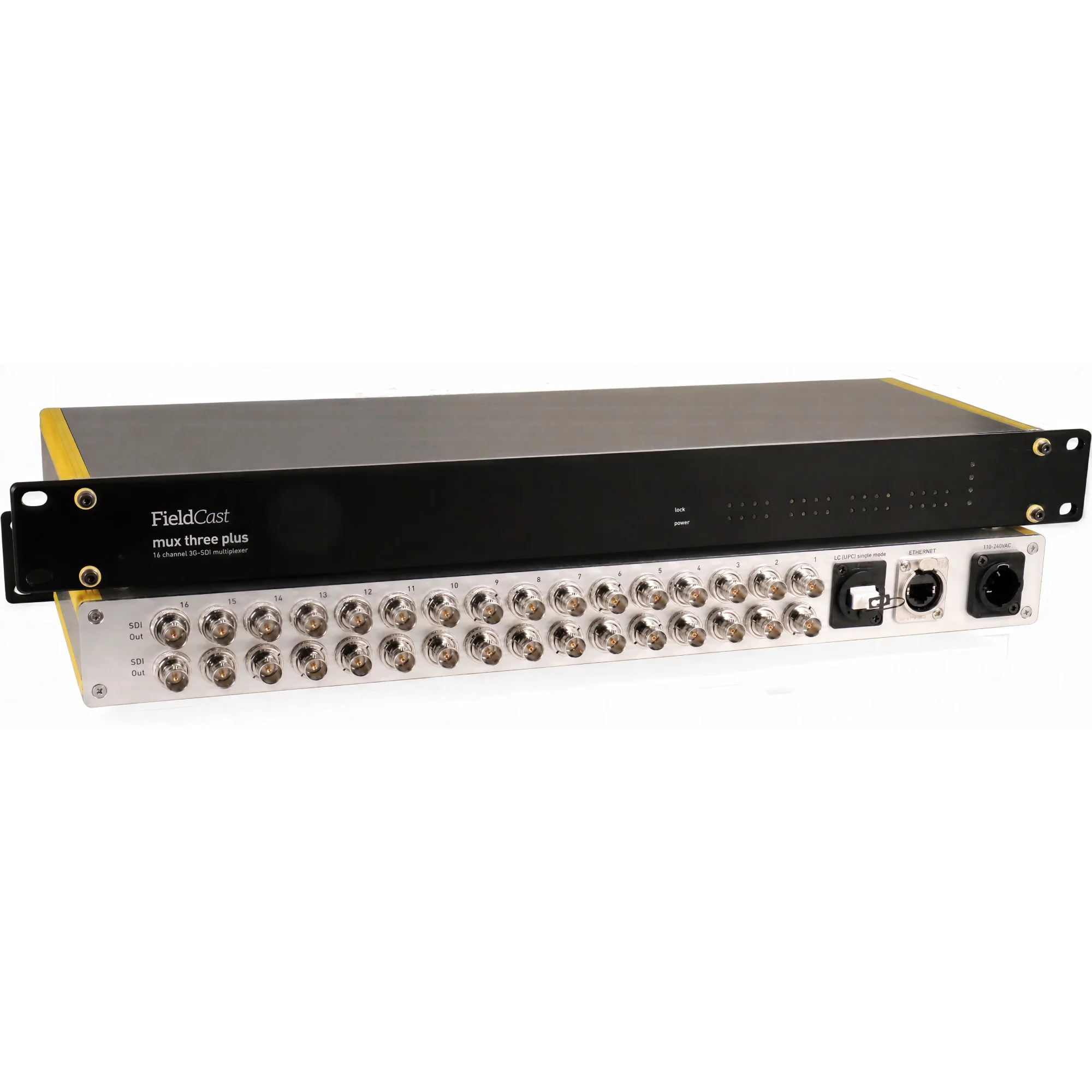
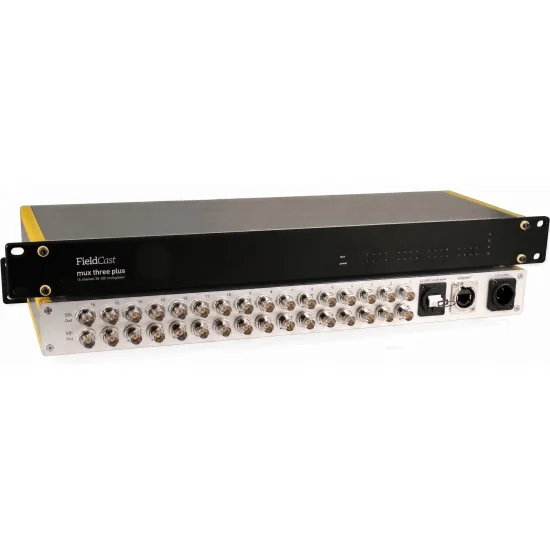
Relier un plateau, un stade ou un site de festival à la régie sans tirer des dizaines de câbles coaxiaux : c'est précisément ce que permet le FieldCast Mux + Demux Three 3G Plus. Ce duo multiplexeur / démultiplexeur achemine seize canaux 3G-SDI indépendants et un lien Ethernet 1 Gb full duplex sur un seul brin de fibre optique monomode 9/125. Le multiplexeur se place côté caméras, le démultiplexeur côté régie ou car-régie, et la liaison tient jusqu'à 40 km, une portée hors d'atteinte pour le cuivre.
L'apport de la version Plus tient à ce port Ethernet 1 Gb présent sur les deux châssis. Conforme aux normes IEEE 802.3u et 802.3z, il emprunte le canal optique COM partagé avec la vidéo et se comporte comme un simple lien Cat5 entre deux commutateurs. Télécommande caméra, pupitres RCP, pilotage PTZ ou commande d'un mélangeur distant circulent donc sur la même fibre que les images, sans tirage supplémentaire.
Côté vidéo, chaque canal accepte du 3G-SDI à 2,97 Gb/s et couvre les standards SD et HD jusqu'au 1080p60, avec conformité SMPTE 259M, 344M, 292M et 424M. Les seize entrées BNC 75 Ω du multiplexeur disposent d'une boucle de renvoi reclockée, pratique pour alimenter un retour local ou un enregistreur. En sortie, le démultiplexeur propose deux sorties SDI par canal : l'une vers le mélangeur, l'autre vers le multiviewer. Aucune compression, aucun traitement — le multiplexage CWDM à couches minces attribue une longueur d'onde à chaque flux et restitue le signal à l'identique, sans latence de codec à compenser en direct.
Les deux unités occupent 1U dans un boîtier tout aluminium, alimenté en 110-240 V AC par connecteur PowerCon, pour une consommation inférieure à 50 W. En façade noire, des LED blanc chaud signalent l'alimentation, l'activité des modules, la présence des entrées, l'état TP/LNK et le lien 1 Gb : diagnostic immédiat en exploitation comme au démontage. La configuration reste unidirectionnelle, seize entrées au mux et seize sorties au demux, en connectique LC (U)PC. Sur un câble à deux cœurs, le second brin reste libre pour une paire de secours, argument décisif en captation sportive ou en production déportée.
Livraison dans toute l’UE pour 20 €, gratuite dès 1 000 €.
Boutique B2B réservée aux professionnels, prix HT.
Distribution et garantie officielles de l'UE.
Paiements en ligne sécurisés via Stripe.
Demande de devis via formulaire ou e-mail: avgear@avgear.shop
16 channels of 3G SDI video plus Ethernet over one fiber core
Mux Three Plus 3G and its twin brother Demux Three Plus 3G, as a pair, allow you to transport sixteen independent channels of 3G SDI video plus full duplex 1 Gb Ethernet over just one fiber optic channel.
Is your infrastructure such that you only have access to one single mode (simplex) fiber optic connection? Mux Three Plus and Demux Three Plus can help you to get this all done, plain and simple.
Or else, do you want to roll out a minimum number of cables in live event environments? Just use Mux Three and Demux Three, multiplex up to sixteen channels of video plus Ethernet, and get all data from A to B using only one strand of fiber!
No hidden processing involved! All 3G video signals preserve full data integrity! What goes in comes out, unchanged.
And the Ethernet connection simply behaves like a Cat5 cable connecting your hubs!
Features
Transport over long distance
The mux/demux pair can transport video over distances of up to 40 km/24 mi for 3G SDI. The mux is typically placed at the camera side, and the demux at the control room side.
16 independent video channels with loop-through and dual output
The set supports 16 independent SDI video channels. The SDI inputs have a reclocked loop-through. The SDI outputs are dual. Hence, monitoring on both sides (input and output) is possible. The SDI input is typically connected to the camera’s SDI output. The SDI output is generally connected to the SDI input of a monitor or switcher.
16 independent bidirectional Ethernet channels
Both the Mux and Demux units contain one full-duplex 1Gb Ethernet port. The 1Gb Ethernet port is typically used to transport camera control data between the camera and the camera controller or switcher. Connect the cameras’ Ethernet ports to a hub, then connect the hub to the Mux’s Ethernet port. On the other side, connect the Demux’s Ethernet port to the camera controller/switcher’s Ethernet port, or connect to a hub if more data controller devices are needed, for instance, a camera controller and a laptop.
Transport over one fiber optic core
All information for up to 16 SDI video channels and their corresponding control data, back and forth, runs over a single fiber optic core. This means a simplex fiber-optic cable is sufficient to bridge the distance between mux and demux, saving on fiber-optic cable costs. Alternatively, if you have a fiber optic cable with 2 cores, you have 1 core (or channel) left for other fiber optic transport. You might, for example, use the free fiber optic core to connect to a second, similar Mux/Demux pair to add redundancy to your setup.
No compression
There is no signal processing involved, so there is no compression; full data integrity is guaranteed.
Unidirectional video by default
The standard model is unidirectional, meaning that 16 SDI signals go from mux to demux; it’s denoted as 16i/o, where ‘i’ stands for input and ‘o’ stands for output.
specifications
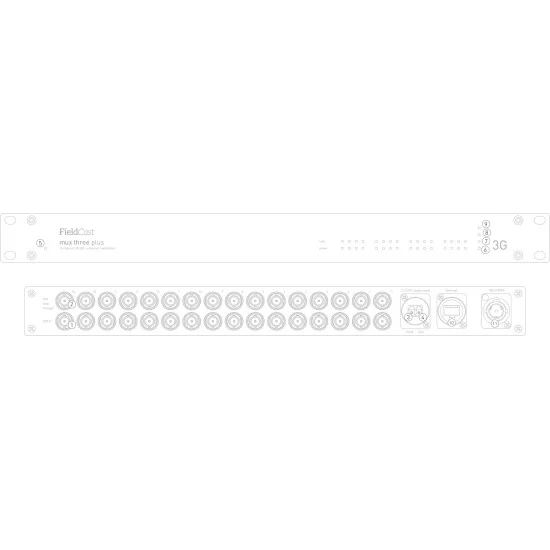
mux three plus 3G
• 16 channel SDI input to 1 channel fiber optic output multiplexer
• 1RU all aluminum enclosure design
• 9/125 single mode fiber optic technology
• sixteen 3G (2.97Gb) SDI input channels (1), each with SDI loopthrough (2)
• 75ohm BNC oonnectors for all SDI inputs and loopthrough outputs
• complies with SMPTE 259M, SMPTE 344M, SMPTE 292M and SMPTE 424M
• accepts all SD and HD standards up to 1080p60
• one LC single mode (U)PC fiber optic channel (COM) for all SDI signals and ethernet (3)
• one LC single mode (U)PC fiber optic upgrade (UPG) channel (4)
• Ethernet protocol: IEEE802.3U IEEE802.3z 1000Base-TxFx
• UTP RJ-45 connector for Ethernet, full duplex or half duplex (10)
• black front panel with 2mm. warm white led indicators
• one led indicator for power (5)
• led indicators for channel module activity (6), input activity (7), TP/LNK (8) and 1Gb (9)
• power consumption ← 50W
• robust thin film CWDM multiplexing technology
• maximum distance between Mux and Demux unit → 40km.
• 110-240VAC input with PowerCon connector (11)
• dimensions: 482(W) x 155(D) x 43(H) mm.
• weight: 2090 grams
• comes with manual and local power cord
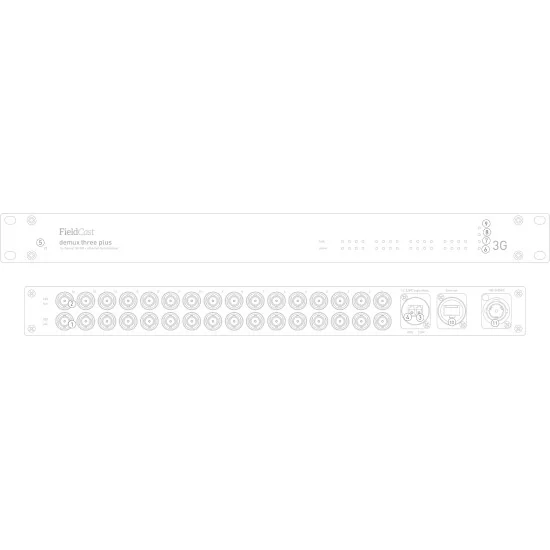
demux three plus 3G
• 1 channel fiber optic input to 16 channel SDI output demultiplexer
• 1RU all aluminum enclosure design
• 9/125 single mode fiber optic technology
• sixteen 3G (2.97Gb) SDI channels with dual SDI output (1)(2)
• 75ohm BNC oonnectors for all SDI outputs
• complies with SMPTE 259M, SMPTE 344M, SMPTE 292M and SMPTE 424M
• accepts all SD and HD standards up to 1080p60
• one LC single mode (U)PC fiber optic channel (COM) for all SDI signals and ethernet (3)
• one LC single mode (U)PC fiber optic upgrade (UPG) channel (4)
• Ethernet protocol: IEEE802.3U IEEE802.3z 1000Base-TxFx
• UTP RJ-45 connector for Ethernet, full duplex or half duplex (10)
• black front panel with 2mm. warm white led indicators
• one led indicator for power (5)
• led indicators for channel module activity (6), input activity (7), TP/LNK (8) and 1Gb (9)
• power consumption ← 50W
• robust thin film CWDM multiplexing technology
• maximum distance between Mux and Demux unit → 40km.
• 110-240VAC input with PowerCon connector (11)
• dimensions: 482(W) x 155(D) x 43(H) mm.
• weight: 2100 grams
• comes with manual and local power cord

Fiche technique
Références spécifiques