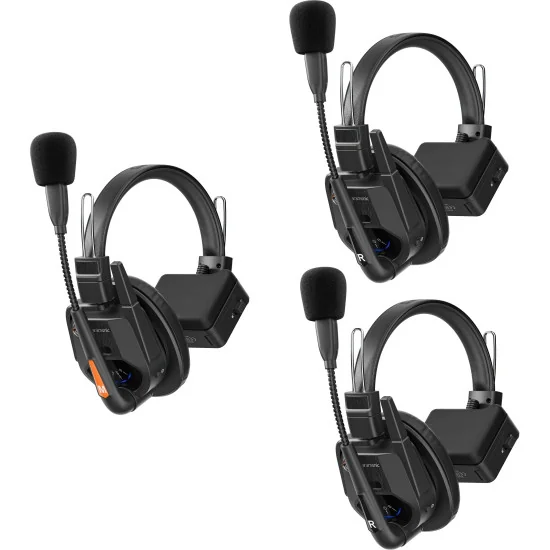
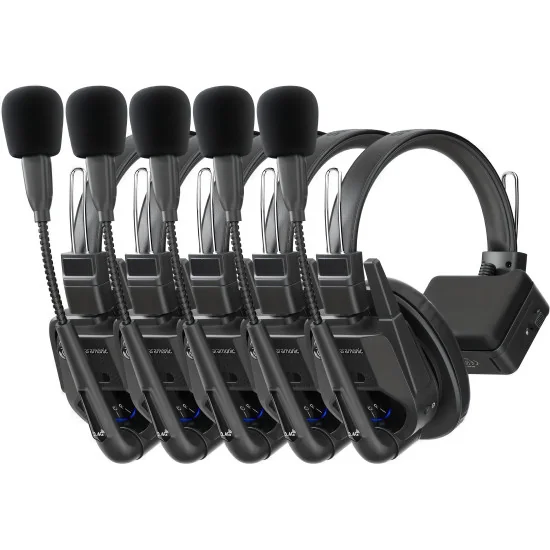
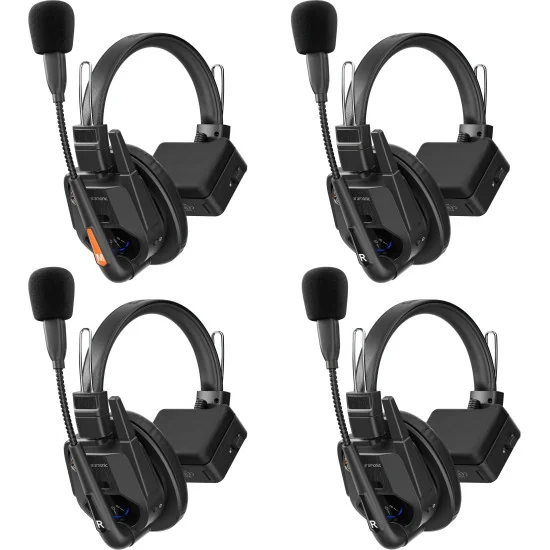
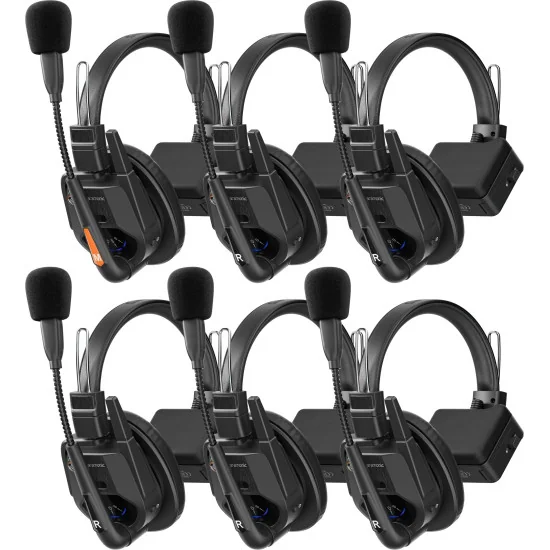
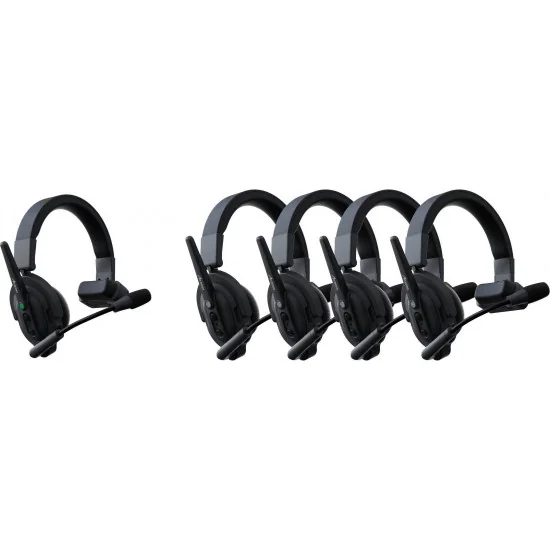
Hollyland Solidcom SE Pro 2S Wireless Intercom System
€419.00
Hollyland Solidcom SE Pro 2S is a purpose‑built two‑person wireless intercom for film sets, OB trucks and live‑stream stages that can’t risk...
Filter By
Brand
Brand
Price
Price
€419.00 - €14,900.00
Transmission Range
Transmission Range
Number of Headsets
Number of Headsets
Wireless Technology
Wireless Technology
Wireless intercom systems keep production crews connected during film shoots, live broadcasts and studio sessions. Full-duplex headsets on DECT 1.9GHz or 2.4GHz from top manufacturers.
Active filters
Behind every well-coordinated broadcast and every tightly-run film set, there is a crew that communicates without hesitation. A dropped cue can cost minutes of airtime or hours of reshoot. That is why wireless intercom systems have become indispensable on sets and stages — they replace walkie-talkie chatter with clear, hands-free, full-duplex audio that lets every crew member speak and listen at the same time.
Film and television remain the most visible adopters of production intercom headsets, yet the technology reaches well beyond the camera department. In live broadcast television, directors call shots to camera operators over intercom, while producers feed instructions to on-air talent through IFB channels. Streaming studios — esports arenas, multi-camera podcast stages — synchronise switching and sound cues the same way. Theatre stage managers coordinate lighting, rigging and entrances through intercom groups spanning over 300 metres. Corporate events, house-of-worship productions, sports venues and construction sites all rely on wireless headset intercom solutions for simultaneous, two-way voice communication without a talk button or a shared radio channel.
A two-person documentary crew has entirely different requirements than a forty-person outside broadcast unit. Modern manufacturers address that gap with modular intercom kits that scale from a handful of headsets to dozens of beltpacks.
Hollyland structures its Solidcom line-up around this principle. The Solidcom C1 Pro ships in bundles of two to eight single-ear headsets that pair out of the box without a hub; adding a hub unlocks A/B group splitting, an announce function and support for up to nine members. Each headset weighs roughly 170 g, runs on a swappable battery and offers dual-microphone Environmental Noise Cancellation — a directional capsule captures speech while an omnidirectional capsule samples ambient noise and subtracts it in real time. The Solidcom H1 moves to a beltpack architecture for larger crews: up to 30 packs and 12 talk groups without a central station, or 80 beltpacks across 100 groups with a Geo Central Station. Each beltpack carries four keys overlaying four channels — 16 talk/listen routes — with connections via Bluetooth, LEMO or 3.5 mm. IP65-equivalent build and 15-hour battery suit it for outdoor broadcasts.
The Solidcom SE Pro supports up to eleven users at roughly 400 metres line-of-sight, with dual-mic ENC and dust-and-splash resistance. It ships pre-paired and ready in seconds — a practical option for run-and-gun crews.
Saramonic takes a similar tiered approach with its WiTalk family. The WiTalk WT5D and WT5S cover five-person crews with a line-of-sight range of about 400 metres, extendable to 800 metres via a body pack. The WiTalk WT8D and WT9S add a Hub Base Station for larger productions. The WiTalk9 series reaches 500 metres via dual antennas and incorporates ClearTalk — a three-microphone array with noise cancellation rated for 130 dB SPL environments. Remote headsets run up to 18 hours; the hub lasts about 3.2 hours on a quick-change battery, supplemented by a ten-bay charger and USB-C power. IPx5 water resistance completes the outdoor package.
Synco enters with its XTalk range, built on 2.4 GHz wireless technology. The XTalk X5 bundles five single-ear headsets connecting without a master unit, offering 350 metres of range and 24 hours of battery per headset. The XTalk XPro adds AEC 2.0 noise reduction, 500 metres of range and a Boost Mode for signal penetration through walls. The XTalk Master pairs with an XStation base to accommodate up to 40 users at 45 ms latency. USB-C firmware updates unlock support for up to 18 headsets per group.
DECT 1.9 GHz occupies a band reserved almost exclusively for cordless voice communication. Wi-Fi routers, Bluetooth devices and video transmitters do not operate here, so a DECT intercom encounters minimal co-channel interference — a critical advantage on sets saturated with 2.4 GHz traffic. Frequency hopping and encryption harden the link further. The Hollyland Solidcom C1 Pro and the Saramonic WiTalk families leverage DECT 6.0, adapting sub-band allocation to regional regulations: 1880–1900 MHz in Europe, Asia and Australia, 1920–1930 MHz in North America, and dedicated slices for Japan, Brazil and Taiwan.
2.4 GHz systems trade spectral isolation for global licence-free availability. Where DECT is restricted, a 2.4 GHz intercom like the Synco XTalk deploys without paperwork. Modern units mitigate interference through adaptive frequency hopping and high-gain antennas, though dense wireless environments — trade-show floors, concert halls, stadiums — can strain the band.
The choice comes down to regional legality, RF environment density and budget. A touring crew may prefer 2.4 GHz for regulatory simplicity; a studio broadcast team benefits from the cleaner DECT spectrum. Many models ship in both frequency variants, letting buyers select at purchase.
check_circle
check_circle