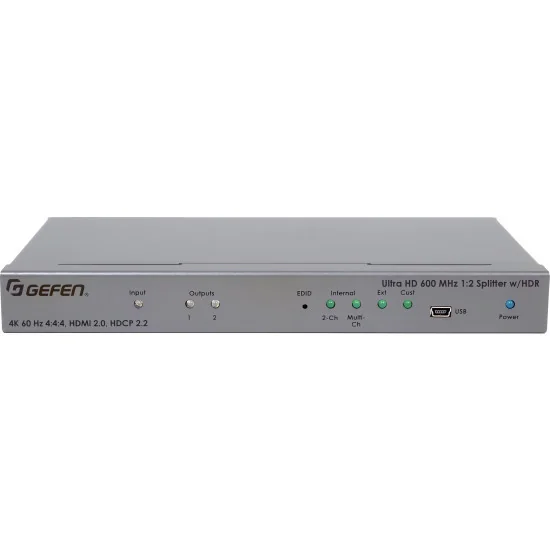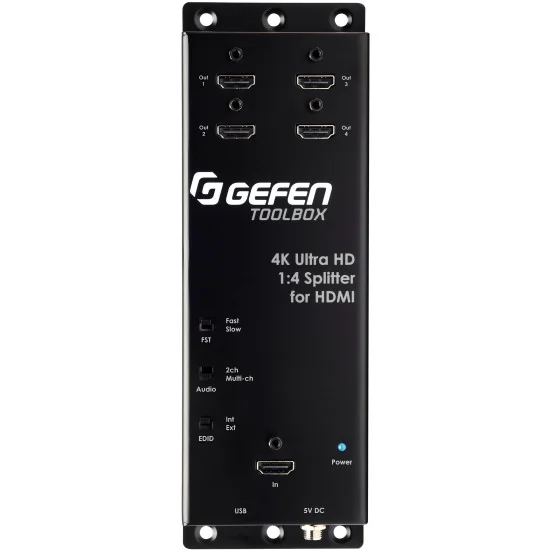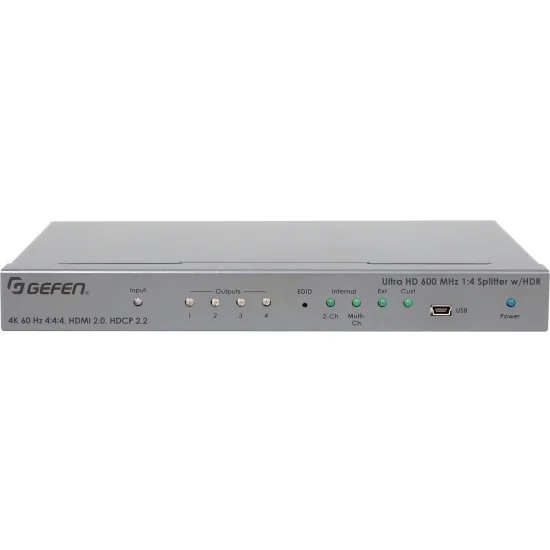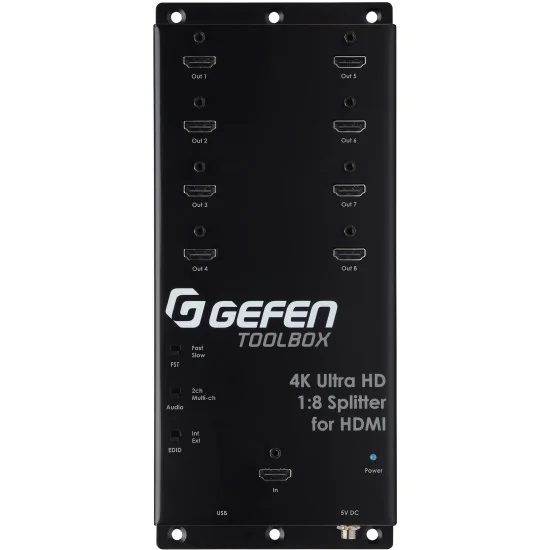
Gefen GTB-HD4K2K-142C-BLK | 4K Ultra HD HDMI Splitter 1:2 300MHz, HDCP
€335.00
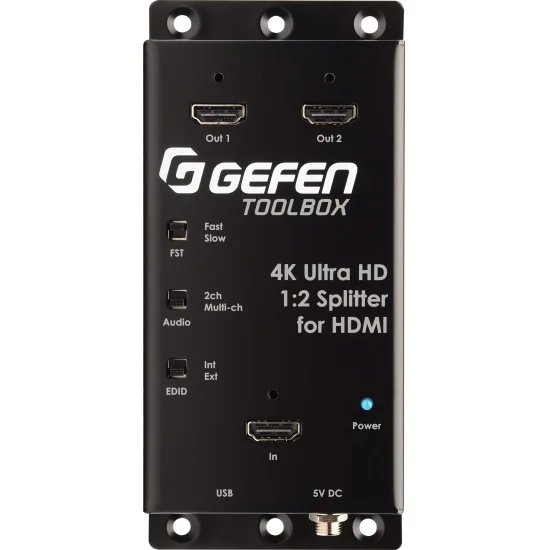
The Gefen GTB-HD4K2K-142C-BLK HDMI Splitter efficiently routes a single 4K Ultra HD source to two HDMI displays at the same time. It handles...
Filter By
Video output channels
Video output channels
Price
Price
€335.00 - €739.00
Max Output Resolution
Max Output Resolution
Output colour sampling
Output colour sampling
Features
Features
Professional-grade HDMI splitters distribute a single 4K video signal to multiple displays without quality loss. Built for broadcast studios, live events, and digital signage installations.
Active filters
When a single video source needs to reach two, four, or eight screens simultaneously, the device that sits between the source and those displays is an HDMI splitter. A professional-grade splitter takes one incoming HDMI signal, amplifies it, and delivers bit-identical copies to every connected output. The signal remains intact — same resolution, same colour depth, same embedded audio channels — across each output port. For broadcast engineers and live event technicians, a frame lost during a live broadcast or a colour shift on a client monitor can derail an entire production.
The source device sends data through three TMDS (Transition-Minimized Differential Signaling) channels, each carrying one colour component, plus a dedicated clock channel. At 600 MHz, the total throughput reaches 18 Gbps — enough to carry 4K DCI (4096×2160) at 60 frames per second with full 4:4:4 chroma subsampling. A distribution amplifier — the technical term for a powered splitter — regenerates and re-clocks each of these TMDS channels so that every output receives a signal as clean as the original. Passive, unpowered splitters lack this amplification and are unsuitable for professional settings.
The most common application of an HDMI splitter is feeding one programme output to several destinations at once. In a television studio control room, the programme feed typically needs to appear on the director's monitor, the technical director's multiview wall, a confidence monitor for on-air talent, and a streaming encoder simultaneously. A 1:4 HDMI splitter handles this with a single device and four matched outputs. Each display negotiates its capabilities through EDID (Extended Display Identification Data), and a well-built splitter manages these negotiations intelligently — presenting the source with a composite EDID that reflects the lowest common denominator of all connected sinks, or allowing manual override when the operator knows each display's requirements.
Gefen addresses this scenario with two distinct product families. The GTB-HD4K2K series operates at 300 MHz and supports resolutions up to 3840×2160 at 60 Hz in 4:2:0 colour space, along with 4096×2160 at 24/30 Hz for DCI cinema content. The GTB-HD4K2K-144C-BLK splits one source to four outputs and passes through Deep Colour up to 12-bit per channel, 3D frame packing, and multichannel audio including 7.1-channel LPCM, Dolby TrueHD, and DTS-HD Master Audio. What sets these units apart is Gefen's proprietary Fast Switching Technology (FST). FST eliminates the prolonged HDCP authentication handshake that normally occurs whenever a display is powered on, disconnected, or switched. On a multi-display signage wall, powering down one panel no longer causes black screens on the remaining seven — the rest continue displaying without interruption.
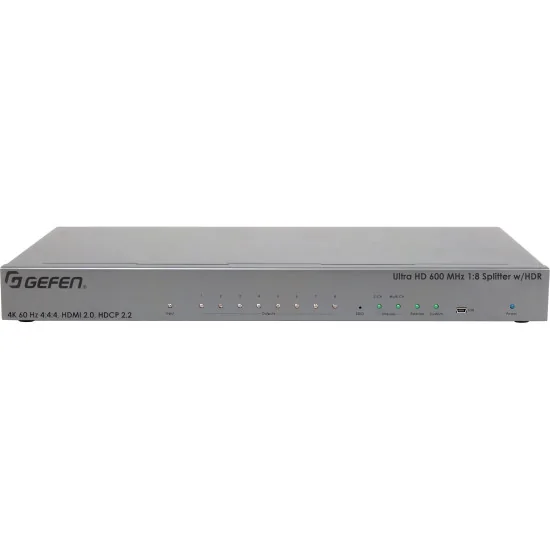
For productions requiring full HDMI 2.0 bandwidth, the Gefen EXT-UHD600 series steps up to 600 MHz / 18 Gbps. The EXT-UHD600-14 distributes one input to four HDMI outputs at 4096×2160 @ 60 Hz with 4:4:4 sampling — the full, uncompressed colour resolution that colour grading suites and broadcast QC stations demand. HDR metadata (HDR10, HLG) passes through unaltered, and the unit supports Dolby Atmos and DTS:X object-based audio alongside traditional surround formats. The 1:8 variant, the EXT-UHD600-18, fits a standard 1U rack and includes LED status indicators on each output — a small but meaningful detail when troubleshooting a signal chain before a morning show.
Cascading multiplies the output count. Connect the four outputs of a 1:4 splitter into four separate 1:8 units and a single source reaches 32 displays. Gefen's FST firmware keeps this cascade stable by handling HDCP re-authentication at each stage without dropping the signal. In large-scale digital signage deployments — airport departure boards, shopping centre video walls, stadium concourse screens — cascaded distribution is the standard architecture. Each splitter stage re-amplifies the signal, so cable runs of up to 9 metres between stages remain clean and free of artefacts.
Beyond Gefen, other manufacturers bring their own strengths to signal distribution. AJA is well known in the broadcast sector for converters like the HA5-4K, which takes an HDMI 2.0 input and outputs four simultaneous 3G-SDI streams — effectively splitting and converting in one step. This matters in facilities where the camera outputs HDMI but the infrastructure runs on SDI. AJA's Hi5-4K-Plus works in the opposite direction, converting quad SDI back to HDMI 2.0 with HDR metadata generation — useful when a production needs to feed an HDMI-only monitor from an SDI router.
WyreStorm targets the integration market with splitters that include built-in scaling on each output. Their SP-0108-SCL allows each of its eight outputs to independently scale between 4K and 1080p via DIP switches — a practical solution when the same source must feed a mix of older Full HD panels and newer 4K displays. Kramer Electronics offers the VM-2H2 and VM-4H2 with data rates up to 17.82 Gbps, plus equalization and re-clocking technology that compensates for cable-induced signal degradation. Atlona's Rondo series (AT-RON-444, AT-RON-448) adds audio de-embedding to analogue and S/PDIF outputs alongside the HDMI split — handy when a separate audio system needs a feed from the same source.
HDCP (High-bandwidth Digital Content Protection) is the encryption layer embedded in the HDMI handshake. Every device in the signal path — source, splitter, cable, display — must authenticate before protected content will play. Two versions coexist in today's production environments, and understanding the difference is critical when specifying equipment.
HDCP 1.4 was the standard for Full HD content. Its encryption was publicly compromised in 2010, but it remains the baseline requirement for 1080p distribution from Blu-ray players, cable set-top boxes, and older production gear. The Gefen GTB-HD4K2K-142C-BLK, GTB-HD4K2K-144C-BLK, and GTB-HD4K2K-148C-BLK all support HDCP 1.4, making them reliable choices for facilities that still operate predominantly in HD.
HDCP 2.2 introduced a fundamentally different encryption architecture to protect 4K Ultra HD content. The authentication mechanism is entirely new — hardware that only supports HDCP 1.4 cannot be upgraded to 2.2 through a firmware update. When a 4K Blu-ray player, streaming device, or broadcast decoder outputs protected 4K content, every link in the chain must support HDCP 2.2 or the signal either drops to 1080p or goes black entirely. The Gefen EXT-UHD600-12, EXT-UHD600-14, and EXT-UHD600-18 carry both HDCP 2.2 and HDCP 1.4 compliance, ensuring backward compatibility while fully supporting next-generation 4K-protected streams.
In practice, HDCP compliance determines whether a splitter can sit in front of a recording device or capture card. Live streaming setups frequently place a splitter between the camera and the capture card: one output goes to a field monitor for the camera operator, the other feeds an encoder running OBS Studio or similar software. Production environments working with original camera footage face fewer constraints, but any facility receiving licensed broadcast feeds or satellite downlinks must verify HDCP support at every stage.
The choice of splitter bandwidth interacts with HDCP version. A 300 MHz unit like the Gefen GTB-HD4K2K-148C-BLK handles 4K at 25/30 fps but limits 60 fps output to 4:2:0 subsampling. A 600 MHz unit like the EXT-UHD600-18 opens up full 4K @ 60 fps at 4:4:4 with HDCP 2.2 — the specification required for HDR grading monitors and broadcast QC displays where accurate colour reproduction at full bit depth is mandatory. In a colour grading suite, a signal path that silently drops from 4:4:4 to 4:2:0 would compromise every colour decision made on that display. Manufacturers like AJA and WyreStorm offer comparable 600 MHz solutions for these demanding environments.
Rack-mountable housings, locking power connectors, and metal enclosures with proper EMI shielding distinguish these professional distribution amplifiers from consumer devices. In a broadcast truck, a live event production rack, or a post-production machine room, equipment runs continuously for hours. The EXT-UHD600-18's 1U chassis and locking DC power connector keep the unit secure during transport, while LED indicators on each output give operators instant visual confirmation that every downstream display is receiving signal.
check_circle
check_circle