Atomos Ninja | 6K RAW Recorder, HDR Monitor 5.2" HDMI
€699.00
The Atomos Ninja is a compact 5.2-inch HDR monitor and 6K RAW recorder, perfect for professional filmmakers and content creators. With its...
Filter By
Brand
Brand
Price
Price
€699.00 - €4,999.00
Video input channels
Video input channels
Video Input
Video Input
Audio Input
Audio Input
Screen Size
Screen Size
Max Output Resolution
Max Output Resolution
Recording Codecs
Recording Codecs
Supported media
Supported media
Display Brightness
Display Brightness
Aspect Ratio
Aspect Ratio
Professional video recorders capture broadcast-quality footage in ProRes RAW, DNxHR, and H.265. From on-camera monitors to rack-mounted multi-channel systems for TV, live events, and film.
Active filters
Every frame matters when a production goes live or a camera rolls on set. A video recorder sits at the centre of that reality — it determines how footage is captured, what codec wraps each frame, and whether the final file survives the demands of colour grading, compositing, and multi-platform delivery. The difference between a compressed 8-bit H.264 clip and a full 10-bit ProRes 422 HQ master can define the look of an entire project. For broadcast engineers, camera operators, and post-production supervisors, choosing the right recorder is not a minor decision; it shapes every stage of the pipeline from acquisition to archive.
Today's recording hardware spans a broad spectrum. A compact 13 cm monitor-recorder clamps onto a cinema camera rig and writes ProRes RAW onto CFexpress media. A 1U rack unit captures four isolated HD feeds simultaneously during a live sports broadcast. A desktop station with a built-in 12.7 cm touchscreen records 4K DCI material to dual SSDs while displaying waveform, vectorscope, and focus peaking overlays. Understanding these categories — and the codecs they support — is essential for anyone specifying equipment for a television facility, an OB van, or an independent film shoot.
An on-camera recorder mounts directly to a camera body or cage, typically via a hot shoe, NATO rail, or ARRI-style accessory mount. Its purpose is twofold: bypass the camera's internal compression limitations and provide a high-brightness monitoring surface for critical focus and exposure evaluation. Because these units travel with the camera, weight and power draw matter as much as recording capability.
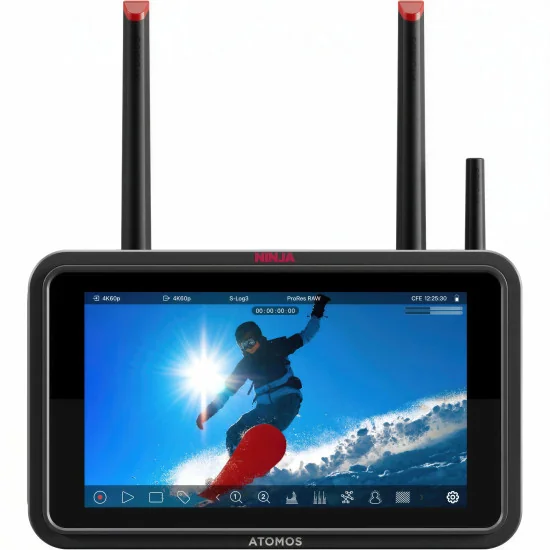
The Atomos Ninja pairs a 5.2-inch touchscreen rated at 1000 nits with recording up to 6K at 30 fps in Apple ProRes RAW or 4K at 60 fps in ProRes and Avid DNxHD. It accepts an HDMI signal from mirrorless and cinema cameras, then writes to CFexpress Type B or USB-C storage. Monitoring tools include SegmentPro, EL Zone exposure mapping, ARRI-style false colour, zebra overlays, and RGB parade waveforms — features that replace standalone scopes on a run-and-gun documentary shoot or a gimbal-based setup where every gram counts.
For productions that need higher resolution headroom, the Atomos Ninja Ultra pushes recording to 8K RAW at 30 fps while maintaining the same 5.2-inch form factor and 1000-nit panel. Both units run AtomOS 11, which adds RecordAssist and PlayBackAssist scheduling, and they share the same accessory ecosystem as the earlier Ninja V — battery plates, sun hoods, and mounting brackets transfer directly.
Stepping up in screen size, the Atomos Shogun offers a 7-inch 2000-nit display alongside 6K ProRes RAW recording through HDMI and 12G-SDI inputs. That SDI connection is critical for ENG and broadcast cameras that lack HDMI RAW output. The Shogun Ultra extends the specification to 8K RAW at 30 fps, 6K at 60 fps, and 4K at 120 fps, making it relevant for slow-motion acquisition in sports or nature cinematography. Both models include Wi-Fi 6E connectivity for remote monitoring via Atomos Connect and AirGlu, letting a director or DIT view the live feed on an iPad or Mac positioned away from the camera.
A desktop video recorder sits on a production desk, inside an OB vehicle, or next to a vision mixer in a live control room. Unlike on-camera units, desktop recorders emphasise multiple inputs, larger displays for confidence monitoring, and robust storage options that handle extended recording sessions — a three-hour church service, a full-day corporate conference, or a continuous studio rehearsal.
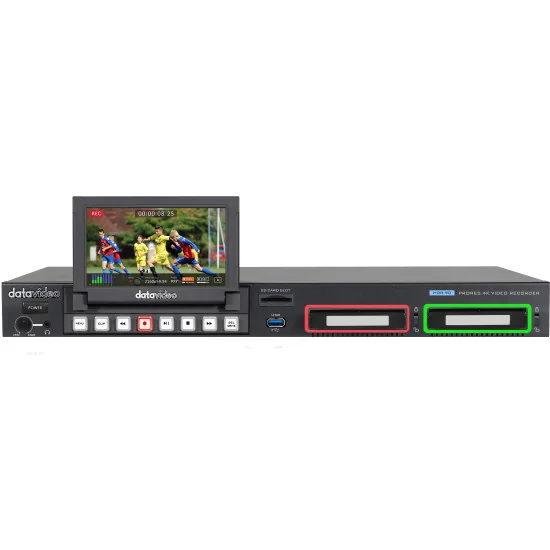
The Datavideo HDR-80 records 4K ProRes 422 10-bit material to dual 2.5-inch SSDs. Its input roster includes one 12G-SDI and one HDMI 2.0 port for 4K sources, plus three additional 3G-SDI and one HDMI 1.4 input for 1080p feeds. A 12.7 cm touchscreen shows waveform, vectorscope, and focus peaking data alongside a quadview display that previews all four inputs at once. This makes the HDR-80 function as both a standalone ISO recorder and a four-channel monitoring station — a combination that saves rack space and budget in small production environments where a separate multiviewer would otherwise be needed.
For streaming-oriented operations, the Datavideo NVS-40 takes a different approach. It encodes and records four simultaneous HD channels in H.264, while also streaming each feed via RTMP, RTSP, or SRT protocols. Educational institutions, houses of worship, and municipal councils use this type of unit to record proceedings locally while pushing a live stream to YouTube or a private CDN. The NVS-40 accepts four SDI and four HDMI inputs, giving operators full flexibility in source routing.
The Datavideo HDR-2 fills a compact niche for single-channel 4K H.265 recording with HDMI input and XLR audio embedding. At a lower price point, it provides a straightforward capture path for studio cameras that feed a live switcher but also need an independent recording for archival or later editing.
Broadcast facilities and OB trucks mount equipment in standard 19-inch racks, and a rack-mount video recorder must conform to that format while delivering the same codec quality and connectivity as its desktop or portable counterparts. Cooling, front-panel access, and remote control via Ethernet or RS-422 become essential specifications when the recorder lives inside a dense equipment frame alongside routers, multiviewers, and audio embedders.
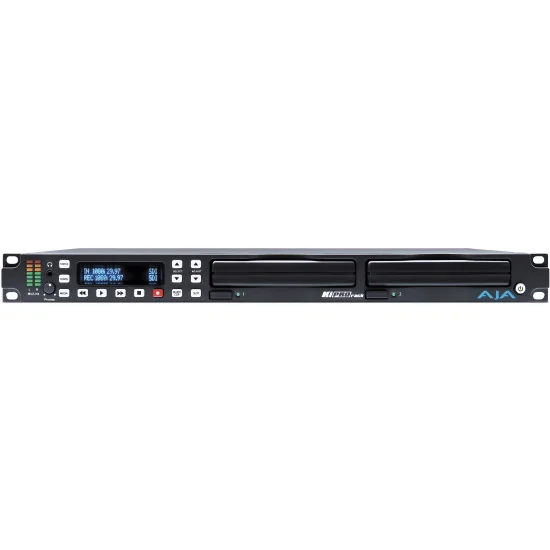
The AJA Ki Pro Rack occupies a single rack unit (1U) and records Apple ProRes and Avid DNxHD to removable AJA Pak SSD media. It connects via 3G-SDI and HDMI, supports embedded audio on up to 8 channels, and offers a web-based remote interface alongside RS-422 machine control for integration with automation systems. News stations rely on this model for ingest from satellite feeds and live camera returns, where media needs to move immediately to a shared storage environment for editing in Avid Media Composer or Adobe Premiere Pro.
The Datavideo HDR-90 mirrors the feature set of the desktop HDR-80 but in a 1U rackmount chassis. It retains the 4K ProRes 422 recording via 12G-SDI and HDMI 2.0, the four-channel HD input array, and the 12.7 cm touchscreen — now accessible through a pull-out tray or via the unit's network interface. Mobile production companies that load and unload gear between events appreciate the HDR-90's ability to slot into a standard rack case alongside other Datavideo switchers and converters.
Live productions with multiple cameras require isolated recordings of every feed — ISO recording — so that an editor can reconstruct a show in post, choose better angles, or repair a switched sequence. A multi-channel video recorder captures two, four, or even eight feeds simultaneously to a single storage system, eliminating the need for one recorder per camera.
The AJA Ki Pro Ultra 12G handles up to four simultaneous HD channels or a single 4K DCI/UHD stream. It records in all six Apple ProRes quality tiers — from ProRes 422 Proxy through ProRes 4444 XQ — as well as Avid DNxHR. Dual AJA Pak media slots enable hot-swap recording: when one drive fills, capture rolls over to the second without dropping a frame. Fiber SFP+ modules extend signal reach over single-mode or multi-mode fibre for stadium, concert, or remote truck scenarios where cable runs exceed 100 metres.
The AJA Ki Pro GO2 takes a different codec route, recording up to four channels of HD or SD in H.265 (HEVC) and H.264. It writes to standard USB drives and can simultaneously record to a network-attached storage volume via its Ethernet port. This redundancy protects against drive failure during a long event — a sports tournament, a conference, or a house of worship service. The GO2's lower bit-rate approach suits organisations that prioritise recording duration and storage economy over maximum bit depth.
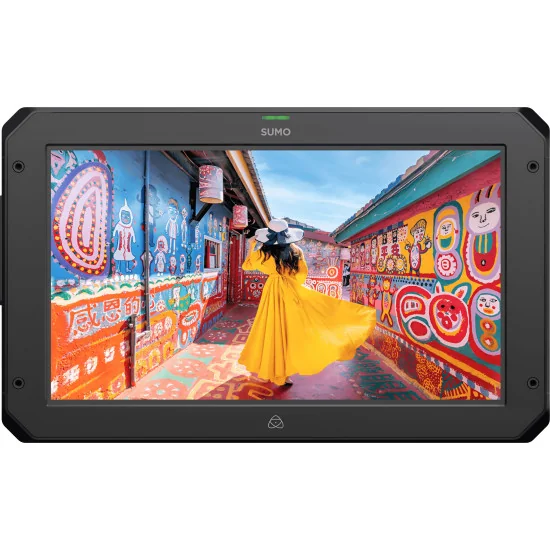
The Atomos Shogun Studio II provides dual 7-inch HDR monitors alongside two 4K recording channels at 60 fps or up to eight HD channels at 60 fps. Each channel supports ProRes, ProRes RAW, and Avid DNx codecs, making this unit a post-production-friendly ISO recorder for multi-camera studio shows, talk programmes, and eSports events. The Atomos Sumo 19 SE complements this range with a 48.3 cm (19-inch) HDR panel that functions as a 6K recorder, live switcher, and programme monitor in a single chassis — a setup that replaces three separate devices in a small production gallery.
Recording in RAW format preserves the maximum amount of sensor data before any colour science or compression is applied. This gives colourists and VFX supervisors full latitude to recover highlights, lift shadows, and adjust white balance without degrading the image. The trade-off is file size and storage speed requirements — but for commercial spots, feature films, music videos, and high-end documentary series, that trade-off is standard practice.
Apple ProRes RAW has become the dominant external RAW format, supported by over fifty camera manufacturers including Sony, Nikon, Panasonic, Canon, and RED. It captures sensor data at up to 8K resolution while maintaining reasonable data rates compared to uncompressed CinemaDNG sequences. Atomos recorders — from the Ninja to the Shogun Ultra — serve as the primary capture devices for ProRes RAW, receiving RAW data over HDMI from compatible cameras and encoding it in real time onto solid-state media.
Blackmagic RAW (BRAW) operates with both constant bitrate (3:1, 5:1, 8:1, 12:1) and constant quality (Q0 through Q5) modes, supporting resolutions from 2.8K to 12K depending on the camera body. Partial de-mosaicing occurs in-camera, reducing the processing load on the recorder and on the edit workstation during playback. CinemaDNG remains relevant as an open, vendor-neutral RAW format with 12-bit RGB data at 4:4:4 colour sampling — no chroma subsampling whatsoever. It stores material as DNG image sequences or within MXF containers, and its lossless compression typically achieves a 2:1 ratio.
When choosing a RAW recording chain, the camera-to-recorder interface dictates what is possible. HDMI carries RAW data from mirrorless bodies and smaller cinema cameras, while SDI RAW output is available on select broadcast and cinema models. The recorder must match the camera's RAW protocol — a critical compatibility point that should be confirmed before purchase.
Not every production requires RAW acquisition. Apple ProRes and Avid DNxHD/DNxHR are mastering-quality codecs that deliver visually lossless results at manageable data rates, and they remain the backbone of broadcast and post-production facilities worldwide.
ProRes 422 records 10-bit 4:2:2 colour at roughly 147 Mbps for 1920×1080 at 29.97 fps — enough quality for broadcast delivery, news packages, and corporate content. ProRes 422 HQ raises that bitrate for productions that plan extensive colour grading or chroma keying, where compression artefacts around edges could become visible. ProRes 4444 steps up to 12-bit colour depth with full 4:4:4 sampling and alpha channel support, making it the standard choice for visual effects plates and motion graphics renders. Its XQ variant targets feature film mastering and projects with extreme dynamic range requirements, preserving highlight and shadow detail several times beyond the Rec.709 range.
On the Avid side, DNxHD handles HD frame sizes in 8-bit and 10-bit variants and remains embedded in many broadcast operations built around AJA ingest hardware and Avid Media Composer timelines. Its successor, DNxHR, lifts the resolution ceiling to any size from 2×2 up to 16384×16384 pixels, supporting 2K, 4K, and 8K production. DNxHR variants range from LB (low bandwidth, 8-bit) through HQX (high quality, 12-bit with alpha channel support). The codec is standardised under SMPTE ST 2019-1, giving it a stable specification that facility planners can rely on for long-term archive strategies.
Recorders from Datavideo, AJA, and Atomos support various combinations of these codecs. The choice between ProRes and DNxHR often depends on the editing platform — Final Cut Pro and DaVinci Resolve favour ProRes, while Avid Media Composer workflows benefit from native DNxHR handling. Many current recorders offer both codec families, allowing a single piece of hardware to serve mixed-NLE environments without transcoding.
check_circle
check_circle