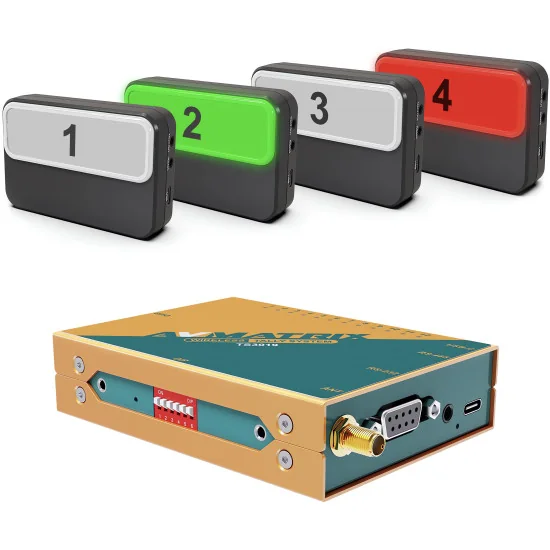
AVMATRIX TS3019-4 Wireless Tally System
€395.00
Multi-camera productions rely on clear, instant communication between the director and each camera operator — and that is exactly where the...
Filter By
Brand
Brand
Price
Price
€395.00 - €869.00
Number of Lights
Number of Lights
Interface
Interface
Transmission Range
Transmission Range
Wireless tally light systems help camera operators and on-air talent identify which camera is live or on preview during multi-camera broadcast and streaming productions.
Active filters
Every second counts during a live broadcast. A missed cue or a presenter staring into the wrong lens can break the flow of an entire show. Tally lights solve this problem — small, bright indicators mounted on cameras that signal in real time which source is currently on air and which is queued for the next cut. For decades, these signals relied on hard-wired connections from the vision mixer through tally breakout boards to each camera. That works inside a permanent studio, but it falls apart when you move outdoors or set up in a venue where pulling cables across 50 or 100 metres is impractical. Wireless tally systems replace physical cabling with radio-frequency links that carry on-air and preview status to each lamp without a single wire between the control desk and the camera.
Two radio technologies dominate today's market. The 433 MHz band offers long wavelengths that penetrate walls well, reaching around 200 metres in open air. The 2.4 GHz LoRa modulation with adaptive frequency hopping pushes range to 800 metres while keeping latency below 150 ms, though it must actively avoid interference from Wi-Fi and Bluetooth in crowded RF environments.
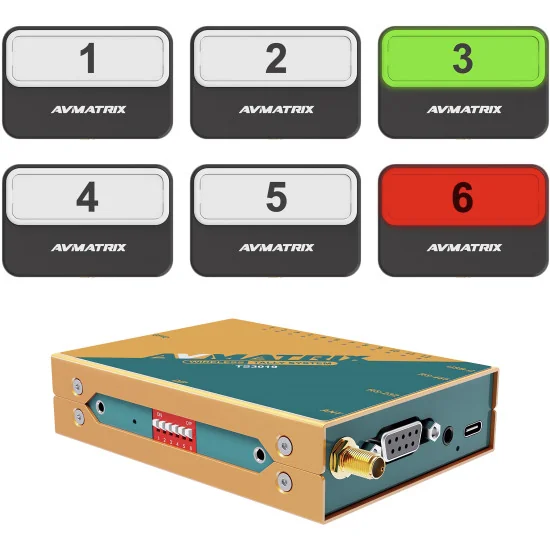
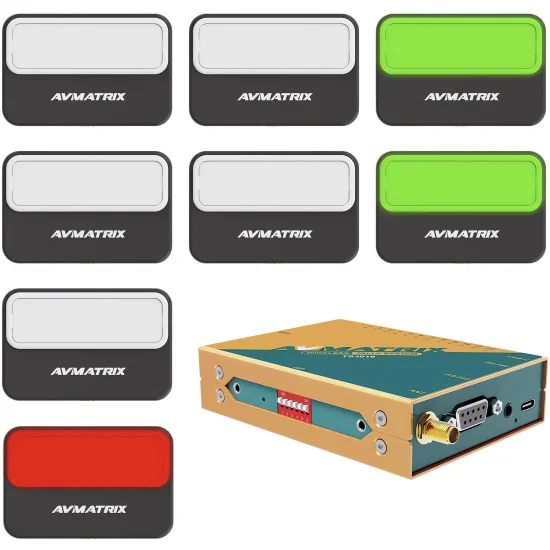
The AVMATRIX TS3019 series is one of the most widely adopted 433 MHz tally solutions. The system consists of a central tally box that connects to your switcher, plus individual tally lamps assigned to camera channels. AVMATRIX offers several configurations: the TS3019-4 ships with four lamps, the TS3019-6 with six — both scalable to 16 channels total.
The tally box connects through multiple interfaces. A GPIO port (DB-25) provides direct compatibility with switchers from Roland, Sony, NewTek, Panasonic, and Datavideo. RS-232/RS-485 serial connections support TSL UMD v3.1 and v5.0 protocols used by Ross Video, Streamstar, and other broadcast infrastructure. A USB Type-C port handles direct integration with vMix. For Blackmagic ATEM switchers, tally data routes through the optional Blackmagic GPI & Tally Interface.
Each AVMATRIX TS3019 lamp carries front and rear LED indicators. The front shows a large numbered display for on-air talent; the rear faces the camera operator. Both show red for on-air and green for preview. Brightness adjusts across four levels up to 2000 cd/m², keeping indicators readable under studio lights and in direct sunlight. A status display shows wireless signal strength and battery charge. Power comes from USB Type-C or a removable 18650 lithium-ion cell, and a 1/4-inch thread lets the lamp slide onto a camera hot shoe in seconds. The TS3019 also passes PTZ camera control wirelessly via RS-232/RS-485, handling both tally and remote pan-tilt-zoom commands on a single link — a practical benefit for houses of worship, lecture halls, and venues running robotic cameras.
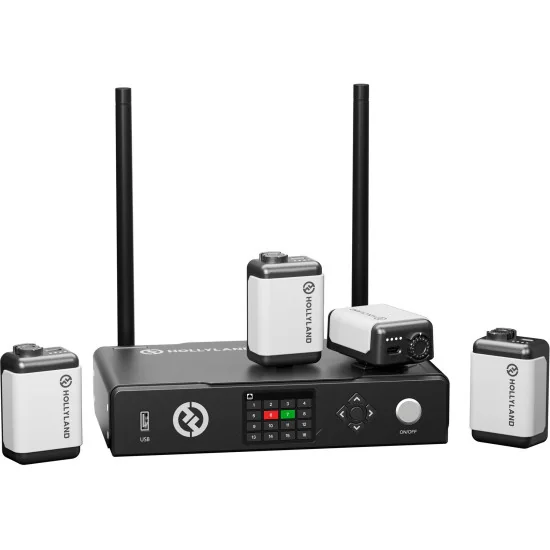
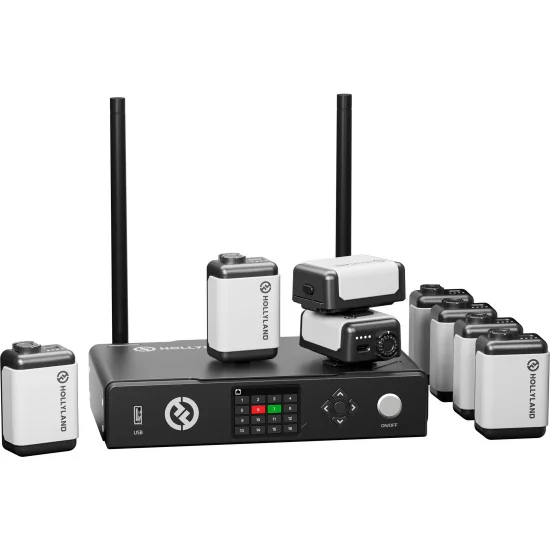
The Hollyland Wireless Tally System takes a different approach with its 2.4 GHz LoRa radio. Available in kits of four or eight lights, the system reaches 800 metres line-of-sight — four times the AVMATRIX range. This matters for stadium sports coverage, festival stages with widely spaced camera positions, and reality TV shoots spanning large areas. Latency stays under 150 ms, and receiver sensitivity below −115 dBm maintains the link even at range limits or with partial obstructions.
The Hollyland station connects via three port types. A DB-25 GPIO handles up to 12 dual-colour tally channels. An RJ45 Ethernet port raises capacity to 16 channels. What sets the system apart is its sequence learning function: rather than relying on a fixed pin-out per switcher brand, the station learns the specific voltage sequence of any connected switcher automatically — whether from Blackmagic Design, Panasonic, Roland, or DeviceWell. Each lamp runs on a detachable rechargeable lithium battery rated for over eight hours, weighs under 100 g, and benefits from adaptive frequency hopping that steers the signal away from congested channels.
Inside a broadcast studio, tally lights serve a deceptively simple but mission-critical role. When the technical director cuts between cameras, red and green indicators instantly tell presenters which lens to address and camera operators which shot is live or coming next. This happens dozens or hundreds of times per hour in news bulletins, talk shows, and sports panels. Without tally, presenters rely on verbal cues through an earpiece — a method that introduces delay and fails the moment the IFB feed drops.
Wireless systems particularly benefit studios that reconfigure frequently. A morning show set that doubles as an afternoon cooking segment may shift camera positions between blocks. With wired tally, every move requires re-routing cables. A wireless setup means each camera simply carries its lamp, maintaining the connection regardless of position.
On location, multi-camera concert coverage places cameras at front-of-house, on a jib at stage left, in a pit below stage, and on a Steadicam roaming through the audience. Running tally cables across those positions is rarely feasible. The same applies to sports where camera positions span hundreds of metres around a pitch or track. Houses of worship with volunteer-operated cameras benefit because the visual indicator replaces verbal coordination that volunteers may not handle quickly. Corporate keynotes using PTZ cameras let the speaker see exactly which lens to address, while the TS3019's PTZ pass-through carries both tally and camera control on one wireless link.
Outdoor reality and documentary shoots push range requirements further. The Hollyland Wireless Tally System's 800-metre reach and eight-hour battery keep crews connected through full shooting days. The AVMATRIX TS3019 suits tighter setups — interview studios, podcast sets, or small streaming stages — where 200 metres and convenient GPIO or vMix USB integration matter most. Both systems support 16 tally channels, display dual-colour on-air and preview status, and mount to standard camera accessories. The operational difference sits in range, radio technology, and how each system integrates with your switcher.
check_circle
check_circle