Datavideo TP-300 | On-camera tablet teleprompter, Android, iPad
€440.00
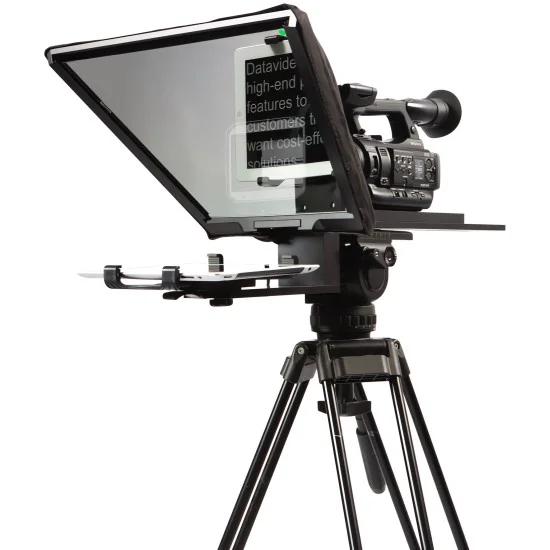
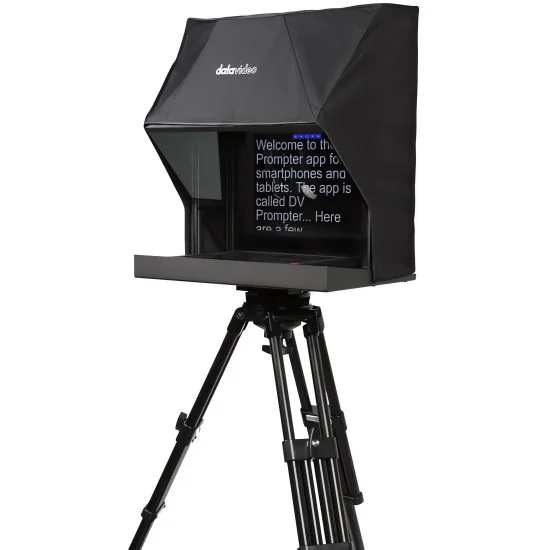
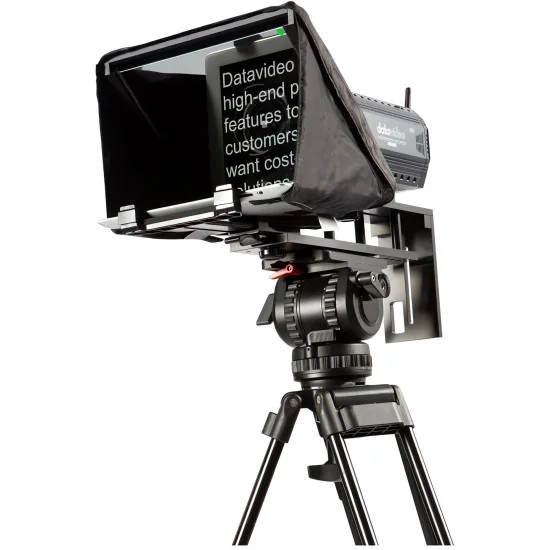
The Datavideo TP-300 is an on-camera tablet teleprompter designed for use with Android and iPad tablets, making it ideal for presentations and...
Filter By
Price
Price
€440.00 - €1,615.00
Teleprompter Type
Teleprompter Type
Teleprompter Screen
Teleprompter Screen
Screen Size
Screen Size
Max Tablet Width
Max Tablet Width
Display Brightness
Display Brightness
Video Input
Video Input
Video Output
Video Output
Professional teleprompters built for broadcast, conference and live production environments. From tablet-based on-camera systems to PTZ and conference prompters, find the right tool for natural, confident delivery on set.
Active filters
Reading a script while maintaining direct eye contact with the camera lens remains one of the core challenges in professional video production. Whether the setting is a broadcast newsroom, a corporate conference stage or a live streaming studio, the teleprompter solves this problem every single day. A well-built prompting system lets presenters, anchors and speakers deliver their lines naturally — without glancing down at notes — while the camera captures a direct, engaging gaze that connects with the audience.
At the heart of every prompting rig sits a beam splitter glass, an optical element coated with a dielectric layer that reflects a precise percentage of light toward the talent while allowing the rest to pass through to the camera sensor. Professional-grade glass uses low-iron substrates to eliminate colour tint. Common ratios include 60/40 (40 % reflectance, 60 % transmittance) and 70/30, where higher reflectance delivers brighter text visibility under strong studio lighting.
Stage and podium presentations demand a prompting solution that looks invisible to the audience while giving the speaker a clear, readable script at eye level. The conference teleprompter — often called a presidential teleprompter — positions a transparent glass panel on a stand next to the lectern. An LCD monitor sits flat at the base, projecting reversed text upward onto the coated glass. The speaker reads the reflected script; the audience sees only a transparent pane.
The Datavideo TP-800 packages a bright 38 cm (15-inch) 4:3 LCD panel, mirror-reflective glass and the built-in dvPrompter Plus application into a single portable kit. Because the software runs natively on the integrated screen, no laptop is needed. The TP-800 accepts Power over Ethernet, so a single Cat-5 cable carries both data and power — a significant cabling simplification on a conference stage. The HDMI loop-through lets you daisy-chain a second unit on the opposite side of the podium, and multiple TP-800 systems synchronise scroll position over IP. Manufacturers such as Prompter People also offer StagePro presidential rigs with dual-panel stands and dedicated operator software for large-scale government and corporate events.
The on-camera teleprompter mounts directly onto the camera support and positions the beam splitter glass at a 45-degree angle in front of the lens. The reflected script sits right over the optical axis, so the presenter reads text and looks straight into the camera simultaneously. This is the standard configuration in television newsrooms, interview sets and corporate video studios worldwide.
The Datavideo TP-700 represents the full-size studio approach: a 38 cm (15-inch) LCD with dvPrompter Plus embedded in the hardware, a multi-height riser system that accommodates everything from a mirrorless body to a full ENG shoulder-mount camera, and the option to run in a freestanding configuration where the camera is independent of the prompter rig. HDMI input also lets the 15-inch panel serve as an external monitor when third-party prompting software is in use. Talent monitor support extends to 48 cm (19-inch) VESA-compatible displays mounted at the rear of the unit.
Broadcast houses that rely on Autocue equipment will find a similarly deep product line. Autocue has been engineering prompting hardware since 1955, and their current Explorer and Pioneer series cover screen sizes from 43 cm to 48 cm with high-brightness panels rated for studio lighting. Their prompting software supports networked script delivery from newsroom computer systems, which matters in live news workflows where scripts change seconds before air.
Pan-tilt-zoom cameras are now the default capture device in many broadcast studios, houses of worship, lecture halls and streaming facilities. Placing a PTZ head behind conventional prompter glass, however, restricts its mechanical range of motion. A PTZ camera teleprompter resolves this by mounting the camera upside down inside the top of the prompter hood on an adjustable pantograph. Inverting the PTZ body positions the lens as close as possible to the centre of the glass, which maximises the usable field of view and allows the camera to pan and tilt through a much wider arc. The inverted image is corrected in the camera menu or in production software such as OBS, vMix or Wirecast.
The Datavideo TP-900 follows this principle. Its bracket supports horizontal and vertical adjustment and is compatible with most PTZ heads on the market. The integrated 38 cm LCD runs at 1024 × 768 with 350 nit brightness, and dvPrompter Plus is pre-loaded. HDMI pass-through and IP synchronisation connect multiple TP-900 units across a studio. Ikan also produces a 48 cm high-brightness PTZ-compatible teleprompter, and CueScript offers a lightweight PTZ mounting frame that replaces heavy tripods with a stand — a welcome weight reduction for mobile production teams.
Field interviews, run-and-gun documentary work, YouTube production and small-studio setups often benefit from a lighter, more compact prompting kit that uses a tablet as the display. The presenter's script runs on an iOS or Android app — typically dvPrompter Plus or a similar application — and the tablet slides into a cradle behind the beam splitter glass, in front of the camera lens.
The Datavideo TP-500 is built for DSLR and mirrorless cameras. It accepts tablets between 110 mm and 210 mm wide (portrait orientation), covering standard 10-inch iPads and Android equivalents. The 60/40 beam splitter glass uses a low-iron substrate with no colour tint, and the included cloth hood blocks ambient light. The WR-500 wired/Bluetooth remote gives a second operator scroll speed control, pause/resume, font size adjustment and the ability to jump between break markers in the script.
For larger ENG camcorders, the Datavideo TP-650 Mark II accommodates tablets up to 265 mm wide, including the 32.77 cm (12.9-inch) iPad Pro. Its multi-height riser system supports heavier broadcast cameras, and a freestanding option means the camera need not attach to the prompter frame at all. The entry-level Datavideo TP-300 shares the same 60/40 glass and WR-500 compatibility but targets lighter camera setups. The full kit weighs just 1.9 kg, adding minimal bulk to a packed equipment case.
Integrated-screen teleprompters eliminate the dependency on external tablets by embedding a dedicated LCD panel — usually 38 cm or larger — directly into the prompter housing, with prompting software pre-installed. The Datavideo TP-700, TP-800 and TP-900 all follow this architecture. The dvPrompter Plus application handles script import (plain text, PowerPoint and Keynote files via the web interface), multi-device IP synchronisation, and per-script adjustments to scroll speed, font, colour and justification. Scripts load and update from any device on the local network through a standard web browser.
The operational benefit is consistency: every time the unit powers up, it is ready to prompt. There is no tablet battery to check, no app update to approve and no Bluetooth pairing to troubleshoot. For permanent studio installations, that reliability counts. The HDMI input on the TP-700 and TP-900 also allows the built-in screen to display output from external sources, so the same hardware serves as a talent confidence monitor when prompting is not needed.
Autocue offers comparable integrated-screen rigs in their Pioneer and Navigator lines with brightness ratings that handle direct studio lighting. Prompter People takes a modular approach with their ProLine Plus series, pairing a dedicated monitor with the Flip-Q software dongle so operators can swap screens or mount the monitor independently of the prompter frame.
Whichever configuration suits the production — conference stage, on-camera studio rig, PTZ enclosure, tablet-based field kit or fully integrated screen — the right teleprompter system turns script delivery into a transparent, reliable part of the broadcast chain. Modern prompting software means a single operator can manage every screen in a multi-camera studio from one browser tab. For production teams that depend on consistent, professional output, that kind of dependability is not optional.
check_circle
check_circle