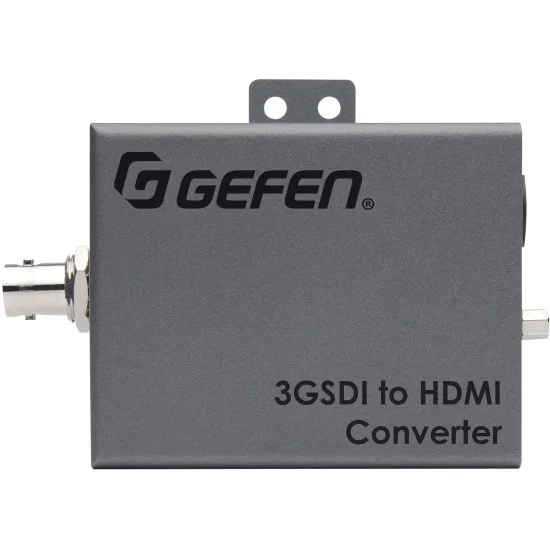
Datavideo DAC-8PA | 3G-SDI to HDMI Converter
€235.00
The Datavideo DAC-8PA is a reliable 3G-SDI to HDMI converter, designed to effortlessly connect SDI sources to HDMI devices and displays....
Filter By
Brand
Brand
Price
Price
€235.00 - €15,299.00
Video Input
Video Input
Video Output
Video Output
Audio Input
Audio Input
Audio Output
Audio Output
Max Output Resolution
Max Output Resolution
Output colour sampling
Output colour sampling
Built-in scaler
Built-in scaler
Control protocol for PTZ cameras
Control protocol for PTZ cameras
Network Connection
Network Connection
Signal converters bridge SDI, HDMI, DVI, and IP formats in real time. From compact mini-converters to multi-channel NDI gateways, they keep every link in the broadcast chain connected.
Active filters
Every broadcast chain, whether it runs through a mobile production truck or a permanent studio control room, depends on one category of hardware that rarely gets the spotlight: signal converters. These compact units sit between cameras, switchers, monitors, recorders, and streaming infrastructure, translating one video or audio format into another in real time. Without them, a 12G-SDI camera feed cannot reach an HDMI confidence monitor, an NDI stream cannot appear on a baseband router, and an HDMI laptop presentation cannot enter a 3G-SDI production switcher. The sections below cover three distinct families — baseband video converters, local interface converters for HDMI, SDI, and DVI, and IP encoders and decoders — each addressing a different stage of the signal path.
At their core, video signal converters accept a source format on one connector and output a different format on another, preserving resolution, colour depth, and frame rate. The simplest models handle a single direction — SDI in, HDMI out, or the reverse. More capable units add up/down/cross-conversion, allowing an SD 576i feed to be scaled to 1080p or a 1080p60 signal to be re-timed to 1080i50 for a PAL-based chain. Frame synchronisation is another frequent feature: when sources arrive from different clock domains, a built-in frame synchroniser locks them to house sync, eliminating glitches during live switching.
Colour-space processing matters equally. A converter bridging SDI (YCbCr) and HDMI (RGB) must remap values accurately, preferably at 10-bit depth to avoid banding in gradients. High-end models support HDR metadata pass-through (ST 2084 / HLG), ensuring wide-colour-gamut content from cinema cameras reaches grading monitors without clipping.
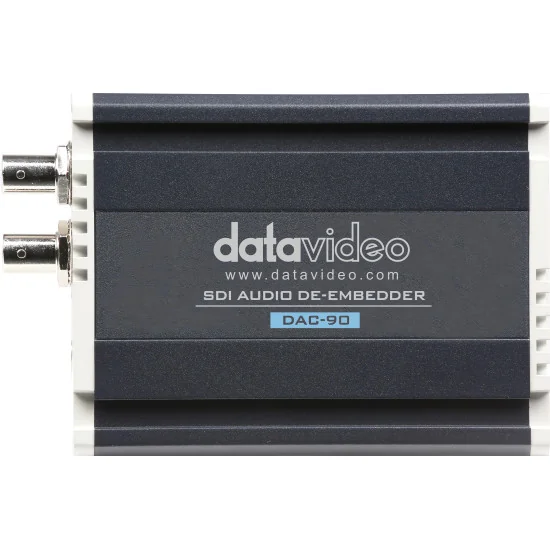
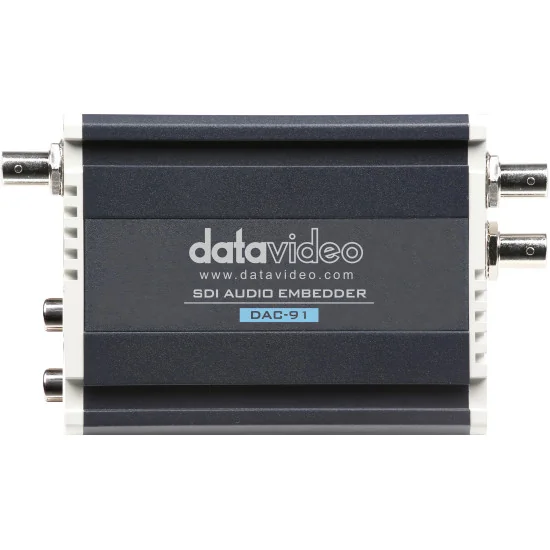
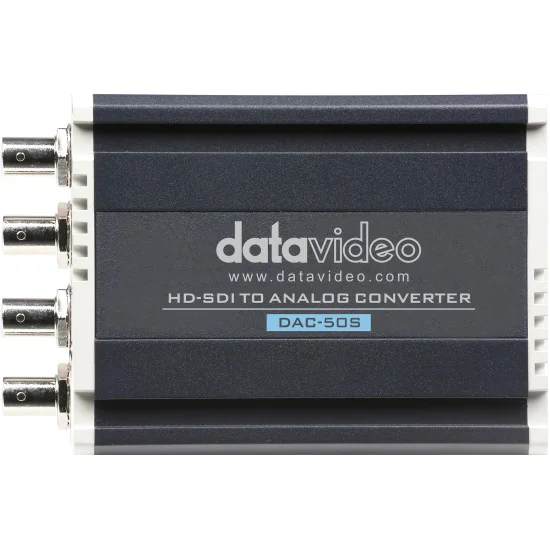
The Datavideo DAC series spans the full range of baseband conversion. The DAC-9P converts HDMI to 3G-SDI with dual SDI outputs, letting operators split a laptop presentation to two destinations simultaneously. The DAC-50S takes 3G-SDI and outputs analogue composite and component (YUV), bridging modern infrastructure to legacy CRT monitors still used in some municipal and house-of-worship venues. For multi-format environments, the DAC-70 works as a full up/down/cross-converter accepting SDI, HDMI, and VGA inputs, then delivering the selected output at up to 1080p60 with 10-bit internal processing. Metal housings dissipate heat without fans, keeping these converters silent beside talent or inside a dense rack.
Mixing HDMI, SDI, and DVI sources in a single production is a daily reality. A guest speaker arrives with an HDMI laptop, the studio cameras output 12G-SDI, and the confidence monitors expect HDMI. Dedicated local converters handle each of these hand-offs at wire speed, typically introducing under one frame of latency.
AJA builds a well-known family of mini-converters that has become a staple in post-production houses and OB vans worldwide. The Hi5-12G takes a single 12G-SDI cable carrying 4K/UHD at up to 60p and outputs HDMI 2.0 for direct connection to a UHD display. Going the opposite direction, the HA5-12G accepts HDMI 2.0 and delivers 12G-SDI on two BNC outputs, functioning simultaneously as a converter and distribution amplifier. For HD setups, the HA5-Plus supports HDMI cable runs up to approximately 30 metres on standard 24 AWG cable — a notable figure, since passive HDMI usually fails beyond 15 metres.
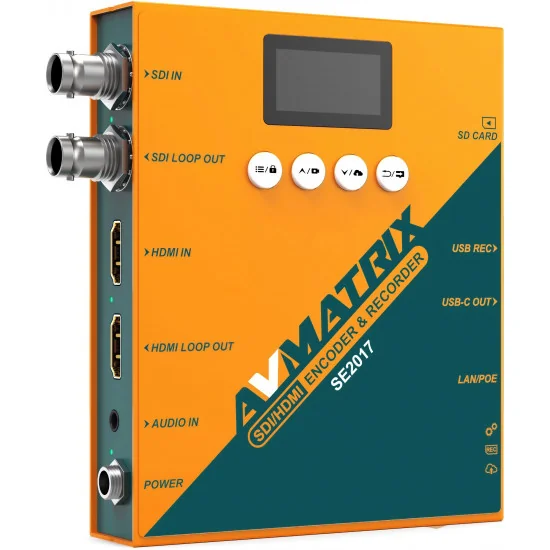
Cross-conversion adds another layer. The AVMatrix SC2030 accepts both HDMI and 3G-SDI inputs and converts either format to the other. DIP switches let operators select between pass-through, up-conversion, and down-conversion modes without a software interface — a time saver during fast-paced live events. An analogue 3.5 mm audio input enables audio embedding into the output signal. For legacy environments relying on VGA, composite (CVBS), S-Video, or YPbPr, the AVMatrix SC7030 accepts all of these alongside SDI and HDMI, outputting both formats with full scaling and frame-rate conversion up to 1080p60.
The Roland VC-100UHD occupies a different niche: it combines 4K scaling, format conversion, and USB 3.0 streaming output in a half-rack chassis. A 12G-SDI or HDMI 2.0 source enters the unit, and the VC-100UHD can simultaneously output a scaled version on 12G-SDI, a second on HDMI, and a USB 3.0 stream for capture by OBS, vMix, or another software tool. This three-way split suits hybrid events where a 4K camera feed must reach both an in-room LED wall and a remote streaming platform at different resolutions.
The transition from point-to-point cabling to IP-based video transport has accelerated. Two protocols define the live-production landscape: NDI (Network Device Interface) for local-area distribution, and SRT (Secure Reliable Transport) for wide-area delivery across the public internet. Many hardware encoders and decoders support both, often alongside RTMP, RTSP, HLS, and MPEG-TS over UDP, giving operators the freedom to route signals to virtually any destination.
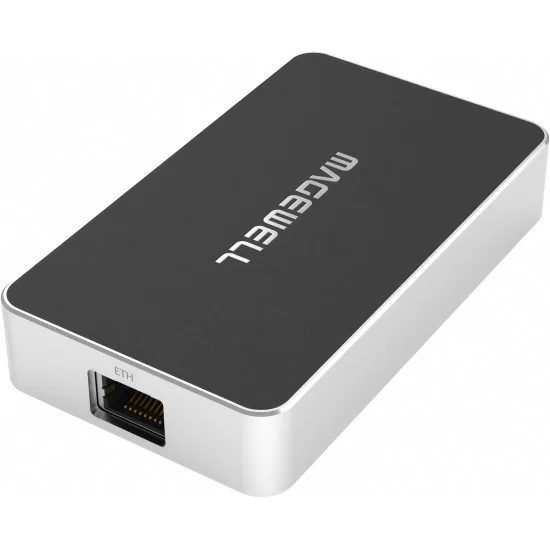
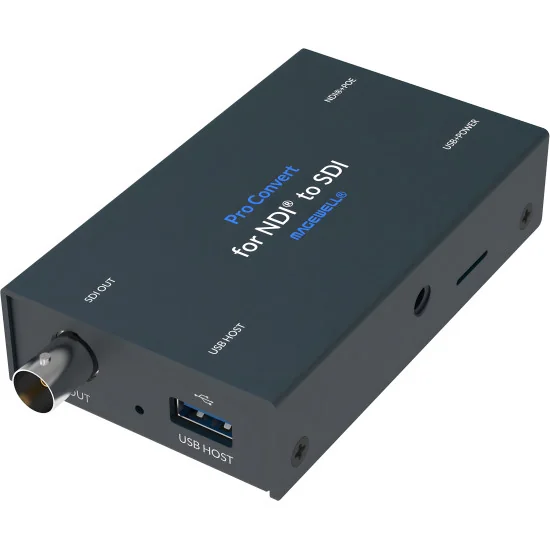
Magewell has built one of the broadest encoder/decoder families in the industry. The Pro Convert line covers every common conversion path. The Pro Convert SDI TX encodes a 3G-SDI input into full-bandwidth NDI over a standard gigabit Ethernet link, with built-in PTZ camera control and tally indication carried through the same cable. On the decoding side, the Pro Convert for NDI to HDMI receives an NDI stream and outputs clean HDMI at up to 1080p60, while the Pro Convert for NDI to SDI serves SDI-based monitoring. All Pro Convert decoders also accept H.264 and H.265 (HEVC) streams via SRT, RTSP, RTMP, HLS, and MPEG-TS, making them multi-protocol receivers. Power over Ethernet (PoE) on every model means a single Cat6 cable carries both data and power. For 4K demands, the Ultra Encode HDMI Plus and Ultra Encode SDI Plus push encoding up to 4K with NDI|HX3, SRT, RTMP, and RTMPS output — suitable for stadium and large-venue productions.
BirdDog embeds a custom silicon NDI chipset into every unit for hardware-accelerated processing. The BirdDog Mini fits in a housing measuring roughly 105 × 113 × 24 mm and weighing 200 g, yet it encodes or decodes full-bandwidth NDI at 1080p60 — switchable between modes through a web console. The Flex 4K IN handles UHD 2160p30 or 1080p60 at 4:2:2 10-bit and its DC output supplies 15 W to power a connected monitor or small camera. The BirdDog 4K HDMI scales up to 3840 × 2160 at 60p with HDMI 2.0 and a selectable 12G-SDI port enabling simultaneous loop or cross-conversion. An integrated Halo Tally system lights up automatically when the source goes live on any NDI-compatible switcher, eliminating separate tally wiring.
For large-scale NDI routing, the AJA Bridge NDI 3G handles up to 16 simultaneous SDI-to-NDI or NDI-to-SDI channels in a single 1RU chassis, making it a backbone device for studios migrating entire SDI routers to an IP fabric. Each channel operates independently, so the same unit can encode eight camera feeds while decoding eight return feeds to SDI monitors.
Choosing the right encoder or decoder depends on the signal path. A single-camera live stream benefits from a compact, PoE-powered NDI encoder. A broadcast studio with thirty SDI sources needs a rack-mounted multi-channel gateway. A remote production linking two cities over the internet needs SRT encoding with adaptive bitrate control. Understanding the protocol, resolution, latency tolerance, and physical environment ensures every converted signal arrives at its destination without artefacts, lip-sync drift, or dropped frames.
check_circle
check_circle