


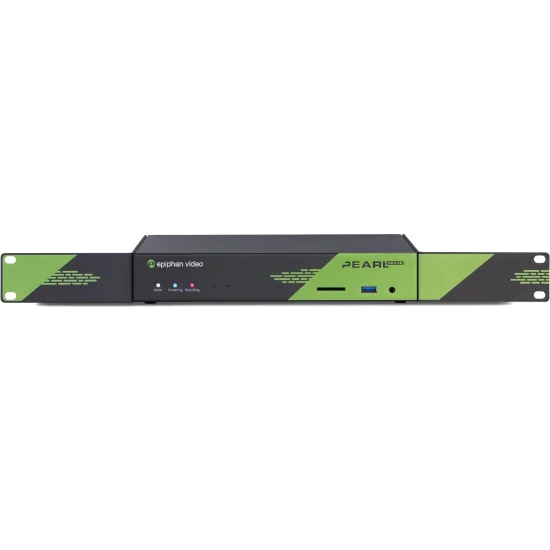
Epiphan Pearl Nexus | Streaming video Encoder, Switcher, Recorder, IP, NDI, SDI, HDMI, XLR
€4,149.00
The Epiphan Pearl Nexus is an all-in-one device designed for professional live video production, offering encoding, switching, and recording...
Filter By
Video Input
Video Input
Video Output
Video Output
Audio Input
Audio Input
Audio Output
Audio Output
Natively supported platforms
Natively supported platforms
Streaming protocols
Streaming protocols
Hardware encoders and IP streamers turn camera outputs into stable, low-latency feeds for broadcast, events, and remote production. Choose formats, protocols, and connectivity that match your uplink.
In professional live video, an encoder is the hinge between baseband signals and IP distribution. It decides how your SDI or HDMI feed behaves once it hits a network: latency, stability under packet loss, codec efficiency, and how well audio stays locked. This category focuses on deterministic hardware for OB vans, studios, corporate webcast rooms, houses of worship, esports stages, and camera-to-cloud crews—where a laptop encoder is a risk you simply don’t budget for.
On AVGear, you’ll see practical, field-proven units such as the Magewell Ultra Encode HDMI (53110) and Ultra Encode SDI Plus (53160), the BirdDog 4K QUAD, Datavideo NVS-35, Kiloview E1-s, Osprey Video Talon G1, and the Teradek Serv 4K v2. Each represents a different engineering priority: multi-destination contribution, AV-over-IP, dual streaming with recording, multi-input flexibility, or encrypted remote collaboration.
Full HD 1080p remains the daily driver for many live deliveries because it travels well through constrained uplinks and cloud ingest. Yet modern workflows increasingly demand 4K UHD and 4K DCI (4096×2160) for premium events, cinema-led branding, or HDR monitoring. The key is to treat resolution as only one variable. For instance, the Teradek Serv 4K v2 targets 4K DCI 60p contribution with professional processing, while devices like Datavideo NVS-35 stay focused on efficient 1080p60 delivery when reliability and quick turnaround matter more than pixel count.
In IP studios, NDI ecosystems can also shift the decision: a unit like the BirdDog 4K QUAD is about moving multiple 4Kp60 paths over a robust network fabric, including higher-speed options, rather than squeezing a single stream through a fragile uplink. If your priority is flexible AV-over-IP routing, start your selection with network architecture, then map resolution to your switching, multiview, and recording chain.
Professionals notice compression artifacts long before they applaud a higher raster. A clean 1080p stream at an appropriate bitrate can look more “broadcast” than a thin 4K feed starved by bandwidth. This is why hardware encoders that expose real control—codec choice (H.264 vs HEVC/H.265), stream profiles, and bitrate ceilings—are the safer path.
As an example, the Magewell Ultra Encode family is built around controlled, repeatable encoding for multi-destination streaming, including defined bitrate limits and dual-stream strategies for primary + confidence feeds. On the high end, Teradek Serv 4K v2 operates with a wide bitrate window suited to both local monitoring and remote stakeholders when image integrity is non-negotiable. In practice, set bitrate from the network backwards: measure sustained uplink, reserve headroom for jitter, then choose resolution and frame rate that keep motion detail intact.
Input choice is workflow choice. HDMI is common for mirrorless, PTZ, and graphics outputs; 3G-SDI and 12G-SDI dominate broadcast cabling, long runs, and embedded audio discipline; DVI still appears in legacy KVM, signage players, and certain computer outputs (often via passive adaptation). Hardware encoders that accept multiple inputs reduce the number of “conversion hops” that quietly add delay and failure points.
If you’re working camera-to-rack, SDI models such as Magewell Ultra Encode SDI Plus (53160) align neatly with routers and SDI patching. For mixed environments, units like Osprey Video Talon G1 bring multi-format ingest (including baseband and legacy sources) into an IP delivery path. When planning, treat the encoder as part of signal integrity: loop-through behavior, embedded audio handling, and timecode/caption support can matter as much as the codec.
“Native” platform support is not marketing fluff—it changes how fast you can deploy at a venue. Encoders that directly target major platforms reduce configuration errors and speed up failover. Many production teams keep a known-good profile for a primary platform and a second profile for a backup CDN, then switch destinations without rebuilding the whole stream stack.
Practical examples include compact encoders used for corporate town halls, sports, and training streams where you need predictable platform ingest, then an internal record for compliance or highlights. Devices such as Datavideo NVS-35 are often selected when teams want streaming plus local recording in a single appliance, cutting down rack space and operator load.
Protocol selection is where engineering meets reality. RTMP/RTMPS remains a common “last mile” into many platforms, while SRT is widely adopted for contribution over imperfect networks—especially when packet loss and jitter are expected. For in-facility production, NDI and NDI|HX options enable IP switching, routing, and multiview without re-cabling an entire studio.
That’s why a brand ecosystem matters. Magewell units commonly appear in workflows that combine SRT contribution with NDI-centric distribution. In multi-camera IP facilities, BirdDog products are frequently chosen to move multiple high-bandwidth signals and integrate tally/comms behavior into a cohesive NDI environment. And for remote collaboration where encryption and controlled access are non-negotiable, Teradek solutions such as Serv 4K v2 focus on secure, professional monitoring and camera-to-cloud style operation.
Network transport is the real constraint in the field. Gigabit Ethernet is the default for stable contribution and predictable latency; Wi-Fi can be viable for fast setups and roaming positions, but it needs RF discipline; cellular modem support matters when venues have congested LANs or when you’re deploying from a moving platform. Many crews carry two strategies: wired primary + wireless/cellular backup, with protocol choices that tolerate disruption.
Hardware encoders that expose network options let you engineer resilience. For example, the Magewell Ultra Encode HDMI (53110) family combines wired and wireless connectivity, while compact SDI appliances like Kiloview E1-s are often positioned as edge encoders for SRT/RTMP contribution from remote cameras back to a central control room. In fixed installs, Osprey Video hardware is regularly specified for steady 24/7 streaming where configuration consistency is as important as picture quality.
To complete the chain, many teams pair the encoder with switching and graphics upstream, then rely on consistent contribution downstream to a CDN, a private cloud, or an internal NDI network. If your job is to deliver a clean feed on time—every time—select for bitrate control, protocol fit, input discipline, and network resilience first. The pixels can follow.
Explore encoder ecosystems from Datavideo for streaming+recording appliances and production-oriented connectivity, and from Kiloview for compact IP encoders that match modern protocol stacks. The right choice is the one that matches your route: camera output → encoding policy → protocol → network → destination—without surprises.
check_circle
check_circle