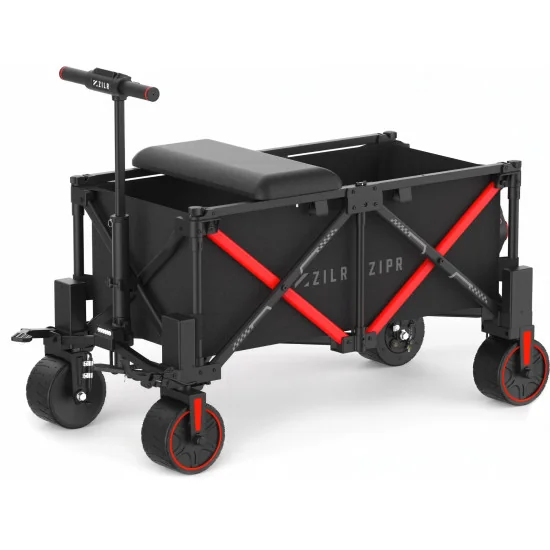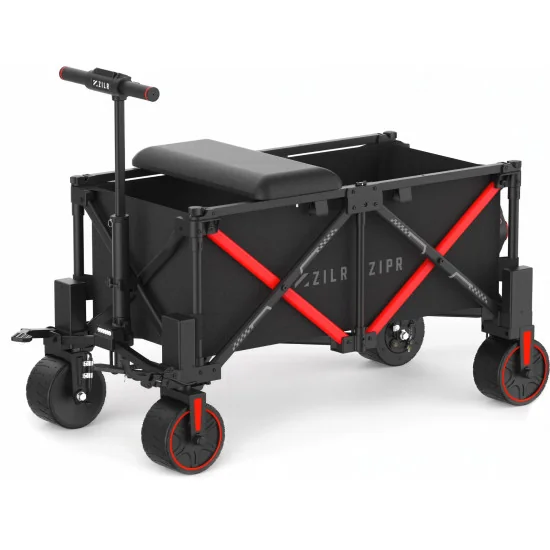
ZILR ZIPR 2WD E-Powered Audio Video Production Cart
€1,490.00
Six flight cases, one loading ramp, fifteen minutes until doors open — moments like these are where the ZILR ZIPR 2WD E-Powered Production Cart...
Filter By
Price
Price
€1,490.00 - €1,990.00
Payload (kg)
Payload (kg)
Features
Features
Every shooting day runs smoother when gear rolls instead of being carried. A production cart gathers cameras, monitors and cabling into one organised trip — here is how to choose the right model.
Active filters
Moving a complete camera package across a location eats more shooting time than most schedules admit. Production carts give image, grip and lighting departments a rolling base that carries the kit, keeps it sorted and doubles as a work surface the moment the wheels lock. One run replaces five, cases stay off wet ground, and the assistant keeps monitors, batteries and filters within arm's reach. Below is a closer look at what current models can do — and which parameters deserve attention before a purchase.
A cart earns its place long before the first slate. During prep it hauls cases from the truck; once cameras roll, it turns into a focus puller's command post, a DIT cart with a calibrated monitor and storage RAID, or a video village on wheels that follows the director between setups. The Tilta Boulder Camera Cart shows how far the concept stretches: its aluminium frame accepts a lockable top drawer, a monitor arm, a Steadicam dock, a tripod holder and even a metal pegboard, so the same platform serves a camera assistant on Monday and a mobile workshop on Friday. After wrap, the top and bottom trays lock together into a hard-shell rolling case that slides into a passenger car boot — no cargo van required. Photo studios build similar digi-stations, rental houses roll prepped packages straight to the loading dock, and broadcasters park a cart behind the OB van as a hub for cabling and signal converters. The pattern repeats everywhere: fewer trips, less lifting, gear that stays organised.
Pushing 250 kg up a ramp marks the border between muscle and motor. The ZILR ZIPR brings an electric drive to the equipment cart: the 1500 W front-wheel-drive version climbs 21% gradients and covers up to 30 km per charge of its LiFePO₄ battery, while the 3000 W four-wheel-drive model hauls 300 kg up 30% inclines — the sort of slope waiting on stadium ramps and festival hills. Crew members push it, pull it or ride it at up to 16 km/h, with hill-start assist and electronic braking keeping the load in check on descents. A hot-swappable spare battery bridges long days, and a full recharge takes roughly three hours. A tow hitch couples a second trailer for bigger moves; the optional passenger seat has even served as a rolling dolly for quick tracking shots. Tilta approaches motorisation from another angle: a motorised wheel kit retrofits the Boulder cart with two powered wheel assemblies and a wireless control handle, so heavy loads climb truck ramps without a second pair of hands. For teams crossing large studio complexes or exhibition grounds, the motor shrinks the slowest part of the day to a footnote.
Concert and event crews roll gear where a studio floor never goes: gravel backstage lanes, cable ramps, cobbled courtyards, damp grass between festival stages. Out there, wheel choice decides more than any other line on the spec sheet. The SHAPE WAGON camera cart rides on all-terrain inflatable wheels with 360° swivel casters at the rear and a foot brake rated for heavy loads, so a fully loaded cart stays put on a sloping stage approach. Its two carpeted shelves swallow rattles — a serious argument when a camera team repositions mid-set during an acoustic number. SmallRig follows the same logic with silent pneumatic casters, because a cart that squeaks across a live venue ends up banished to the corridor. Touring crews also weigh collapsibility: the WAGON folds into a latched travel case with its own transport wheels, while the SmallRig Lite variant stays within most airline oversize allowances and flies with the rest of the kit. Corner posts take light stands, shelves carry intercom chargers and IFB racks, and the same cart covers a corporate conference on Saturday and an arena load-in on Sunday.
Two numbers separate a professional camera cart from a warehouse trolley: the weight it accepts and the hardware that attaches to it. Load capacity among current models starts around 200 kg with the steel-and-aluminium SHAPE WAGON and reaches 250 kg on the aluminium decks of the SmallRig Video Production Camera Cart, while the four-wheel-drive ZIPR moves up to 300 kg — a full camera package, lens cases, a fleet of V-mount batteries and a monitor bridge in a single pass. Mounting interfaces decide what happens after the brakes drop. Cheese plates with 1/4″-20 and 3/8″-16 threads plus ARRI locating holes keep monitor arms and wireless receivers from twisting loose; 16 mm baby pins accept practical lights and articulated arms; a front fence with anti-rotation points holds a slate, a router or an audio recorder right on the rail. Tilta carries cross-standard compatibility the furthest — NATO rails, Manfrotto-style plates and 40 mm posts on one frame — and SmallRig adds C-stand compatibility so grip hardware drops straight on. Before ordering, weigh the heaviest configuration your team actually moves, then count the accessories: a cart with the right threads spares you a drawer full of adapters.
Tilta, SHAPE, SmallRig and ZILR answer the same question with different accents — modularity, terrain handling, portability, electric drive. Matching that accent to your productions is the whole craft of choosing production carts: the right one dissolves into the crew's routine, and only its absence would ever be noticed.
check_circle
check_circle