


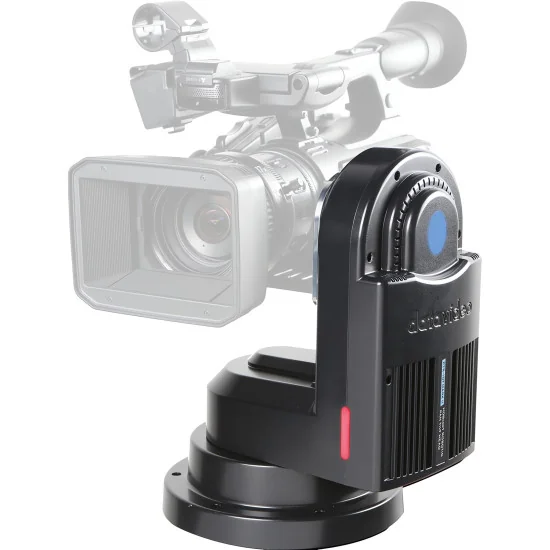
Datavideo PTR-10T Mark II | Motorized Pan/Tilt Head, HDBaseT, HDMI, SDI, RS422
€2,849.00
Enhance your production setup with the Datavideo PTR-10T Mark II, a motorized pan-tilt head that converts standard camcorders or block cameras...
Filter By
Video Input
Video Input
Video Output
Video Output
Audio Input
Audio Input
Audio Output
Audio Output
Control protocol for PTZ cameras
Control protocol for PTZ cameras
Controlled motion for live and film sets. Motorized heads, vest-and-arm support, compact jibs and car mounts keep shots steady and repeatable.
Active filters
Stabilizers are a control system for camera motion. On professional sets the difference comes down to three numbers: payload, control of micro-vibrations (stiffness + damping), and repeatability (presets, motor steps). Whether you shoot a live show, a studio interview or a moving vehicle insert, stabilization keeps the frame intentional while the environment keeps moving.
Choose the system by shot type: remote pan/tilt cues, long handheld walking takes, high-angle reveals, or exterior vehicle angles. Many crews build around edelkrone motion control for programmed moves, then add quick-release plates, clean power distribution and safety redundancy.
Motorized pan/tilt heads let you run repeatable moves without swapping to a full PTZ camera. For studios and streaming galleries, the integration details matter: RS-422 VISCA, IP control, tally, and pass-through video (HDMI/SDI, sometimes HDBaseT). Presets are the practical win—recall the same framing for podium shots, product demos or talk-show positions, with predictable acceleration and stop points.
Datavideo PTR-10 Mark II converts a compact camera into a remotely controlled pan/tilt unit with HDMI/SDI pass-through and serial/IP control, while Datavideo PTR-10T Mark II adds HDBaseT transport to cut cabling when the head is far from the control room. For motion-control on sliders and jibs, edelkrone HeadPLUS v3 and HeadPLUS PRO v3 focus on ultra-fine 2-axis step control with full 360° pan and wireless programming in the edelkrone App. That makes looping moves feasible: repeat a reveal, a parallax drift, a focus-pull cue, or a timed “hit” on talent, then match it across multiple shooting days. For VFX plates and product turntables, this repeatability reduces framing drift between passes.
Handheld gimbals handle roll/pitch/yaw, but long takes still reveal operator fatigue and vertical bounce. Vest-and-arm systems add a sprung, damped link between the body and the gimbal so footstep energy is absorbed before it reaches the camera. Key parameters are payload rating, spring range, arm geometry and how fast the operator can re-balance.
Tilta Float Dual Handle Support System and Tilta Float Handheld Gimbal Support System V-Mount pair a light vest with a shock-absorbing arm for common cinema gimbals, supporting “10 kg class” builds for events, documentaries and commercials. For heavier ring rigs, Tilta Armorman 3.0 shifts weight to the operator’s core via mechanical arms and supports higher payloads, which helps when the build includes remote focus, wireless video and larger batteries. In live production this is often the difference between a roaming camera that looks good for two minutes and one that stays stable for an entire segment.
Jibs are still a fast route to overhead tabletop shots, sweeping stage entrances and controlled reveals from behind set pieces. The critical specs are payload vs arm length, bowl size (75/100 mm), rigidity under load and safe, quick counterweight handling.
Libec JB40 Jib Arm uses a compact front-operation layout with an adjustable arm length (about 0.63–1.0 m) and high payload capacity depending on configuration. Libec JB40 Jib Arm Kit adds matching tripod and dolly so the crane can roll between marks on smooth studio floors. For programmed crane cues, edelkrone JibONE v3 and edelkrone JibPLUS v1 bring app-controlled motion and quick balancing; pair them with a motorized head such as HeadPLUS v3 to get multi-axis moves that stay locked on a point while the camera travels.
Vehicle mounting is where stabilization meets safety engineering. Look at payload, suction cup layout, shock absorption range, rail rigidity and the ability to add redundancy (safety straps, secondary anchors, lockable clamps). Power and control also matter: V-Mount/G-Mount plates, D-Tap distribution and remote run/stop so the crew stays inside the vehicle.
Tilta Hydra Alien Car Mounting System V-Mount uses a multi-cup base and shock-absorbing arm for gimbal mounting. For a rail-based structure with more mounting positions, Tilta Speed Rail Car Mounting Kit uses rigid 50 mm rails to spread force across multiple contact points. For high-end vehicle shots with controlled travel, Tilta Hydra Arm Motorized Slider Pro Kit V-Mount adds a motorized slider on the arm, combining isolation with a programmed push-in or lateral move while the vehicle is moving.
Stabilizers are easiest to buy when you map them to shot types: repeatable cues, long walking takes, overhead reveals and vehicle inserts. Once the motion is defined, choose a system that carries the camera safely, integrates with your control infrastructure, and stays consistent from rehearsal to the live take.
check_circle
check_circle