- New
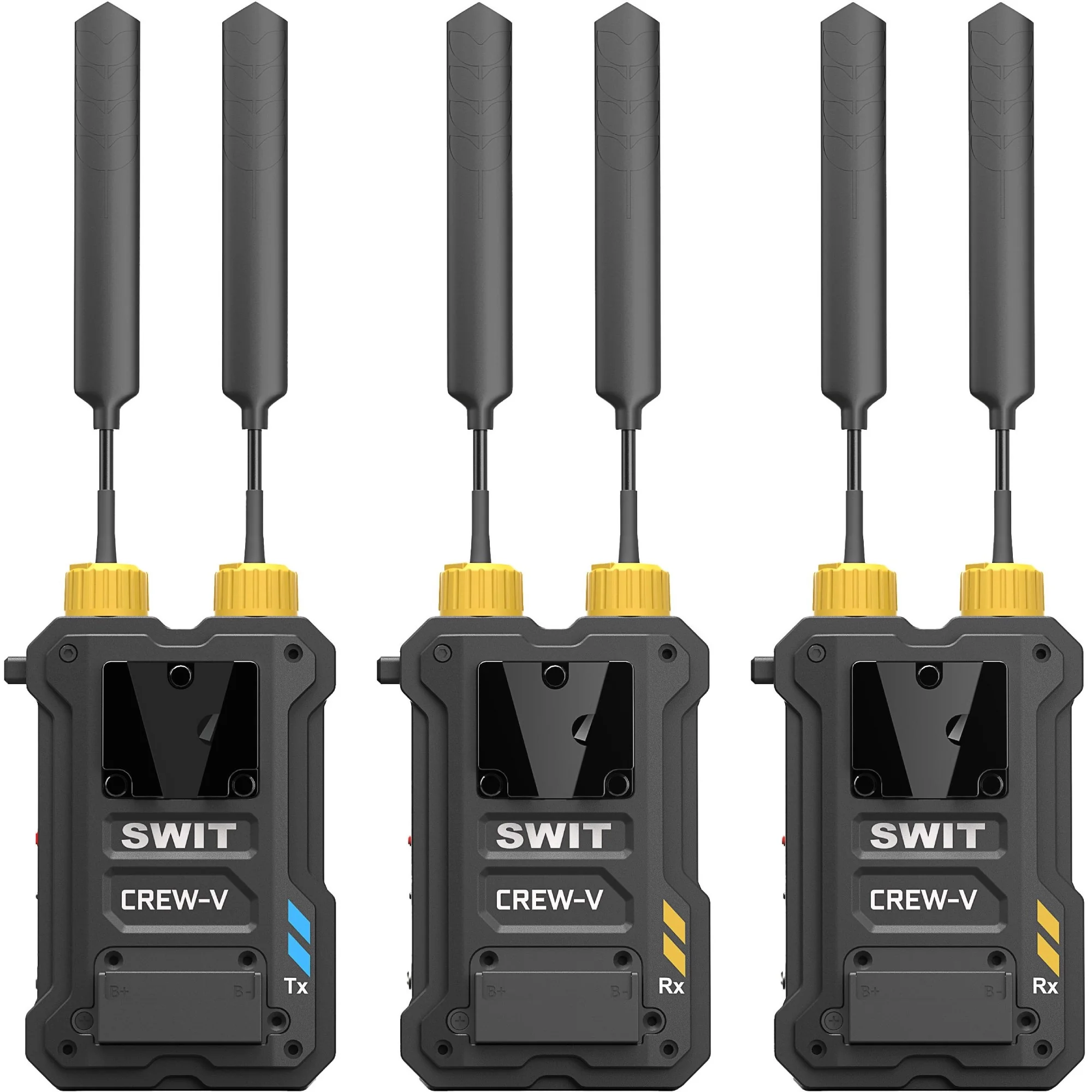
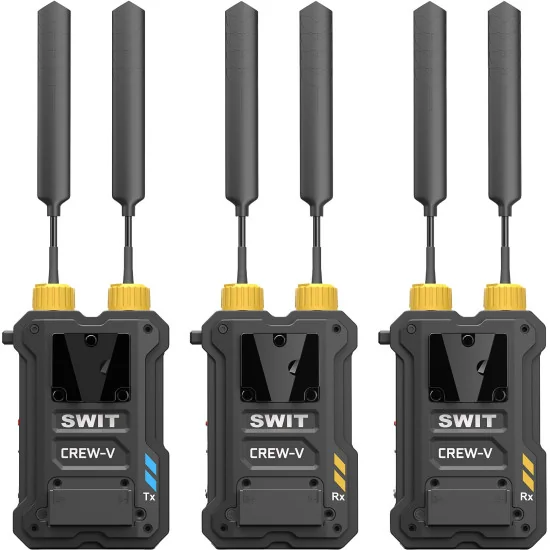
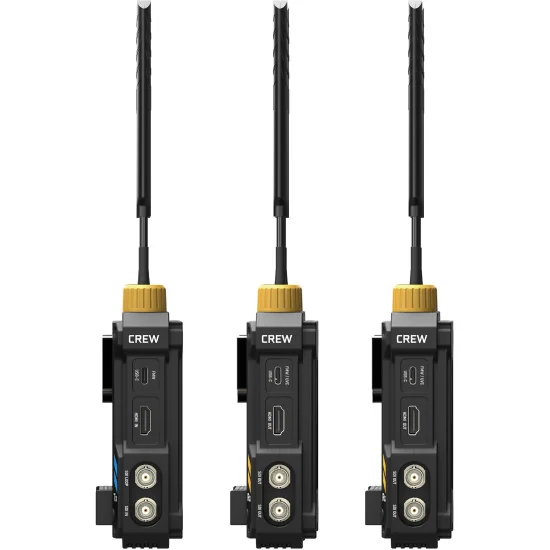
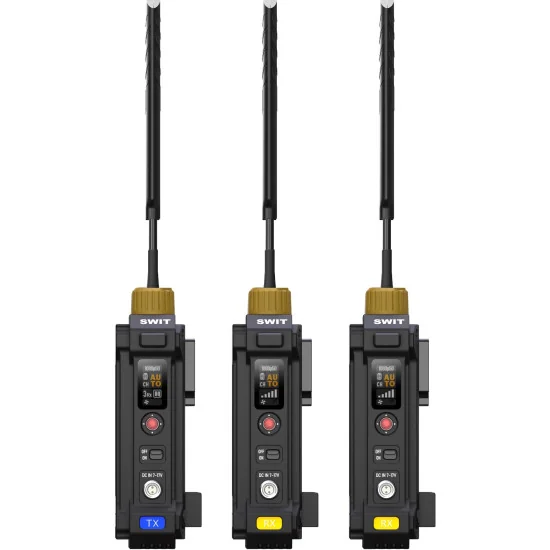
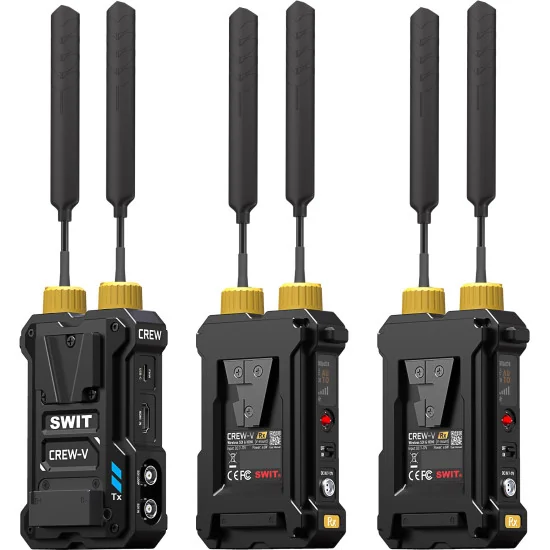
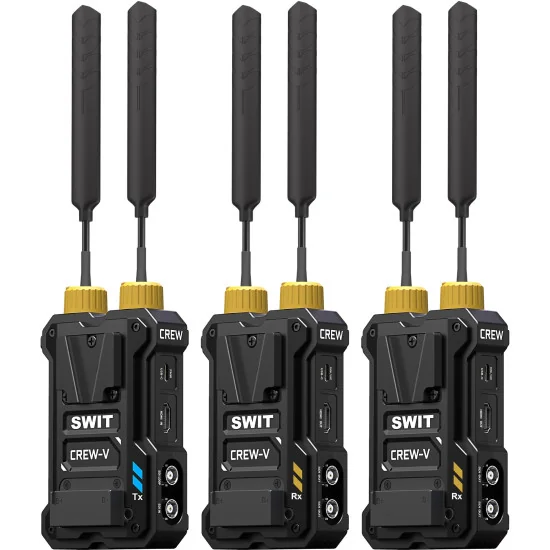
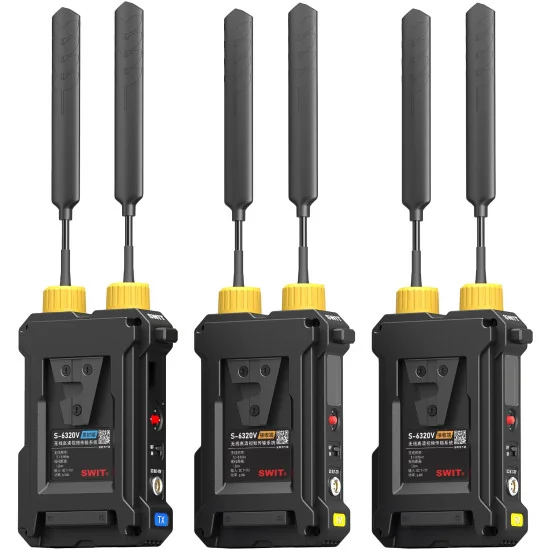
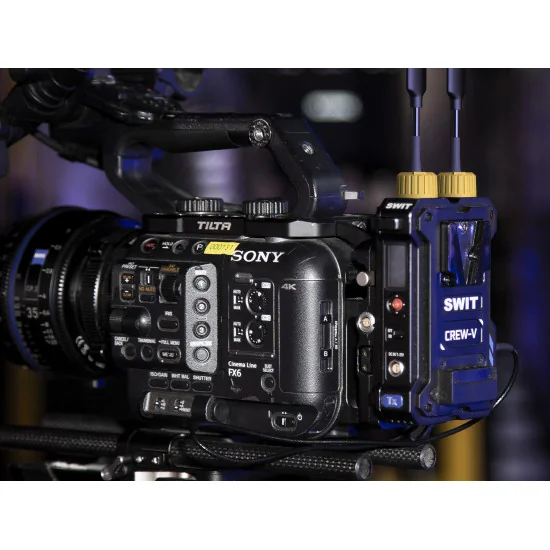
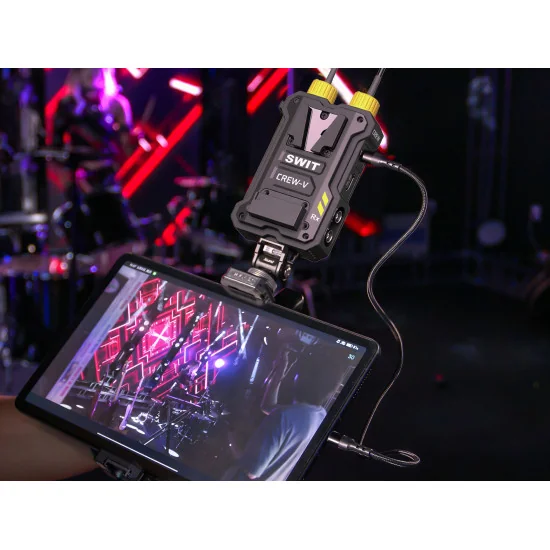
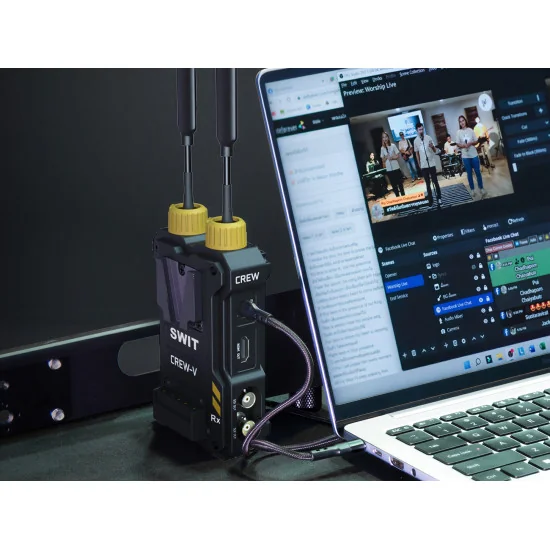
Three matched units share one carrying case in the SWIT CREW-V TX + 2RX wireless video transmission system: a dual-sided V-mount transmitter and two identical receivers. SWIT names this one-to-two layout as the usual monitoring arrangement on a film set, with the cinematographer watching one picture and the 1st AC pulling focus from the other. The kit covers that job from day one, with no separate receiver to order.
Each receiver works as a complete output hub. Twin 3G-SDI outputs, HDMI out and USB-C capture all carry the image at once, regardless of which input the camera uses. Across both receivers, that is eight simultaneous feeds from a single camera. On a commercial, receiver one at video village can run the director's monitor, a recorder and an agency screen, while receiver two travels on the focus puller's handheld rig.
Both receivers show the picture with the same constant 32 ms latency, a value SWIT states does not drift with radio interference. One frame at 25p lasts 40 ms, so the delay stays inside a single frame; at 50p it comes to a little over one and a half. A fixed figure means the focus puller can trust the timing, and wireless cameras reaching a vision mixer stay aligned.
Bringing two receivers online is a short routine. Each one enters the pairing menu in turn and is confirmed on the transmitter, whose OLED then displays the count of linked receivers, a quick check before a take that both positions are live. Once paired, the three units find each other again at power-on, so the next shooting day starts without repeat pairing. Firmware files go onto a USB flash drive and load via the supplied OTG adapter; afterwards the set needs pairing again.
Two receivers are a starting point, not a ceiling. One transmitter accepts up to four in multicast, and SWIT quotes no loss of distance, latency or image quality as receivers are added. Any CREW-family receiver can join: another CREW-V, an NP-F CREW unit, or the CREW MAX panel receiver, which SWIT rates at 3 km with this same transmitter.
We ship across the EU for €20, free over €1,000.
B2B sales only, prices excl. VAT.
Official EU distribution and warranty.
Secure online payments via Stripe.
Send your enquiry via the form or email avgear@avgear.shop
On larger sites, the manufacturer allows up to eight links to operate in parallel, on condition that every transmitter in use has a recognisable source connected. White and yellow tags clipped to the antennas identify each group at a glance.
Range depends on the antennas. Standard soft-base 3 dBi antennas cover about 900 m in line of sight; the six 5 dBi high-gain antennas in the case, two per unit, lift the rating to 1.2 km and hold the link better through partitions. SWIT's manual adds the practical side: antennas vertical, the receiver mounted as high as possible and turned towards the transmitter, with walls, trees and water kept off the path.
Behind the link sits SWIT's KUWI 2.0 Pro radio chip, paired with a proprietary protocol rather than Wi-Fi and working in the licence-free 5.1–5.9 GHz band with DFS compliance, OFDM modulation and 23 dBm output. In Auto, a built-in scanner hops to a cleaner frequency without interrupting the image, which matters in stadiums and congress centres crowded with routers and phones. Channel and image mode are chosen on the transmitter only, and both receivers follow on their own. Moving from the high-quality mode to the wall-crossing mode calls for a transmitter restart, so it belongs in prep.
Video is encoded in H.265 with a 26.8 Mbps bitrate ceiling, which SWIT describes as visually lossless next to a cable. Supported formats cover 1080p from 23.98 to 60, 1080psF from 23.98 to 30, interlaced 1080i50/59.94/60 and 720p50/59.94/60. This is a Full HD system, so a UHD or large-format cinema camera should send it an HD monitoring output. The transmitter offers a 3G-SDI input with loop-out next to a full-size HDMI input; with both connected, SDI is used.
For cinema crews the link carries more than pictures. SDI-embedded camera metadata reaches the DIT for live grading, and timecode plus the record start/stop trigger travel as well (SWIT's manual mentions ARRI cameras), so a recorder on a receiver can roll in step with the camera body. 2-channel embedded audio rides along with the picture.
Privacy has two layers: SWIT's closed KUWI radio protocol, then AES-256 encryption of the content. On a closed set, a confidential corporate presentation or a pay-per-view event, only receivers paired to this transmitter can display the feed.
The USB-C port on each receiver is a UVC output. Windows and macOS read it as a camera without drivers, at 1080p50/60, and OBS offers it straight away as a capture source. In practice, the second receiver can sit beside a laptop and push a live stream or a remote-guest feed while the first one feeds the switcher. Plugged into a smartphone or tablet with any third-party “USB camera” viewer, the same port turns a mobile device into a viewing screen for a producer or client.
All three units carry a dual-sided V-mount plate. Mounted between camera and battery, the transmitter draws from the same pack as the camera, and SMBus pins pass straight through, so the camera body still reads the battery's digital charge data. Receivers fit any V-mount plate in the same sandwich arrangement. SWIT's manual rules out high-voltage V-mount packs on these plates.
Other power paths are a 2-pin LEMO input accepting 7–17 V and USB-C, which needs 9 V/2 A at the transmitter and 5 V/2 A at each receiver. The transmitter draws 16 W and each receiver 6 W, the rated environment runs from −10 to 40 °C, and the cooling fan either follows temperature or can be stopped entirely for silent scenes. For a receiver parked at a fixed position, SWIT also lists a mains adapter with a LEMO plug.
Inside the case: the transmitter, both receivers, six high-gain antennas, six white and six yellow ID tags, three D-Tap to 2-pin LEMO cables, three USB-C to USB-C leads plus an OTG adapter (USB-A to USB-C). Every unit gets its own power lead, so the set goes out on its first job with no extra purchases.
| Model | CREW-V |
|---|---|
| Input / Output | |
| Transmitter | SDI input×1, loop output ×1 |
| HDMI® input×1 | |
| Receiver | SDI output×2 |
| HDMI® output ×1 | |
| USB-C Video capture output ×1 | |
| Video Formats | |
| SDI / HDMI® | 1080p60, 1080p59.94, 1080p50 1080p23.98, 1080p24; 1080p25, 1080p29.97, 1080p30; 1080psf23.98, 1080psf24, 1080psf25, 1080psf29.97, 1080psf30 1080i60, 1080i59.94, 1080i50; 720p60, 720p59.94, 720p50 |
| Compression | H.265 up to 26.8M bit-rate |
| Embedded Audio | 2-ch |
| Metadata | Yes |
| Timecode & Trigger | Yes |
| Wireless | |
| Frequency | 5.1 - 5.9GHz |
| RF Modules | OFDM 16QAM, 64QAM, QPSK, BPSK |
| RF Power | 23dbm |
| Distance | 1.2km / 4000ft (Line of sight) |
| Latency | 32ms |
| Multicast | 1 Tx up to 4 Rx |
| Encryption | AES-256 |
| Power | |
| Battery Plate | Tx & Rx: Dual sided V-mount |
| DC Input | Tx & Rx: 2-pin LEMO 7-17V |
| USB-C Input | Tx: 9V/2A; Rx: 5V/2A |
| Power Consumption | Tx: 16W, Rx: 6W |
| General | |
| Environmental | -10°C to 40°C |
| Net weight(without packaging) | Transmitter 0.4kg Receiver 0.4kg |
| Product dimensions(without packaging) | Transmitter 130×85.9×44.8mm Receiver 130×85.9×44.8mm |
| Gross weight(with packaging) | 2.8kg |
| Package dimensions | 390×135×320mm |

Data sheet
Specific References