


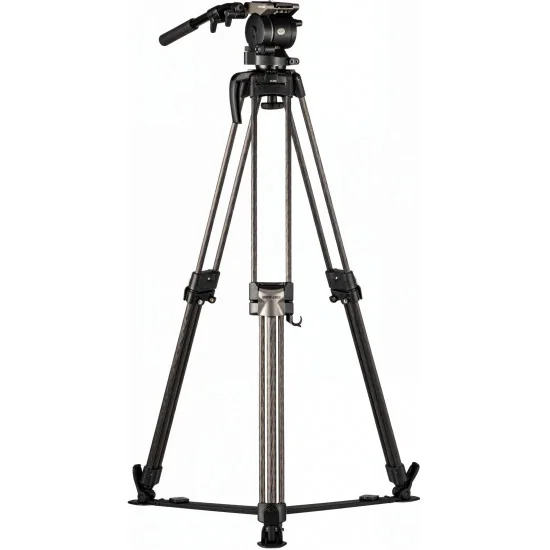
Libec HS-350QC Video Tripod
€1,549.00
Libec HS-350QC is a floor-spreader tripod system for broadcast, live production and streaming crews who need repeatable balance under pressure....
Filter By
Payload (kg)
Payload (kg)
Maximum Height (cm)
Maximum Height (cm)
Professional video tripods keep shots stable and repeatable on set and in live production. Learn how legs, heads and spreaders affect control, and when a studio pedestal makes more sense.
Video tripods keep framing repeatable, protect focus pulls from micro-vibration and let one operator execute clean pans and tilts during long takes or multi-hour live shows. A solid system is always a combination of legs, a fluid head and the right spreading method, matched to payload, lens length, wind and set pace.
Start with payload and interface. Bowl sizes such as 75 mm or 100 mm make levelling fast on uneven ground, while a flat base helps when the head must jump onto a slider, a hi-hat or a car rig. Carbon-fibre legs damp vibration and stay comfortable in cold weather; aluminium legs take daily knocks and clamp hard for quick resets. Twin-tube legs add torsional stiffness for long lenses; single-tube legs suit lighter kits.
Small details affect day-to-day speed: a long sliding plate range helps you rebalance after swapping batteries or adding a matte box; an illuminated bubble level keeps levelling accurate in dark venues; and 3/8-16 accessory threads on the crown let you mount a monitor arm, wireless receiver or tally light without stressing the pan bar.
In AVGear’s range, compact kits such as the Libec TH-X support mirrorless and small camcorders, while systems like the Libec RSP-750M move into heavier rigs with more counterbalance and drag control. For mobile crews needing a carbon kit with consistent feel, the Sachtler System Ace XL CF MS Mk II pairs carbon legs with defined drag grades.
In studios, a tripod often shares duties with a pedestal. A pneumatic or electric column gives vertical moves without touching the camera body, and a dolly base tracks smoothly across seams and cable ramps—useful for talk shows, worship, e-sports, education and corporate stages.
Examples include the Libec P110S and Libec P110B for larger camera packages; their dolly bases use large casters (around 125 mm) and double-bearing guidance to keep fast height changes stable. The Libec LX-ePed 2 Studio adds motorised lift for controlled height trims during a live segment. A pedestal won’t replace a tripod outdoors, but in fixed multicam rooms it becomes the main camera support.
Stability is not only “no shake”. A rigid support keeps autofocus and tracking more reliable, reduces rolling-shutter wobble during long-lens moves, and gives the operator a stable base for slow pans that match a director’s rhythm. Consistent levelling and plate travel also speed up camera changes.
As rigs grow with matte boxes, wireless video and V-mount batteries, legs and head must still balance predictably. Systems such as the Sachtler System aktiv6 flowtech75 MS or the Cartoni Focus 22 EFP 2-St CF System MS stay stable with cine builds while remaining practical on location.
On heavier studio builds the Cartoni Master 25 Studio 2-St Alu System keeps moves smooth under high payloads while two-stage legs and a ground spreader hold geometry on polished floors too. For fast resets, mark height and pan limits per camera position.
Tripod choice turns technical when you look beyond “maximum payload”. The key is how the head balances at your camera’s centre of gravity. On the legs side, clamp type, bowl rigidity, torsional stiffness and the spreader change how the system behaves. A mid-level spreader helps on uneven ground; a ground spreader locks leg angles for studio floors and venues.
Outdoor sets often need spiked feet and a mid-level spreader to clear cables or crowd barriers. For low angles, a hi-hat keeps the head close to the ground and preserves the same pan/tilt feel between takes with few delays.
Transport matters too: a shorter folded length fits small cases, but a slightly heavier kit can still save time if it sets fast and stays level after every move. For tight spaces, compact supports can substitute for a light tripod; edelkrone options like StandPLUS PRO provide a stable base with a small footprint.
A true fluid head is about controlled starts and stops. Look for independent pan/tilt drag settings, positive locks, and a counterbalance system that holds the camera at any tilt angle without constant hand pressure. Step-based systems keep the feel repeatable across operators; continuous systems allow finer tuning for unusual rigs.
The continuous approach from Cartoni helps when one head must cover several camera builds in a day. Sachtler’s aktiv heads combine sideload plates with defined drag grades for multicam consistency. Libec’s higher-load systems pair counterbalance with drag tuning and, on some models, dual-base mounting for quick moves from tripod to slider.
For productions that benefit from motorised height control, the edelkrone Tripod X PRO and edelkrone Tripod X RAPID add motorised lifting and self-levelling concepts for time-lapse, product video and fast camera re-positioning.
check_circle
check_circle