


BirdDog X1 Bundle – the perfect kit for your streaming studio.
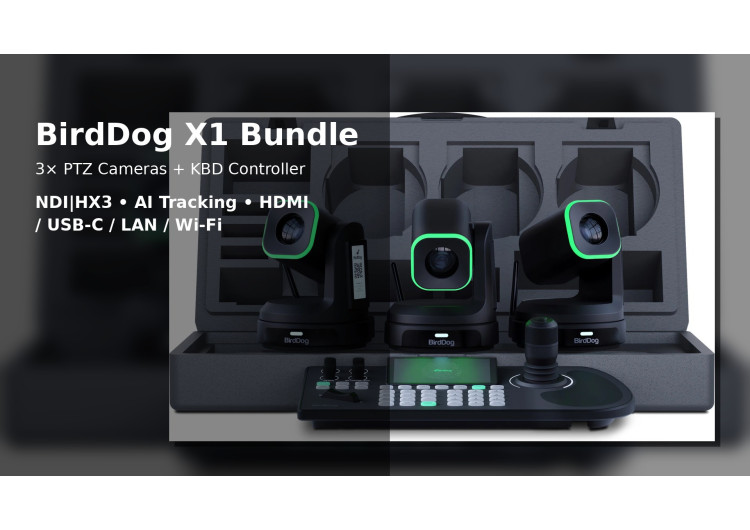
Three PTZ cameras and a hardware controller in one kit. Set up a compact studio with repeatable framing and fast control. Built for live workflows.
When a compact studio has to deliver repeatable framing, clean switching, and predictable latency, the weak point is rarely camera “quality” in the abstract—it’s control, transport, and the time it takes to make the system behave. BirdDog X1 Bundle Black brings three matching PTZ heads and a dedicated hardware controller into one workflow: one operator, one network plan, and consistent shot grammar across an entire production day.
Each X1 pairs a Sony 1/2.8" CMOS imaging block with true 1080p 50/60 output and a 20× optical zoom (5.5–110 mm), so the same camera can cover a wide two-person table scene and then pull a tight podium shot from the back of a small room. Mechanics are tuned for live cues—up to ±175° pan and -90° to +90° tilt with speed control from slow creep to fast repositioning—while up to 255 presets per camera support consistent blocking across recurring shows.

A solution for video podcast studios, local television stations, and live corporate productions.
For video podcast studios, the bundle answers the classic friction point: you want three perspectives, but you do not want three operators. Use one X1 for a locked wide, one for the host, one for the guest, and let presets handle predictable moments—intro, cross-talk, reaction shots, and sponsor reads. The camera set stays visually coherent because all three share the same sensor class, lens range, and colour tools, including a multi-axis colour matrix with per-channel saturation control.
In local TV and community channels, X1 works as an entry point into IP video without abandoning baseband. The camera can feed a traditional switcher via HDMI, while the same unit can run an IP workflow via NDI|HX2/HX3 and contribution transports such as SRT, RTSP, or RTMP. That gives engineering teams a practical path for hybrid racks: baseband where it must stay, IP where it reduces cabling and speeds routing.
For live corporate productions, reliability is not just “does it power on,” but “does it behave under time pressure.” X1 supports power via PoE (IEEE 802.3af) or DC, simplifying fixed installs: one Ethernet line can carry power, control, tally, and network video. When the studio sits inside a broader corporate network, the web-based BirdUI consolidates configuration and firmware work, reducing one-off hand setup across multiple rooms.
Operational clarity matters too. The front-facing Halo Tally border is visible to talent under studio lighting, and the 7.4 cm (2.93") E-Ink label keeps camera identity readable even when powered down—useful in multi-room buildings where PTZ endpoints are moved, renamed, and re-addressed between shows.
Three cameras and one producer. (One person can control three cameras and video production.).
Three cameras only help if the operator can think in shots, not menus. The BirdDog KBD controller anchors the bundle with a four-axis joystick (with zoom ring), dedicated camera selection buttons, and direct access to presets. A single producer can keep the show moving by triggering pre-built compositions—wide, host tight, guest tight, product table—without “hunting” for framing on-air.
Monitoring is integrated into the control surface. KBD includes a 12.7 cm (5") 1280×720 display that can preview up to four NDI feeds, helping the operator confirm focus, exposure, and framing while keeping hands on the joystick. In practical studio terms, that reduces the need for a separate multiview monitor on small desks and makes a one-person control position realistic for podcasts, webinar studios, and compact broadcast rooms.
From an integrator’s viewpoint, protocol coverage is the real differentiator. KBD supports NDI, VISCA, VISCA-IP, ONVIF, plus RS-232 and RS-422 for legacy control. That lets KBD sit as the control layer even when the facility mixes vendors or keeps older PTZs in secondary spaces. The architecture scales to 255 cameras, so the “three-camera kit” can become the nucleus of a bigger multi-room deployment without changing operator muscle memory.
Physical integration is straightforward: the controller footprint is 377 × 177 × 118 mm (including joystick), power is via PoE or 12 V DC, and typical consumption stays under 5 W. For install crews, that means predictable rack power budgeting and clean cable management in tight control desks.

Multiple connection options: HDMI, LAN, USB, Wi-Fi.
The X1 is unusually flexible at the I/O edge, which is exactly where studio systems fail when they are rushed. For baseband pipelines, HDMI provides direct connection to switchers, recorders, or confidence monitors. For laptop-centric production, USB-C UVC exposes the camera as a standard webcam source, avoiding capture-card latency and driver risk in Teams/Zoom/Webex rigs. For IP workflows, LAN carries NDI and streaming transports, while keeping audio available via HDMI/NDI/USB paths depending on the routing choice.
Wireless is a practical option when a clean cable route is not. Built-in Wi-Fi 5 (802.11ac) lets you place a PTZ where the set demands it—pop-up podcast stages, temporary corporate studios, or overflow rooms—while PoE handles permanent installs with one cable per camera. For integrators, this reduces external power supplies and keeps the camera endpoints easy to service.
Optically, a 20× zoom paired with a horizontal field of view from roughly 55.8° (wide) to 3.2° (tele) supports a wide two-person desk and a tight face shot from across the room. Production teams who colour-match across multiple sources also get practical tools: exposure modes (auto, shutter priority, iris priority, manual), backlight compensation, and 2D/3D noise reduction for lighting situations that change between segments.

AI Auto-Tracking.
For talk formats and corporate segments, AI Auto-Tracking changes staffing assumptions. Instead of allocating a second operator to chase a presenter, the camera can keep the subject framed during natural movement—whiteboard teaching, product walkthroughs, keynote pacing, or fitness instruction. The value is operational predictability: one person can manage PTZ cues, stream switching, graphics, and audio while the tracking model maintains headroom and shot size.
Tracking also works in structured production. In a podcast set, you can let the model handle conversational movement, then take manual control for a deliberate push-in, a fast reframe to a reaction, or a preset recall for a sponsor segment. On-air discipline becomes more consistent when talent can see the live state: Halo Tally makes on-air status obvious, reducing misdirected eye-lines and wrong-camera moments.
The E-Ink label adds an operations detail that matters to technical teams: a camera can sit powered down between sessions and still present its identity, helping crews re-deploy endpoints across rooms without guesswork or power-cycling each PTZ just to confirm labels.
Fast NDI transmission protocol.
NDI is often the difference between a “studio” and a “cable pile.” With NDI|HX2/HX3 support, X1 places video onto standard Ethernet where a software switcher, router, or recorder can subscribe without SDI infrastructure. In network-managed facilities, that matters because endpoints remain routable while bandwidth stays controllable. KBD explicitly supports NDI Discovery and NDI Access Manager, aligning PTZ control with common NDI network practices.
The bundle also leans into two-way IP workflows. X1 includes an integrated NDI HX decoder for return video or teleprompter-style confidence feeds over the same network path—useful in corporate studios where a presenter needs slides or a remote guest feed in sightline. On the controller, NDI preview and router behaviour can follow the currently active camera, keeping the operator’s multiview aligned with what they are steering.
Put together, the three-camera kit becomes a coherent “small studio core”: PoE switches feed cameras, NDI carries multiview and ISO paths to the production workstation, HDMI remains as an immediate baseband fallback, and SRT/RTMP provide contribution to remote production or CDNs. If your goal is a controllable studio that runs with minimal crew and minimal on-site cabling, BirdDog X1 Bundle Black is a practical route to a repeatable streaming room.
Comments
No comment at this time!
Leave your comment