


Canon CR-N700 – top-of-the-range PTZ camera from Canon
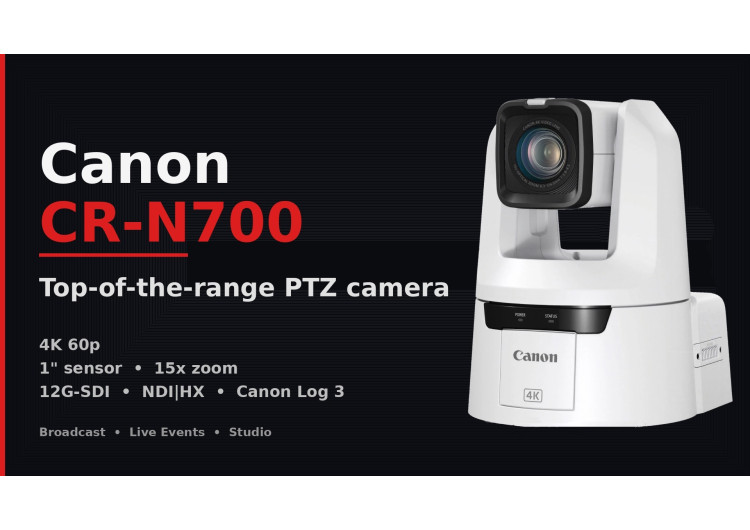
The Canon CR-N700 brings a 1-inch sensor, 15x Canon optics and 4K 60p over 12G-SDI and NDI|HX to demanding broadcast and live event rigs.
Among the remote-controlled cameras chasing broadcast-quality output, the Canon CR-N700 stands apart for one straightforward reason: it brings the imaging pedigree of Canon's cinema and EOS lines into a compact PTZ housing. For production studios already running EOS C-series or Cinema bodies, this matters in practical terms — colour matching against an existing fleet stops being a guessing game in post. Live event producers gain a fixed-position camera that handles low-light venues, high-contrast stage lighting, and 4K streaming without the compromises that smaller-sensor PTZs force on directors.
This piece walks through what the Canon CR-N700 actually delivers when integrated into demanding production environments — from the 1-inch sensor and DIGIC DV7 processor at its core, through Canon's professional optics and exposure controls, to the gamma profiles and connectivity options that determine whether a camera earns a slot in a multi-camera rig. The intent here is not a feature dump but a working operator's view of where each capability matters on a live shoot, in a control room, or inside a broadcast switcher.
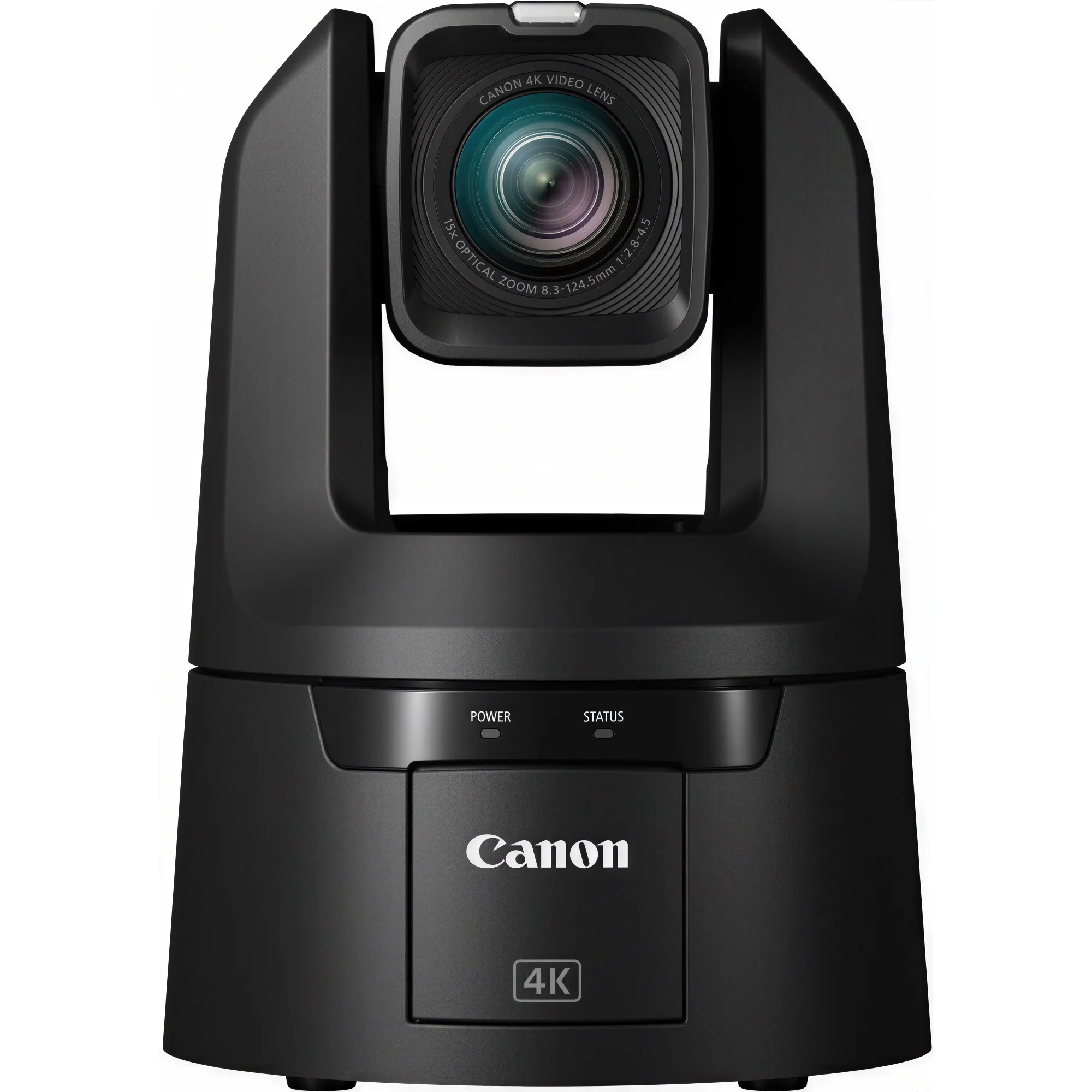
Large 1-inch sensor with DIGIC DV7
The CR-N700 carries a 1.0-type CMOS sensor, and the practical consequence for camera operators is what that surface area gives you in difficult lighting. Compared with the 1/2.3-inch or 1/2.5-inch chips that populate most mid-tier PTZ cameras, this sensor pulls roughly four times the light per pixel. Translated to the studio floor: cleaner footage at higher ISO, shallower depth of field when the look calls for separation between presenter and backdrop, and far less aggressive noise reduction grinding away facial texture in low-key segments.
The DIGIC DV7 processor is the same generation that drives Canon's Cinema EOS and recent EOS R bodies. Inside the Canon CR-N700, it handles 4K UHD at 59.94p and 50p with 4:2:2 10-bit colour sampling. The figure that matters to colourists is the 10-bit depth — 1024 luminance steps per channel rather than the 256 you get with 8-bit — which keeps gradient transitions in skin tones and gradual backgrounds smooth when you grade aggressively. House-of-worship operators streaming services with stained-glass backgrounds, sports producers tracking athletes against grass and stadium lights, corporate AV teams handling executive presentations under tungsten and LED mixed sources — all of them benefit from the extra headroom in highlights and shadows that this combination preserves.
Sensitivity climbs to ISO 25600 in standard mode, and there's a dedicated Night Mode that pushes further when the room goes dark. For event halls where lighting designers cut levels for moody segments, or houses of worship that dim everything during prayer, this matters more than a spec sheet implies. The sensor also drives Canon's full image stabilisation pipeline, which keeps long-focal-length shots steady when the camera is rigged on a truss or pole mount susceptible to building vibration.
Canon optics with 15x zoom
Canon builds the lens for the CR-N700 in-house, and that fact alone separates it from PTZ products that pair generic optics with a capable sensor. The zoom range covers 25.5 mm to 382.5 mm in 35 mm-equivalent terms — a 15x optical span — and Full HD acquisition extends that to 30x through Canon's extended-zoom function, which uses the sensor's pixel surplus rather than digital interpolation. In a corporate auditorium 30 metres deep, this is the difference between a usable single-camera coverage plan and rigging extra units to reach the back row.
The widest field of view sits around 70 degrees diagonal, generous enough for a two-shot at conversational distance without distorting facial geometry the way many ultra-wide PTZ optics do. Push the zoom toward the long end and you get genuine telephoto compression — useful for product close-ups in shopping channels, talent reaction shots in panel discussions, or following a soloist on a large stage from the FOH position. Maximum aperture moves from f/2.8 at the wide end to f/4.5 at full telephoto, which keeps the lens usable in venues without aggressive lighting plots.
Focus is handled by Canon's Dual Pixel CMOS AF, the same phase-detection-on-sensor system that put Canon ahead in autofocus performance across its hybrid lineup. With EOS iTR AF X layered on top, the camera recognises human heads and pupils, then maintains lock even when a subject turns away from camera — a real benefit for unscripted television, conferences with roaming presenters, and worship services where pastors move freely. Auto-tracking on the CR-N700 lets a single operator manage multiple cameras during live events, freeing camera operators from holding focus pulls manually.
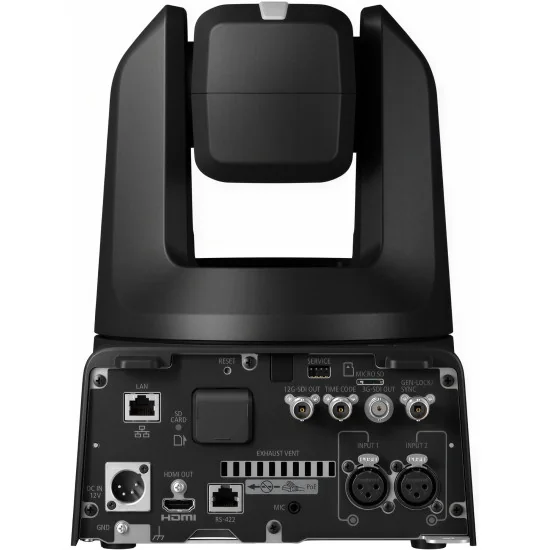
Built-in ND filters
Built-in motorised ND filtration is the kind of feature that separates broadcast-grade cameras from prosumer hardware, and the CR-N700 carries three density steps plus a clear position. Options run Off, 1/4, 1/16, and 1/64 — a two-stop, four-stop, and six-stop reduction respectively. Why this matters on a live shoot comes down to keeping the aperture in its optical sweet spot regardless of conditions. A camera permanently stopped down to f/16 to handle bright stage washes will exhibit diffraction softening; a camera forced wide open in the same scene loses depth control and risks blown highlights when the lighting cue spikes.
For outdoor work — broadcast booths covering daytime sports, corporate keynotes on open-air stages, news anchors reporting from sunlit locations — the ability to dial in ND remotely from a control panel saves the rig-and-strip ritual that affects bolted-on filter solutions. Switching ND positions on the Canon CR-N700 happens through the same control protocols that drive pan, tilt, and zoom, so the camera operator at the rack never needs physical access to the unit once it's mounted on a ceiling bracket or truss.
Worth noting: the ND mechanism is motor-driven and silent in operation. For services and ceremonies where audio capture matters, this absence of mechanical noise during exposure changes is a small but real win — competing solutions that rely on filter wheels with audible detents can creep into nearby microphone feeds in quiet venues.
Professional colour profiles including Canon Log 3, BT.709 and others
The gamma menu on the CR-N700 reads like a Cinema EOS spec sheet, and that's the point. Canon Log 3 is the headline option for productions intercutting with C300 Mark III, C500 Mark II, or C70 bodies — same logarithmic curve, same colour gamut handling, same LUT targets in the colourist's tool of choice. For a production company that already owns Canon cinema cameras, the Canon CR-N700 drops into the timeline without forcing a separate grading pass for the PTZ angles.
BT.709 is offered in multiple flavours — BT.709 Normal, BT.709 Wide DR, and BT.709 Standard — so engineers integrating the camera into a broadcast chain can match the gamma to whichever house standard the master control room enforces. Wide DR specifically extends dynamic range beyond conventional Rec.709 transfer characteristics, preserving highlight detail in environments where overexposure is a recurring problem: televised church services with bright lectern lighting, sports halls with sodium-vapour mixed sources, retail studios with fluorescent ceilings.
HDR delivery is supported through both HLG (Hybrid Log-Gamma) and PQ (Perceptual Quantizer). HLG is the broadcast standard for HDR transmission in much of Europe and Asia, used by BBC iPlayer, NHK, and similar broadcasters; PQ targets streaming distribution standards including Dolby Vision and HDR10. Carrying both means a single camera body covers UHD broadcast deliverables and HDR streaming pipelines without recalibration. Wide DR sits as a compromise option when an HDR pipeline isn't in place but the production still needs latitude for highlight roll-off.
Custom Picture functionality lets engineers save matched setups across multiple cameras, which is the realistic way to manage a three- or four-camera PTZ rig. Black gamma, knee, sharpness, and matrix coefficients all expose at the parameter level rather than hiding behind preset names. Shading correction handles vignetting at extreme zoom or tilt positions, useful when the camera shoots toward white backgrounds in product or fashion segments.
4:2:2 10-bit transmission
Colour sampling at 4:2:2 with 10-bit depth is the threshold below which a camera struggles to call itself broadcast-grade. The CR-N700 delivers this across its 12G-SDI output and over HDMI at 4K resolutions, which is the working specification for live switching environments where signals route through professional vision mixers and feed onward to encoder racks. Compared with the 4:2:0 8-bit pipeline typical of consumer-grade HDMI sources, the chroma resolution doubles and the tonal precision quadruples — graphics keying behaves predictably, green-screen extraction holds cleaner edges, and gradient backgrounds don't band when projected to large LED walls.
For live production teams running ATEM Constellation, Sony XVS, or Ross Carbonite switchers, this matters because the camera feed survives multiple downstream processes — keyer, DVE, format converter, encoder — without the cumulative damage that 8-bit signals show after three or four generations of processing. The Canon CR-N700 output stays clean through that chain, which is why broadcasters and high-end corporate AV companies choose 10-bit-capable cameras even when the final distribution is web streaming at 8-bit.
Internal recording isn't part of the brief here — this is a transmission-focused camera, not an acquisition tool with cards inside — but the network and SDI paths both carry full-spec 4:2:2 10-bit at frame rates up to 60p in UHD. Region of Interest cropping is a related capability: the camera can output a primary 4K stream alongside a cropped FHD region, effectively giving production a wide shot and a tight shot from a single unit. For lean operation teams running multi-camera coverage without proportional camera counts, this changes how you plan coverage.
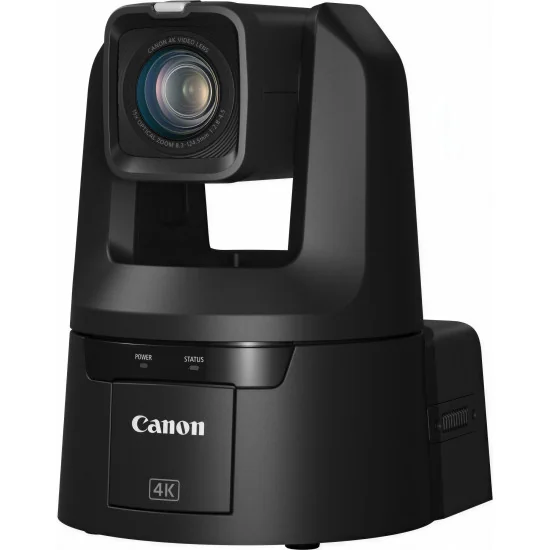
Connectors: 12G-SDI, HDMI, IP transmission, NDI at 4K 60p
The connectivity panel on the CR-N700 reflects current broadcast engineering reality: every signal path needs to coexist because no two installations run identical infrastructure. The 12G-SDI BNC handles full 4K 60p over a single coaxial cable up to roughly 80 metres on quality cable — the standard interface for broadcast routers and switchers in production trucks and master control. A 3G-SDI output is provided alongside for legacy paths and for backup feeds at 1080p.
HDMI 2.0 sits next to the SDI ports for installations using lower-cost converters or direct connections into encoder cards and computer-based switchers. GEN-LOCK input is wired for synchronising the camera to a house reference signal — essential in multi-camera switching environments where frame-accurate alignment between sources prevents glitches at cuts and dissolves. Without genlock, mixing sources causes the familiar one-frame stutter at every transition, and any engineer who has tried to switch live without it remembers the experience.
Network transmission is where the CR-N700 separates from older PTZ generations. NDI|HX handles low-bandwidth IP delivery for studio environments running NewTek TriCaster, Vizrt, vMix, or OBS-based productions over standard Ethernet. SRT carries the camera feed across unmanaged networks and the public internet with encryption and error correction, which matters when the remote operator is in a different city from the camera. RTMP and RTMPS handle direct streaming to platforms including YouTube and Facebook Live, and RTP/RTSP cover IP-based broadcast and surveillance integrations.
FreeD protocol output is the spec that distinguishes the Canon CR-N700 in virtual production environments. The camera streams pan, tilt, zoom, and focus metadata in real time to virtual studio engines like Unreal Engine, Vizrt Reality, or Brainstorm InfinitySet. For broadcasters running augmented graphics — sports analysis, weather forecasts, news desks with composited backgrounds — this metadata feed lets the graphics engine track camera moves precisely, keeping virtual elements anchored as the camera pans across the set.
Power delivery via PoE++ (IEEE 802.3bt) lets a single CAT-6 cable carry both signal and power across the run, which simplifies cabling significantly on large installations. Worship spaces, lecture halls, council chambers — anywhere that running separate AC mains to ceiling-mounted cameras adds cost or compliance burden — benefit directly from single-cable installation. Dual XLR audio inputs handle microphone or line-level feeds with phantom power, embedded into the SDI and IP outputs alongside the video signal.
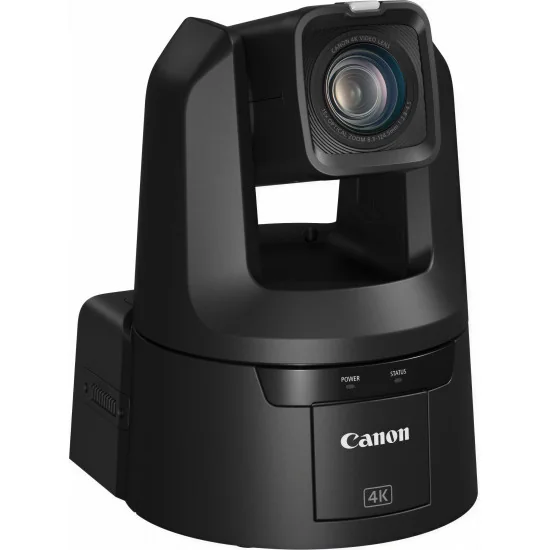
Control protocols round out the integration story. The camera responds to VISCA over IP, the most widely supported PTZ command set across joystick controllers, switchers, and automation software. Canon XC and Standard protocols cover Canon's own controllers — the RC-IP100 desktop unit and the larger RC-IP1000 broadcast-style panel — with full access to the camera's parameter set including custom picture, gamma, ND, and white balance. For installations standardising on third-party automation like Newtek Connect Spark, vMix, or Skaarhoj, the multi-protocol support means the CR-N700 doesn't lock a facility into Canon-only control.
Built-in tally LEDs respond to switcher commands automatically, which is the kind of small detail that broadcast engineers notice. Front and rear tallies illuminate independently — the front for on-air signalling visible to talent, the rear for camera operators monitoring the rack. The Canon CR-N700 in the satin black finish suits installations where the camera body itself needs to disappear against dark ceilings or stage backdrops; a satin white variant exists for venues with bright interiors where visual presence should match the architecture rather than fight it.
For production company owners evaluating a PTZ purchase from a business perspective, the calculation comes down to reliability, return on investment, and time savings. The CR-N700 reduces operator headcount on multi-camera shoots through auto-tracking and remote control, it integrates without protocol conversion into existing broadcast chains, and the Canon optics plus 1-inch sensor produce footage that matches owned EOS Cinema bodies. Service life and parts availability sit at the level expected of a major manufacturer's professional line, with firmware updates extending feature sets over the camera's deployment cycle.
Comments
No comment at this time!
Leave your comment