


Complete camera kit for podcasting
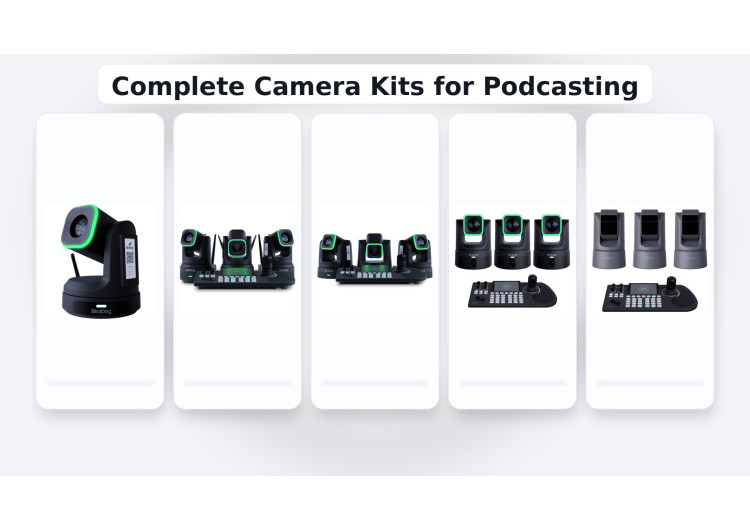
Equip your studio or event venue with a ready-to-use multi-camera PTZ system. Each BirdDog bundle pairs three matched cameras with a hardware controller.
PTZ cameras are the best choice for video podcasts
Pan-tilt-zoom cameras have fundamentally changed how modern content creators and broadcast professionals approach video production. Unlike static cameras that require multiple units to cover different angles, a single PTZ camera eliminates the need for camera operators during recording or livestreaming sessions. This capability proves invaluable whether you're running a solo podcast, managing a multi-camera conference setup, or coordinating a complex broadcast event.
The mechanical control systems in PTZ cameras allow operators to adjust framing in real time while content plays out. With preset positions stored in memory, you can program exact camera angles before recording begins—cutting to a wide shot for introductions, zooming in on speakers during Q&A, and returning to establish shots without missing a moment. This automation removes the friction that comes with manual camera adjustments and lets your production team focus on audio quality, guest management, and content flow.
Network integration through NDI (Network Device Interface) streaming has simplified how PTZ cameras connect to modern production pipelines. Instead of running separate video cables through your facility, cameras transmit over standard Ethernet, which means cleaner cable management, simpler equipment relocation, and the ability to control cameras from anywhere on your network. The simultaneous support for multiple protocols—HDMI, SDI, USB output—ensures compatibility whether you're working with legacy broadcast equipment or contemporary streaming infrastructure.
For podcasters specifically, PTZ technology delivers professional multi-angle production without hiring additional crew. One person managing the camera controller can maintain dynamic framing that keeps viewers engaged, while your host or production assistant handles other responsibilities. The thermal and electrical efficiency of modern PTZ units means they can run extended sessions without overheating, making them reliable for all-day conference coverage or marathon streaming events.
The sensor technology in contemporary PTZ cameras captures sufficient dynamic range and color fidelity to work in varying lighting conditions common to podcasting environments. Combined with built-in noise reduction and the ability to adjust exposure via network commands, these systems adapt to unpolished studio setups without requiring constant manual intervention. This adaptability extends the usable lifespan of your equipment as your production grows beyond your initial facility.
Set for streamers and YouTube channels – BirdDog X1 Bundle

The BirdDog X1 Bundle represents an entry point for streamers and YouTube channels transitioning from single-camera setups to multi-angle production. This bundle includes three cameras and a controller, enabling simultaneous capture from different vantage points or sequential switching during your broadcast. The 1/2.8" Sony CMOS sensor maintains strong signal-to-noise performance even in suboptimal lighting, which matters when you're streaming from unconventional spaces or during unpredictable daylight conditions.
At Full HD 1080p60 resolution, the X1 matches the streaming requirements of most YouTube channels and Twitch broadcasters. The 60 frames-per-second capture ensures smooth motion during camera pans and speaker movements, eliminating the stuttering or motion artifacts you'd experience with 30fps in dynamic content. For streamers with viewers on lower-bandwidth connections, 1080p60 provides sufficient quality without requiring excessive bitrate allocation, keeping your stream accessible to international audiences with varying internet speeds.
The 20x optical zoom with f/1.6 aperture at the wide end gives you substantial framing flexibility from a single camera position. When shooting a podcast set with multiple guests, you can establish a wide shot showing all participants, then zoom in during someone's speaking turn to capture emotional reactions and gestures. The constant f/1.6 brightness at wide focal length ensures that when you're zoomed out taking environmental shots, the image remains bright and detailed without requiring aggressive sensor gain that would introduce digital noise.
Power delivery through PoE (Power over Ethernet) with less than 15W consumption simplifies installation in temporary setups. You run a single Ethernet cable to each camera for both power and data, eliminating the need for separate power supplies and dedicated video cables. This capability proves especially valuable if you're streaming from a rented space or setting up a temporary studio—you can position cameras quickly without extensive infrastructure.
The included BirdDog KBD controller features a 5-inch touchscreen display and physical joystick for camera control. During your broadcast, one crew member monitors all three cameras simultaneously through the multiview interface, executing smooth pans and preset switches. The 10 preset buttons store your favorite framing positions—intro shot, guest close-up, screen capture view—so you can switch between setups with a single button press without fumbling with joystick movements.
The 2.93-inch E-Ink display mounted on each camera provides live monitoring feedback. During setup, you can walk to each camera position and see its framing in real time, making focus adjustments and composition refinements before recording begins. This feature eliminates the guesswork of positioning cameras blindly and helps you verify that your shot selection actually captures what you intend.
Integration with standard streaming software happens through HDMI output or USB webcam mode. The HDMI connection works with traditional video capture cards and switchers, while USB output allows direct integration with software like OBS Studio on Windows or Mac without external capture hardware. This means you can start with a basic setup using USB connectivity, then scale to more complex processes later.
The 255 available presets and pan speed range from 0.1 to 80 degrees per second create possibilities for both slow, deliberate repositioning and rapid cuts between camera angles. For comedy podcasts where you want punchy transitions, you dial up the pan speed and execute snappy moves between speakers. For serious interview content, slower speeds at 5-10 degrees per second deliver smooth, professional motion that doesn't distract from the conversation.
Advanced kit for live events and conferences – BirdDog X4 Ultra Combo

The BirdDog X4 Ultra Combo escalates your production capability with 4K resolution and enhanced connectivity for live event coverage. Events present unique challenges: variable lighting across banquet halls and outdoor venues, the need to capture both wide environmental shots and tight speaker detail, and the requirement to produce broadcast-quality output simultaneously for multiple distribution channels. The X4 handles these demands through its larger sensor size and comprehensive output options.
The 1/1.8" UHD CMOS sensor represents a significant increase in light-gathering capacity compared to smaller sensors. In the context of a conference keynote stage with theatrical lighting, this larger sensor means you capture shadow detail in the moderator's facial expressions without losing highlight information on the screen behind them. The 4K60 output at 3840x2160 resolution provides future-proofing for event organizers archiving footage for educational platforms or creating high-resolution promotional materials.
The combination of 20x optical zoom plus 16x digital zoom reaches approximately 320x total magnification. In practical terms at a conference, you position one camera at the rear of a 500-seat hall, and the 20x optical zoom (without any digital enhancement) brings a speaker at the front stage to full-frame close-up. If you need even tighter framing—capturing a speaker's hand gestures or highlighting a specific detail on a presentation slide—the 16x digital zoom extends your reach while maintaining usable image quality.
The 60-degree wide field of view captures expansive room views that establish context. When you're switching between close-ups of individual speakers and wide shots of the entire panel, that wide FOV ensures your environment shots show meaningful detail rather than harsh framing that cuts off participants or misses important visual context.
Built-in AI auto-tracking represents a significant operational advantage during unscripted events. When a presenter moves across a stage or a panelist gestures emphatically, the camera automatically follows, maintaining framing throughout the action. For a small production team managing multiple cameras, this automation means one less task requiring manual attention during critical moments. You can focus on switching between angles rather than continuously adjusting each camera's position.
The X4 Ultra provides simultaneous NDI High Bandwidth and NDI|HX3 streaming over the same Ethernet connection. This dual-protocol support lets you send full-quality NDI feed to your main production control room while simultaneously transmitting a lighter NDI|HX3 stream for remote monitoring or secondary recording. Conference organizers managing both live-to-web streaming and on-site broadcast to multiple screens can leverage these separate feeds without running additional cables.
The 3G-SDI output maintains compatibility with existing broadcast infrastructure while the HDMI and USB-C options integrate with modern switchers and streaming encoders. This redundancy matters during important events—if one output pathway experiences issues, you maintain broadcast continuity through an alternative connection.
The built-in 9450mAh battery provides 4-6 hours of operation, offering contingency power during extended events when power sources prove difficult to access or when repositioning cameras temporarily. For cordless setups at outdoor conferences or events with complex electrical distribution, battery operation eliminates dependence on finding available power outlets.
The HALO tally system displays which camera is currently "hot" (broadcasting). During a multi-camera conference production, talent can glance at the camera and see immediately whether they're on air, helping them position themselves appropriately. This feedback loop refines camera work by eliminating the awkward moments where speakers aren't positioning themselves for active cameras.
Professional set for small TV stations and live production crews – BirdDog X5 Ultra Combo

The BirdDog X5 Ultra Combo addresses the requirements of small broadcast stations and independent production companies handling complex multicamera assignments. Beyond simply capturing video, these operations need comprehensive monitoring, confidence feeds for talent, and integration with studio infrastructure including prompter systems and remote production pipelines.
The Sony 4K60 sensor delivers the image quality standards expected in television production. For news broadcasts, sports coverage, and live events distributed through broadcast platforms, 4K resolution ensures that archival footage remains relevant across multiple distribution channels and future display technologies. The 20x optical zoom provides the framing flexibility required for dynamic camera work across studio productions, from tight presenter close-ups to wide shots capturing newsdesk geography.
The critical distinction of the X5 is its built-in NDI|HX decoder, which enables confidence monitoring and teleprompter integration directly within the camera. Talent using a teleprompter receives the confidence feed from the camera's decoder, creating a closed loop where the presenter can read lines while the camera displays their framing. This eliminates the need for separate confidence monitoring feeds and external decoder hardware, simplifying the technical chain and reducing latency that disrupts teleprompter operation.
12G-SDI output ensures compatibility with professional broadcast infrastructure that many stations still rely on for routing, recording, and distribution. The dual HDMI 2.0 outputs support simultaneous feeds to multiple monitoring locations or recording devices. A typical production setup might route one HDMI to a backup recording system while the 12G-SDI connects to the primary broadcast infrastructure, providing redundancy for critical programming.
The dual 2.983-inch E-Ink displays mounted on each camera provide extensive status information including camera identification, focus confirmation, frame rate, and active preset. During multicamera productions where multiple operators manage different cameras, these displays help each operator verify their camera is operating correctly and confirm settings without requiring constant communication with the production control room.
The 49mm filter ring accepts standard broadcast filters including neutral density and polarizer options. For outdoor live coverage, adding an ND filter reduces sensor exposure without closing the aperture, maintaining the optical characteristics of your shot while preventing overexposure in bright sunlight. Polarizers reduce reflections from glass surfaces and water, important when covering outdoor events reflected in windows or water features.
BirdDog X5 Ultra supports simultaneous Full NDI (SpeedHQ) plus NDI|HX3 transmission, allowing production teams to route full-quality uncompressed NDI internally while simultaneously offering compressed streams for remote monitoring and low-bandwidth distribution. For stations producing content for both broadcast distribution and web platforms, this simultaneous transmission eliminates the need to run separate camera feeds through different encoding pathways.
The Gigabit Ethernet connection with PoE+ power (802.3at standard) provides sufficient power delivery for extended operations. While portable Ethernet switches might deliver this power, the PoE+ specification ensures that wherever your network infrastructure reaches, the camera receives adequate power and bandwidth simultaneously.
The 5-year warranty reflects the confidence manufacturers place in equipment reliability. For television stations and production companies making purchasing decisions based on total cost of ownership, this extended coverage reduces capital expenditure uncertainty and provides budget predictability across multiple years of operation.
The included BirdDog KBD controller with its 4D joystick and preset management system supports up to 255 cameras, though most productions operate with 3-4 cameras simultaneously. The Super-Fine mode provides 10x joystick sensitivity for precise focus adjustments and minute position corrections, essential when framing participants in formal studio settings where exact positioning directly impacts lighting and composition.
Top-tier PTZ video quality for professional TV production – BirdDog XL Ultra Combo
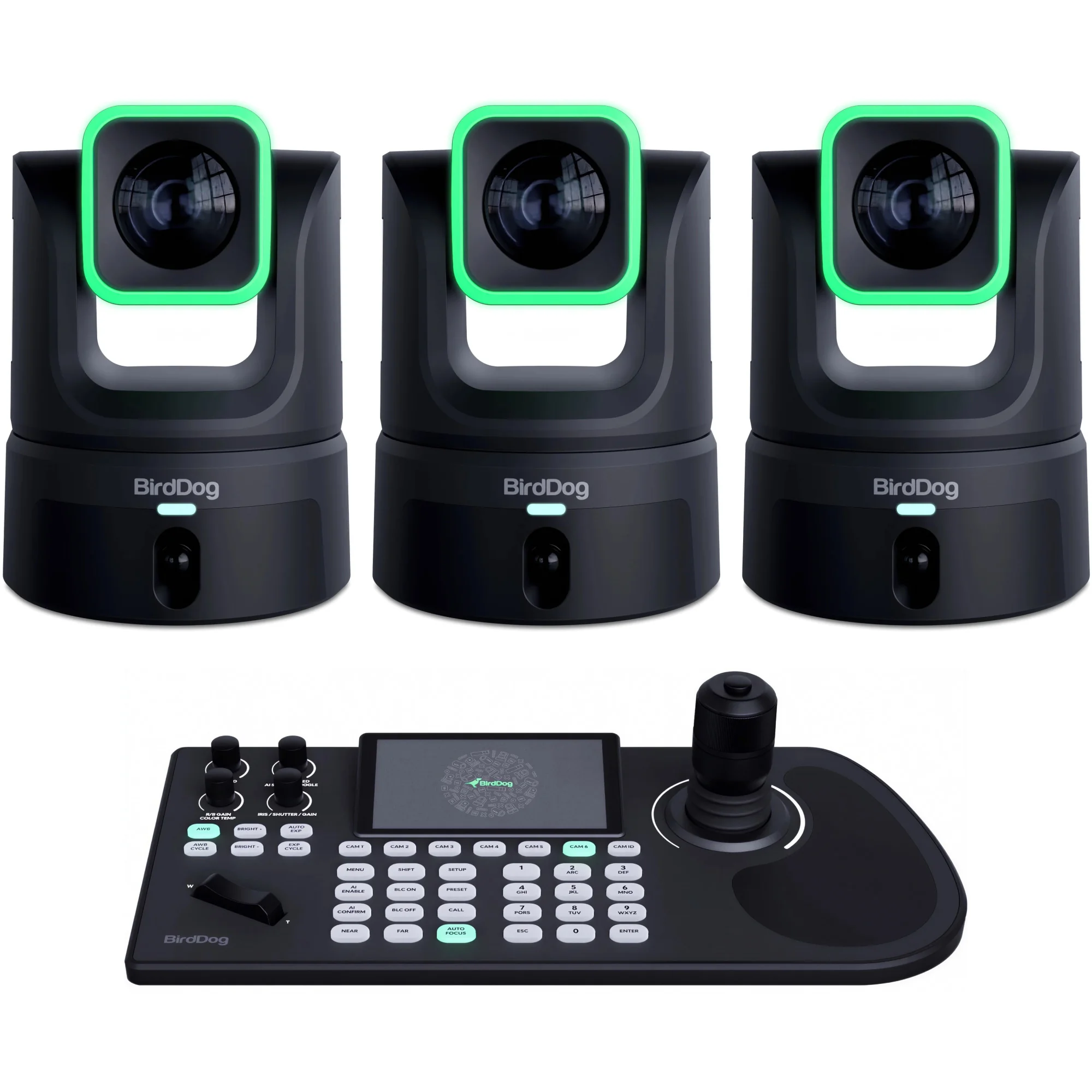
The BirdDog XL Ultra Combo represents the pinnacle of PTZ camera technology for professional television production environments. Rather than approaching camera design through incremental revisions, the XL redefines what PTZ systems accomplish through dual-sensor architecture, high-grade optical features, and broadcast-grade connectivity that accommodates fiber networks and complex routing requirements.
The large 4/3" CMOS sensor at 20.89 megapixels captures substantially more light than conventional PTZ cameras. In cinematography terms, this sensor size approaches the frame size of professional cinema cameras, enabling bokeh depth-of-field effects and shallow focus work impossible with smaller sensors. For television productions where lighting designers create specific visual moods through precise aperture and focus control, this sensor capacity provides the latitude required.
The 20x optical zoom extends to 40x magnification in HD mode, leveraging the sensor's 20.89MP resolution to digitally zoom while maintaining HD clarity. During a live sports broadcast, this capability lets you compose wide establishment shots showing stadium atmosphere, then zoom continuously to follow action without loss of detail. The optical zoom range covers everything from capturing an entire sports field to framing a specific player's expression.
Built-in optical low-pass filter combined with integrated neutral density filters addresses two distinct optical challenges. The low-pass filter prevents aliasing artifacts common to high-resolution sensors imaging fine details like mesh fabrics or distant trees. The integrated ND filters reduce exposure without sacrificing aperture control, critical for creative focus work where maintaining a specific aperture is more important than adjusting aperture to accommodate light changes.
The secondary 100-degree panoramic camera captures wide context simultaneously with your primary framing. In sports broadcasting, while the main camera frames a batter during a baseball pitch, the panoramic sensor captures the entire field, runners on base, and crowd context. This secondary feed provides backup framing and dynamic switching capability without requiring additional camera positions or operators.
The architecture delivers dual 4K60 simultaneous output streams, each of which can be independently routed through different output pathways. A sports broadcaster might use one 4K stream for archive and promotional content creation, while the second 4K stream feeds an internal monitoring network. Both streams operate simultaneously with independent control over which camera is assigned to each output.
12G-SDI primary output with dual 3G-SDI secondary outputs creates redundancy in broadcast infrastructure. Your main program routes through the 12G-SDI connection, while backup recording or alternative distribution pathways use the 3G-SDI connections. If one SDI router port experiences issues, you maintain continuity through alternative ports without interrupting your broadcast.
The SFP+ cage supporting fiber connectivity enables long-distance camera placement with minimal signal degradation. For large production complexes or outdoor sports venues, fiber connections eliminate the distance limitations of copper Ethernet, allowing camera deployment across areas that would be impractical with traditional networking infrastructure. Broadcast engineering teams benefit from fiber's immunity to electromagnetic interference, critical in environments with numerous wireless systems and RF equipment.
Simultaneous Full NDI (SpeedHQ) plus NDI|HX3 transmission ensures that modern IP-based production pipelines receive full-quality feeds alongside compressed streams for distribution and monitoring. The SRT/RTMP/RTSP protocol support accommodates diverse streaming architectures, from traditional RTMP ingest to newer SRT protocols that prioritize low-latency transmission.
The FreeD protocol integration supports virtual camera control systems and augmented reality processes. In sports broadcasting and live event coverage, FreeD data streams camera position and zoom information to graphics systems, automatically positioning virtual graphics and overlays that correspond to the camera's framing. The Genlock compatibility ensures frame-accurate synchronization when multiple cameras feed into broadcast infrastructure, eliminating sync drifts that cause technical artifacts.
AI tracking with neural processor provides sophisticated object recognition capabilities. Rather than simply tracking motion, the neural processor identifies specific subjects—a particular athlete, a specific vehicle, or a designated speaker—and maintains framing even as they move through complex backgrounds. For editorial processes where you want the camera to follow specific talent through unconstrained movement, this capability delivers broadcast results from a PTZ system.
The XL Ultra features ultra-quiet motors that minimize mechanical noise during operation. In audio-sensitive environments like news studios where ambient sound is carefully controlled, the reduced motor noise prevents pickup by sensitive microphones. The PoE++ power delivery (802.3bt standard) provides substantially higher power capacity than standard PoE, ensuring that all systems operate without power limitation regardless of environmental conditions or operational demands.
Balanced XLR audio input enables the camera to capture ambient sound synchronized with video. For documentary-style broadcasts or environmental coverage where ambient audio adds context, integrated audio eliminates the need for separate audio synchronization and provides broadcast-grade audio signal on the same cable pathway as video.
Specialized kit of professional outdoor PTZ cameras – BirdDog O4 Combo
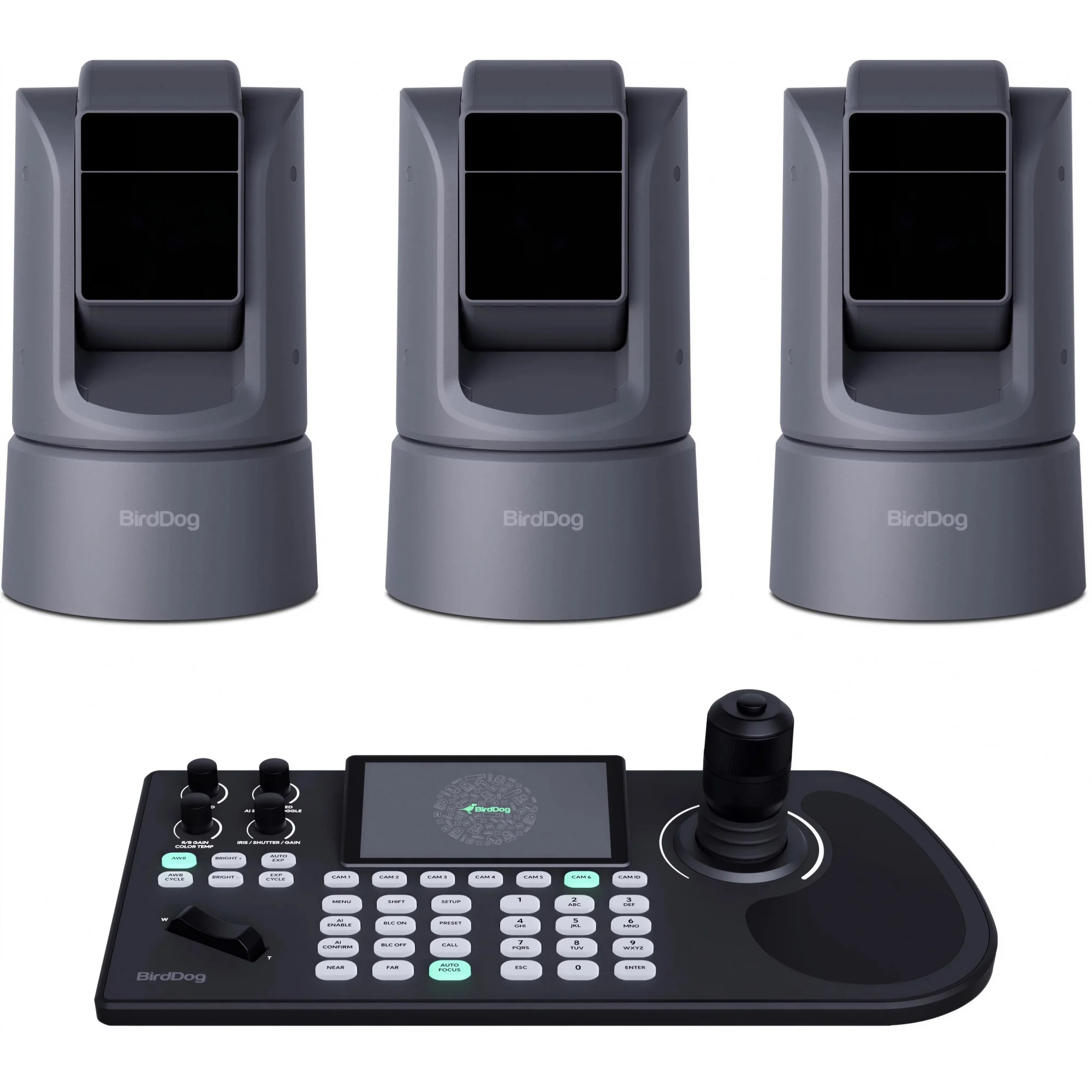
The BirdDog O4 Combo addresses the specialized requirements of outdoor broadcast and event coverage where environmental conditions determine equipment survival and operational viability. Conventional cameras built for controlled studio environments suffer equipment failure, image degradation, and operational interruptions when exposed to weather extremes, temperature fluctuations, and challenging lighting conditions. The O4 engineering specifically targets these outdoor challenges.
IP66 weatherproofing means the camera withstands direct water spray from any direction without compromising electrical safety or image quality. This specification covers heavy rain scenarios, spray from fountains or water features at outdoor events, and even pressure washing during maintenance. For outdoor sports venues, music festivals, and televised events happening in unpredictable weather, this environmental tolerance eliminates the need for protective housings that obscure optics and complicate mounting.
The operating range from -40°C to +60°C accommodates temperature extremes from arctic broadcasts to desert coverage. Conventional cameras rated for 15-30°C operation experience focus drift, electronic component failures, and LCD display malfunction outside this comfort zone. The O4's engineering ensures that a camera deployed in Canadian winter outdoor coverage or middle-eastern summer event filming maintains calibration and reliability without special environmental chambers.
The die-cast aluminium body provides structural rigidity while remaining significantly lighter than steel housings. For camera rigs that mount on stadium structures, outdoor broadcast vehicles, or portable crane systems, weight savings have direct operational impact—reducing total equipment weight means smaller support infrastructure, faster deployment, and lower power requirements for motorized mounting systems.
The 1/1.8" 8.4MP CMOS sensor with 4K60 resolution and HDR (High Dynamic Range) capture addresses the extreme lighting challenges of outdoor production. When a sunny sports field creates harsh shadows and bright highlights simultaneously, HDR processing captures detail across the entire brightness range. The REC.2020 color space ensures wide gamut color accuracy, maintaining color fidelity across broadcast distribution to displays with varying color reproduction characteristics.
30x optical zoom reaching 60x in HD mode provides the reach required for distant subject coverage. For outdoor sports events spanning large physical areas—a golf tournament, yacht racing, large outdoor amphitheater performances—the 30x zoom captures both wide environmental context and tight subject detail from single camera positions, reducing the need for multiple cameras to achieve complete coverage.
The 500-meter IR laser night vision dramatically extends operational capability into darkness. For 24-hour facility monitoring, security coverage, and outdoor events that extend beyond daylight, the laser illumination system projects infrared light that the camera's sensor detects, generating visible images in complete darkness. The 500-meter range covers large outdoor areas—parking facilities, perimeter security, amphitheater grounds—from single camera positions.
Integrated heater with anti-fog lens coating prevents the optical degradation that occurs when moisture condenses on the lens during temperature transitions. When a camera transitions from warm sheltered areas to cold night air, condensation forms on the lens, obscuring the image. The integrated heater warms the lens to prevent condensation, while the anti-fog coating provides secondary protection through hydrophobic surface treatment.
Anti-fouling lens coating resists organic buildup—pollen, dust, insect residue—that accumulates on outdoor optics. Combined with regular cleaning, this coating extends the intervals between maintenance, important for cameras in remote locations where frequent professional cleaning isn't practical.
The O4 delivers simultaneous 12G-SDI and NDI High Bandwidth plus NDI|HX3 output, accommodating both broadcast infrastructure and contemporary IP-based production pipelines. The SFP+ fiber connectivity supports remote camera deployment where fiber runs to outdoor venues, providing noise-immune signal transmission across long distances without the bandwidth limitations of copper ethernet.
AI tracking with adjustable motion profiles enables sophisticated subject following in outdoor environments. A sports broadcaster can configure the camera to track a specific athlete, automatically adjusting framing as the athlete moves across the field. The adjustable profiles accommodate different movement speeds and patterns—rapid directional changes for soccer, steady movement for golf, explosive bursts for baseball—optimizing tracking behavior for specific sports and event types.
255 preset positions combined with reliable pan/tilt positioning ensure accurate camera moves across extended outdoor coverage sessions. Even after hours of operation in temperature-varying conditions, preset accuracy remains consistent, critical for sports productions and event coverage where camera positioning consistency directly impacts audience experience.
The PoE++ power delivery provides the substantial electrical current required for outdoor operation including IR illumination, heating systems, and motor functions. Even when environmental conditions demand maximum power consumption—infrared night vision, active heating during cold weather, rapid pan speeds—the PoE++ specification ensures the camera receives adequate power without voltage sag that degrades performance.
The grey finish, distinct from the black models in other bundles, provides practical benefits for outdoor deployment. The lighter color reflects solar heat differently than black finishes, potentially reducing internal temperature buildup and extending operational stability during extended outdoor use. Professional broadcasters often specify the O4 specifically for permanent outdoor installations where thermal management directly impacts equipment longevity.
Comments
No comment at this time!
Leave your comment