


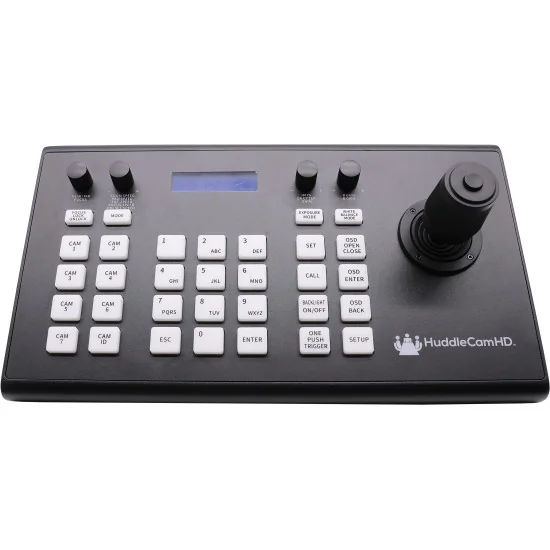
HuddlecamHD PTZ Joystick HC-JOY-G4 | PTZ Camera Controller, Visca, Pelco-P & D, RS Serial
€319.00
Level up your broadcast with the HuddleCamHD PTZ Joystick HC-JOY-G4, a controller for live productions. Enjoy three-axis joystick control for...
Filter By
Interface
Interface
Control protocol for PTZ cameras
Control protocol for PTZ cameras
Command multiple PTZ cameras from a single control surface. Professional joystick controllers, dedicated panels, and universal protocols like VISCA over IP and NDI for live production and streaming.
Active filters
Camera control represents one of the most critical operational layers in live production environments. Whether you are managing multiple PTZ camera rigs in a broadcast studio, orchestrating NDI streams across a networked facility, or directing coverage from a compact remote production truck, the quality of your control interface directly affects both the precision of your shots and the responsiveness of your direction.
A capable joystick controller is not merely a peripheral device — it is the command centre through which directors, technical operators, and camera controllers translate their creative vision into real-time camera movement and parameter adjustment. Modern controllers must handle multiple simultaneous functions: pan and tilt operations, focus and iris adjustment, white balance compensation, and sometimes entire scene recall sequences, all while maintaining the tactile responsiveness that professionals demand.
Dedicated PTZ camera controllers form the backbone of most professional live production setups. These units combine hardware ergonomics with intelligent protocol support, allowing operators to command multiple camera types from a single control surface. The joystick itself — whether four-axis or three-axis — must provide proportional movement that matches the operator's intention without lag or dead zones. Pressure-sensitive controls offer another layer of precision, enabling subtle focus adjustments or rapid iris changes depending on how the operator engages the mechanism.
PTZOptics has established significant presence in this segment with models like the PT-JOY-G4, a joystick controller supporting both VISCA over IP and traditional RS-232 serial protocols. This unit accommodates up to 255 cameras, features PoE power delivery (802.3af), and includes 9 quick-call preset buttons with capacity for 255 total camera positions. Its SuperPresets trigger synchronised moves across up to eight cameras from a single button press — a genuinely useful feature during multi-camera live events where timing between shots must be precise. The SuperJoy variant adds an LCD display and multi-brand compatibility, recognising that modern facilities often operate heterogeneous camera ecosystems mixing PTZOptics, Sony, and third-party systems.
AVMATRIX addresses similar operational needs through the PKC3000, which supports VISCA, VISCA-over-IP, ONVIF, and Pelco P/D protocols. With a 2.2-inch LCD screen and 4D joystick housed in a metal chassis, this controller manages up to 255 IP cameras. The PKC4000 steps up to a 5-inch touchscreen interface — 340 mm wide, weighing 1730 g — managing up to 100 cameras through 10 grouped presets. For facilities requiring NDI|HX integration alongside traditional protocols, the PKC4000-NDI provides real-time monitor feeds on the touchscreen, bringing camera preview and control into one surface.
Datavideo targets smaller-scale operations and dedicated camera chains with the RMC-180 Mark II, a compact RS-422 controller for up to four Datavideo PTZ cameras. Measuring just 310 mm across and incorporating a monochrome LCD with tally LED support for studio integration, it connects through four RJ-45 ports. The preset memory enables swift scene changes during live events — four positions per camera, or eight when only two cameras are connected.
Lumens occupies the compact end of the PTZ controller spectrum. The VS-K20 weighs merely 500 grams, operates on 12V DC power under 2 watts, and controls up to seven cameras via VISCA or Pelco-D protocols. Its OLED display and PIN protection system suit boutique studios and mobile production rigs where weight and footprint matter considerably. For installations requiring IP connectivity, the VS-KB21 offers a 3.5-inch LCD with stream preview, PoE power, and support for up to 255 camera positions — while the VS-KB21N variant adds native NDI support. The VS-KB30 rounds out the range with four-axis joystick control, a zoom seesaw lever, and simultaneous VISCA, VISCA over IP, Pelco P/D, and NDI|HX operation.
Universal controllers operate across protocol boundaries, translating operator input into commands compatible with cameras and systems from multiple manufacturers. This solves a genuine operational problem: production facilities rarely standardise on a single vendor's entire ecosystem. A universal controller accommodates that reality, functioning as a translation layer between human intent and heterogeneous hardware.
The PTZOptics SuperJoy exemplifies this approach. Its support for VISCA, VISCA-over-IP, Pelco-P, Pelco-D, NDI, Panasonic HTTP, and WebSockets means a single operator console can command HuddleCamHD cameras, Sony systems, BirdDog units, and PTZOptics rigs without protocol translation software. The pressure-sensitive dials and LCD interface provide consistent tactile feedback regardless of the underlying hardware — a significant factor in reducing operator fatigue during extended broadcasts.
Bolin Technology's KBD-1020N similarly bridges protocol divides, supporting VISCA, VISCA over IP, ONVIF, Pelco P/D, and NDI simultaneously. With dedicated knobs for iris, shutter speed, and focus, plus a three-axis joystick, this controller accommodates 14 cameras via serial and 255 via IP networks. PoE power at 802.3at specification and 12V DC backup ensure robust power delivery in complex production environments.
Telycam's V-Joy+ AT introduces another universal approach, incorporating auto-tracking integration alongside protocol support for NDI|HX, VISCA over IP, serial VISCA, ONVIF, and Pelco protocols. Its dual replay modes and four memory slots for PTZ motion sequences enable operators to recall complex camera choreography with single-button activation. The OLED display and RS232/422/485 connectivity address both modern network-based facilities and legacy serial-dependent studios.
The operational advantage of universal controllers extends beyond mere protocol compatibility. When a broadcaster integrates cameras from AVMATRIX, Blackmagic Design, and Lumens on the same production infrastructure, training operators on multiple control interfaces becomes unnecessary. A single universal controller establishes consistent operational patterns, reducing onboarding time and error rates during high-pressure live events.
Certain production scenarios demand specialised control surfaces optimised for specific hardware or signal architectures. These dedicated controllers sacrifice breadth of compatibility for depth of integration, offering features directly tailored to particular camera systems or switcher environments.
Marshall's CV-RCP-V2 exemplifies this specialisation. Built around a five-inch touchscreen (800 x 480 resolution) in an aluminium housing, it manages up to seven cameras via three-pin XLR connections over distances up to 305 metres. Its parameter adjustment capabilities — white balance, gain, gamma, black level, brightness, iris, and shutter control — make it a comprehensive camera control unit rather than merely a positional controller. At 12V and under 12W consumption, it remains energy-efficient enough for battery-powered field deployment.
The ATEM Camera Control Panel from Blackmagic Design represents another specialist approach. With four built-in CCUs and broadcast-style joysticks, this unit directly controls URSA Mini, URSA Broadcast, Studio, and Micro Studio cameras. Its control over iris, shutter speed, white balance, gain, pedestal, and full RGB adjustment for broadcast colour correction makes it substantially more than a position controller — it is an integrated camera control solution. The metal chassis and Ethernet loop-through architecture suit permanent infrastructure installations where multiple panels daisy-chain across a facility.
The KUMO CP from AJA serves entirely different operational needs, functioning as a 1RU control panel for SDI router matrices rather than cameras themselves. With 40 buttons, support for 32-input / 32-output configurations, and eight salvo presets, it addresses the core problem of signal routing in broadcast facilities. Its ability to handle ganged dual and quad port routing for 4K and UHD signals — through grouped 3G-SDI connections — makes it essential for modern high-resolution production chains.
BirdDog's MAKI Studio Control Surface takes yet another specialised route, operating as a Bluetooth-connected hardware panel for the MAKI Live camera ecosystem. It combines six programme/preview buttons, a T-bar, ten transition shortcut keys, and four audio preset keys on a compact surface that works alongside iPad-based switching interfaces. With support for up to 10 live inputs via NDI|HX and full bandwidth NDI, it occupies a distinct niche in modern network-based production architectures.
Modern controllers must navigate a landscape of competing and complementary protocols. Understanding these technical foundations determines which controller will function in your specific facility architecture.
VISCA — the Video System Control Architecture protocol developed by Sony — originated as a serial communication standard and remains the most widely implemented protocol in PTZ camera control. Its simplicity and broad adoption mean virtually every professional controller supports VISCA in either serial or IP variant. VISCA over IP extends this serial protocol across network infrastructure, packaging serial commands into IP packets. This makes it suitable for networked facilities while maintaining backward compatibility with serial-based camera systems. Controllers like the PTZOptics PT-JOY-G4 and the Lumens VS-KB21 demonstrate this dual-protocol approach, operating serial VISCA and VISCA-over-IP simultaneously.
NDI — Network Device Interface — represents a fundamentally different architectural philosophy. Rather than treating the network as mere transport for point-to-point control signals, NDI integrates video, audio, and control metadata into a unified IP stream. Controllers supporting NDI|HX or full-bandwidth NDI can simultaneously display camera preview video alongside control interfaces, providing operators with immediate visual feedback. The AVMATRIX PKC4000-NDI exemplifies this integration, its five-inch touchscreen displaying real-time camera feeds while accepting control inputs. The PTZOptics SuperJoy and Bolin Technology KBD-1020N similarly incorporate NDI support, recognising that modern production facilities increasingly adopt NDI-based infrastructure.
ONVIF — Open Network Video Interface Forum — establishes a standardised framework for IP-based video surveillance and control systems. While less common in broadcast production than in security applications, ONVIF compliance ensures compatibility with a wide range of IP cameras and integrates smoothly into facilities already managing networked video infrastructure. The AVMATRIX PKC3000 and Bolin Technology KBD-1020N include ONVIF support, bridging broadcast production and professional video networks.
Pelco-D and Pelco-P represent proprietary serial protocols that retain significant presence despite VISCA's dominance. Pelco-D operates as a binary protocol while Pelco-P uses ASCII formatting. Controllers maintaining dual Pelco support, such as the Lumens VS-K20, accommodate installations where Pelco-based cameras remain in service. RS-232 and RS-422 physical connections — serial standards providing single-pair and multi-pair differential transmission respectively — remain the mechanical foundation for these protocols. Datavideo's RMC-180 Mark II and numerous universal controllers maintain RS-422 connectivity for facilities with extensive serial camera infrastructure.
Power delivery protocols matter equally in controller selection. Power over Ethernet (PoE) at various specifications — 802.3af delivering 15W, 802.3at delivering 30W — reduces cabling complexity in networked facilities. Controllers accepting PoE simplify installation in conference rooms and distributed production spaces, while 12V DC backup options provide operational continuity during temporary installations or in facilities with mixed power infrastructure.
Selecting appropriate controllers requires honest assessment of your facility's current infrastructure and realistic planning for evolution. A controller supporting legacy serial protocols alongside modern IP and NDI frameworks accommodates both existing equipment and future expansion, reducing the likelihood of obsolescence as your production capabilities mature.
check_circle
check_circle