


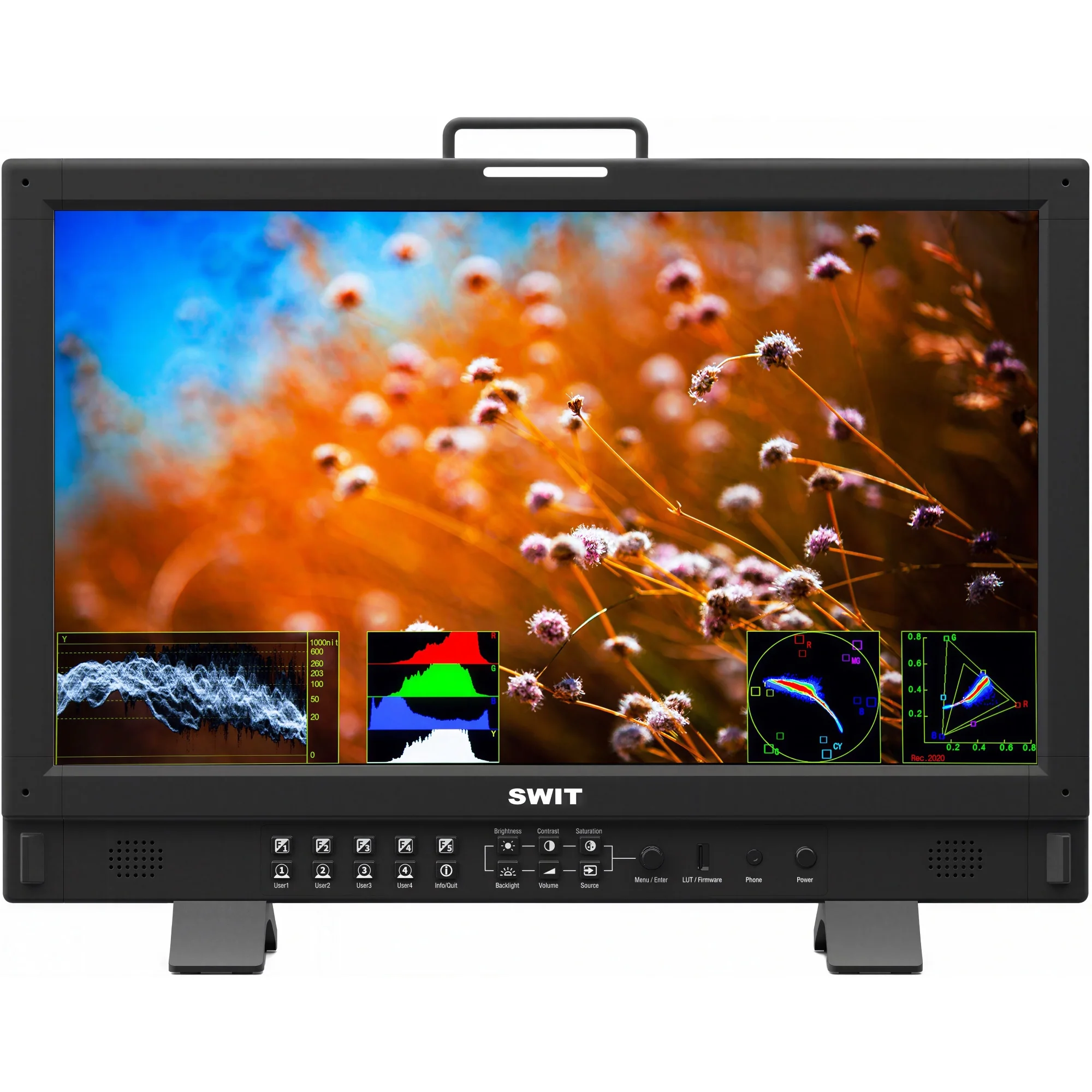
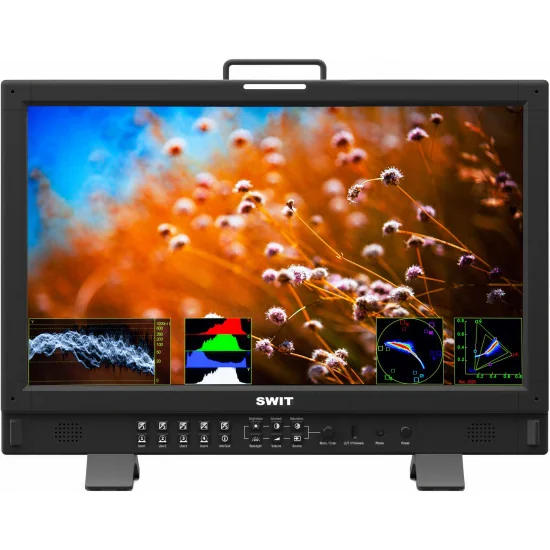
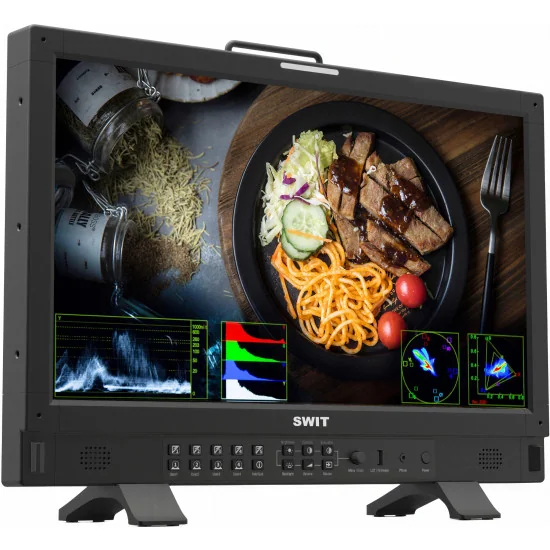
Four quadrants, one camera feed, four different transfer curves. The SWIT BM-H215HDR can mirror a single input into a quad split and give each quadrant its own EOTF and colour gamut, so an HLG image, a PQ version and a Rec.709 SDR rendition of the same shot appear together on one 21.5-inch screen. Productions mastering in HDR while feeding an SDR simulcast get that comparison without a second reference display in the gallery.
The picture comes from a Full HD QLED panel with a 1000-nit backlight, 1000:1 contrast, 178° viewing angles horizontally and vertically, and 100% DCI-P3 coverage. Bit depth is 10-bit (8-bit + FRC), and the signal chain runs at 18-bit internally. SWIT places a quantum-dot film between the LCD and the LED backlight; it narrows the blue peak and evens out the red, green and blue primaries, which earned the panel a VICO visual-comfort score of 1.97, Class A. Over a long live shift, that translates into less eye strain.
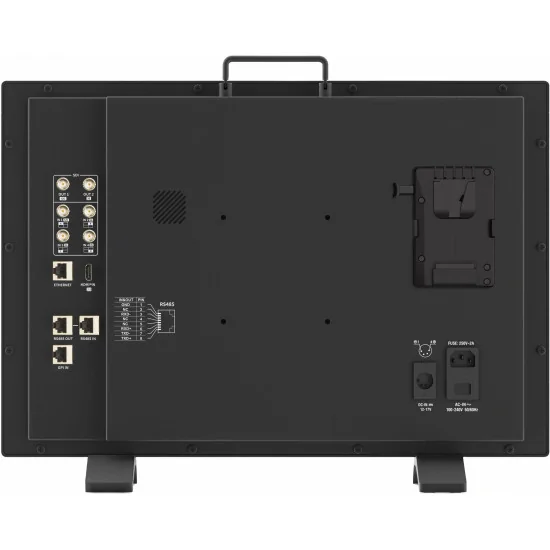
Every input is 4K-ready, even though the panel itself is 1920×1080. SDI 1 accepts 12G-SDI single-link signals up to 4096×2160 at 60p, SDI 2 to 4 take 3G-SDI, and all four BNC connectors can be read together as quad link 4K in square-division (SQD) or 2SI mapping. HDMI 2.0 also reaches 4K60, although HDCP-protected material is not displayed – worth knowing before connecting a laptop that plays protected content. Two loop outputs, 12G on SDI 1 and 3G on SDI 2, pass the camera signal on to a switcher, a recorder or a second screen.
Checking focus from a UHD camera on a Full HD screen is handled in two ways. Pixel-to-pixel scanning maps the 4K image 1:1, so the operator sees a native-resolution crop, and the zoom function splits the picture into nine areas that can be stepped through one by one.
We ship across the EU for €20, free over €1,000.
B2B sales only, prices excl. VAT.
Official EU distribution and warranty.
Secure online payments via Stripe.
Send your enquiry via the form or email avgear@avgear.shop
In multiview, the monitor shows four independent sources with SDI and HDMI mixed, or switches to side-by-side (PBP) and inset (PIP) layouts, the inset sitting in any of five positions. Each tile keeps its own range, gamut, gamma, UMD and Payload ID setting, which turns a single unit into a compact preview wall for a flypack, a small OB unit or a streaming desk.
HDR work leans directly on that 1000-nit backlight: HLG, PQ and S-Log3 curves sit alongside SDR gamma 1.0, 1.8, 2.2, 2.4 and 2.6, gamut can be set to the panel's own, Rec.709, DCI-P3 or Rec.2020, and HLG system gamma has its own adjustment. On SDI, Payload ID detection reads the stream metadata, and curve, gamut, quantisation range, colour space and depth then follow the incoming signal, so a camera swap between segments does not leave the screen on the wrong curve.
For log acquisition, preloaded log conversion LUTs cover RedLogFilm, Log-C, C-Log, V-Log, J-Log1, S-Log2 and S-Log3, each mapped to HLG 1000, PQ 1000 or Rec.709. A DIT can also bring the project look on a USB stick as a 17×17×17 .cube file and apply it on set, so the director and the client judge the intended grade instead of flat log.
Colour accuracy stays an in-house matter. SWIT's 3D LUT auto-calibration software runs inside the monitor itself. With an X-Rite i1 Pro (SWIT OEM build) or a JETI specbos 1211 connected at the front USB socket, the screen displays test colours, reads them back and builds its own correction LUT. SWIT's timings are about 15 min for an i1 pass and about 45 min for a specbos pass, ending at ΔE ≤ 1.0; the manual asks for a 30-minute warm-up in a darkened room first. A separate Measure routine checks the current state in around 30 seconds against the previous calibration, so a rental house or multi-room facility knows when recalibration is really due.
The analysis toolset is generous for a 21.5-inch unit. Waveform in Y, Cb, Cr, R, G or B with a single-line view sits next to a vectorscope able to overlay the BT.709, P3 and BT.2020 gamut boundaries, an R/G/B/Y histogram, two-colour focus assist, false colour and zebra.
Blue-only, H/V delay, freeze frame and SDI timecode (LTC and VITC) cover the engineering side, and framing markers run from 4:3 to 2.39:1 with two user-defined options. On SDI 1, an eye pattern displays the signal margin of a 12G link, so an overlong cable run or a worn connector is found while rigging rather than during the broadcast.
With zero-latency mode engaged, picture delay stays below 1/100 of a frame, which keeps sound and image aligned when the monitor sits beside a live switcher. Zoom and odd/even field selection are disabled in that mode. Audio meters show up to 16 embedded SDI channels; pick any pair for monitoring on the internal speaker or a 3.5 mm headphone jack. Lissajous figures and a 5.1/7.1 surround phase view help catch reversed polarity.
Gallery integration follows broadcast habits. TSL 3.1/4.0 UMD arrives over RS-485 and loops on to the next monitor. Six GPI pins can each be assigned to tally in red, green or yellow, displayed on screen and on the front lamp, or to tools such as waveform and false colour. F1 to F5 keys, four user presets and a key lock keep settings consistent between operators. Through the gigabit Ethernet port, a web control panel opens in any browser and adjusts inputs, picture and function keys with no software to install, and firmware files load from a USB drive.
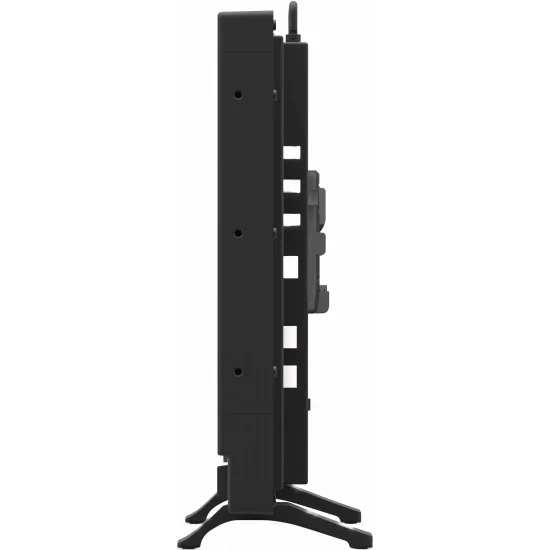
The SWIT BM-H215HDR draws up to 60 W from AC 100–240 V or from 12–17 V DC on a 4-pin XLR, and a V-mount plate is fitted at the rear (Gold Mount optional) for location work away from mains. Two desk stands are supplied, a VESA area on the back accepts arms and wall brackets, and the unit is specified for operation from 0 to 50 °C.
This 21.5-inch HDR monitor fits a vision-control position in a TV studio, a DIT cart on a drama set, the multiview desk of a concert or esports production, a corporate streaming control room or a client screen beside a grading suite. Putting HDR comparison, multiview and engineering-grade measurement into one housing means fewer devices to rig, power and transport on every job.
| Model | BM-H215HDR |
|---|---|
| LCD Performance | |
| Size | 21.5 inches |
| Display area | 476×268mm |
| Resolution | 1920×1080 |
| Aspect ratio | 16:9 |
| Brightness | 1000nits |
| Contrast | 1000:1 |
| Color depth | 10-bit |
| Signal process | 18-bit |
| Viewing angle | 178°(H) /178°(V) |
| Input | |
| BNC ×1 | 12G/6G/3G/HD/SD-SDI input |
| BNC ×3 | 3G/HD/SD-SDI input |
| HDMI® ×1 | HDMI® 2.0 input |
| RS485 ×1 | TSL 3.1/4.0 UMD input |
| RS485 ×1 | GPI (Tally) input |
| RJ45 ×1 | 1000M Ethernet input for Webserver IP control |
| Output | |
| BNC ×1 | 12G/6G/3G/HD/SD-SDI loop output |
| BNC×1 | 3G/HD/SD-SDI loop output |
| RS485 ×1 | TSL 3.1/4.0 UMD output |
| Analog audio | 3.5mm headphone and speaker |
| Video Format | |
| SDI 1 | 4096×2160p (60 / 59.94 / 50 / 30 / 29.97 / 25 / 24 / 23.98) 3840×2160p (60 / 59.94 / 50 / 30 / 29.97 / 25 / 24 / 23.98) 2048×1080p (60 / 59.94 / 50 / 30 / 29.97 / 25 / 24 / 23.98) 2048×1080i (50 / 59.94 / 60) 1080p (60 / 59.94 / 50 / 30 / 29.97 / 25 / 24 / 23.98) 1080i (60 / 59.94 / 50) 1080psf (30 / 29.97 / 25 / 24 / 23.98) 720p (60 / 59.94 / 50) 480i (59.94), 576I (50) |
| SDI 2/3/4 | 2048×1080p (60 / 59.94 / 50 / 30 / 29.97 / 25 / 24 / 23.98) 1080p (60 / 59.94 / 50 / 30 / 29.97 / 25 / 24 / 23.98) 1080i (60 / 59.94 / 50) 1080psf (30 / 29.97 / 25 / 24 / 23.98) 720p (60 / 59.94 / 50) 480i (59.94), 576I (50) |
| Quad Link 4K (Each channel) | 2048×1080p (60 / 59.94 / 50 / 30 / 29.97 / 25 / 24 / 23.98) 1080p (60 / 59.94 / 50 / 30 / 29.97 / 25 / 24 / 23.98) |
| HDMI® | 4096×2160p (60 / 59.94 / 50 / 30 / 29.97 / 25 / 24 / 23.98) 3840×2160p (60 / 59.94 / 50 / 30 / 29.97 / 25 / 24 / 23.98) 1080p (60 / 59.94 / 50 / 30 / 29.97 / 25 / 24 / 23.98) 1080i (60 / 59.94 / 50) 720p (60 / 59.94 / 50) |
| General | |
| Input voltage | DC 12V-17V, AC 100-240V, 50/60Hz |
| Power consumption | 60W |
| Working temperature | 0°C~+50°C |
| Working humidity | 10%~90% |
| Storage temperature | -15°C~+60°C |
| Storage humidity | 10%~90% |
| Net weight(without packaging) | 6.52kg |
| Product dimensions(without packaging) | 531×364×67mm |
| Gross weight(with packaging) | 9.4kg |
| Package dimensions | 640×170×500mm |

Data sheet
Specific References