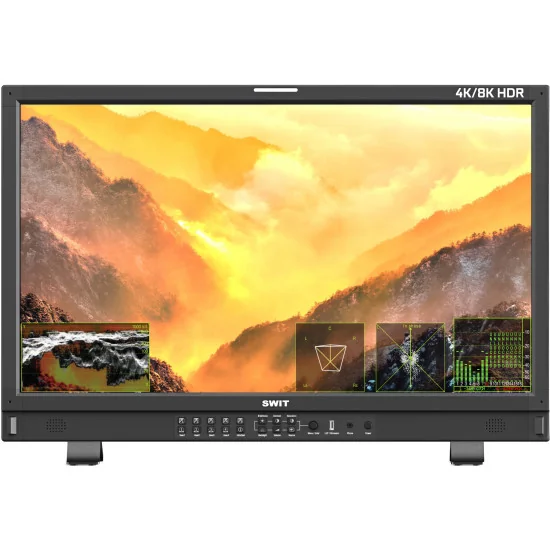
- New
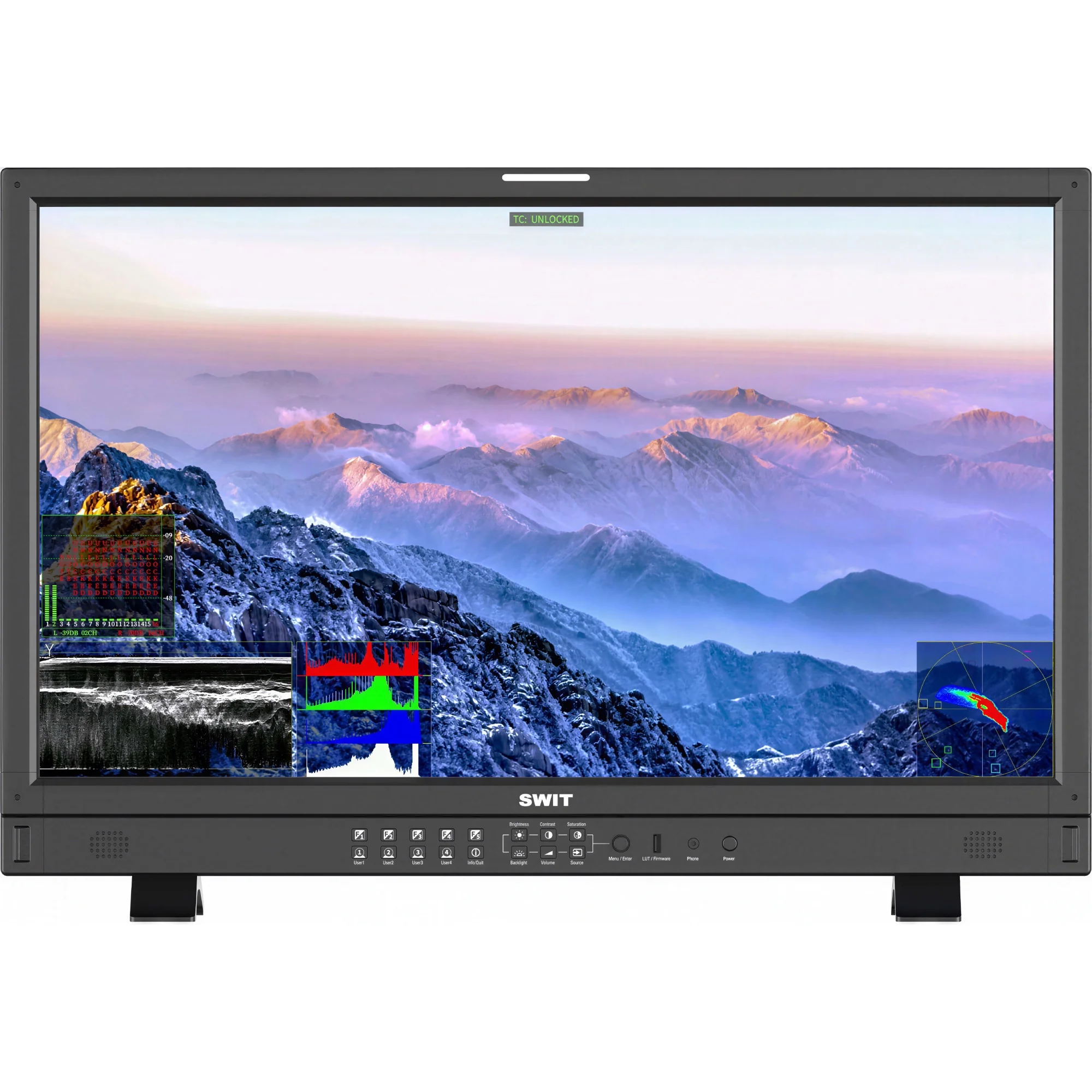
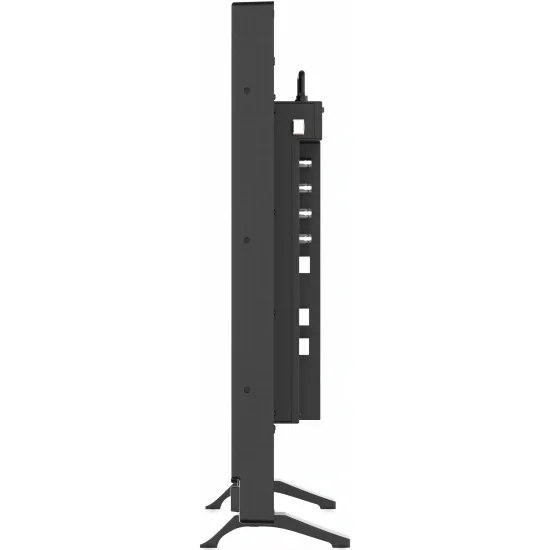
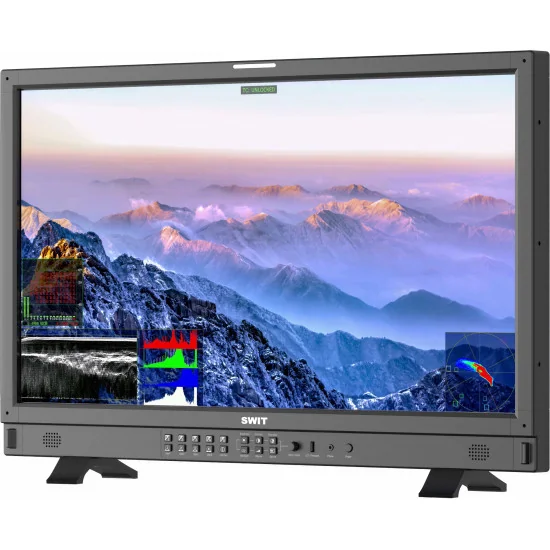
Three hundred nits and a native 3000:1 contrast ratio tell you where the SWIT BM-U325 belongs: on the desk or wall of a facility that delivers SDR programme output and still has to accept every format its router carries, from 576i archive tape to quad-link 8K. The 31.5-inch 10-bit UHD panel resolves 1.07 billion colours, the signal path runs at 18 bits, and the picture stays consistent out to 178° in both planes – which matters when a vision engineer, a director and a client share one screen from three different chairs.
Colour coverage reaches 100% of Rec.709, 99.4% of DCI-P3 and 71.3% of Rec.2020. You pick the target per input – panel native, BT.709, DCI-P3 or BT.2020 – along with gamma 1.0, 1.8, 2.2, 2.4 or 2.6. Where the source carries SMPTE Payload ID, the monitor reads it and sets transfer curve, gamut, range, colour space and bit depth by itself. A gallery router can cut from a P3 film playout to a Rec.709 studio camera, and nobody has to touch a menu.
HLG, PQ and S-Log3 are on board as well, and it is worth being straight about what that means at 300 nits. This panel will not show you how a 1,000-nit specular highlight lands; that job belongs to the BM-U325HDR or the Mini-LED BM-U325MD. What it does very well is prove that an HDR feed is flagged and mapped correctly – and, through multi-gamut and EOTF viewing, copy one input into four windows with different settings. BT.2020 HLG beside BT.709 gamma 2.4 lets a shading position watch the SDR simulcast of an HDR production live.
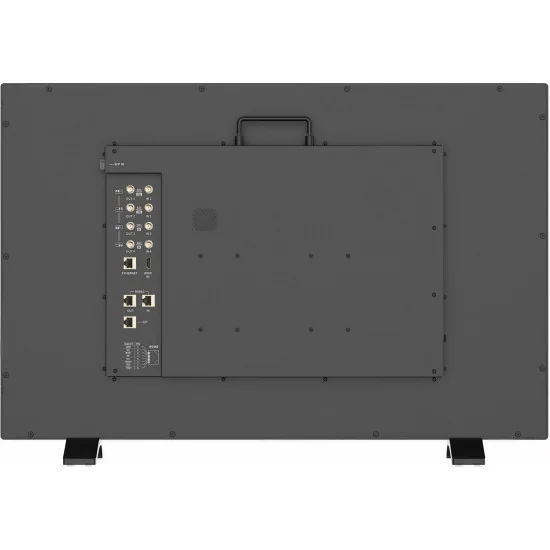
Four BNC connectors on the back accept any SDI rate up to 12G, and every one of them is paired with a loop output for a recorder or a client screen. Over a single 12G-SDI cable the monitor takes DCI 4K (4096 × 2160) at up to 60p, and it still reads 1080psf, 720p and the 480i/576i formats of older archives. For quad link, four 3G-SDI cables carry a 4K picture and four 12G-SDI cables an 8K one, with square-division and 2SI mapping both supported. HDMI 2.0 covers 4K60p from an edit workstation or media server.
We ship across the EU for €20, free over €1,000.
B2B sales only, prices excl. VAT.
Official EU distribution and warranty.
Secure online payments via Stripe.
Send your enquiry via the form or email avgear@avgear.shop
The panel itself is UHD, so an 8K feed is scaled to fit. When focus on an 8K camera test or moiré on an LED volume has to be judged at source resolution, a pixel-to-pixel zoom selects one of nine zones and shows it 1:1.
Four independent sources can share the screen in a mixed-format quadview, combining 12G, 6G, 3G and HD-SDI with HDMI at versions 2.0, 1.4 or 1.3. Each quarter carries separate scopes, level meters, UMD text and EOTF/gamut choices. Two sources can also run picture-by-picture or picture-in-picture, with the inset sized and placed where you want it. On a compact OB desk or a flypack, one 31.5-inch display standing in for four small monitors means one power feed, one mount and one calibration to maintain.
A single SFP cage connects the monitor to fibre or IP. With a 12G-SDI receiver – SWIT names the Embrionix EB12LC2R-MNR-P and the MPT-SDI-12GR35-20, the second one good for runs of up to 20 km – a camera or stage-box fibre lands directly on the monitor and is re-emitted on the copper loop as 12G-SDI. An ST 2110 transceiver in the same slot receives HD video over IP up to 1080p50/60, a sensible first contact with an IP core rather than a 4K IP input. Both modules are optional.
Colour accuracy is maintained in-house. 3D LUT self-calibration needs no computer: connect a JETI specbos 1211 or the SWIT-specific version of the X-Rite i1 Display to the USB port, and the monitor displays its own test patches, reads the probe and stores the correction table internally. SWIT puts a full run at about a quarter of an hour with the i1 or around 45 minutes with the specbos, ending at ΔE ≤ 1.0. Re-checking a whole row of displays becomes a scheduled half-day for your own staff rather than an outside service call.
Camera log material is handled by factory conversion tables for Sony S-Log2 and S-Log3, ARRI Log C, Panasonic V-Log, Canon C-Log, REDLogFilm and J-Log1, with Rec.709 SDR, HLG or PQ as the output. Your own 17-point cube LUTs come in on a USB stick, so a client review shows the agreed grade rather than flat log footage.
For signal analysis there are luma/chroma and RGB waveforms with a nits scale, a mode that isolates one line, a vectorscope, a histogram and a gamut plot against Rec.709 and Rec.2020. An eye pattern displays SDI signal integrity, so a tired 12G patch lead or a loose BNC gets caught during line-up rather than as drop-outs on air. Exposure and framing aids include zebra, false colour, focus assist, single-channel R/G/B or mono view, freeze, H/V delay, and safe-area markers for 15:9, 14:9, 13:9, 4:3, 2.35:1, 2:1 and 1.85:1, plus user-defined ones.
With 4K sources the processing delay is below 0.01 frame, close enough to zero that sound-to-picture alignment and racking cameras during a live show can be judged on this screen. Meters cover up to sixteen embedded audio channels, two of them can be routed to the internal speaker or to headphones via the 3.5 mm jack, and Lissajous plus 5.1/7.1 phase views make a reversed-polarity pair obvious.
Integration is broadcast-standard. Over RS485 the monitor both receives and passes on TSL UMD (versions 3.1 and 4.0), takes GPI tally, and prints source names and tally text on screen. On the gigabit Ethernet port, any web browser reaches a control page where operators choose inputs, adjust the picture, set audio and video functions and map the F-keys – there is nothing to install – and firmware updates load from USB.
It runs from 100–240 V AC with consumption capped at 80 W, a modest heat load inside a truck or machine room. The chassis takes VESA 100 × 100 or 100 × 200 mounting for walls and arms.
| Model | BM-U325 |
|---|---|
| Display | |
| Size | 31.5 inches |
| Display area | 698.4×392.85mm |
| Resolution | 3840×2160 |
| Aspect ratio | 16:9 |
| Brightness | 300nits |
| Contrast | 3000:1 |
| Color depth | 1.073G colors, 10-bit |
| Signal process | 18-bit |
| Viewing angle | 178°(H) /178°(V) |
| Input | |
| BNC ×4 | 12G/6G/3G/HD/SD-SDI input |
| HDMI® ×1 | HDMI® 2.0 input |
| SFP ×1 | Optical Fiber input (By optional SFP adaptor) |
| RS485 ×1 | TSL 3.1/4.0 UMD input |
| RS485 ×1 | GPI (Tally) input |
| RJ45 ×1 | 1000M Ethernet input for Webserver IP control |
| Output | |
| BNC ×4 | 12G/6G/3G/HD/SD-SDI loop output |
| RS485 ×1 | TSL 3.1/4.0 UMD output |
| Analog audio | 3.5mm headphone and speaker |
| Video Format | |
| SDI 1/2/3/4 | 4096×2160p (60 / 59.94 / 50 / 30 / 29.97 / 25 / 24 / 23.98) 3840×2160p (60 / 59.94 / 50 / 30 / 29.97 / 25 / 24 / 23.98) 2048×1080p (60 / 59.94 / 50 / 30 / 29.97 / 25 / 24 / 23.98) 2048×1080i (50 / 59.94 / 60) 1080p (60 / 59.94 / 50 / 30 / 29.97 / 25 / 24 / 23.98) 1080i (60 / 59.94 / 50) 1080psf (30 / 29.97 / 25 / 24 / 23.98) 720p (60 / 59.94 / 50) 480i (59.94), 576I (50) |
| Quad Link 4K (Each channel) | 2048×1080p (60 / 59.94 / 50 / 30 / 29.97 / 25 / 24 / 23.98) 1080p (60 / 59.94 / 50 / 30 / 29.97 / 25 / 24 / 23.98) |
| Quad Link 8K (Each channel) | 4096×2160p (60 / 59.94 / 50 / 30 / 29.97 / 25 / 24 / 23.98) 3840×2160p (60 / 59.94 / 50 / 30 / 29.97 / 25 / 24 / 23.98) |
| HDMI® | 4096×2160p (60 / 59.94 / 50 / 30 / 29.97 / 25 / 24 / 23.98) 3840×2160p (60 / 59.94 / 50 / 30 / 29.97 / 25 / 24 / 23.98) 1080p (60 / 59.94 / 50 / 30 / 29.97 / 25 / 24 / 23.98) 1080i (60 / 59.94 / 50) 720p (60 / 59.94 / 50) |
| General | |
| Input voltage | DC 12V-17V, AC 100-240V, 50/60Hz |
| Power consumption | 80W |
| Working temperature | 0°C~+50°C |
| Working humidity | 10%~90% |
| Storage temperature | -15°C~+60°C |
| Storage humidity | 10%~90% |
| Net weight(without packaging) | 12kg |
| Product dimensions(without packaging) | 754×490×89mm |
| Gross weight(with packaging) | 22.2kg |
| Package dimensions | 850×170×618mm |

Data sheet
Specific References