


BirdDog X4E – a new 4K camera for live production
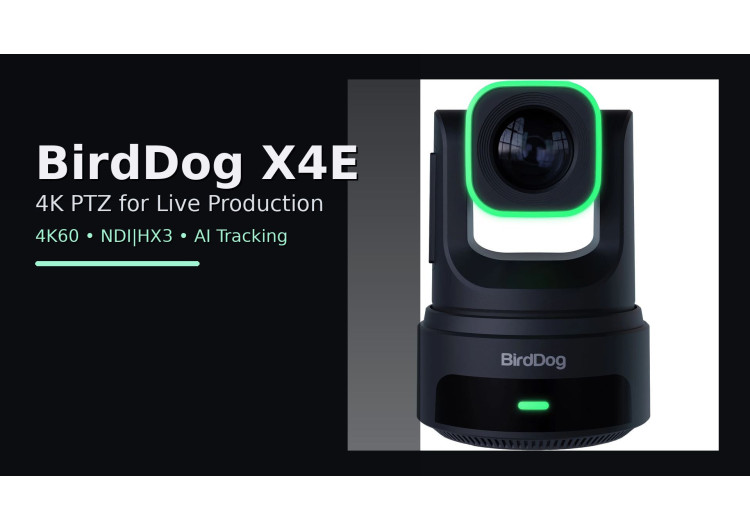
A compact wired PTZ for studios and venues. BirdDog X4E delivers crisp 4K60 images, IP streaming and fast control in multi-camera workflows.
In modern control rooms, camera choice is no longer separated from network architecture. The BirdDog X4E Ultra sits exactly in that intersection: a wired 4K60 PTZ camera for continuous duty, predictable cabling and repeatable moves in multicam switching. By omitting Wi-Fi and an internal battery, X4E keeps the focus on fixed infrastructure—Gigabit Ethernet, PoE+ distribution and deterministic control—so crews can treat every camera position as a reliable endpoint rather than a variable wireless node.
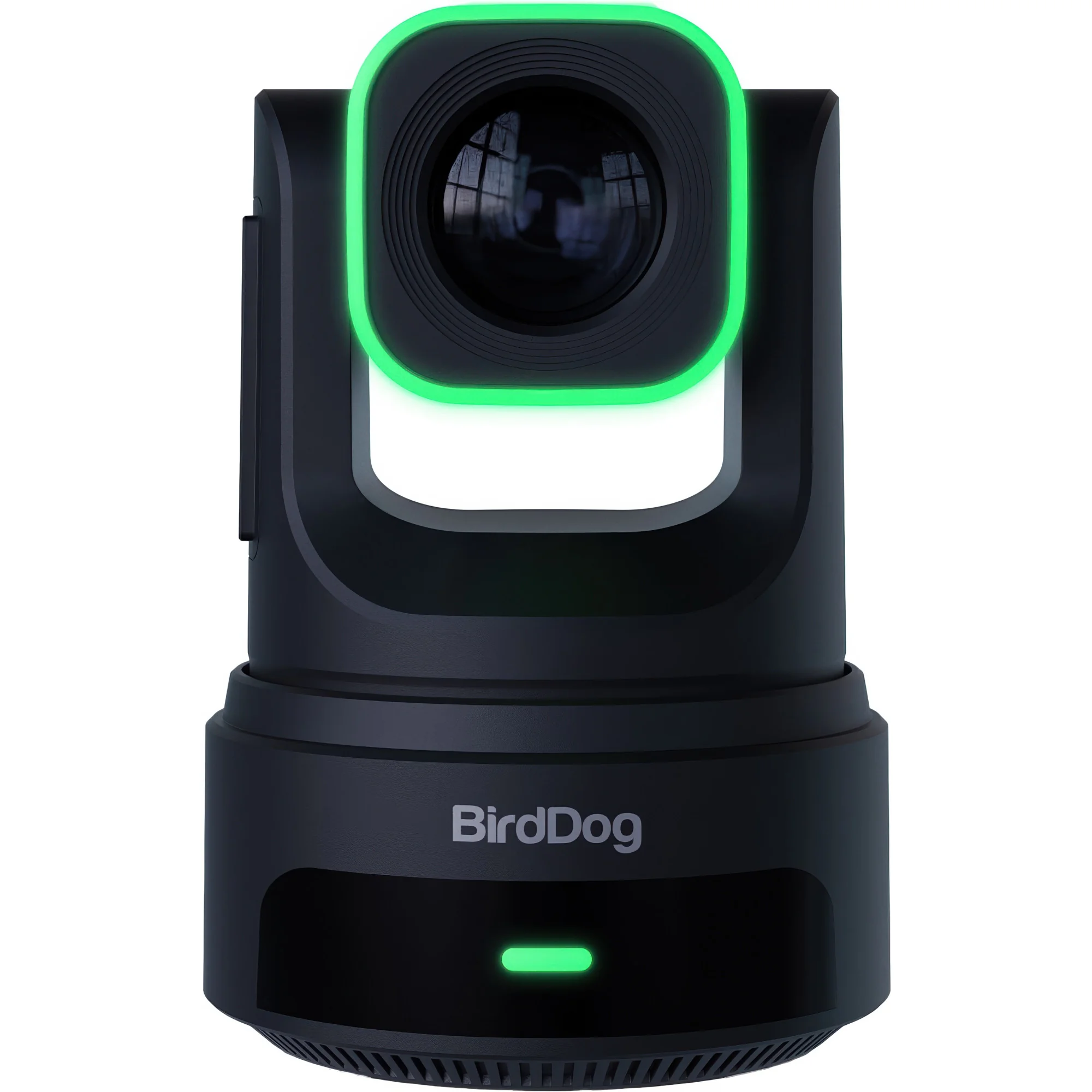
When a show brief includes fast turnaround, limited operators, or a requirement to keep talent eye-line consistent, X4E’s combination of optics, tally and automation becomes operationally relevant. The camera can feed SDI, HDMI, USB and IP pipelines in parallel, enabling one position to supply a switcher, a local recorder, a conferencing workstation and an IP production stack without constant re-patching.
Large 1/1.8" Sony sensor
At the core is a Sony 1/1.8-inch UHD CMOS sensor with 8.42 MP effective pixels, supporting UHD 3840×2160 acquisition up to 50/60p. In live production, the practical advantage is consistency: highlights remain controlled, dark wardrobe textures stay legible and the image holds together when transported over constrained links. The imaging pipeline includes 3D noise reduction and backlight compensation, useful for stages with LED walls, hard key lights, and mixed colour temperatures in event spaces.
The optics cover a practical working range: a 20× optical zoom (6.25–125 mm) with F1.58–F3.95 aperture and a horizontal angle of view from 60° wide to 3.5° tele. In one mount position, that spans establishing shots and tight head-and-shoulders framing from the back of a room, without moving a tripod or changing lenses. Auto/manual focus and exposure modes (including shutter and iris priority) make it easier to match multiple angles across a PTZ grid, then lock critical parameters for stable intercutting.
For permanent installations and event crews.
The X4E is aimed at venues where the camera must power up every day and behave the same way each time. Power and network consolidate via PoE+ (IEEE 802.3at), reducing wall adapters and simplifying UPS-backed distribution. Where PoE budgets are constrained, the camera also accepts 12 V DC. An indoor operating envelope of 0–40 °C and 20–80% humidity aligns with control-room, stage and studio environments.
For technicians building facility-wide workflows, wired PTZ is often about risk containment: fixed Ethernet paths, managed switching and predictable transport policies. With standard structured cabling runs up to 100 m, the X4E can sit at balcony level, truss height or the rear of a conference hall while staying inside typical building infrastructure. Its compact body (approx. 14 × 18.9 × 20 cm, 2.19 kg) fits wall mounts, ceiling drops and truss clamps without forcing oversized hardware, which is relevant when multiple cameras must be deployed in symmetric positions.
Ideal for multi-camera productions
Multicam success is often decided by repeatability rather than peak resolution. X4E offers pan ±170° and tilt −30° to +90° with variable speeds up to 80°/s pan and 60°/s tilt, plus 255 presets for rapid recalls. In practice, that enables a technical director to build a preset map that mirrors a run-of-show: podium, panel two-shot, audience reaction, product demo table, wide safety and roaming details. Presets can be recalled from a PTZ controller, production software, or a control surface that speaks VISCA-IP and related protocols, enabling consistent shot language across multiple operators or across recurring events.
On-air signalling is equally critical when several PTZ units share a set. The HALO Tally ring gives a 360° cue that reads in bright rooms and from wide angles, while the rear number tally helps crew coordinate camera IDs when multiple units are mounted in a line. Together, tally and presets reduce comms overhead—particularly in hybrid events where the same stage serves an in-person audience and a streamed program output, with minimal crew on the floor.
For video podcast studios and interviews
Video podcasts and interview formats reward stable framing and repeatable colour. The X4E’s sensor/optics pairing produces a clean, detailed image for tight shots, while the PTZ head maintains consistent compositions across episodes. In a typical three-camera layout—wide, host and guest—operators can store presets for each chair and alternate shots without moving a dolly or interrupting lighting continuity, keeping microphones and acoustic treatment undisturbed.
Where podcasts are recorded and streamed simultaneously, output redundancy becomes valuable. X4E can feed a hardware switcher over 3G-SDI (up to 1080p60) while also delivering UHD over HDMI to a recorder or monitor, and a USB-C UVC feed to a conferencing workstation for remote guests. This parallel output model supports workflows such as “clean feed plus program feed” or “ISO record plus program stream” without stacking additional converters.
Multiple streaming protocols, NDI HX3, RTMP, SRT
IP contribution is where the X4E becomes a strategic asset. The camera supports NDI|HX3 (and HX2) for low-latency, bandwidth-aware transport across standard networks, enabling software switchers and NDI-aware routers to subscribe to camera feeds without SDI cabling. When productions require internet contribution, X4E supports SRT for secure, error-resilient transport over unpredictable links, along with RTMP and RTSP for platform ingest and monitoring. Codec support (H.265 and H.264) allows teams to balance bandwidth against detail retention depending on whether the feed is LAN-only, venue-to-studio, or platform distribution.
For network administrators, the practical value is choice: NDI HX3 for controlled LAN workflows; SRT for venue-to-studio contribution; RTMP for direct distribution; RTSP for surveillance-style monitoring and third-party recorders. This makes X4E relevant in broadcast-style control rooms and also in corporate AV, where the same camera may serve webinars, Teams/Zoom sessions and a fully produced live stream within a single week.
SDI, HDMI and USB-C video outputs
Connectivity is not a checkbox; it is a routing strategy. X4E provides simultaneous outputs via 3G-SDI, HDMI, USB-C UVC and the network interface. SDI remains the stable choice for switchers, distribution amplifiers and long cable runs; HDMI is often preferred for local monitoring and recorders; USB-C presents the camera as a UVC class device, useful when a studio needs to hand a clean feed to a computer without capture hardware. In practical terms, a single camera can serve broadcast routing and “desktop production” needs at the same time.
Audio integration is equally direct: a 3.5 mm TRS line/mic input can be embedded into SDI/HDMI/USB and NDI audio paths. In compact productions this can reduce external audio patching, while larger shows can continue to mix audio centrally and treat X4E as a pure video endpoint. Either way, the camera avoids fragile adapters and stays aligned with standard production wiring.
E-Ink screen
One of the most production-friendly details is the always-on 2.13" E-Ink display. Instead of guessing which camera is which after a power cycle, crews can identify units at a glance—even when the camera is off or rack power is down. The display can show camera ID and scannable access information, accelerating the moment when an engineer must reach the web interface during deployment. In multi-room facilities, this reduces setup time and lowers the risk of controlling the wrong unit when several cameras are commissioned in parallel.
Extensive AI features, Autotracking
The X4E includes AI tracking modes such as presenter tracking and zone-based behaviour, offering automation that maps to real production constraints: fewer operators, more deliverables and higher expectations for professional framing. In lecture capture, the camera can hold a presenter across a stage; in worship or corporate town halls, it can maintain speaker framing while the director switches other angles; in esports and panel formats, zones can keep the shot stable while preventing the camera from drifting to screens, audience movement or off-stage traffic.
Automation does not eliminate control; it complements it. The camera can be managed via BirdUI in a browser and integrates through industry protocols including VISCA (serial and VISCA-IP), RS-232, ONVIF and NDI control. For integrators, that means X4E can fit into existing controller ecosystems, room automation and broadcast control software without forcing a single-vendor stack.
For teams sourcing a wired PTZ that behaves like a broadcast tool while speaking modern IP, the BirdDog X4E Ultra Black PTZ Camera becomes a practical choice: a 4K60 imaging core, reliable power over Ethernet, multiple output paths, and the operational details—tally, E-Ink identification and AI framing—that keep a live workflow moving when time and staffing are tight.
Comments
No comment at this time!
Leave your comment