


Canon CR-N400 – a PTZ camera offering broadcast-quality and standards.
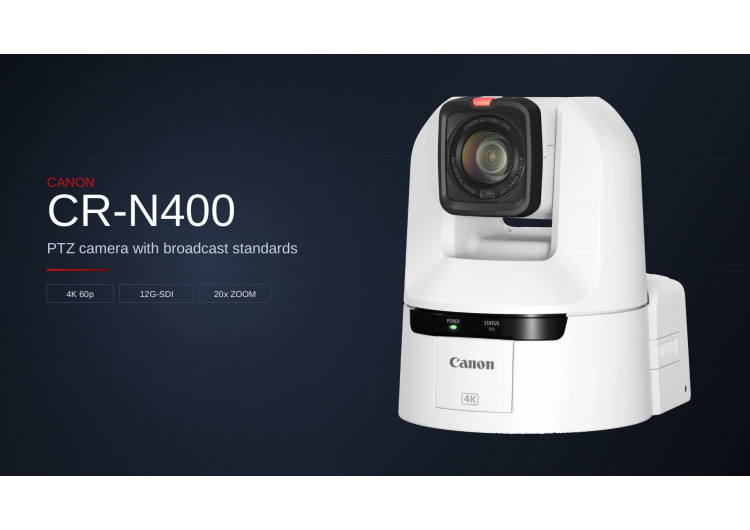
A close look at the Canon CR-N400 PTZ camera, its 4K 60p broadcast signal chain, IP protocols, audio handling and colour pipeline for live work.
Production houses juggling multi-camera shoots tend to reach a point where the limits of a fixed-position rig start to dictate the schedule. The Canon CR-N400 arrives at that exact pressure point. It is a remote-controlled head with a 4K UHD imaging chain, a generous zoom range and the kind of professional I/O that lets a director plug it into an existing broadcast chain without compromise. Operators familiar with Canon's cinema and broadcast lineup will recognise the colour science straight away, and the rest of the spec list reads like a checklist for serious live work — 12G-SDI, time code, gen-lock, dual XLR audio and a deep stack of IP protocols including NDI|HX2 and SRT.
This article walks through the camera in the way a technical director would assess it: lens behaviour, signal chain, IP capabilities, audio handling, sync architecture and colour pipeline. The aim is to translate the spec sheet into practical consequences for the people who actually push the buttons and ride the iris during a live broadcast or a corporate streaming day.
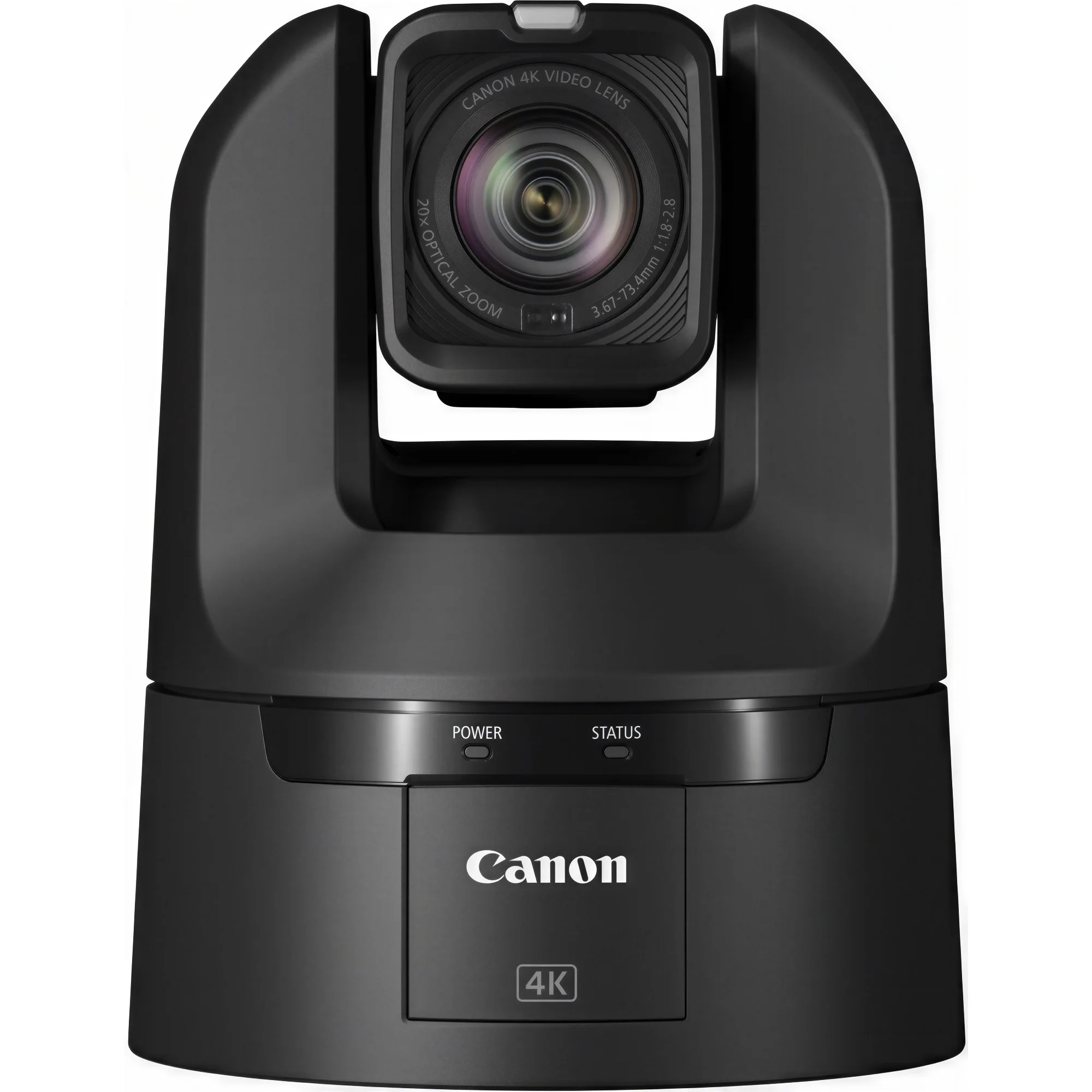
Excellent Canon optics with 20x zoom and fast AF.
The defining piece of hardware on the Canon CR-N400 is its lens. Twenty times optical zoom, with the wide end sitting at a 35 mm equivalent of roughly 29.3 mm and the long end reaching 601 mm in 4K capture modes. Drop the camera into Full HD and a digital extension pushes that reach to 40x, equivalent to 1202 mm at the telephoto end — useful when you need to pick out a single face in a back row or a logo on the far side of a sports hall. The optics carry Canon's Optical Image Stabilisation, which is more than a marketing line on a PTZ; it earns its place every time the camera is mounted to a truss or a temporary stage rig that vibrates under foot traffic or PA bass.
Autofocus is where the camera really separates itself from older PTZ generations. Canon's Hybrid AF combines phase-detection elements with contrast-based confirmation, so the lens drives to focus quickly and then settles without the visible breathing that often gives away cheaper systems. Face, eye and head detection run in parallel, which matters during keynote shoots where a presenter walks past a fixed mark and the AF needs to hold the eyes rather than wander to the lectern behind. In a worship setting, the same logic keeps the focus locked on the speaker even when a musician steps briefly into frame. The autofocus speed is set in stages, so a camera operator can dial down the responsiveness for a steady, cinema-style rack and dial it up for fast-moving panel discussions.
Built into the optical path is a motorised neutral density filter offering variable exposure control. For broadcast use this removes the awkward moment when a venue's lighting designer suddenly punches a spotlight onto a presenter and the exposure needs to come down without altering shutter or aperture. The filter ramps smoothly, which on a clean cut between cameras matters more than the actual stop count. Combined with Canon's familiar exposure modes, the CR-N400 behaves like a manual broadcast camera when an operator wants it to, and a fully automated unit when staffing is thin.
For television studios and live-event producers, the practical benefit is reach and reliability. A single CR-N400 above a centre-stage truss can frame everything from a wide establishing shot to a tight head-and-shoulders on a guest in the third row, all without an extender or a manual lens swap. Operators with cinema experience will appreciate the way the lens behaves at the long end — the image holds its sharpness rather than dissolving into the soft, low-contrast look common to older PTZ telephoto extensions.
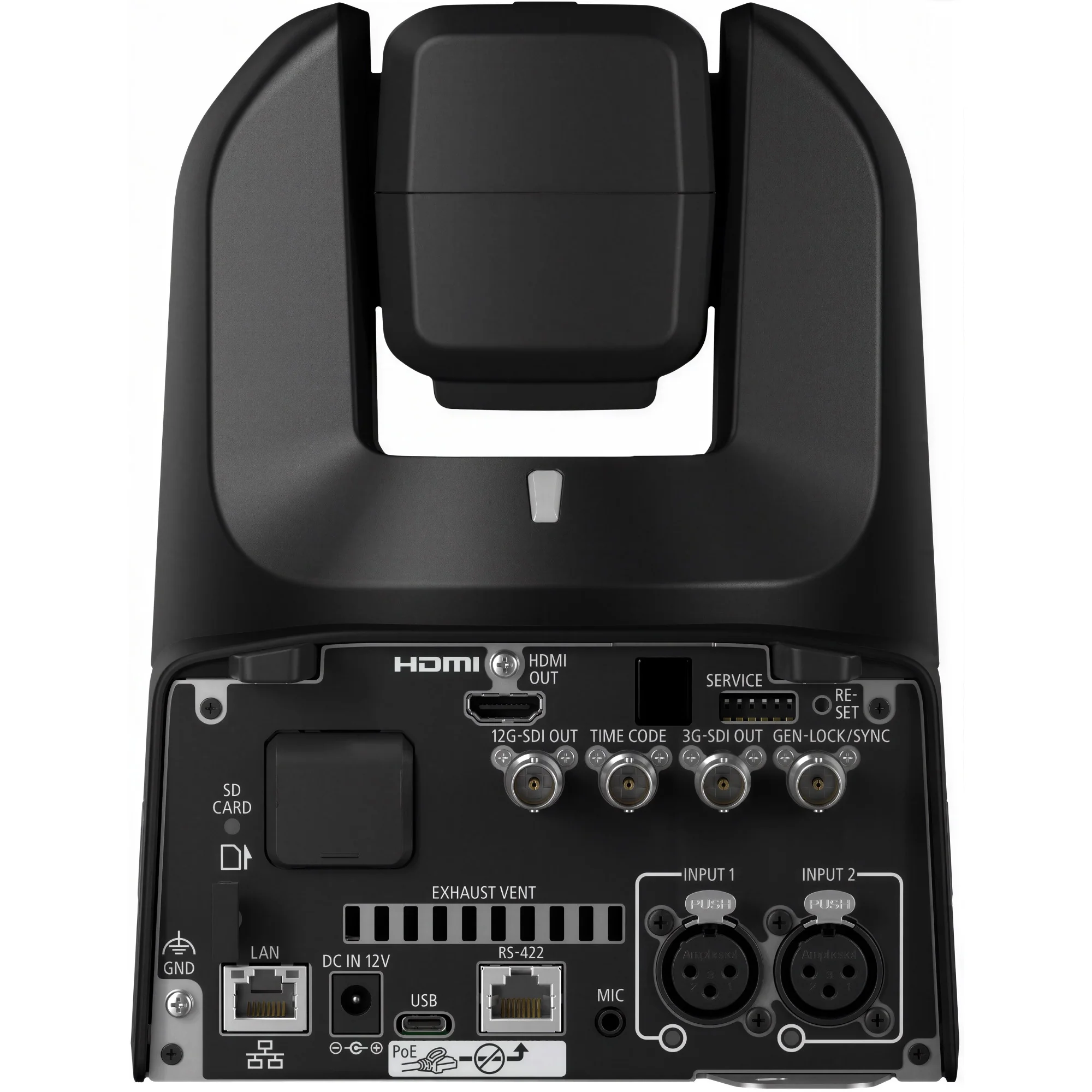
12G-SDI with 4:2:2 10-bit.
On the back of the housing sits the spec that anchors the Canon CR-N400 in genuinely professional territory: a 12G-SDI output carrying 4K 60p at 4:2:2 10-bit. For broadcast directors, that is the single line item that decides whether a camera can sit in the rack next to a Sony, a Grass Valley or a higher-tier Canon system camera without needing a conversion box. The 4:2:2 colour sampling preserves enough chroma data to survive keying, grading and downstream compression; the 10-bit depth keeps gradients smooth when a venue's lighting drifts from warm tungsten to cool LED across the night.
Alongside the 12G-SDI line, the camera carries a 3G-SDI output and HDMI. The combination is more than convenience. A common operational pattern is to send a 4K 60p feed over the 12G line into a master switcher while simultaneously routing a Full HD 60p feed from the 3G-SDI output to a monitor wall, a confidence display or a separate streaming encoder. Doing both in parallel, from a single body, eliminates the need for a downstream converter — and removes one more box that can fail during a live show.
The signal chain inside the camera runs on Canon's DIGIC DV7 processor, the same generation found across the company's broadcast and cinema range. That matters because the noise reduction, debayering and motion-adaptive scaling behave predictably when intercut with footage from a C300, a C400 or an EOS R5 C. Production houses already invested in Canon will not need to re-grade or apply heavy correction to bring the PTZ output into line with their hero cameras. For mixed-rig productions the saving in colourist hours during post is real and measurable.
HDR delivery is supported directly. The camera can output PQ for HDR10 distribution chains or HLG for live broadcast applications, both at the full 4K 60p, 10-bit specification. For sports producers experimenting with HDR live broadcasts, this means a PTZ unit that is no longer the weak link in the chain — it carries the same dynamic range envelope as the manned cameras.
4K 60p IP streaming
If 12G-SDI is the legacy-friendly side of the camera, the IP stack is what defines its future-proofing. The Canon CR-N400 ships with NDI|HX2 native support, allowing audio, video, control, tally and even power to ride down a single Cat6 cable when the camera is fed from a PoE++ injector or a compatible switch. For installation contractors retrofitting a corporate auditorium or a university lecture hall, that single-cable approach cuts conduit work and removes the need for separate audio runs and tally cabling.
NDI|HX2 is not the only protocol on the menu. SRT is implemented with adaptive bitrate, which is the meaningful detail for anyone pushing streams across public internet to a remote production hub. When the network jitter spikes, the camera throttles intelligently rather than simply dropping the connection. RTSP/RTP, RTMP and RTMPS are also available, the latter pair letting the camera publish directly to YouTube Live, Facebook Live and similar destinations without an external encoder in the chain. For a one-person streaming operation — think a smaller production house covering a regional sports league — that is a meaningful reduction in equipment and points of failure.
One of the genuinely new features in this generation is IP cropping. A single CR-N400 can output its main 4K feed alongside two Full HD cropped regions, each selectable as a separate IP stream. In practical terms, a single camera mounted at the rear of a conference room can deliver a wide establishing shot of the stage plus a tight crop on the speaker and a second tight crop on a sign-language interpreter — three distinct angles from one head, with no additional optics and no mechanical movement to give the trick away. A vertical 9:16 crop is also available, which suits short-form social content cut alongside the main horizontal stream.
For virtual production, the camera supports the FreeD protocol with up to four destinations. That number matters because in larger XR or AR stages the camera tracking data often needs to feed multiple game engines, a render manager and a recording system simultaneously. Studios building hybrid sets that mix live presenters with rendered backgrounds can place a CR-N400 in the role normally filled by a much more expensive system camera with a tracked optical block.
XLR audio
Audio is where many compact PTZ cameras quietly compromise, leaning on 3.5 mm line inputs that pick up RF interference and force operators into adapter chains. The Canon CR-N400 sidesteps the whole issue with two balanced XLR inputs, with phantom power available for condenser microphones. For a production team feeding a presenter's lavalier and an ambient overhead into the same camera body, the signal arrives clean and at line level without an external mixer.
The practical consequence is that the camera can act as the local audio aggregator for a small streaming setup. A corporate AV team broadcasting a town hall meeting can run a wireless lav into the first XLR, a venue feed into the second, embed both into the 12G-SDI output as discrete channels, and arrive at the switcher with a fully synchronised audio-video package. The same logic helps in a worship environment where a single CR-N400 on a balcony rail captures both the spoken word from the pulpit and the room ambience from the choir loft.
Phantom power and adjustable input gain bring the camera into the same operational ballpark as a dedicated camcorder. For broadcast pipelines that demand level-matching against EBU R128 or ATSC A/85 loudness specifications, this is the difference between a usable feed and one that needs to be rebuilt in post.
Time Code and Gen-Lock Sync
Multi-camera production lives or dies on synchronisation. The Canon CR-N400 carries a BNC connector dedicated to time code, supporting both input and output, alongside a separate gen-lock input that doubles as a sync reference output. Together these two terminals let the camera fall into line with a tri-level sync generator in a broadcast truck or a master clock distributed across a corporate AV control room.
For an outside broadcast crew arriving at a sports venue with a mix of system cameras and PTZ heads, the ability to slave the CR-N400 to the same reference as the manned units means clean cuts in the vision mixer with no frame slip. Time code embedded in the SDI signal travels through the switcher and recording systems, so editors picking up the rushes the next morning find aligned material without manual sync work. On a wedding-style live event the same feature lets multiple CR-N400 cameras around a hall feed a single recorder with matched timestamps across hours of continuous coverage.
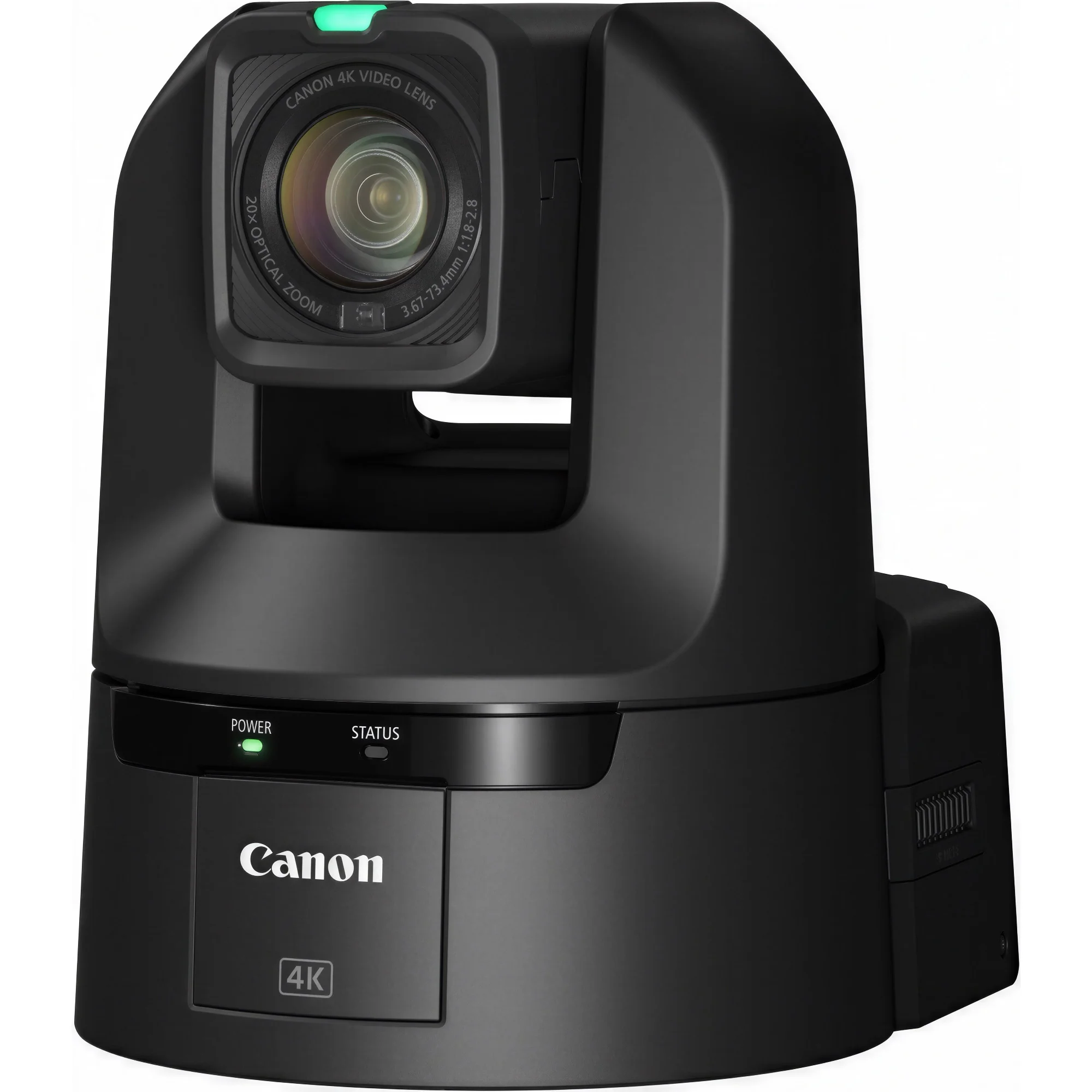
For production houses that operate hybrid rigs — some traditional broadcast, some streaming-first — the sync architecture lets the same camera serve both pipelines. The 12G-SDI feed travels to the rack-mounted production switcher under gen-lock, and the NDI|HX2 output simultaneously feeds an IP switcher running on a separate network segment, both locked to the same time base. The redundancy is genuine, not theoretical.
Colour in Canon Log3, BT.709, Canon 709 and others.
Colour science is the area where the Canon CR-N400 earns its place in a fully professional pipeline. The camera records and outputs in Canon Log 3, the company's most recent log curve, which preserves roughly 1600% dynamic range at ISO 800 and above. That extra latitude survives the journey through grading suites such as DaVinci Resolve, Baselight or Adobe Premiere Pro, allowing colourists to push midtones and recover highlight roll-off in a way that flat Rec.709 capture simply cannot match.
For live broadcast where there is no time to grade, the camera also offers BT.709 Wide DR and standard BT.709 modes, plus Canon's own 709 look that matches the rendering of its cinema cameras. PQ and HLG are available for HDR pipelines. The 12G-SDI port carries Canon Log 3 with a Wide DR or BT.709 LUT baked on the output without a conversion box in line, which is the kind of operational detail that saves an engineer's evening when a truck pulls up to an unfamiliar venue.
The practical takeaway for a production house running multiple cameras is consistency. A C400 capturing main interview footage, a CR-N400 covering wide and a CR-N300 on a corner — all rendered with matched Canon colour science — produce a final cut that does not require heavy correction to unify the look. Time saved at the grading desk converts directly into margin on every project, and the reliability gained from a single colour pipeline shows up in client review meetings as fewer revisions.
For streaming-first operations that hand off footage to social channels minutes after capture, the BT.709 Wide DR mode delivers a broadcast-ready signal that holds up on consumer screens without intervention. For longer-form productions where a finishing pass is part of the schedule, Canon Log 3 sits ready for the colourist. The Canon CR-N400 covers both ends of the spectrum from the same head, which is exactly what a production owner sizing up the camera against a fleet purchase needs to hear before signing the order.
Across studios, live events, corporate venues, education spaces and worship facilities, the Canon CR-N400 sets itself up as a serious broadcast tool rather than a step up from a webcam. Its combination of long-reach optics, broadcast I/O, deep IP protocol support, balanced audio inputs, professional sync and consistent Canon colour rendering places it in a category where the value calculation runs against system cameras costing several times as much. For production houses where reliability, return on investment and time-on-target define the buying decision, this is the kind of unit that earns its slot in the rack.
Comments
No comment at this time!
Leave your comment