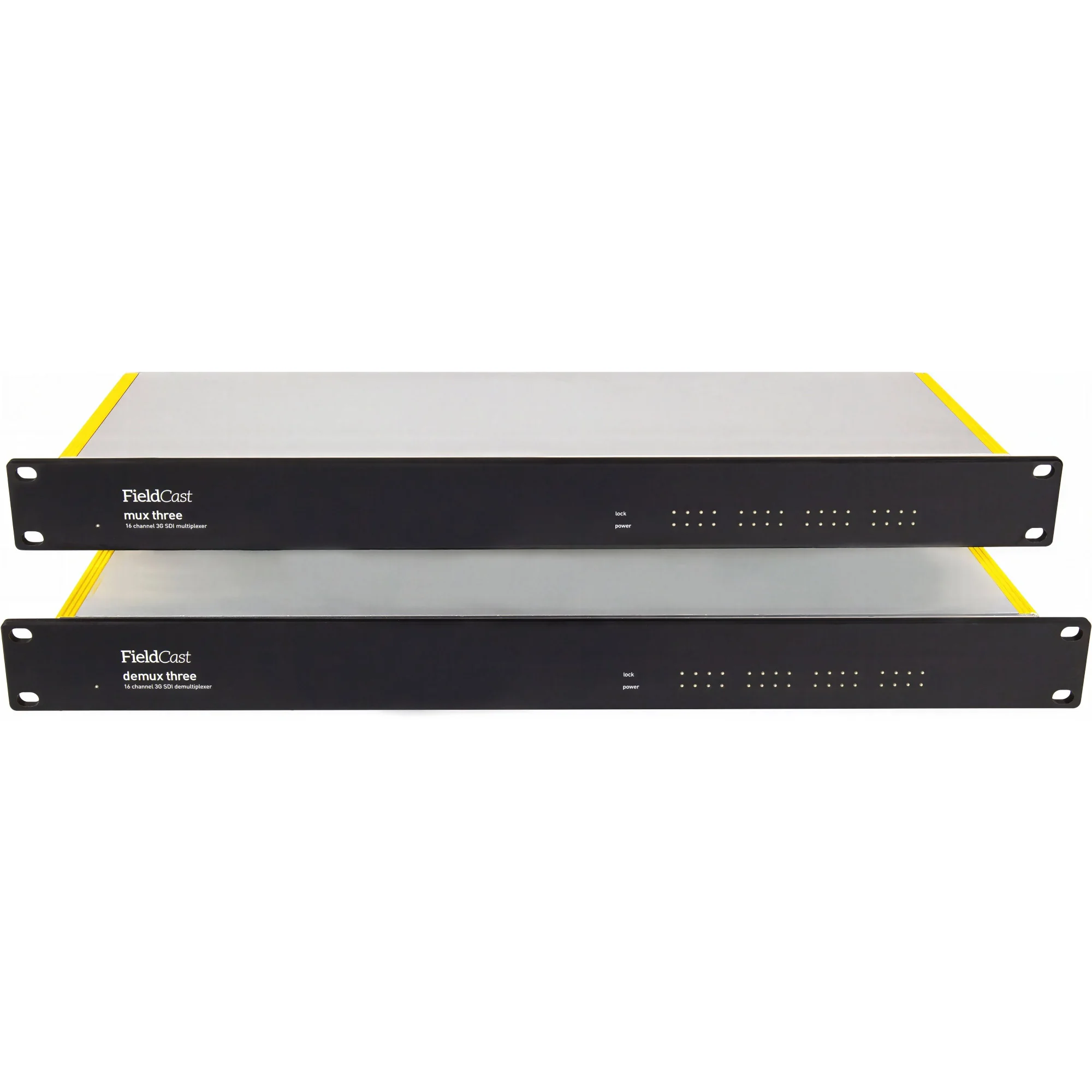
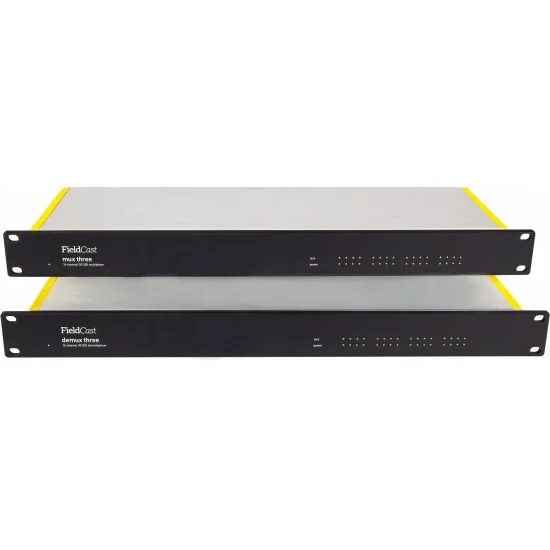
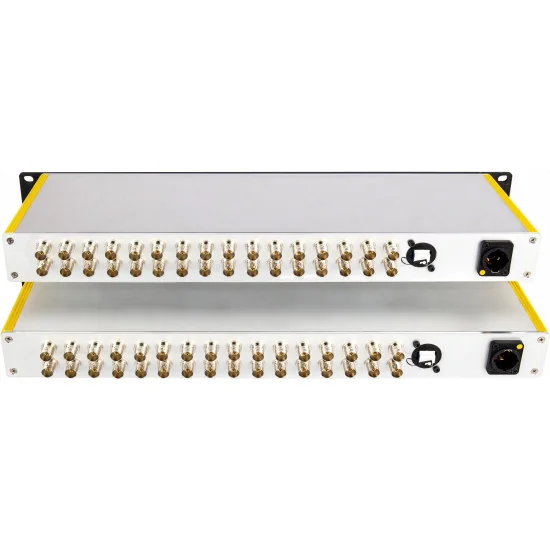
Getting sixteen 3G-SDI feeds down a single strand of glass changes the cabling arithmetic at a large venue, and that ratio is what the FieldCast Mux + Demux Three 3G exists to deliver. The set ships as a matched pair of 1U aluminium units: the multiplexer takes sixteen 75 ohm BNC inputs at the camera end, the demultiplexer sits in the gallery and hands back sixteen channels. Between them runs one 9/125 single-mode fibre core on LC (U)PC terminations.
Channel separation happens optically, through thin-film CWDM filters rather than any form of encoding, so nothing in the path touches the picture. Nothing is compressed or re-encoded — each 2.97 Gb/s SDI stream leaves the demux exactly as it entered the mux. Sources conforming to SMPTE 259M, 344M, 292M and 424M pass straight through, covering SD and HD formats up to 1080p60. The two boxes can sit 40 km apart, bringing a remote arena, a second campus building or a transmitter site within reach of the control room.
Every SDI input on the mux carries a reclocked loop-through, and each demux channel is doubled, so a shader keeps a local monitor at the camera while the far end feeds a switcher and a multiviewer at once. One fibre core serves the COM path, and a second LC channel sits beside it, leaving a whole core free on a duplex cable — room for a mirrored second pair where a show tolerates no single point of failure. Standard configuration is unidirectional, sixteen in to sixteen out.
Front panels read at a glance: warm white LEDs for power, sixteen for channel module activity, sixteen more for input status — fault-finding on a dark truck ramp becomes a quick look rather than a cable-by-cable hunt. Each unit draws under 50 W and accepts 110–240 VAC through a locking PowerCon inlet, so touring racks keep the power looms they already run. Worth settling before ordering: the optics are single-mode only, so multimode patching already installed at a venue will not carry these channels. For multi-camera live switching, outside broadcast relay, esports arenas and theatre installs short on dark fibre, the pair replaces sixteen separate optical links.
Getting sixteen 3G-SDI feeds down a single strand of glass changes the cabling arithmetic at a large venue, and that ratio is what the FieldCast Mux + Demux Three 3G exists to deliver. The set ships as a matched pair of 1U aluminium units: the multiplexer takes sixteen 75 ohm BNC inputs at the camera end, the demultiplexer sits in the gallery and hands back sixteen channels. Between them runs one 9/125 single-mode fibre core on LC (U)PC terminations.
Channel separation happens optically, through thin-film CWDM filters rather than any form of encoding, so nothing in the path touches the picture. Nothing is compressed or re-encoded — each 2.97 Gb/s SDI stream leaves the demux exactly as it entered the mux. Sources conforming to SMPTE 259M, 344M, 292M and 424M pass straight through, covering SD and HD formats up to 1080p60. The two boxes can sit 40 km apart, bringing a remote arena, a second campus building or a transmitter site within reach of the control room.
Every SDI input on the mux carries a reclocked loop-through, and each demux channel is doubled, so a shader keeps a local monitor at the camera while the far end feeds a switcher and a multiviewer at once. One fibre core serves the COM path, and a second LC channel sits beside it, leaving a whole core free on a duplex cable — room for a mirrored second pair where a show tolerates no single point of failure. Standard configuration is unidirectional, sixteen in to sixteen out.
Front panels read at a glance: warm white LEDs for power, sixteen for channel module activity, sixteen more for input status — fault-finding on a dark truck ramp becomes a quick look rather than a cable-by-cable hunt. Each unit draws under 50 W and accepts 110–240 VAC through a locking PowerCon inlet, so touring racks keep the power looms they already run. Worth settling before ordering: the optics are single-mode only, so multimode patching already installed at a venue will not carry these channels. For multi-camera live switching, outside broadcast relay, esports arenas and theatre installs short on dark fibre, the pair replaces sixteen separate optical links.
We ship across the EU for €20, free over €1,000.
B2B sales only, prices excl. VAT.
Official EU distribution and warranty.
Secure online payments via Stripe.
Send your enquiry via the form or email avgear@avgear.shop
16 channels of 3G SDI video over one fiber optic channel
Mux Three Plus 3G and its twin brother Demux Three Plus 3G allow you to transport sixteen independent channels of 3G SDI video over just one fiber optic channel.
Is your infrastructure such that you have limited access to individual fiber optic connections? Mux Three and Demux Three can help you run multiple video channels without the need for separate cables.
Or else, do you want to roll out a minimum number of cables in live event environments, just use Mux Three and Demux Three, multiplex up to sixteen channels of video, and get all data from A to B using only one strand of fiber!
No hidden processing involved! All 3G video signals preserve full data integrity! What goes in comes out, unchanged.
Features
Transport over long distance
The mux/demux pair can transport video over distances of up to 40 km/24 mi for 3G SDI. The mux is typically placed at the camera side, and the demux at the control room side.
16 independent video channels with loop-through and dual output
The set supports 16 independent SDI video channels. The SDI inputs have a reclocked loop-through. The SDI outputs are dual. Hence, monitoring on both sides (input and output) is possible. The SDI input is typically connected to the camera’s SDI output. The SDI output is generally connected to the SDI input of a monitor or switcher.
Transport over one fiber optic core
All information for up to 16 SDI video channels, back and forth, runs over a single fiber optic core. This means a simplex fiber optic cable is sufficient to bridge the distance between the mux and the demux, saving on fiber optic cable costs. Alternatively, if you have a fiber optic cable with 2 cores, you have 1 core (or channel) left for other fiber optic transport. You might, for example, use the free fiber optic core to connect to a second, similar Mux/Demux pair to add redundancy to your setup.
No compression
There is no signal processing involved, so there is no compression; full data integrity is guaranteed.
Unidirectional video by default
The standard model is unidirectional, meaning that 16 SDI signals go from mux to demux; it’s denoted as 16i/o, where ‘i’ stands for input and ‘o’ stands for output.
specifications
mux three 3G
• 16 channel SDI input to 1 channel fiber optic output multiplexer
• 1RU all aluminum enclosure design
• 9/125 single mode fiber optic technology
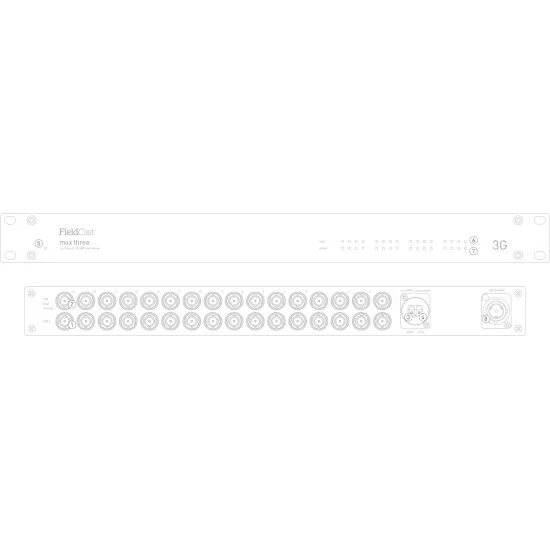
• sixteen 3G (2.97Gb) SDI input channels (1), each with SDI loopthrough (2)
• 75ohm BNC oonnectors for all SDI inputs and loopthrough outputs
• complies with SMPTE 259M, SMPTE 344M, SMPTE 292M and SMPTE 424M
• accepts all SD and HD standards up to 1080p60
• one LC single mode (U)PC fiber optic (COM) channel (3)
• one LC single mode (U)PC fiber optic upgrade (UPG) channel (4)
• black front panel with 2mm. warm white led indicators
• one led indicator for power (5)
• sixteen led indicators for channel module activity (6)
• sixteen led indicators for SDI signal input activity (7)
• power consumption ← 50W
• robust thin film CWDM multiplexing technology
• maximum distance between Mux and Demux unit → 40km.
• 110-240VAC input with PowerCon connector (8)
• dimensions: 482(W) x 155(D) x 43(H) mm.
• weight: 2070 grams
• comes with manual and local power cord
demux three 3G
• 1 channel fiber optic input to 16 channel SDI output demultiplexer
• 1RU all aluminum enclosure design
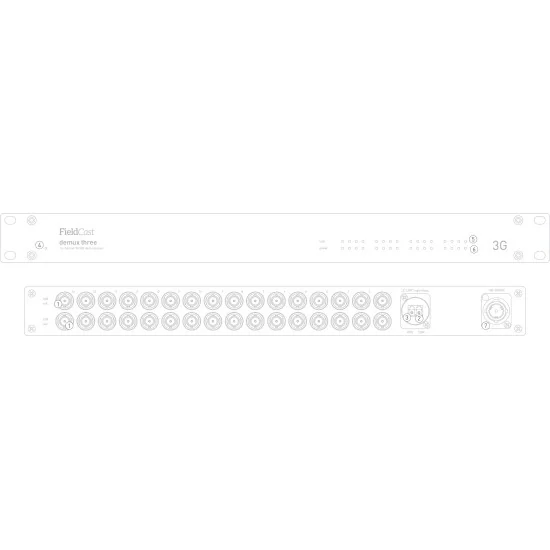
• sixteen 3G (2.97Gb) SDI channels with dual SDI output (1)
• 75ohm BNC oonnectors for all SDI outputs
• complies with SMPTE 259M, SMPTE 344M, SMPTE 292M and SMPTE 424M
• accepts all SD and HD standards up to 1080p60
• 9/125 single mode fiber optic technology
• one LC single mode (U)PC fiber optic (COM) channel (2)
• one LC single mode (U)PC fiber optic upgrade (UPG) channel (3)
• black front panel with 2mm. warm white led indicators
• one led indicator for power (4)
• sixteen led indicators for channel module activity (5)
• sixteen led indicators for fiber optic signal input activity (6)
• power consumption ← 50W
• robust thin film CWDM demultiplexing technology
• maximum distance between Mux and Demux unit → 40km.
• 110-240VAC power input with PowerCon connector (7)
• dimensions: 482(W) x 155(W) x 43(H) mm.
• weight: 2100 grams
• comes with manual and local power cord

Data sheet
Specific References