- New
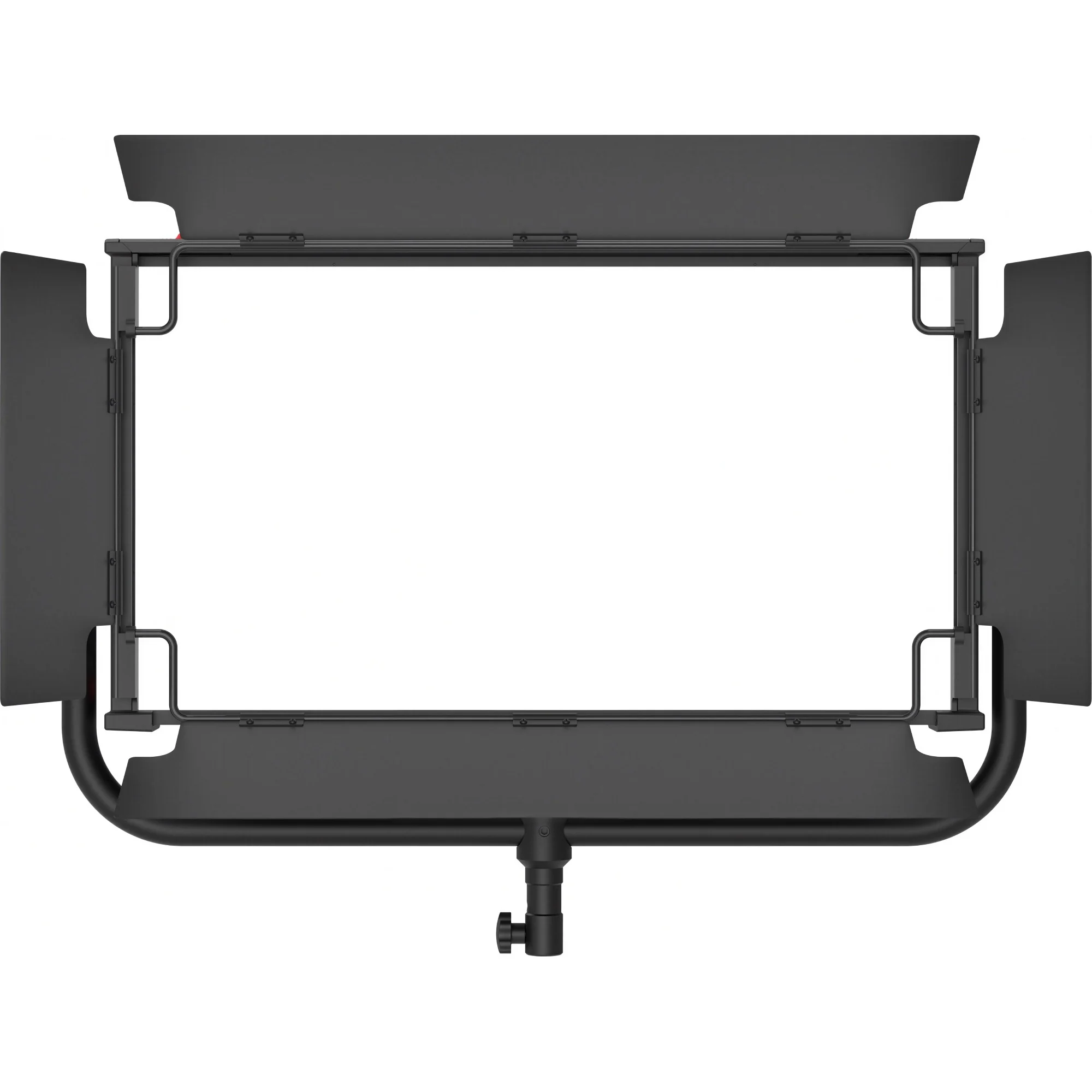
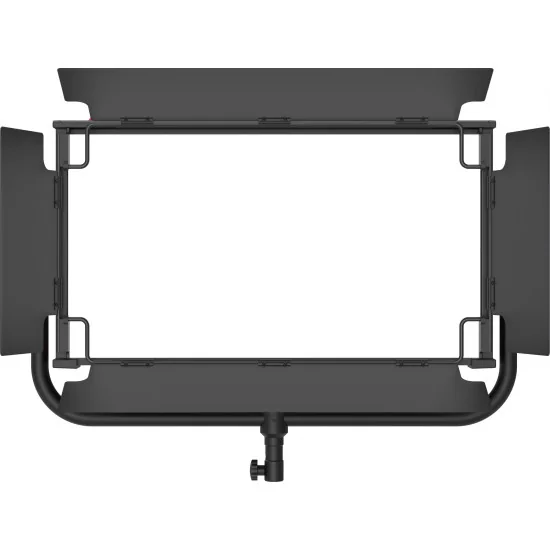
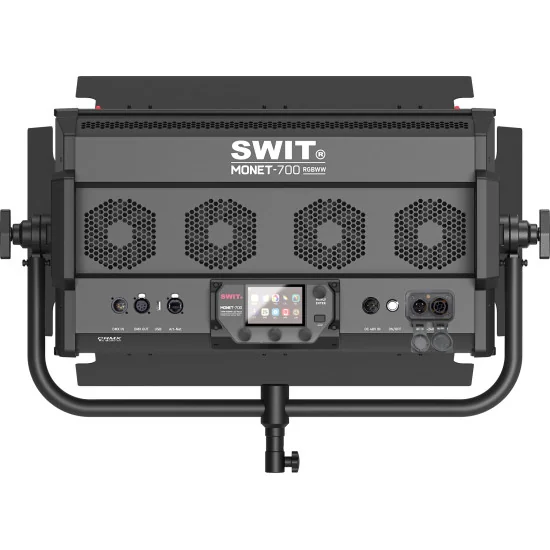
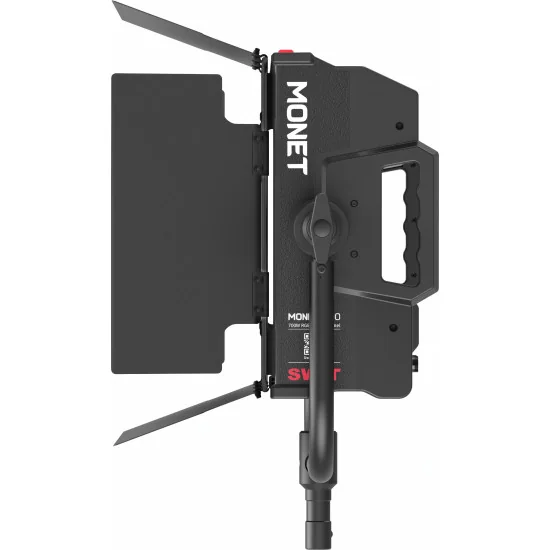
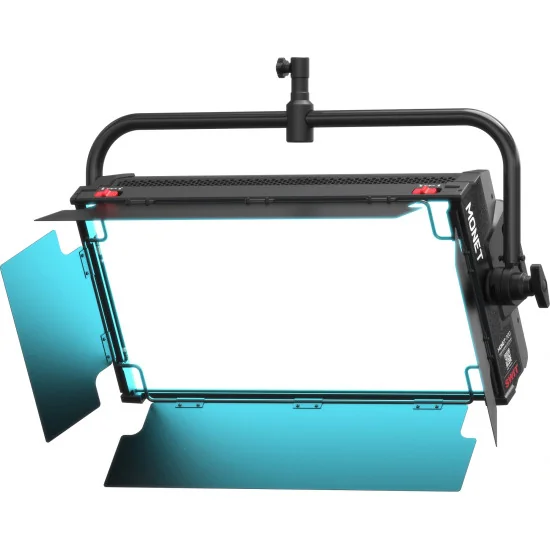
2,352 LEDs sit behind the diffuser of the SWIT MONET-700: 784 RGB emitters, 784 cold white and 784 warm white, driven together as a 700 W, 2×1 RGBWW LED panel. SWIT aims it at TV and virtual studios, live shows and film sets, and the photometrics support that brief, with a rated 20,000 lux at 1 m and roughly 2,700 lux at 3 m.
Those numbers come from a beam that spreads to 120° with a 65° half-peak angle. The centre keeps its density while the edges roll off gradually, so a single fixture hung from a grid can key a two-presenter news desk or cover a long stretch of backdrop without hot spots. On larger sets that translates into fewer heads on the rig, fewer circuits and shorter focus sessions.
Saturated colour is where this panel parts company with most RGB softlights. SWIT puts conventional RGB fixtures at somewhere between 30 and 60% of their output once they leave white light. The MONET-700 uses the company's patented CTDM (Colour Light Time Division Multiplexing) drive, which lets a single primary, whether red, green or blue, draw the full 700 W on its own. The manufacturer rates the result at around three times the saturated brightness of an RGB panel of the same wattage.
Think of a deep blue backlight on a concert stage, a talk-show set punctuated by strong accent colours, or a conference hall lit in a client's exact brand tone. The hue stays dense on camera, and the camera team is not forced to open the iris to compensate.
White light runs from 2800 K to 10,000 K plus a ±1.00 green/magenta trim, enough to sit beside tungsten practicals, match daylight through a window or follow the white point of an LED wall in a virtual studio. Rendering figures are CRI Ra 95 and TLCI 95, plus SSI (D55) 75 and TM-30 values of Rf 96 and Rg 106. For multi-camera productions, those numbers help skin tones hold from angle to angle and keep grading time down.
We ship across the EU for €20, free over €1,000.
B2B sales only, prices excl. VAT.
Official EU distribution and warranty.
Secure online payments via Stripe.
Send your enquiry via the form or email avgear@avgear.shop
The menu offers six operating modes: colour temperature (CCT), RGB, HSI, CIE coordinates, gel emulation and lighting effects. The gel library holds forty filter references, split evenly between Rosco and LEE, so a crew can rebuild the exact filter a cinematographer specified on an earlier job. Everything is reachable on the rear panel through a 3.5-inch colour LCD with a visual colour picker, a control knob and hotkeys.
Integration takes no extra boxes. Five-pin DMX512 in and out handles wired rigs, with channel layouts selectable for the different modes. An EtherCON socket carries Art-Net to networked consoles. Wireless DMX arrives through an internal LumenRadio CRMX receiver, so no dongle hangs off the yoke. For quick tweaks without a desk, SWIT's free Console app pairs with a phone or tablet over Bluetooth, on iOS or Android, and reaches the same colour modes, gel presets and effects.
One practical consequence: the same fixtures can stay patched on Art-Net in a permanent studio during the week, then travel to a trade show or product launch and run over CRMX from the event desk, with no data cable taped along the truss.
Cooling is rated at about 40 dB in low-noise operation, and a silent mode switches the fans off entirely. With a lavalier or boom close to the source, as in sit-down interviews, quiet drama scenes or panel discussions recorded in small rooms, that option keeps the production sound clean.
Power arrives through PowerCON TRUE1 (100–240 V AC, 50/60 Hz) with a loop output for chaining fixtures from one feed. Plan that chain against the circuit: at up to 700 W per head, a 16 A line at 230 V carries about five panels on paper. A 3-pin XLR input accepts 48 V DC for mobile power setups, and a USB-A port supplies 5 V to accessories and loads firmware updates. There is no separate ballast to rig, cable or lose.
The supplied studio yoke combines a 16 mm baby-pin receiver with a 29 mm junior-pin spigot, so the panel goes onto a light stand, a studio hook or a pantograph without adapters. Where a lighting grid is installed, an optional pole-operated yoke gives pan and tilt from the studio floor.
The front is open-face, with a double-layer quick-release slide for modifiers. An S-Polytech diffuser and a four-leaf barn door ship in the box. Optional extras include a 40° honeycomb and a foldable softbox, through which SWIT still quotes 14,500 lux at 1 m: a very soft key for portrait-style interviews without a dramatic loss of level.
The fixture is certified "Exempt – No Photobiological Hazard" under IEC 62471. For presenters who spend long studio days under the light, or for recordings in museums and heritage interiors where UV and blue-light exposure is monitored, that certificate is worth having on file.
For a production company, the case for the SWIT MONET-700 is consolidation. One 2×1 fixture type keys, fills, washes and paints with colour, runs on mains or 48 V, and talks DMX, CRMX, Art-Net and Bluetooth. Fewer fixture types mean shorter prep lists, a smaller spares shelf and rigs that move between studio and event work without redrawing the control plan.
| Model | MONET-700 |
|---|---|
| LED | 784pcs RGB + 784pcs cold white + 784pcs warm white |
| Illuminance | 20,000Lux @ 1m |
| Beam angle | 120° (65° half peak) |
| Color Temperature | 2800K~10000K, G/M±1.00 |
| Color Render | CRI Ra95, TLCI 95, SSI(D55) 75, Rg 106, Rf 96 |
| DMX | DMX512, 5-pin XLR IN & OUT |
| Art-Net | EtherCON LAN connection |
| CRMX | Built-in CRMX Receiver |
| USB | USB-A 5V power out & firmware update |
| Power | 700W |
| AC | PowerCON TRUE1 AC 100-240V 50/60Hz input & output |
| DC | 3-pin XLR DC 48V input |
| Lighting area | 583.4×316mm |
| Net weight(without packaging) | 15.2kg |
| Product dimensions(without packaging) | 641×354×170mm |
| Gross weight(with packaging) | 20.9kg |
| Package dimensions | 880×300×615mm |

Data sheet
Specific References