- New
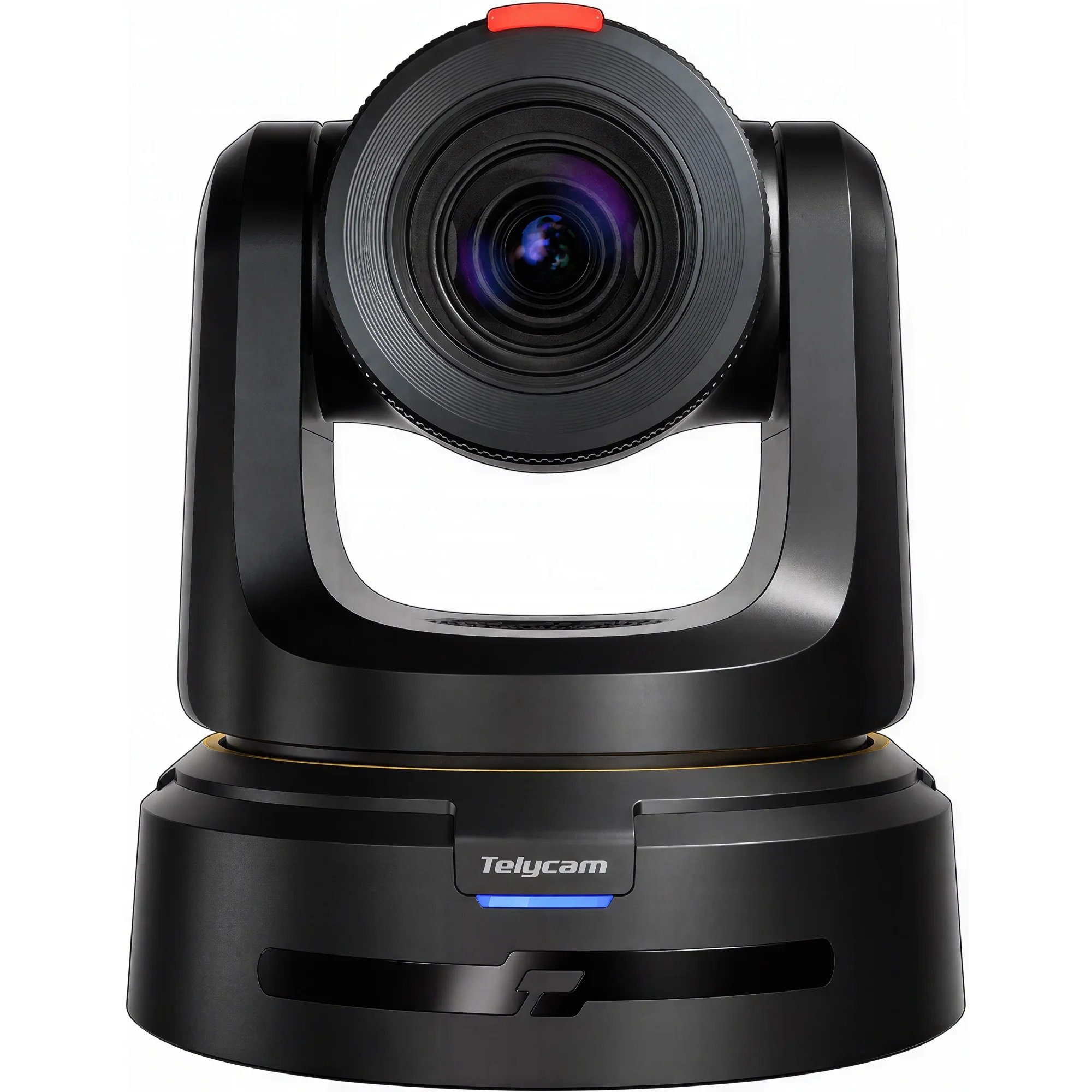
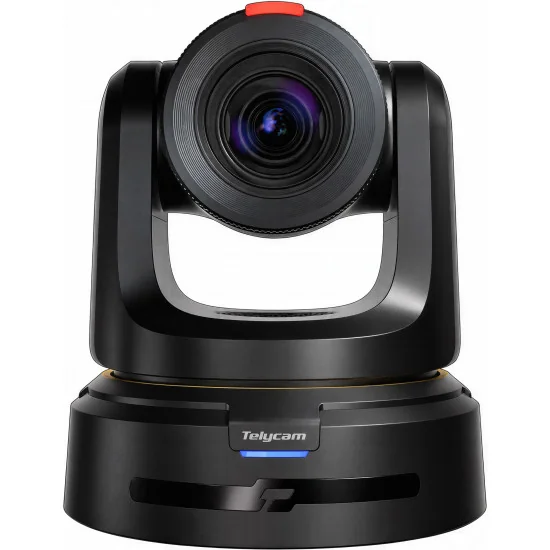
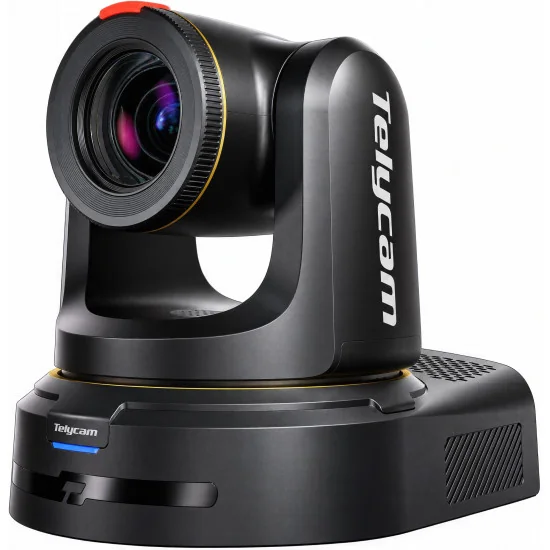
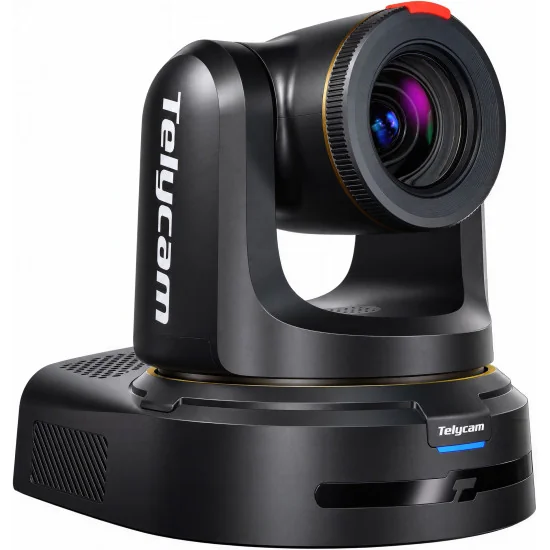
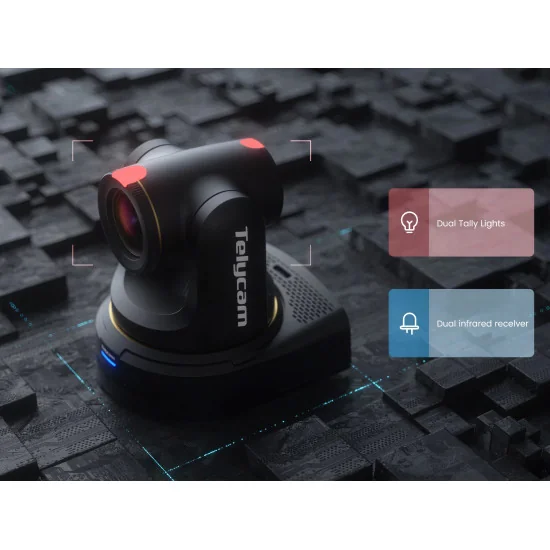
For close-ups of speakers in motion, the Telycam Explore 500 Black 4K PTZ camera uses hybrid PDAF/CDAF autofocus to acquire the subject and refine focus. Its Sony 4/3-type 9MP CMOS sensor and 20× optical zoom cover studio interviews and stage close-ups. The F2.8–F4.5 lens works with built-in ND settings of 100%, 25%, 6.3% and 1.6% transmission to manage exposure without relying solely on aperture changes. Minimum working distance is 1.5 m, a placement consideration in compact studios. An optical low-pass filter reduces moiré and aliasing from LED scenery.
For a conference with a moving speaker, native AI auto-tracking and auto-framing handle subject following and framing adjustments. Brushless DC motors coordinate pan, tilt and zoom during preset recall, keeping transitions between saved shots controlled. Pan and tilt speeds range from 0.1°/s to 150°/s, accommodating slow on-air moves and rapid repositioning. Front and rear tally lights show Program and Preview status.
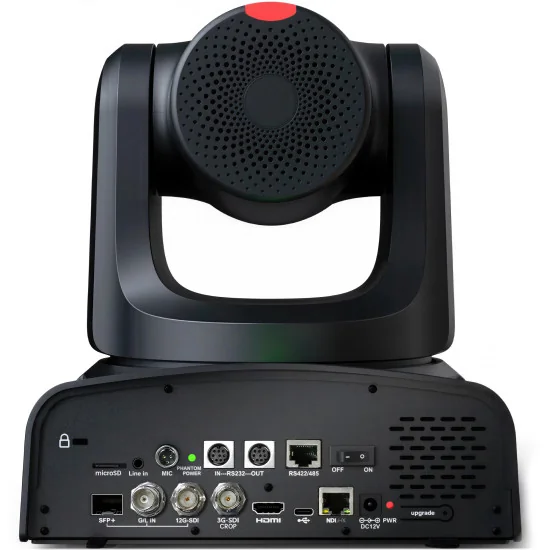
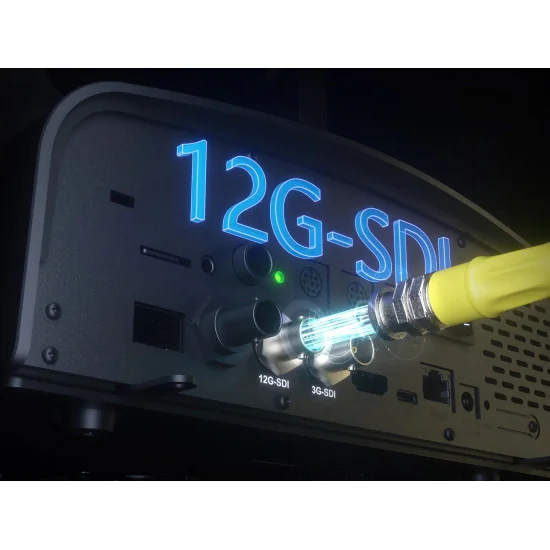
UHD 4K60 reaches the production system through 12G-SDI, HDMI 2.0, SFP+, NDI High Bandwidth or NDI HX3. A separate 3G-SDI output provides an HD crop. USB-C supports up to 4K30 in MJPEG or H.264/H.265, with USB and NDI operation mutually exclusive. SRT, RTMP and RTSP support direct IP streaming. Genlock accepts a reference for multicamera synchronisation; FreeD supplies pan, tilt, zoom and focus data to compatible virtual sets, linking camera movement with the rendered scene.
Local microSD recording keeps a camera-side copy available for review. Mini-XLR with phantom power and a 3.5 mm stereo line input connect microphones or mixer feeds. Operators can use the web interface, VISCA over IP or RS232/RS422/RS485 control. Four scene presets store image settings for different lighting conditions. Power comes from 12 V DC or PoE++ (IEEE 802.3bt), allowing a compatible Ethernet connection to carry power, IP video and control to a remotely mounted camera.
For close-ups of speakers in motion, the Telycam Explore 500 Black 4K PTZ camera uses hybrid PDAF/CDAF autofocus to acquire the subject and refine focus. Its Sony 4/3-type 9MP CMOS sensor and 20× optical zoom cover studio interviews and stage close-ups. The F2.8–F4.5 lens works with built-in ND settings of 100%, 25%, 6.3% and 1.6% transmission to manage exposure without relying solely on aperture changes. Minimum working distance is 1.5 m, a placement consideration in compact studios. An optical low-pass filter reduces moiré and aliasing from LED scenery.
For a conference with a moving speaker, native AI auto-tracking and auto-framing handle subject following and framing adjustments. Brushless DC motors coordinate pan, tilt and zoom during preset recall, keeping transitions between saved shots controlled. Pan and tilt speeds range from 0.1°/s to 150°/s, accommodating slow on-air moves and rapid repositioning. Front and rear tally lights show Program and Preview status.
UHD 4K60 reaches the production system through 12G-SDI, HDMI 2.0, SFP+, NDI High Bandwidth or NDI HX3. A separate 3G-SDI output provides an HD crop. USB-C supports up to 4K30 in MJPEG or H.264/H.265, with USB and NDI operation mutually exclusive. SRT, RTMP and RTSP support direct IP streaming. Genlock accepts a reference for multicamera synchronisation; FreeD supplies pan, tilt, zoom and focus data to compatible virtual sets, linking camera movement with the rendered scene.
Local microSD recording keeps a camera-side copy available for review. Mini-XLR with phantom power and a 3.5 mm stereo line input connect microphones or mixer feeds. Operators can use the web interface, VISCA over IP or RS232/RS422/RS485 control. Four scene presets store image settings for different lighting conditions. Power comes from 12 V DC or PoE++ (IEEE 802.3bt), allowing a compatible Ethernet connection to carry power, IP video and control to a remotely mounted camera.
We ship across the EU for €20, free over €1,000.
B2B sales only, prices excl. VAT.
Official EU distribution and warranty.
Secure online payments via Stripe.
Send your enquiry via the form or email avgear@avgear.shop
Sony 4/3" Sensor: More Light. More Detail.
Explore 500 is built around a high-performance 4/3″ Sony sensor, delivering exceptional image depth, natural subject separation, and accurate color reproduction. The larger sensor format creates a more immersive visual experience while maintaining the consistency required for professional broadcast and live production.
Fast Hybrid AF: Always in Focus
The Explore 500 combines Phase Detection Auto Focus (PDAF) and Contrast Detection Auto Focus (CDAF) to deliver fast, accurate, and stable focusing performance. PDAF enables rapid subject acquisition and instant focus lock, while CDAF provides precise focus refinement for enhanced image sharpness. Together, they maintain continuous, reliable focus through movement and changing conditions — no hunting, no hesitation.
DC Brushless PTZ Motor System with Preset Sync
The Explore 500 features a precision DC brushless PTZ motor system with synchronized Pan, Tilt, and Zoom control during preset recall, ensuring smooth movement between preset positions.
With stable torque across the full speed range, the system delivers especially smooth and precise low-speed operation, reducing jitter and abrupt transitions while eliminating robotic motion commonly found in conventional PTZ cameras for natural broadcast-grade performance.
Optical Low-Pass Filter (OLPF)
As LED walls, large displays, and virtual production workflows become increasingly common, image artifacts can become a challenge. Explore 500 integrates an Optical Low-Pass Filter (OLPF) to help reduce moiré and aliasing before they appear in the image.
The result is cleaner image reproduction and more natural rendering when shooting LED displays, presentation screens, and detailed patterned backgrounds.
Native AI-Based Auto-Tracking & Auto-framing
The Explore 500 incorporates native AI-based auto-tracking and auto-framing technology, this intelligent feature automatically follows subjects, enhancing ease of use and ensuring that important moments are captured flawlessly.
Built-in ND Filter for Light Management
Explore 500 comes with a built-in variable ND filter, allowing adjustment of light transmission levels to 1.6%, 6.3%, 25%, and 100%. Users can also attach their own ND filter directly to the lens using reserved threads for precise control over lighting in various scenarios.
High-Speed 12G-SDI for Professional 4K Video
The Explore 500 PTZ camera features 12G-SDI, a high-speed video interface capable of transmitting 4K video at 60 frames per second over a single cable. This ensures uncompressed, high-quality video output with minimal latency, making it ideal for professional broadcasting and live event production. The 12G-SDI connection also supports longer cable runs without signal degradation, providing reliable performance in demanding environments.
NDI® and NDI® HX Support
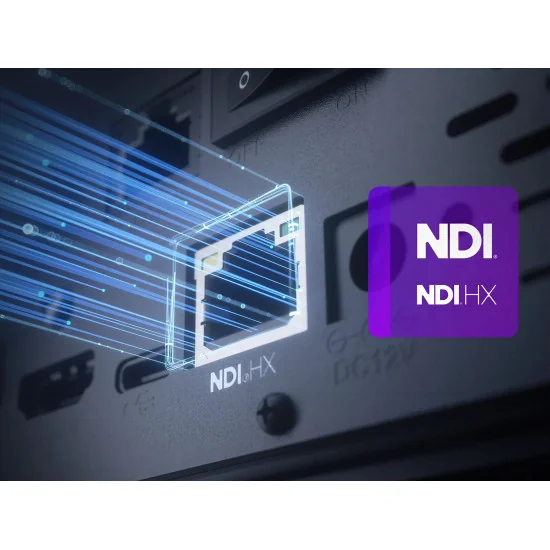
The Explore 500 PTZ camera supports both NDI® and NDI®|HX, offering flexible, high-efficiency video streaming options. NDI® provides high-quality, low-latency video over IP networks, while NDI®|HX optimizes bandwidth usage for smoother performance in network-constrained environments. This dual support ensures robust and adaptable connectivity for diverse broadcasting needs.
Genlock Ensures Seamless Synchronization for Multi-Camera Productions
In multi-camera productions, Genlock (generator lock) ensures seamless switching and compositing of video sources. This synchronization technique provides a reference signal, typically from a dedicated generator or a master camera, guaranteeing all connected devices capture frames at precisely the same time. This prevents tearing and inconsistencies during video production and editing. The Explore 500 features Genlock for superior synchronization, allowing it to function as the main camera and ensure precise video synchronization with sub-cameras in broadcasting and live streaming setups.
FreeD Integration Unlocks Immersive Virtual Productions
FreeD is a protocol that enables precise transmission of Pan, Tilt, Zoom, and Focus (PTZF) data directly from the camera to tracking system. Widely supported by most virtual set systems, FreeD makes virtual productions easier than ever. The Explore 500 seamlessly integrates FreeD technology, empowering users to explore dynamic shooting angles and perspectives, ideal for versatile real-world and virtual-world applications. Explore 500’s broad compatibility with industry-leading virtual set systems like Brainstorm, Vizrt, Zero Density, Aximmetry, Unreal Engine, and VSet3D ensures a smooth workflow for all your virtual production needs.
Robust Audio Capabilities
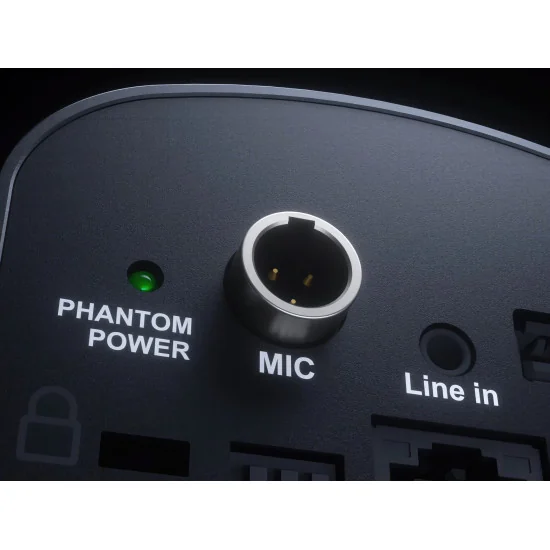
The Explore 500 features 3.5mm line-in and Mini XLR with Phantom power, providing compatibility with various microphones and audio equipment.
Versatile Output Options
The Explore 500 offers diverse output options, ensuring 4K60p output through NDI®, NDI®HX, 12G-SDI, HDMI, and SFP+. It provides great flexibility and compatibility to Telycam users. Note that USB and NDI cannot output simultaneously.
Local Recording for Backup and Cloud Production
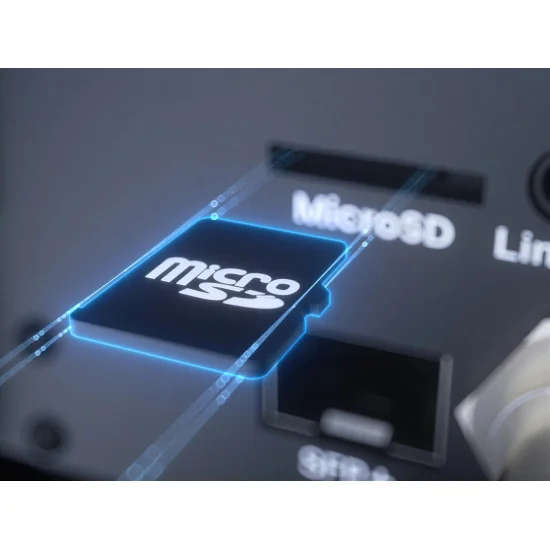
Explore 500 empowers you with in-camera recording via a microSD card slot. Simply insert a Micro SD Card for local recording, providing instant backup during network issues, quick access for event review, and readily available files for upload to your preferred cloud platform. This versatile recording solution ensures peace of mind and streamlines your cloud production process.
Seamless Camera Setup with SSDP
Setting up your Telycam PTZ camera has never been easier, thanks to SSDP integration. This feature streamlines the process of finding your camera’s IP address, especially under multi-camera streaming, eliminating the need for complicated searches or additional tools. Simply connect your camera with an Ethernet cable, ensuring it’s on the same local network with your computer.
Dual Tally Lights for Effortless Production Cues
Explore 500 features built-in dual tally lights, visible on both the front and back of the camera. These lights work seamlessly with NDI, Visca Serial, and Visca over IP protocols. With a simple glance, on-screen talent and crew can identify the currently live camera (“Program”) and the one lined up for the next transition (“Preview”). This intuitive system ensures clear communication, guaranteeing smooth video production.
| Camera | |
|---|---|
| Camera | Explore 500 |
| Part Number | TLC-900-IP-20-4K(NDI)-AB-G2 |
| Sensor | Sony 4/3” inch 9MP UHD CMOS sensor |
| Zoom | 20X optical zoom |
| Lens | f=9.79~186.5mm, F2.8~F4.5 |
| Horizontal View Angle | 71°(Wide)~4.05°(Tele) |
| Vertical Viewing Angle | 39.6°~2.2° |
| Diagonal Viewing Angle | 78.5°~4.6° |
| Minimum Working Distance | 1.5m |
| S/N Ratio | ≥50dB |
| Built-in ND Filter | Variable ND (1.6%, 6.3%, 25%, 100%) |
| Video Format | |
| 12G-SDI | 3840*2160P60/50/30/25/59.94/29.97/24/23.98; 1920*1080P60/50/30/25/59.94/29.97/24/23.98; 1920*1080I60/50/59.94; 1280*720P60/50/30/25/59.94/29.97 |
| 3G-SDI | 1920*1080P60/59.94/50/30/29.97/25/24/23.98; 1920*1080I60/59.94/50; 1280*720P60/59.94/50/30/29.97/25 |
| HDMI2.0 | 3840*2160P60/50/30/25/59.94/29.97/24/23.98; 1920*1080P60/50/30/25/59.94/29.97/24/23.98; 1920*1080I60/50/59.94; 1280*720P60/50/30/25/59.94/29.97 |
| NDI® / NDI®HX3 | Main Stream: 3840*2160P15~60; 1920*1080P15~60; 1280*720P15~60; 1024*576P15~60; Sub Stream: 640*360P15~30 |
| SFP+ | 3840*2160P60/50/30/25/59.94/29.97/24/23.98; 1920*1080P60/50/30/25/59.94/29.97/24/23.98; 1920*1080I60/50/59.94; 1280*720P60/50/30/25/59.94/29.97 |
| USB Type-C | NV12: 1920*1080P5; 1280*720P15; 1024*576P25; 800*448P30 YUYV: 1920*1080P5; 1280*720P15; 1024*576P25; 800*448P30 MJPG: 3840*2160P30; 1920*1080P60; 1280*720P60; 1024*576P60; 800*448P60 H264/H265: 3840*2160P30; 1920*1080P60; 1280*720P60; 1024*576P60; 800*448P60 |
| Image Parameters | |
| Noise Reduction | 2D&3D |
| Minimum lux | 0.5 lux(50 IRE Max AGC, 1/30, F2.8) |
| White Balance | Auto/Manual/ATW/Push/Indoor/Outdoor/Color Temperature |
| Exposure | Auto/Manual/Shutter Priority/Iris Priority/Brightness Priority |
| Anti-Flicker | OFF, 50Hz, 60Hz |
| Image Flip/Mirroring | Supported |
| Focus/Iris/Electronic-shutter | Auto/Manual |
| Gamma | Supported |
| Backlight Compensation | Supported |
| IP Streaming | |
| Video Encoding | H.264/H.265 (Sub stream supports MJPEG) |
| Bitrate Control | Variable bitrate(VBR), Constant bitrate(CBR) |
| Video Bitrate | NDI®HX3: 3Mbps ~ 120Mbps; NDI® High Bandwidth: 90Mbps ~ 250Mbps |
| Network Port Speed | 1000M |
| Protocol | NDI®, NDI®HX3, SRT, HTTP, HTTPS, RTSP, RTMP, RTMPS, ONVIF, VISCA over IP(TCP&UDP), VISCA, PELCO P/D, SSDP, FreeD, NTP, RTP Multicast, WebRTC, MPEG-TS |
| Pan/Tilt Movement | |
| Preset | Remote controller: 10; Serial port: 256; Accuracy:0.1° |
| Pan Rotation Angle | -170°~+170° |
| Tilt Rotation Angle | -90°~+90° |
| Pan Rotation Speed | 0.1°~150°/s |
| Tilt Rotation Speed | 0.1°~150°/s |
| I/O Interface | |
| Control Port | RS232, RS485, RS422, RJ45, USB, NDI®HX3 |
| Video Port | NDI®, NDI®HX3, HDMI 2.0, 12G-SDI, 3G-SDI, SFP+, USB Type-C |
| Audio Port | Mini XLR(with phantom power), stereo 3.5mm line in |
| Tally | Supported |
| POE++ | Supported |
| Daisy Chain | Supported |
| General | |
| Input Voltage | DC12V, POE++(IEEE802.3bt) |
| Operating Temperature | -10℃~50℃ |
| Operating Humidity | ≤80% |
| Dimension(L×W×H) | 232.5 mm×264mm×273mm |
| Net Weight | 4.6kg |
| Color | Black/White |

Data sheet
Specific References