


Canon CR-N500 – PTZ camera with a 1" sensor, NDI, XLR Audio, ND Filters
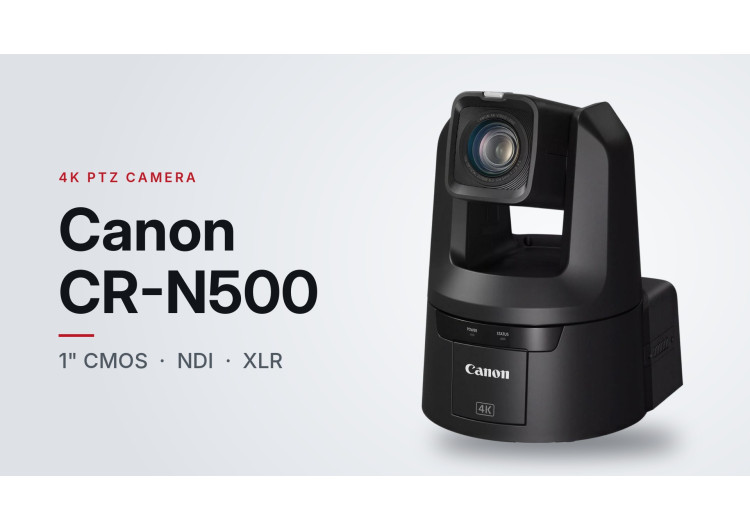
The Canon CR-N500 packs a 1-inch sensor, 15x zoom, XLR audio, NDI and PoE+ into one PTZ body. Broadcast picture and auto-tracking.
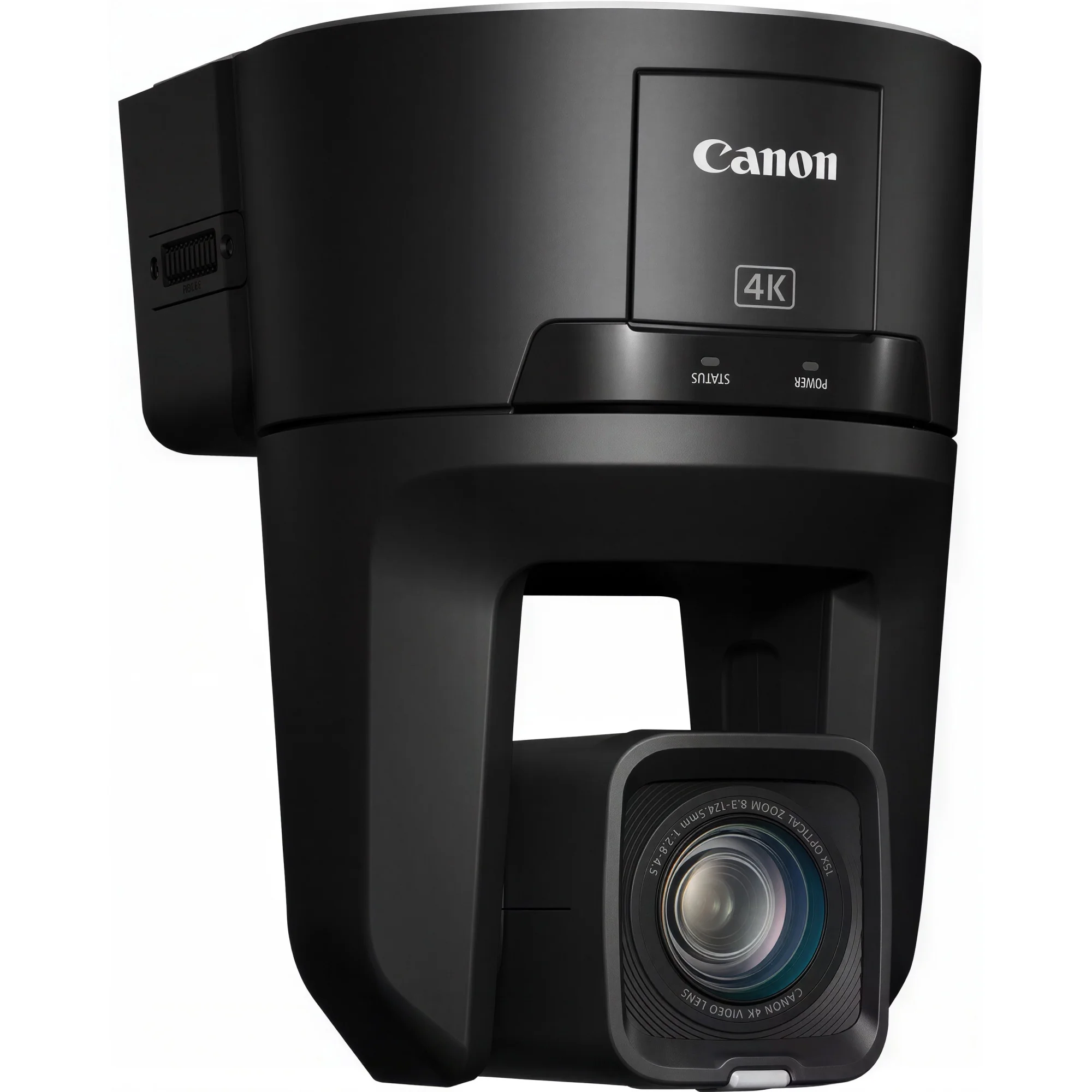
Three point two micrometres. That is the width of a single photosite on the sensor inside the Canon CR-N500, and it says more about this camera than the 4K badge on its base. The 1/2.8-inch chips fitted to many conference PTZ heads pack their 4K pixels at roughly 1.5 µm, so each pixel on the Canon has four to five times the light-gathering area. The rest of the spec sheet – a 15x Canon lens, two XLR inputs, a motorised ND wheel, PoE+ and tracking that runs inside the camera – is built around that sensor.
Canon launched the camera in 2021 and has kept adding to it through free firmware: SRT and FreeD, NDI 5 and later NDI 6, control over the SDI timecode overlay and, from 2024, a Lite edition of its auto-tracking software at no extra cost. For a production company that keeps its cameras in service for five or six years, that update history counts as much as the hardware. Below, each part of the camera is set against a real job, limits included.
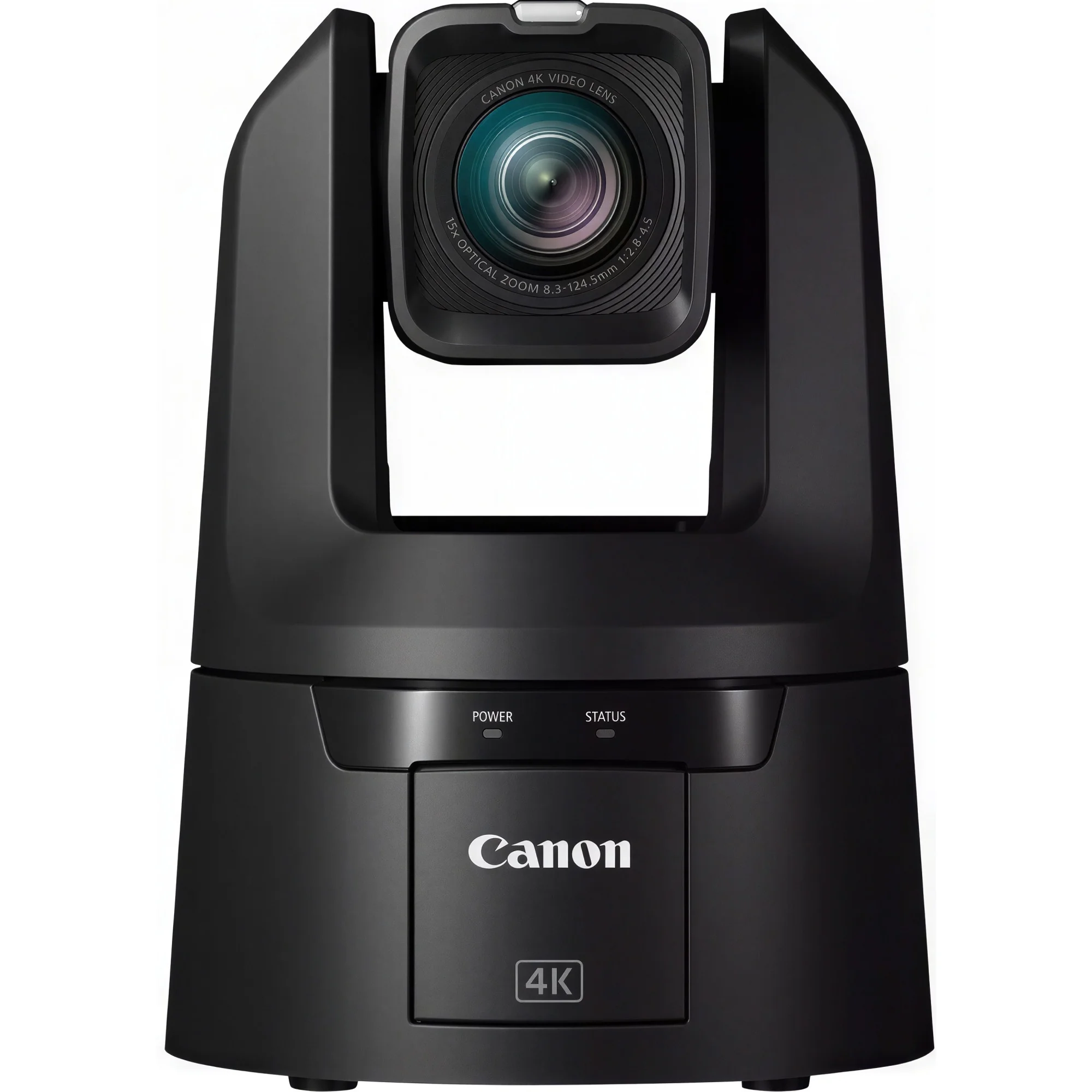
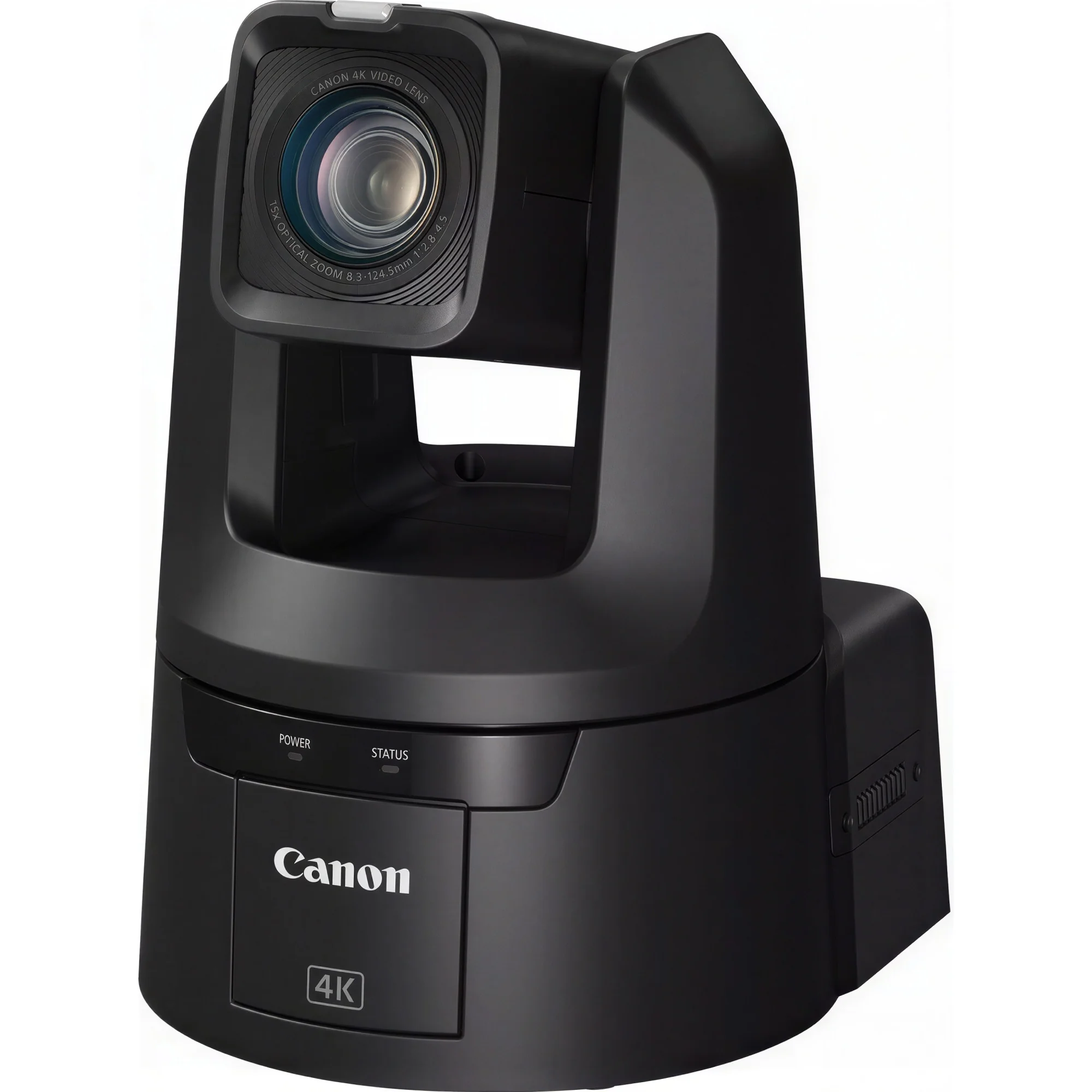
Premium video quality thanks to Canon's 1-inch sensor
The 1.0-type CMOS sensor carries about 13.4 million pixels in total, of which roughly 8.29 million form the 3840 × 2160 active picture. A DIGIC DV6 processor reads it out as 4K UHD at up to 29.97p and as Full HD at up to 59.94p. The HD signal is produced with oversampled processing, so it draws on far more detail than 1920 × 1080 strictly needs. A pinstripe suit, a printed step-and-repeat or the fine mesh of a speaker grille stays clean instead of shimmering.
Low light is where the large photosites pay their way. Minimum illumination is rated at about 1.5 lux in 4K (1/30 s, 33 dB gain) and about 3 lux in 1080p59.94. Gain runs from -6 dB to +33 dB, which gives the vision engineer room in both directions: below zero for a bright TV set, well above it for an awards dinner lit by table candles and a handful of warm spots. A 1.0-type chip usually stays clean at moderate gain settings where small-sensor PTZ cameras already show visible grain in the shadows.
Colour handling follows Canon's cinema practice. Alongside standard curves such as BT.709 sit a Wide DR gamma with 800% dynamic range and Canon Log 3, the same log curve found across the Cinema EOS range. On a recorded concert or a branded-content shoot, CR-N500 footage can be graded in the same project as material from an EOS C70 or C300 Mark III without inventing a separate correction for the PTZ angles.
Focus is handled by Dual Pixel CMOS AF. Every pixel doubles as a phase-detection point, so the lens settles on a moving presenter quickly, without searching back and forth through the focus range. Face Only mode ignores the set entirely, AF speed can be set to high, normal or low, and a focus guide in the control software confirms whether a manually set point is actually sharp. That guide earns its keep at the long end of the zoom, where depth of field gets thin.
Best-in-class Canon optics – 15x zoom lens
The integrated 15x optical zoom runs from 8.3 to 124.5 mm (about 25.5–382.5 mm in full-frame terms) at F2.8–F4.5, closed by a nine-blade iris. Horizontal angle of view swings from 73° to 5.7°, and those two figures translate straight into positions on a floor plan:
- At 73°, a camera three metres from a panel table covers roughly 4.4 metres of width – four or five chairs with air on either side.
- At 5.7°, a frame about 1.2 metres wide, a clean waist-up single, is available from around 12 metres.
- Mounted 20 metres back, the camera still holds a frame about two metres wide at full telephoto: lectern plus speaker, no empty stage.
Beyond the optical range there is a 20x digital zoom setting. Treat it as reserve reach rather than a working focal length, since it crops into the sensor. Firmware 1.7.0 lets the operator cap the maximum digital magnification, so nobody slides into it by accident halfway through a show.
Long lenses magnify every tremor in the mount. A balcony rail flexing under footsteps or a truss carrying moving lights shows up as wobble at full telephoto, so Canon fits an optical-shift image stabiliser with a Standard mode for small vibrations and a Powered IS mode for heavier shake.
Pan covers ±170° and tilt -30° to +90°, both at speeds from 0.1°/s to 100°/s. On air the slow end matters more than the fast one. A gentle drift over an orchestra during a quiet passage, or over a car on a motor-show turntable, only reads as deliberate if the head moves smoothly at a fraction of a degree per second. Up to 100 presets can be stored. Firmware also allows a preset move to be defined by duration instead of speed level, which makes repeated transitions land on the same musical beat every night of a run.
XLR audio input for microphone or line-level signal
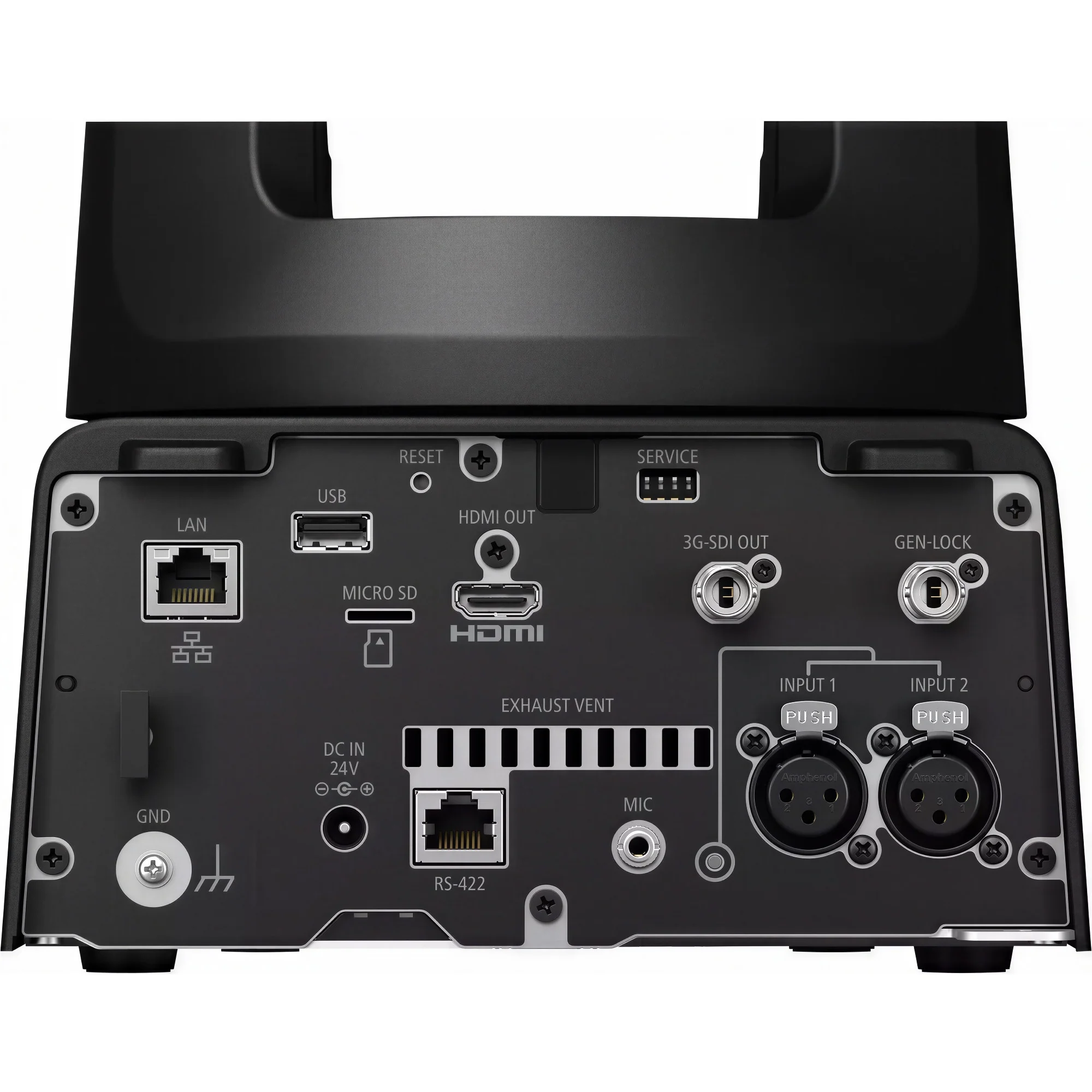
Most PTZ cameras treat sound as an afterthought: a 3.5 mm jack, if anything. The Canon CR-N500 has two full-size, balanced XLR inputs on its rear panel, each switchable between microphone and line level. In microphone mode the sensitivity is -60 dBu, with a 20 dB attenuator for loud sources. Line mode takes the +4 dBu professional level that comes out of a mixing desk. The XLR pair can also supply 48 V phantom power, so a compact condenser mic runs straight from the camera without a separate power unit. A third input, a 3.5 mm stereo mini-jack with 2.4 V plug-in power, accepts a lavalier receiver or a consumer line source at -10 dBV.
Two independent XLR channels change what a single camera can deliver. On a conference stream, input 1 typically takes the sound desk's programme output at line level, while input 2 carries a room microphone at mic level for applause and audience questions. The mixer downstream, or the editor in post, balances the two instead of living with one baked-in mix. At an esports final or a club gig, the 20 dB pad stops a shotgun aimed at the crowd from clipping on the first cheer.
Whichever inputs are selected, their audio is embedded in every output – 3G-SDI, HDMI, NDI|HX and the IP streams. Because picture and sound are packaged in one device, drift between separate audio and video paths stops being a variable on remote productions. An SRT feed from a satellite venue reaches the gallery as one complete signal that a single operator can route, record or put to air.
HDMI, SDI with timecode
For hardware switchers and SDI routers, the camera provides a BNC 3G-SDI output at 1080p59.94/50, 1080i and 720p, all in 4:2:2 10-bit. Next to it sits a full-size HDMI connector carrying 4K UHD at 29.97p, 25p or 23.98p, also 4:2:2 10-bit, plus the same HD formats. No adapter tail, no micro plug to snap off on a rigging day.
One detail belongs in the planning stage. SDI and HDMI share a single output format, and selecting 3840 × 2160 on HDMI switches the SDI port off. In practice there are two sensible set-ups: run the camera in HD on both outputs for an SDI-based gallery, or give HDMI to a 4K recorder on shows where the IP stream carries the live picture and SDI is not needed at all.
The SDI signal embeds timecode as VITC and LTC. On a multi-camera shoot where every angle is also recorded, matching timecode lets the editor line up every angle in one step instead of hunting for a clap, and on a weekly talk show that saving repeats with every episode. Since firmware 1.5.0 the timecode overlay on SDI can be switched on or off, so an engineer can burn it into a monitoring feed and keep the programme output clean. The same release added colour bars for line-up checks before doors open.
A BNC genlock input (1.0 Vp-p, 75 Ω) takes its reference from the sync generator, so every frame from the CR-N500 starts in step with the other sources on the vision mixer. Without it, many hardware switchers have to frame-synchronise the input, which adds up to a frame of delay to that source – small on its own, but it stacks with every other delay in an IMAG chain. Firmware 1.3.0 also lets the SDI and HDMI outputs run with no network cable attached, which is handy for a quick standalone position powered from the 24 V adapter.
NDI outputs and various IP streaming protocols
On the network side the Canon CR-N500 speaks NDI|HX without an additional licence. Canon has kept the NDI stack current: firmware 1.3.0 brought NDI 5 compatibility, and version 1.7.0, released in July 2025, NDI 6. IP video runs up to 4K at 29.97 fps (4:2:0, 8-bit) and up to 59.94 fps in 1080p and 720p. NDI|HX uses long-GOP compression, which keeps the per-camera load a fraction of full-bandwidth NDI and leaves room on a gigabit core for control data and other services.
For direct delivery, RTMP and RTMPS push to streaming platforms, RTP/RTSP feed decoders and recorders, and SRT handles contribution over the public internet with encryption and packet recovery. SRT arrived with firmware 1.2.0, adaptive bitrate followed in 1.4.0, and 1.7.0 added automatic reconnection for both RTMP and SRT. That last change is quiet but valuable on a nine-hour congress where the venue uplink drops for a few seconds after lunch. For hybrid meetings, Canon's free webcam driver brings up to 4K30 from the camera into conferencing software over Ethernet, a long way above what a desk webcam can offer a boardroom.
Virtual production is the third IP use. The camera outputs pan, tilt and lens data over FreeD to virtual-set engines, and since firmware 1.4.0 it can send that data to up to four destinations at once. Canon's own XC protocol covers remote control and integration with other Canon devices. On the Future Games Show, two CR-N500 heads served as close-up cameras on a green-screen set rendered in Unreal Engine, feeding their position data over FreeD so the crew needed no separate tracking hardware on the heads.
PoE power supply – full camera operation with a single cable
One PoE+ (IEEE 802.3at) connection on the gigabit LAN port powers the camera and carries NDI|HX video, embedded audio, IP control and tally. Maximum draw is about 19.6 W for the body, and Canon specifies a Class 4 power source. On a lecture-theatre ceiling or a museum installation, that means a single Cat 6 run of up to 100 metres back to the rack, and no request to the building's facilities team for a new mains socket above the seating. Where PoE is not available, the supplied 24 V DC adapter powers the camera at about 18.6 W.
Plan the power budget with the same care as the bandwidth. Eight CR-N500 heads at roughly 20 W each need about 160 W from the switch before any reserve, and many compact AV switches share a total PoE budget smaller than the sum of their port ratings. The figure that counts is the total PoE budget on the switch datasheet, since a per-port class rating says nothing about how many ports can deliver full power at once. Keep 20–25% in hand for a controller or touch panel drawing from the same unit.
Ceiling hardware ships in the box: a mounting plate with fittings and safety wires, and an installation setting for hanging use. Wall positions need Canon's separate bracket. Operating temperature spans 0 to 40 °C, comfortable for a heated studio grid but not for an unheated loading dock in January.
Built-in ND filters for professional image quality control
A PTZ without ND has only two answers to too much light: close the iris or raise the shutter speed. Both cost something. Stopping a lens far down softens fine detail through diffraction and pushes depth of field so deep that the presenter merges with the set behind them. Fast shutter speeds chop motion into a staccato series of frames and can expose flicker from LED fixtures. The Canon CR-N500 sidesteps the trade with a motorised ND filter in three densities – 1/4, 1/16 and 1/64, equal to two, four and six stops of reduction – switched remotely from the controller or the web interface.
Picture a morning-show set built against a window wall. By mid-morning the daylight overwhelms the key lights, and without ND the iris would close towards its smallest aperture. Engage the 1/16 filter and the iris can sit around F4 while shutter speed holds at 1/50 s, or 1/60 s on 60 Hz systems, so the background keeps some separation from the host. The same logic helps with camera matching: if a handheld Cinema EOS body on the same set works at F2.8, the PTZ can hold a similar aperture, and the cut between the two angles no longer jumps in depth.
The remaining exposure tools suit a broadcast chain. Shutter runs from 1/3 to 1/2000 s, a shutter-angle mode arrived with firmware, and white balance covers 2,000 K to 15,000 K with two memory settings for quick recall. Because the ND moves by motor, density changes happen from the gallery in the middle of a show, with nobody climbing a ladder.
Multiple Canon auto-tracking options: Lite and Full
Tracking on the CR-N500 runs inside the camera through Canon's RA-AT001 Auto Tracking Application – no PC server in the rack. It comes in two tiers. The Lite edition is free: it is preinstalled on cameras sold since June 2024 and reaches earlier units with firmware 1.5.0 or later. The full edition needs a paid licence, sold separately. Both use head detection with a tracking algorithm that holds its lock when another person walks through the shot, and both ease pan and tilt moves in and out instead of snapping onto the subject.
Lite covers the single-presenter case well. The camera picks the subject automatically, keeps it centred, offers two subject sizes and stores one tracking set-up, with sensitivity fixed. For a lecturer moving between lectern and whiteboard, or a chief executive pacing a small stage at a town hall, that is often everything the production needs.
The full licence turns tracking into a framing tool:
- Manual or automatic choice of subject, ten sensitivity levels and five subject sizes.
- Free placement of the target in the frame – off-centre to leave room for a lower third or a slide in picture-in-picture.
- Auto Framing modes: Multi-Person for panels and podcasts, Face Direction to add looking room, Sit/Stand to reframe as a speaker gets up.
- Priority display areas, fixed angle-of-view zones, exclusion areas that stop the camera locking onto faces on posters or screens, and limits on the tracking range.
- Up to five saved tracking set-ups, for example one per session format on a multi-day congress.
All settings are made in a web browser, and the main tracking controls are also available on Canon's RC-IP1000 controller and in the Remote Camera Control Application. The Golden Joystick Awards live stream gives a fair picture of the business case: three ceiling-mounted CR-N500 cameras covered a crowded stage, driven over the XC protocol from one RC-IP1000, with tracking taking care of presenter moves. Fewer hands per position, and the same framing quality from the first session to the last.
The camera suits lecture theatres and corporate studios that need broadcast-grade pictures without an operator on every head, event companies moving between SDI galleries and NDI-only streaming kits, and virtual sets that want tracking data without extra hardware. Before ordering, it pays to run the numbers on your own venues. Share a floor plan, or simply the distance from each mounting point to its subject, along with the PoE switch and controller you already own. Our engineers will tell you which positions the 15x lens covers, how much power headroom remains and whether the full tracking licence earns back its cost over a season. The resulting offer can combine cameras, licences and accessories from the Canon PTZ range, invoiced without VAT under intra-community rules for EU-registered companies.
Comments
No comment at this time!
Leave your comment