


DZOFilm Lenses - Black Friday 2026 Promotion
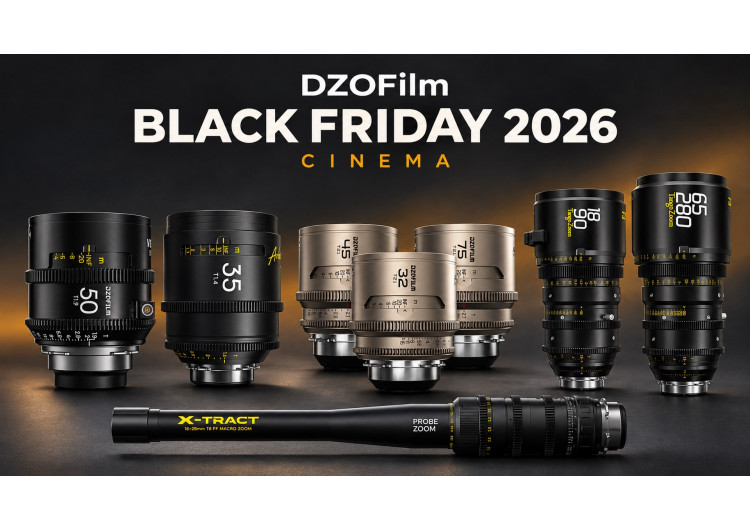
DZOFilm Black Friday offers run until 30 November 2026. Compare the lens families and plan your next production purchase.
Black Friday discounts on selected DZOFilm lenses are available until the end of November 2026.
A lens purchase usually has to serve more than the next shoot. It must fit the cameras already earning their keep, the way the crew works and the projects expected over the coming year. The DZOFilm Black Friday 2026 selection at avgear.shop brings together cine primes, anamorphic sets, a macro probe and production zooms, with promotional offers on selected lenses available until 30 November 2026.
The useful comparison starts with the shot. An interview package, a food commercial and a concert camera need different things from their optics. Here is where Vespid, Arles, X-TRACT, Arcana and Tango fit, and what to check before committing the budget. Current product pages give the applicable price and configuration; a lower lens price only helps when the complete camera package is ready for the job.
DZO Vespid Prime and Vespid2
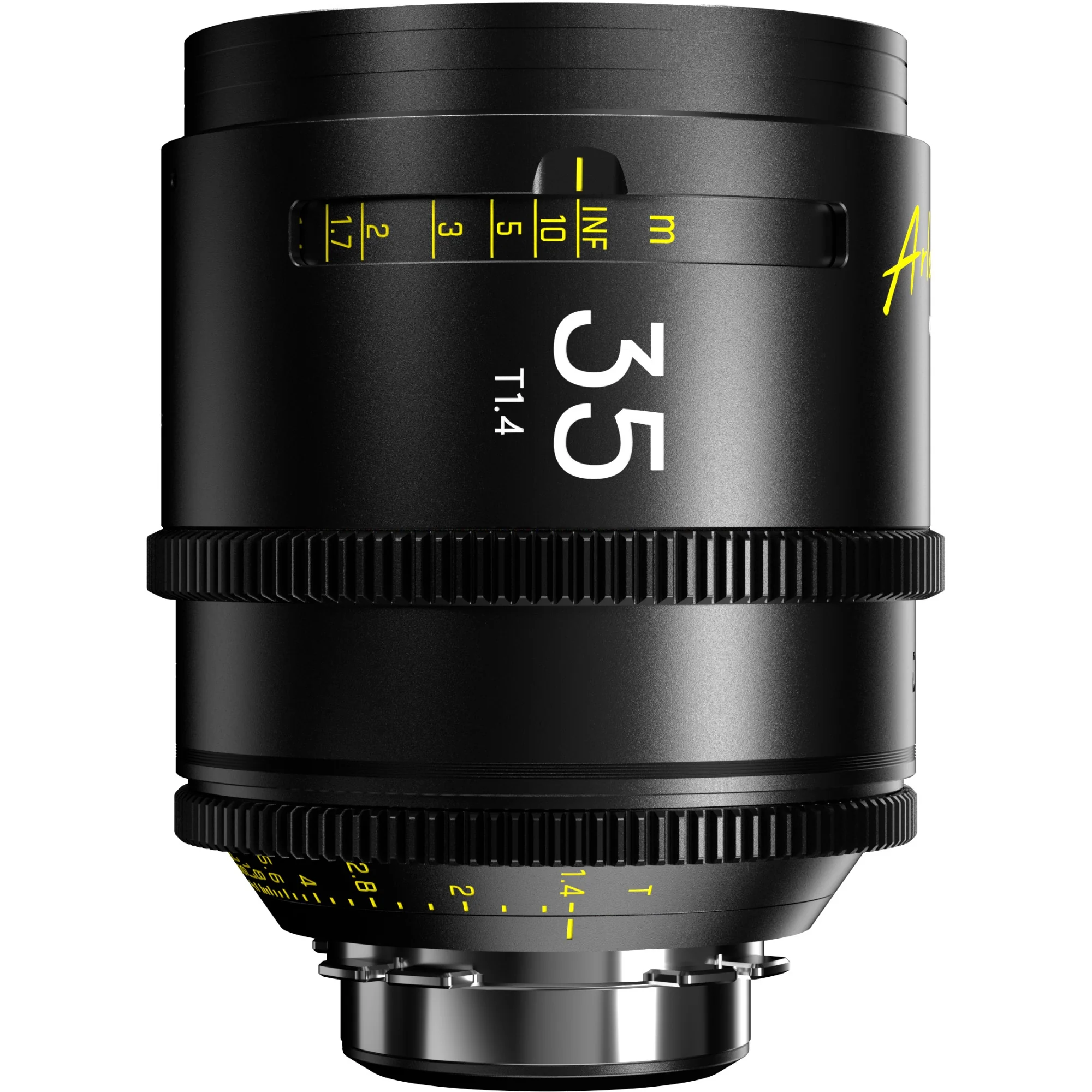
For a small crew moving between an office interview, a location scene and handheld coverage, the DZOFilm Vespid Prime 50mm T2.1 keeps the lens package compact. Its approximately 732 g body makes a tangible contribution to the weight carried by the operator. A 46.5 mm image circle accommodates full-frame capture within that coverage, while the 270° manual focus rotation gives the assistant room to place repeatable marks. The supplied EF mount also gives owners a route between compatible PL and EF camera packages, with flange depth checked after a mount change.
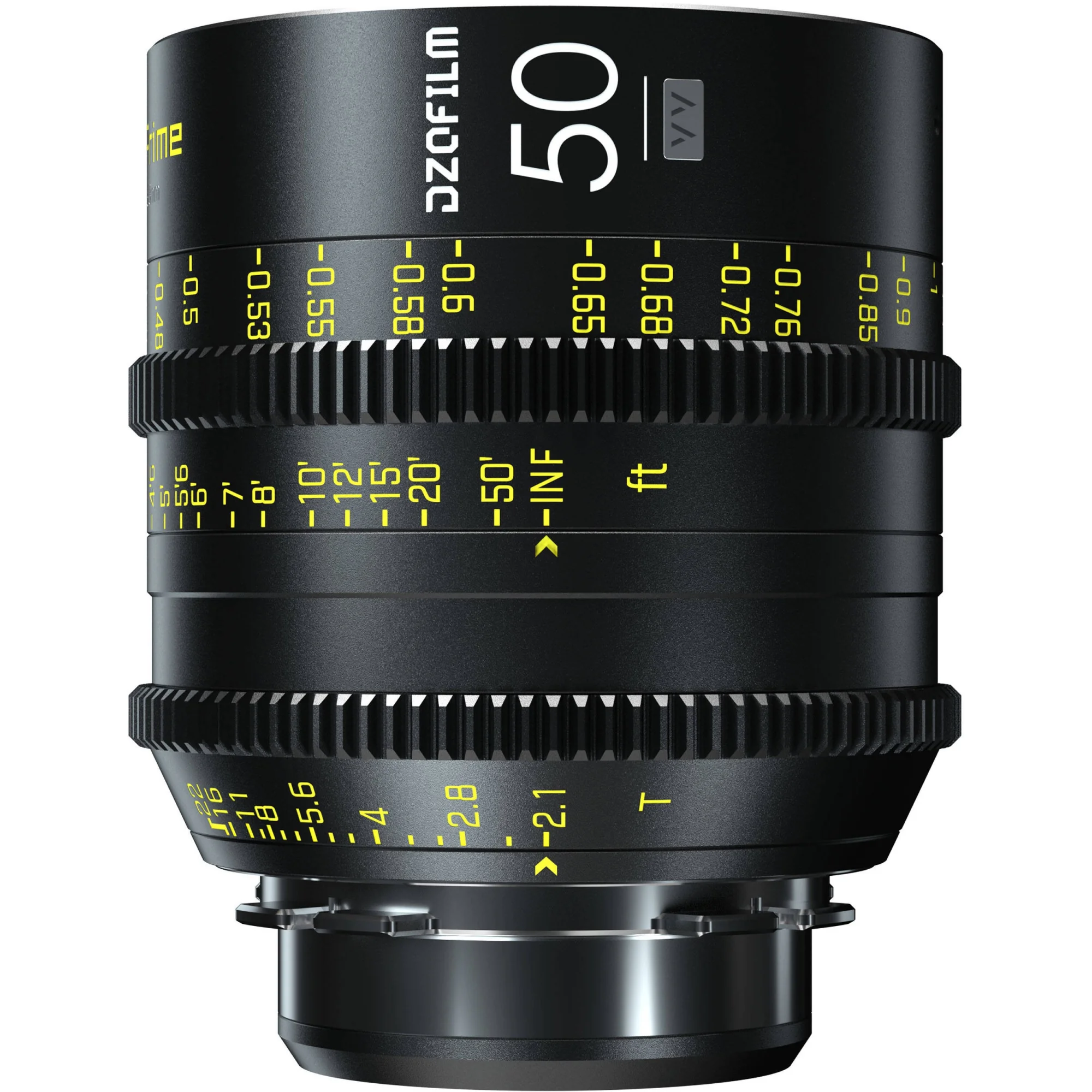
The DZOFilm Vespid Prime2 50mm T1.9 addresses another production requirement: Cooke /i lens metadata. With a compatible camera and data connection, focal length, aperture and focus distance can accompany the recording. That information is useful when a post-production team has to reconstruct a camera setup for compositing. It does not focus the lens for the operator. The 300° focus travel remains a mechanical control, and T1.9 provides an additional exposure option for interiors.
Both featured 50 mm lenses use an 80 mm front diameter and M77 filter thread. Existing filters and a suitably sized matte box can therefore remain relevant when choosing between them. Check the actual camera, mount and metadata path before buying Vespid2 for its electronic communication: a mechanical adapter alone does not establish that connection.
DZO Arles Prime
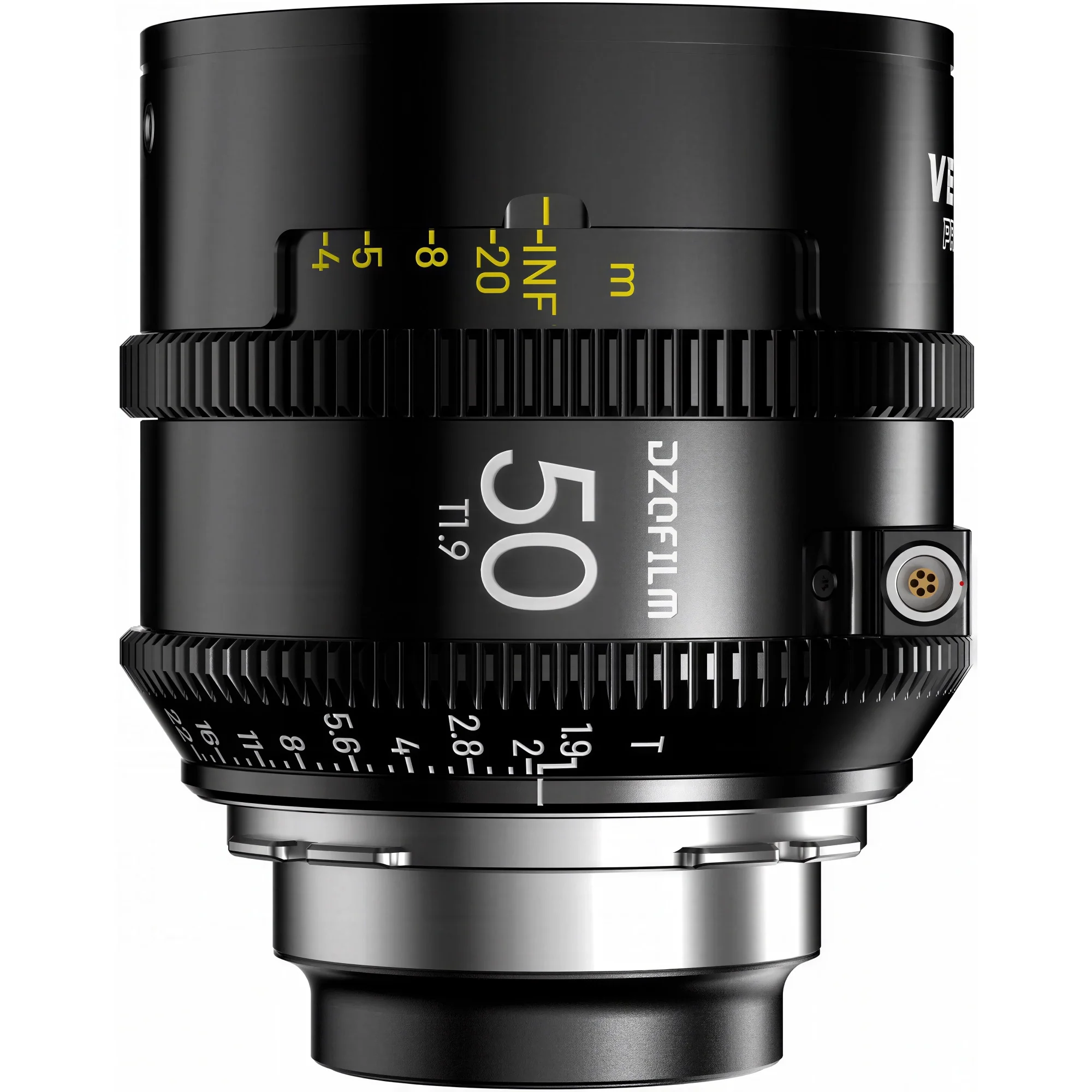
A rehearsed scene permits a different balance between lens size, focus control and exposure. The DZOFilm Arles 35mm T1.4 with metric focus scales gives a cinematographer room to work with practical lamps or to hold a face against a softer background. Its 46.5 mm image circle supports large-format capture within that diameter. In a staged interview, the 35 mm focal length can include the subject's surroundings; moving the camera and arranging the background determine how that context reads.
T1.4 is a choice, not a compulsory setting. A presenter who leans forward or a conversation with several people may benefit from stopping down. The 95 mm front and M86 filter thread also belong in the purchasing decision: a production company moving from smaller lenses should account for its matte box, ND filters and lens support. That is often more consequential than comparing aperture numbers in isolation.
DZO X-Track
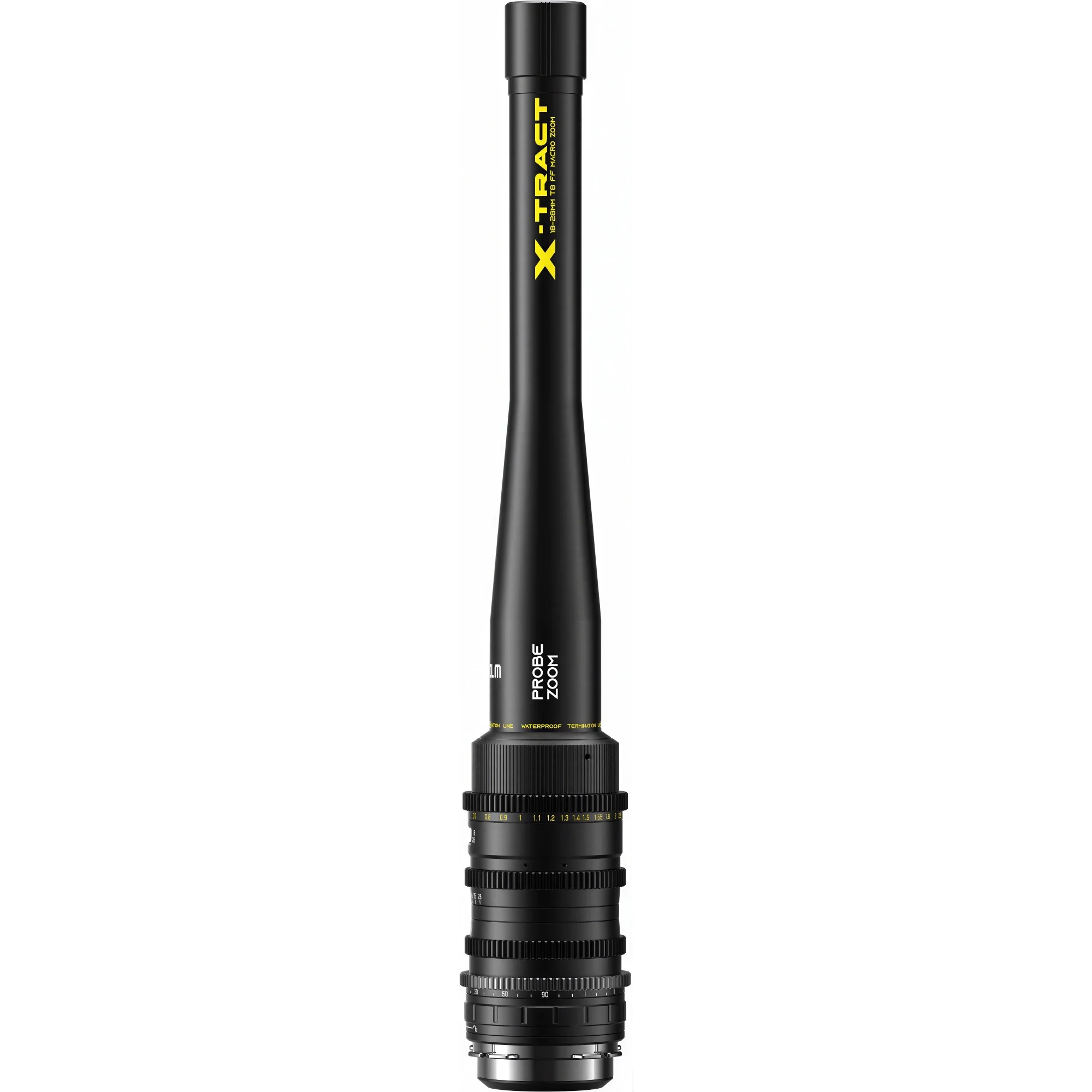
The X-TRACT probe zoom takes the camera into a different scale of scene. The DZOFilm X-Tract 18–28mm T8 0° Direct View combines a slim probe with a zoom range, letting the operator adjust framing while the lens tip stays near a product. Its maximum 2.1× magnification at 28 mm can turn surface texture into the subject of a shot. Think of a camera move alongside roasted coffee beans or through the components of a small mechanism, with enough surrounding space to explain what the viewer is seeing.
The distinction between focus distance and working clearance matters here. At the closest setting, the front of this probe can sit just 6 mm from the subject; the corresponding sensor-plane distance is about 0.47 m. Lighting, reflections and the path of a moving prop need planning around that small gap. T8 also calls for a considered lighting budget, especially when high frame rates shorten exposure time. The resulting inserts can serve a television commercial, an online launch film or a retail display campaign.
DZO Arcana 3-Lens Bundle
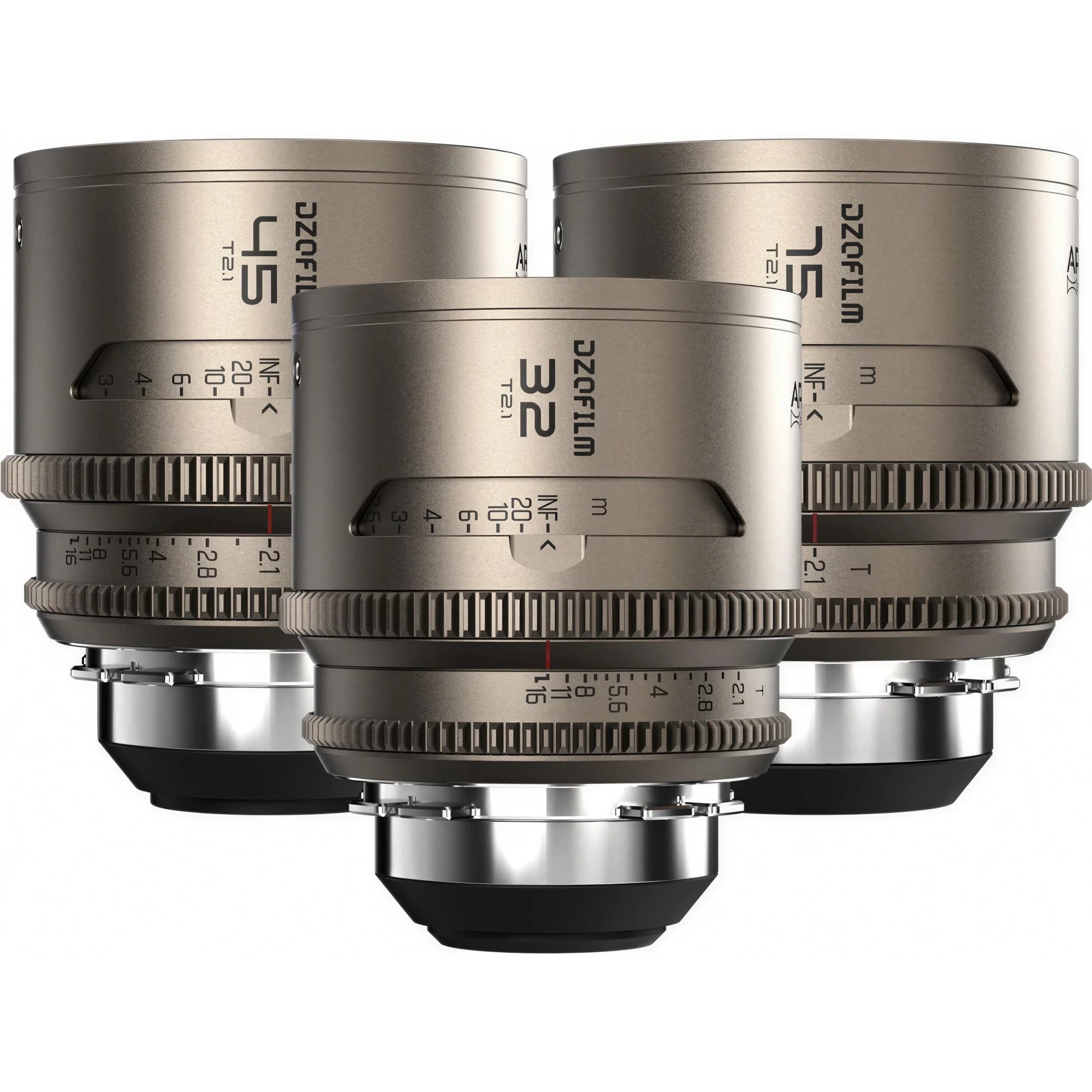
The DZOFilm Arcana 32/45/75mm T2.1 three-lens bundle gives a production a coherent starting point for anamorphic storytelling. The 32 mm can establish a location, the 45 mm carry a conversation and the 75 mm concentrate on a reaction. Each records with a 1.5× anamorphic squeeze, so monitoring and post-production can use the same de-squeeze setting throughout the set.
Arcana combines cylindrical optics with an oval iris to produce elongated out-of-focus highlights. Horizontal flares respond to the colour of the light source, making the placement of practical lamps part of the visual treatment. A music video or branded short can use those characteristics deliberately; a clean product packshot may call for more restrained lighting. The lenses weigh around 0.7 kg each and share an M77 filter thread. That makes the set manageable for mobile camera work, while balance and motor calibration still deserve a check after every lens change.
DZO Tango Zoom
During a concert or conference, the operator may need a tighter frame before anyone can stop to change a lens. The DZOFilm Tango two-lens zoom kit pairs an 18–90 mm T2.9 with a 65–280 mm T2.9–4. On compatible Super 35 camera configurations, the first covers a broad range of stage and presenter shots; the second reaches isolated performers or speakers from a more distant camera position. Their overlapping focal ranges help when assigning cameras to complementary positions.
The 18–90 mm maintains T2.9 throughout its zoom range. The longer lens reaches T4 at its long end, so an exposure plan must account for that change. Both are parfocal zooms, with flange-back adjustment available to match the camera. Their 31.5 mm image circle is a Super 35 coverage specification, which should be checked against the selected recording area. Full-frame mode is not an automatic fit.
For operated live cameras, an optional MOVCAM servo system can provide remote lens control with a compatible setup. It is separate from the featured lens bundle. Include control hardware, power, support rods and the total camera load when costing a streaming, worship or event-production package.

Excellent prices on other DZOFilm lenses, including special bundle offers
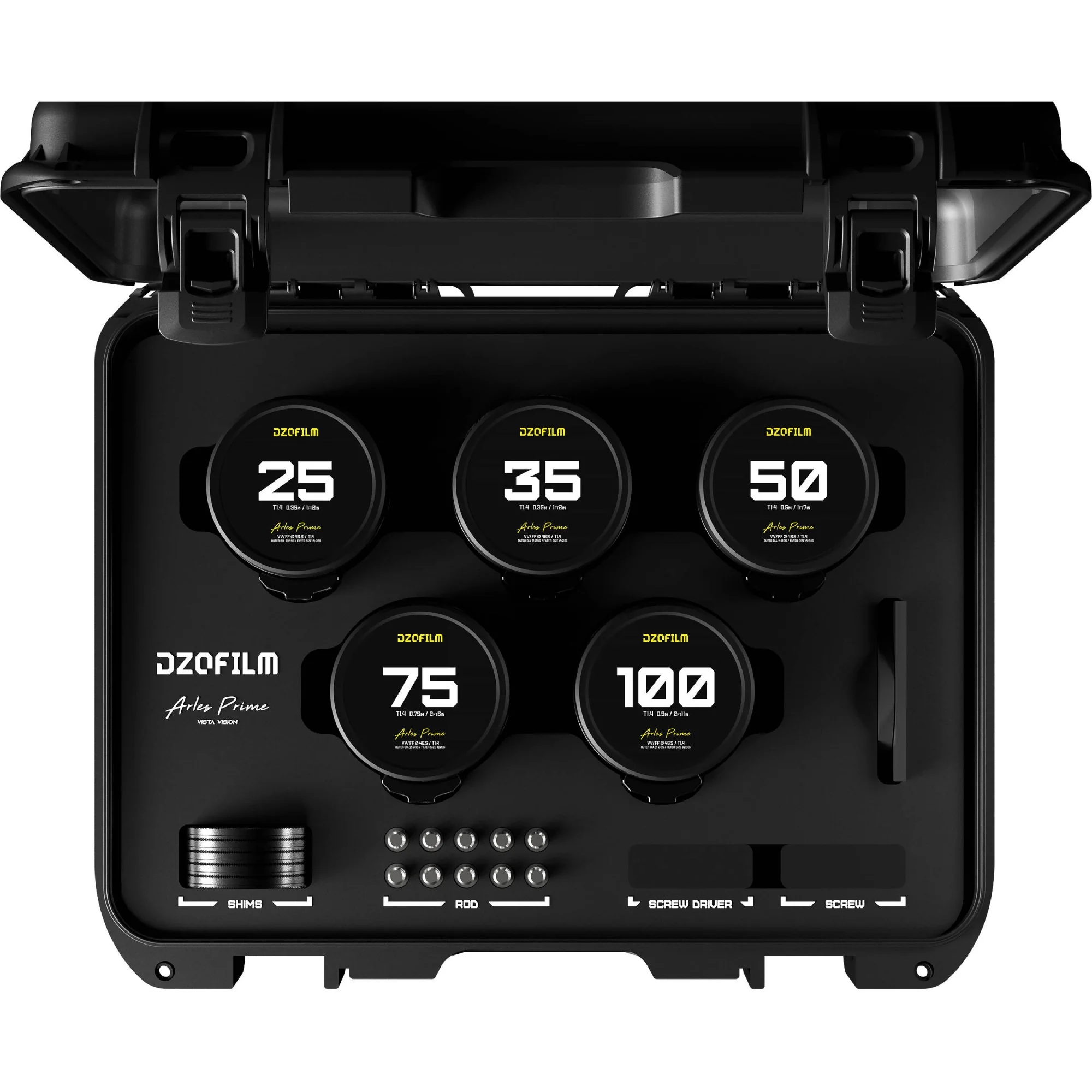
A bundle earns its place when its focal lengths will be used. The DZOFilm Arles five-lens kit with 25, 35, 50, 75 and 100 mm primes covers a sequence of wide, conversational and closer framings with T1.4 available across the set. For a production company shooting recurring corporate films or drama, that can form a planned core kit rather than a series of unrelated purchases.
Compare the bundle with the lenses already on the shelf. A missing focal length, a second interview camera or a repeated rental requirement may justify the next purchase more clearly than the size of a set. Other DZOFilm lenses and bundle offers are also available at avgear.shop; check the current configuration and price, then request a quotation around the camera bodies, accessories and shooting dates involved.
Full frame or Super 35: check the recording area first
Lens coverage depends on the active sensor area. The same camera can use different areas for open-gate capture, cropped high-speed recording or a Super 35 mode. Compare the diagonal of that active area with the lens's specified image circle, then test the intended settings. A mount that locks into place establishes mechanical attachment, not complete optical coverage.
This distinction separates several choices in this promotion. The featured Vespid and Arles primes specify 46.5 mm, Arcana 43.3 mm and X-TRACT 43.2 mm, while Tango specifies 31.5 mm. Those numbers answer a practical question: can this lens cover the camera mode required for delivery? They do not, by themselves, certify performance on every sensor marketed as full frame or VistaVision. For a studio sharing lenses between bodies, write down recording modes as well as camera names before placing an order.
What a T-stop tells you about exposure
A T-stop describes light transmission, accounting for optical losses as well as aperture geometry. It helps a crew compare exposure when changing lenses. It does not describe every aspect of depth of field, sharpness or contrast, and it cannot replace a lighting test with the actual subject.
Consider a two-person interview recorded for a training programme. Opening the lens may preserve the intended brightness, but it can leave too little tolerance when both speakers move. Adding light and stopping down may make the take more dependable. A macro insert presents a different problem: the X-TRACT's T8 and the desired frame rate determine how much illumination is needed around a very small subject. Choose the lens and lighting together.
Plan anamorphic framing before the first take
A 1.5× lens requires a corresponding horizontal de-squeeze. Starting with a 16:9 recording produces approximately 2.67:1 before cropping, calculated as 16 ÷ 9 × 1.5. Delivery at 2.39:1 therefore needs a framing decision, usually involving a crop at the sides when retaining the full image height. Set the final frame guides on the monitor before actors, props and titles occupy those edges.
A cinema master and a portrait social version may need different compositions, even when they come from the same campaign. Decide which delivery takes priority and allow for a separate setup when necessary. With the Arcana three-lens set, the shared squeeze factor makes the technical setup consistent; it does not make every horizontal composition suitable for a narrow crop.
Parfocality, focus breathing and remote control are different things
A parfocal zoom holds focus while focal length changes, provided the lens and camera are correctly adjusted. Focus breathing describes a change in framing as focus moves. Remote control describes how the rings are driven. These are separate properties, and checking one does not establish the others.
Before putting a Tango zoom on an event camera, test focus at both ends of the range and follow the lens-specific flange-back procedure if adjustment is needed. Then rehearse the zoom speed and the operator's control position. For a panel discussion or a university broadcast, a slow, repeatable framing change is more useful than discovering a control incompatibility during transmission. A cine lens also needs an appropriate focus solution when the camera is beyond the operator's reach.
Build the purchase around the complete camera package
The cost of ownership includes adapters, filters, matte-box fittings, motors, supports and preparation time. A common front diameter can reduce duplicated accessories, but the package still has to balance on its tripod, shoulder rig or stabiliser. For a studio with several operators, agreeing on distance scales and control conventions can prevent avoidable delays between assignments.
Estimate likely use from the production calendar: paid shooting days, recurring rental costs and the projects that require a specific optical look. Avoid assigning a payback period without those figures. To discuss the DZOFilm lenses and sets available from avgear.shop, send the camera model, recording mode, preferred mount and planned application with your enquiry. Those details turn a Black Friday shortlist into a quotation that can be checked against the work booked ahead.
Comments
No comment at this time!
Leave your comment