


Servo Lenses for Blackmagic Ursa Broadcast
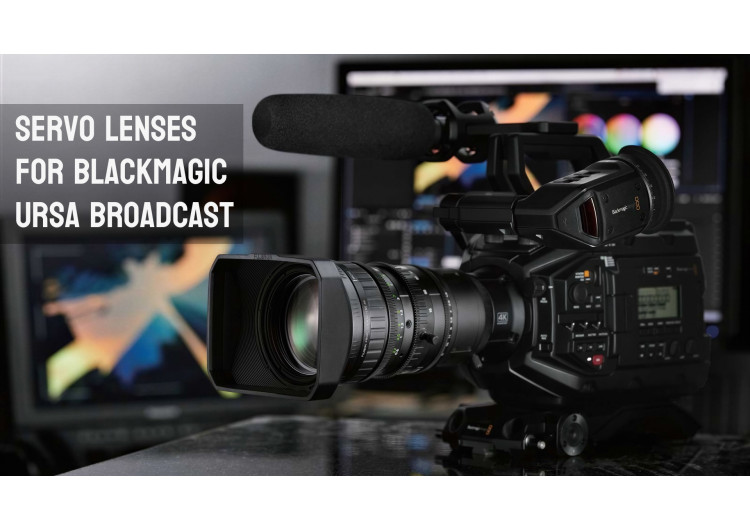
Servo zoom lenses unlock the full broadcast potential of the Blackmagic URSA Broadcast G2. This guide covers two Fujinon B4 mount options built for 4K ENG and live production.
When a broadcast camera leaves the warehouse and heads to a stadium, a news scene, or a house of worship, the lens mounted on its front determines most of what the audience will see. Sharpness at the telephoto end, colour rendition under mixed lighting, the smoothness of a slow zoom during a concert — all of these come down to glass. The Blackmagic URSA Broadcast G2 ships with a B4 lens mount already installed, which opens the door to a mature ecosystem of 2/3-inch servo zoom lenses from manufacturers such as Fujinon and Canon. Two lenses in particular stand out for operators who need a single, self-contained optical package with motorised zoom and focus: the Fujinon LA16x8BRM and the Fujinon LA30x7.8BRM-XB2.
Both lenses resolve at 4K across the zoom range, include a built-in servo drive unit, and communicate electronically with the camera body through the standard 12-pin broadcast connector. That last point matters: it means iris, zoom, and focus data travel back to the camera and, from there, to an ATEM switcher or remote-control panel, so a single operator in an OB truck can pull focus or ride the iris without touching the lens barrel.
Choosing a Lens for the Blackmagic Ursa Broadcast
The Blackmagic URSA Broadcast G2 is often described as three cameras in one body. With the B4 mount attached, its 6144 × 3456 sensor crops to a 2/3-inch 4K window, behaving exactly like a traditional broadcast camera. Swap in the included EF mount, and the full 6K sensor area becomes available for cinematic shooting. This dual personality makes lens choice especially important: the B4 configuration is where the camera earns its living in studios, outside-broadcast vans, and live streaming rigs, so the lens sitting on the front needs to match the demands of those environments.
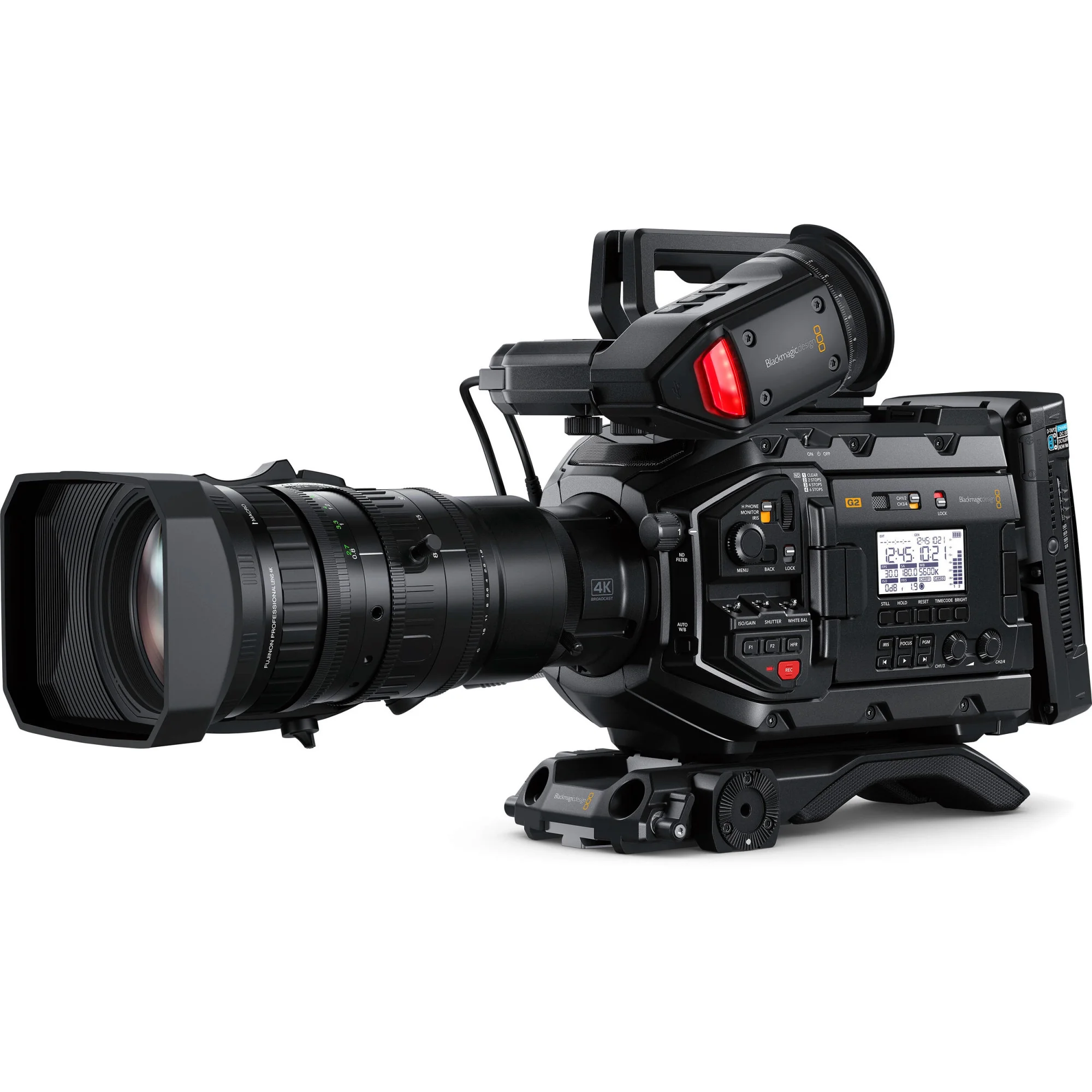
A few factors separate a broadcast servo lens from a cine or photo zoom. First, parfocality: a true broadcast zoom holds focus throughout the entire zoom range, which is non-negotiable when you are live on air and cannot cut away to hide a soft frame. Second, the servo mechanism itself — a motor-driven zoom and focus assembly that responds to external demands from a zoom controller, a focus demand knob, or software commands sent over SDI from an ATEM panel. Third, the 12-pin connector on the lens barrel passes iris, zoom position, and focus position metadata to the camera, enabling features like virtual set integration, augmented-reality graphics overlays, and remote lens shading.
The URSA Broadcast G2 sensor uses dual native ISO values of 400 and 3200, stretching from −12 dB (ISO 100) to +36 dB (ISO 25,600). Under studio lighting the base ISO of 400 keeps noise invisible, but when covering a dimly lit press conference or a night-time sports event the jump to ISO 3200 gives the operator roughly three extra stops without a visible penalty in grain. This means that even a lens with a modest maximum aperture can still produce a clean image at low light levels, because the camera body contributes so much sensitivity on its own.
Built into the camera body sits a four-position ND filter wheel — clear, 2-stop, 4-stop, and 6-stop — which removes the need for external matte boxes or screw-on ND filters. Combined with electronic iris control through the B4 mount, an operator can balance exposure from the lens grip or from a remote panel without ever taking a hand off the tripod handle.
Recording options on the URSA Broadcast G2 cover the full broadcast chain: H.265, Apple ProRes 422, and Blackmagic RAW. In 4K with the B4 mount the camera records up to 60 fps in ProRes, which satisfies the slow-motion requirements of most sports productions. The 12G-SDI input and output allow direct programme return from a switcher, and that return feed is what enables remote lens control via ATEM — a detail that integrates seamlessly with the servo lenses discussed below.
Fujinon LA16x8BRM
The Fujinon LA16x8BRM has earned a reputation as the go-to entry point into 4K B4 servo zoom territory since its introduction in 2019. Its focal range of 8 mm to 128 mm gives a 16× zoom ratio, and the maximum aperture starts at a fast T1.9 on the wide end, ramping to T2.8 at full telephoto. In practical terms, the 8 mm wide end translates to a horizontal angle of view of approximately 61.9°, wide enough to frame an entire news desk or a small stage, while the 128 mm telephoto narrows the field to about 4.3°, tight enough to isolate a speaker at a podium from across a medium-sized venue.
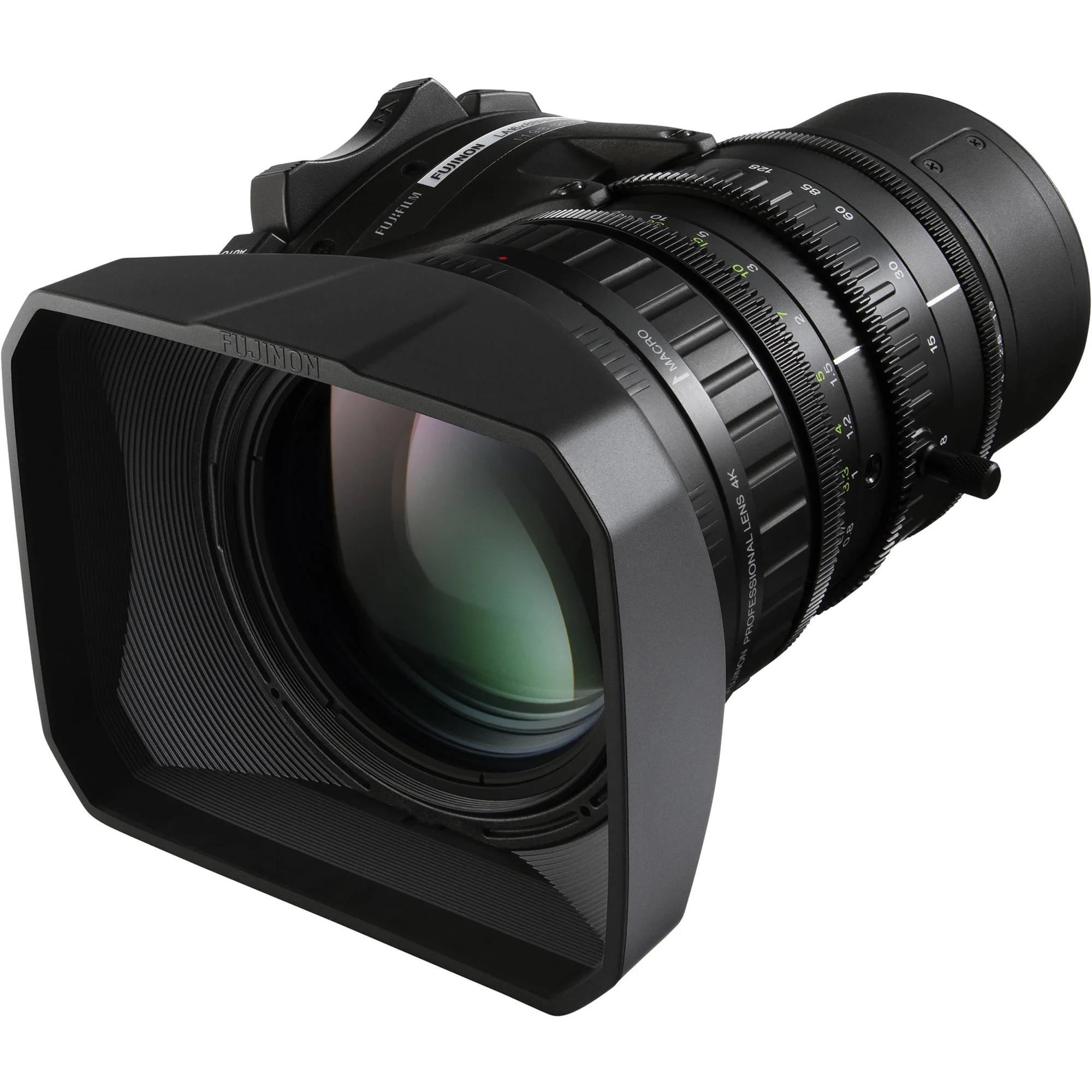
What makes the LA16x8BRM stand apart from similarly specified HD-era lenses is its optical resolution. Fujifilm engineered the glass groups to resolve 4K detail from corner to corner at every focal length, not just at the centre of the image circle. For multicam church services, corporate town halls, or educational live streams where the audience views on large monitors or 4K displays, that edge-to-edge sharpness translates into noticeably cleaner text on lower-thirds and crisper faces at the margins of wide shots.
Physically, the lens measures just 163.8 mm in length with a diameter of 85 mm, and its weight sits at 1.6 kg. That is light enough to maintain a comfortable balance on the URSA Broadcast G2 even on a lightweight carbon-fibre tripod, and compact enough to travel in a standard Pelican case alongside the camera body and accessories. For ENG crews who carry their rig on a shoulder for hours at a time, every hundred grams matters — and the LA16x8BRM keeps the centre of gravity close to the operator's body.
The lens uses a rear focus mechanism, meaning the focusing group sits behind the zoom groups rather than at the front of the barrel. This approach brings two concrete benefits. First, it substantially reduces focus breathing — the subtle shift in framing that occurs when you rack focus, which is distracting on air. Second, it keeps the front element stationary during focus pulls, so any lens-mounted accessories such as a matte box or a prompter hood stay in place without vibration or shifting.
An electronic flange-back adjustment eliminates the traditional process of shimming the lens mount to achieve back focus. Instead, a single button on the lens body triggers an internal motor that sets the correct flange distance digitally. During a multicam shoot where several URSA Broadcast G2 bodies share a pool of lenses, this feature saves valuable minutes at the start of the day: mount the lens, press the button, confirm back focus on a chart, and start shooting.
The built-in macro function overrides the minimum object distance of 0.8 metres by sliding the focus ring forward, allowing the operator to focus on subjects as close as approximately 5 cm from the front element. This is not a gimmick — product demonstrations, cooking shows, and medical training broadcasts all require extreme close-ups of small objects, and the macro mode delivers those shots at full 4K resolution without an additional diopter or close-up attachment.
The included servo drive unit handles both zoom and focus electronically. When the lens is connected to the URSA Broadcast G2 via the 12-pin connector, zoom and iris can be controlled remotely from Blackmagic's ATEM software or a hardware zoom demand — provided both SDI cables (programme out from the switcher to SDI in on the camera, and SDI out from the camera back to the switcher) are connected. That bidirectional link also sends lens position metadata, which is increasingly relevant for studios using augmented-reality graphics or virtual sets.
The M82 × 0.75 mm filter thread accepts standard 82 mm screw-on filters. While the URSA Broadcast G2's internal ND wheel handles most exposure scenarios, some operators prefer to add a polariser for outdoor sports coverage near water or glass, or a diffusion filter for interview setups — and the 82 mm thread accommodates those without an adapter ring.
In terms of use cases, the Fujinon LA16x8BRM fits naturally into several common broadcast scenarios. A two- or three-camera church production typically places one wide and one tight; the 16× range of this lens can cover either role. Corporate event streaming — keynotes, panel discussions, product launches — benefits from the fast T1.9 aperture under variable stage lighting. Small-market television news studios that have transitioned to 4K find that a pair of URSA Broadcast G2 bodies fitted with LA16x8BRM lenses replaces much more expensive legacy studio camera chains while delivering sharper output. And for esports broadcasts, where cameras often sit on fixed positions pointing at players and commentators, the compact footprint and reliable servo operation make it a set-and-forget solution.
Fujinon LA30x7.8BRM-XB2
Released in late 2025, the Fujinon LA30x7.8BRM-XB2 nearly doubles the zoom ratio of its predecessor while adding only 200 grams and 26 mm of length. Its focal range stretches from 7.8 mm to 234 mm, delivering a 30× zoom — the highest ratio in its weight class among 2/3-inch 4K portable broadcast lenses. The wide end offers a horizontal angle of 63.2°, marginally wider than the LA16x8BRM, while the telephoto end reaches 2.3°, which in practice lets an operator frame a head-and-shoulders shot of a musician on the far side of a concert hall or isolate a referee on a football pitch from a camera position behind the goal line.
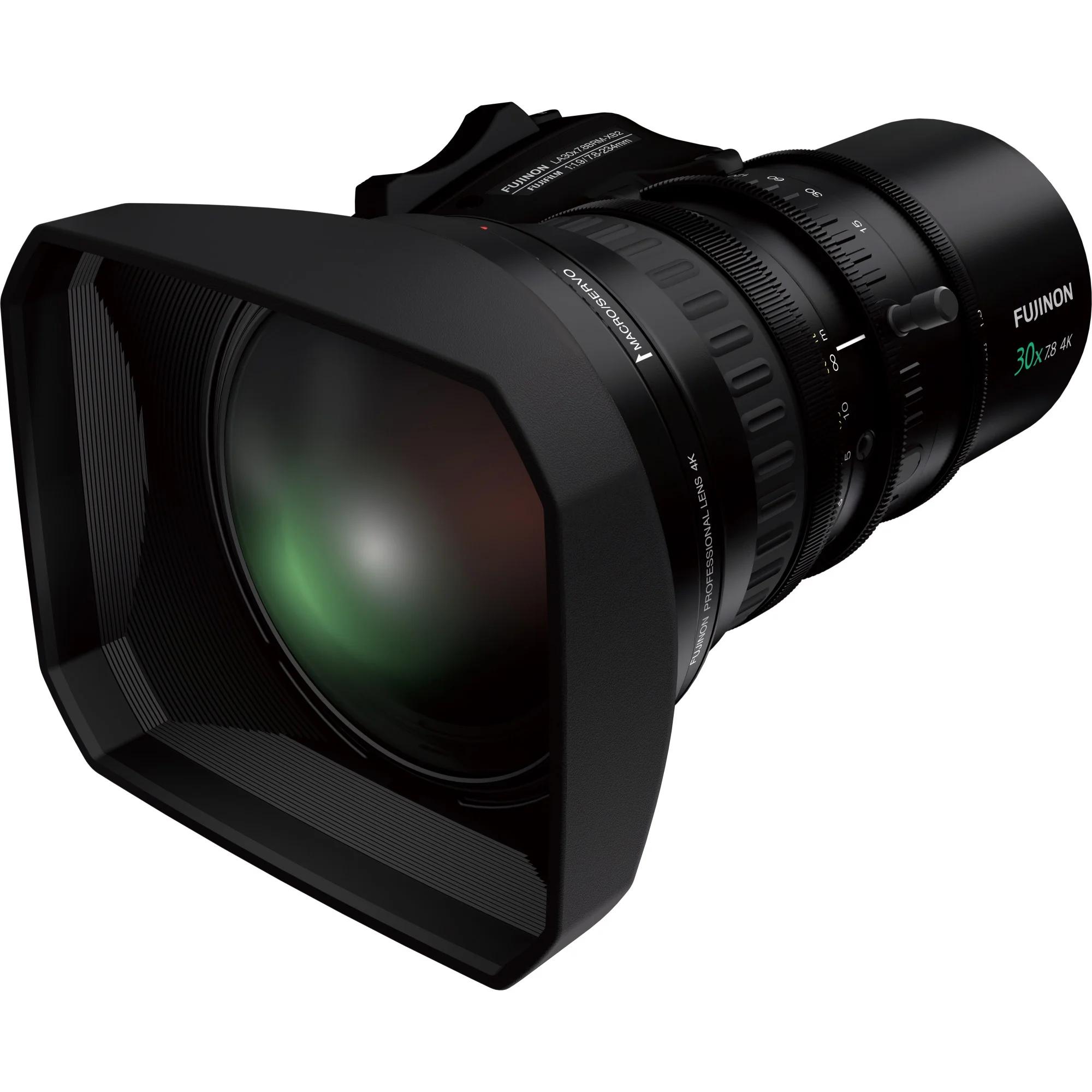
The maximum aperture of f/1.9 at 7.8 mm narrows to f/3.9 at the 234 mm telephoto end. That telephoto-end figure is roughly one stop slower than the LA16x8BRM at its long end, which is an expected trade-off for almost doubling the reach. In outdoor daylight conditions this difference is inconsequential; during evening events the URSA Broadcast G2's high-base ISO of 3200 compensates comfortably.
Where the LA30x7.8BRM-XB2 takes a significant step forward is in its drive unit. Fujifilm equipped this lens with 16-bit encoders on the zoom, focus, and iris axes. Compared to the 12-bit or 14-bit encoders found in many older broadcast lenses, the 16-bit resolution delivers far more precise position data — 65,536 discrete steps per axis instead of a few thousand. For conventional shooting, this means smoother servo response. For virtual production stages and augmented-reality graphics, it means the tracking engine receives lens metadata accurate enough to lock a CG element to a real-world position with sub-pixel precision, even during a fast zoom. Broadcasters who overlay sponsor graphics onto a playing field, or insert virtual advertisements into stadium hoardings, will see fewer registration errors.
The zoom motor itself is remarkably flexible in speed. At its fastest, the lens racks from the 7.8 mm wide end to the 234 mm telephoto end in approximately 1.0 second — fast enough to follow a breakaway in football or a fast break in basketball. At the slowest setting, the same travel takes around 120 seconds, producing an imperceptible creep zoom that music-concert directors and documentary shooters favour for building dramatic tension without drawing the viewer's attention to camera movement.
Fujifilm's HT-EBC multi-layer coating (High Transmittance Electron Beam Coating) covers the optical surfaces to maximise light throughput and suppress internal reflections. In a lens with this many glass elements — necessary to maintain 4K resolution across a 30× range — each air-to-glass surface is a potential source of flare and contrast loss. The HT-EBC treatment reduces these artefacts to a level where shooting into a bank of stage lights or towards a low sun produces controlled, predictable flare behaviour rather than a washed-out image.
Like the LA16x8BRM, the LA30x7.8BRM-XB2 employs a rear focus mechanism that limits breathing and stays quiet when responding to autofocus commands from the URSA Broadcast G2. The electronic flange-back adjustment is again present, activated by a single button — a welcome time-saver on multicam shoots. And the macro function works identically: slide the focus ring forward to override the 0.8-metre minimum object distance and focus on subjects as close as 5 cm from the front glass.
The filter thread has grown to M95 × 1, which is a standard diameter shared by many ENG lenses in the 20×-and-above class, so existing filter sets and lens caps from other Fujinon or Canon broadcast zooms often fit without an adapter.
At 1.8 kg and 190 mm in length, the LA30x7.8BRM-XB2 remains a genuinely portable package. By comparison, many 20×-class broadcast zooms from the previous generation weigh over 2 kg and extend past 220 mm, and they only resolve to HD. The weight saving may seem modest in isolation, but when the lens sits on a shoulder-mounted URSA Broadcast G2 for a four-hour live event, it accumulates into significantly less operator fatigue.
The practical applications of a 30× 4K servo zoom extend well beyond standard news gathering. Sports broadcasters covering regional leagues — semi-professional football, rugby, athletics meets — often work with smaller crews and fewer camera positions than a top-tier network production. A single LA30x7.8BRM-XB2 mounted on a Blackmagic URSA Broadcast G2 at midfield can provide both a wide establishing shot and a tight replay-worthy close-up without swapping lenses or repositioning the camera. House-of-worship installations where the camera sits at the back of a large nave gain the reach to frame a speaker at the altar in a close-up, something that was previously the preserve of much heavier and more expensive box lenses. Live music and festival coverage benefits from both the extreme zoom speed — following a guitarist who suddenly crosses the stage — and the slow creep zoom that builds atmosphere during a ballad. And for remote-operated studios or robotic camera systems, the 16-bit encoder data integrates cleanly with PTZ head controllers and virtual-set engines, providing the precise positional feedback those systems demand.
Both the Fujinon LA16x8BRM and the Fujinon LA30x7.8BRM-XB2 share a philosophy: deliver 4K optical performance in a package light enough for shoulder work, with servo electronics that talk natively to the Blackmagic URSA Broadcast G2 and its wider ecosystem of switchers, controllers, and software. The choice between them often reduces to reach versus weight: if most of your production work happens within the 8–128 mm focal range, the LA16x8BRM keeps the rig lighter, simpler, and less expensive. If you regularly need to punch in past 130 mm — sideline sports, large-venue events, outdoor ceremonies — the LA30x7.8BRM-XB2 covers that ground without a second body or a lens change, and its 16-bit encoders future-proof the investment for virtual-production and AR-graphics work that is rapidly becoming standard across the industry.
Comments
No comment at this time!
Leave your comment