Roland VC-1-HS Video Converter
€545.00
Roland VC-1-HS is a professional HDMI to SDI converter built for workflows that demand exact signal integrity. It accepts an HDMI source and...
Roland production switchers unify PTZ control, IP contribution and multi-format I/O into reliable rigs for broadcast, corporate events, education and houses of worship. This article maps the capabilities of key models—V-600UHD, VR-120HD, V-160HD, V-80HD, VR-6HD, V-8HD, VR-1HD, V-1HD, V-1SDI, and the classic VR-4HD—to three camera categories searched by technical buyers: PTZ flagship cameras, NDI premium cameras, and POV/Micro camera series.
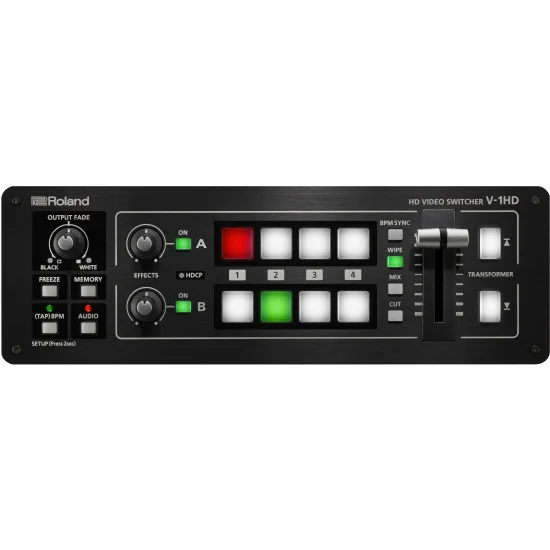
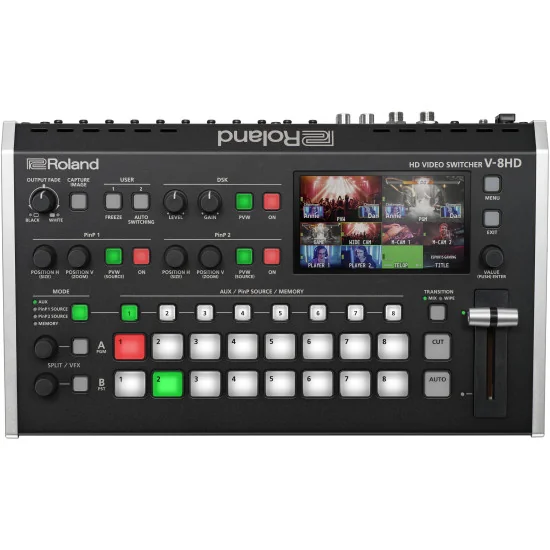
The V-600UHD handles 4K60 HDR with 10-bit 4:4:4 processing, four HDMI 2.0 and two 12G-SDI inputs, independent scalers per input, and downconversion on outputs—ideal for parallel IMAG and streaming. The V-160HD provides a hybrid matrix—8× HDMI + 8× SDI, multi-bus architecture, and a 40-channel audio mixer. For compact rigs, the V-8HD offers eight HDMI inputs with scene memories and external 14-V battery support, while V-1HD and V-1SDI deliver proven four-input portability (HDMI-only or 3G-SDI/HDMI mixed). The VR-1HD adds USB streaming, mic processing and auto switching for single-operator streaming. All models integrate frame sync and scaling to absorb mismatched sources without external converters.
For distributed studios and auditoria, PTZ control built into Roland switchers is decisive. V-160HD and VR-120HD natively control leading PTZ families (Canon, JVC, Panasonic, Sony, PTZOptics, Avonic and other VISCA over IP implementations). VR-6HD offers the same paradigm in a smaller footprint. Operators recall presets, drive pan/tilt/zoom from the panel, numeric keypad, GPI/CTL, or iPad apps, and run up to 16 cameras on the V-160HD and up to 12 cameras on the VR-120HD. Tally and preset recall integrate with macros, so a single button can move cameras, fade lower-thirds and route an AUX feed.
In medium rooms, V-80HD pairs SDI for long runs with HDMI for local devices. Typical 3G-SDI cabling reaches ~328 ft (100 m) on quality coax; 12G-SDI in the V-600UHD supports 4K over single-link, cutting copper count and simplifying stage wiring. For flypacks, V-8HD with compact POE-powered PTZs (via SDI/HDMI extenders) gives silent operation at the lectern and clean operator sightlines.
Roland switchers interoperate smoothly with NDI® camera ecosystems. While ingest on many models occurs via HDMI/SDI, the VR-120HD, VR-6HD, and V-80HD also accept SRT IP feeds over LAN, useful when an NDI workflow is mirrored to SRT for contribution. In practice, premium NDI cameras publish a simultaneous SDI/HDMI or SRT path: SDI/HDMI feeds the switcher directly; SRT lands on the LAN input for remote guests or overflow rooms. This approach preserves frame-accurate switching and program delay discipline while keeping NDI on the camera/control side.
For stage-to-control distances beyond copper limits, convert NDI to SDI/HDMI at the edge and ride SDI back to the rack; AUX buses on the V-600UHD and V-160HD then drive confidence monitors, teleprompter returns, or clean-feeds for replay.
POV/Micro cameras are now standard for drum kits, overhead drawing shots, and lab benches. Their HDMI outputs drop straight into V-8HD, V-1HD, or VR-1HD without converters; where cable runs are long, a micro camera with SDI pairs well with V-1SDI or the SDI banks on V-160HD and V-80HD. Use scene memories to jump between multi-angle layouts, and key matte graphics from in-switcher DSK/PinP.
V-600UHD — 4× HDMI 2.0 + 2× 12G-SDI inputs, 4K60 HDR, 10-bit 4:4:4, independent scalers on every input, ROI cropping to derive multiple HD shots from one 4K source, multi-view, and flexible AUX outputs for stage confidence monitors.
V-160HD — 8× HDMI + 8× SDI cross-point architecture, PTZ camera control for up to 16 units, USB-C streaming, 40-channel audio with Bluetooth, eight-layer effects engine, and macro sequencing to automate complex cues.
VR-120HD — 6× SDI + 6× HDMI inputs, dual streaming encoders via LAN and USB-C webcam output, PTZ control for up to 12 cameras, integrated graphics via Graphics Presenter support, and SRT ingest/output for remote contribution.
V-80HD — Hybrid SDI/HDMI switcher with SRT over LAN, eight channels assignable to cross-points (including two down-scaling 4K HDMI), dual SDI and triple HDMI outputs plus USB-C streaming; ideal for esports, training rooms, and multi-room campuses.
VR-6HD — Six HDMI inputs, three HDMI outputs, LAN/USB-C streaming, PTZ integration for up to six cameras, iPad remote control, and scene/sequence automation for single-operator hybrid events.
V-8HD — Eight HDMI inputs with frame sync, 18-channel audio mix, on-board recording control via macros, scene recall, and optional 14-V external battery operation for mobile kits.
VR-1HD — Two HDMI + one USB video input paths with mic processing, automatic audio/video switching, and direct USB streaming for podcast rooms and classrooms.
V-1HD — Four HDMI inputs, dual HDMI outputs (program/preview), 12-channel audio mix, PinP/DSK, MIDI control, and companion RCS/Remote apps.
V-1SDI — Three 3G-SDI + two HDMI inputs with a scaler on Input 4, quad multi-view, and full 1080p support; suited to long-run venues at up to ~328 ft (100 m) on SDI cabling.
VR-4HD — All-in-one AV mixer with four inputs, USB 3.0 streaming/recording, integrated audio mixer and touch interface—a compact studio when footprint is tight.
Audio: from the 18-channel mix in V-8HD up to 40/42-channel engines in V-160HD/VR-120HD, with XLR combo inputs, de-embedding/embedding per cross-point, and Bluetooth program audio on select models. Graphics Presenter support on current switchers streamlines lower-thirds and bugs without a separate CG workstation.
Streaming: USB-C webcam out covers Zoom/Teams, while LAN encoders handle RTMP/RTMPS and SRT. Record clean program to external recorders and route AUX for ISO or confidence displays.
Control: front-panel operation, iPad Remote, RCS software, MIDI/GPI/CTL, tally outputs, and scene/macro sequencing allow one tech to run camera moves, graphics and switching. VISCA over IP serial bridges keep legacy PTZ heads in play.
PTZ Flagship: choose V-160HD for multi-camera auditoria and broadcast classrooms, or VR-120HD when you need dual encoders, bigger audio, and SRT contribution. Small control rooms favour VR-6HD.
NDI Premium: route camera SDI/HDMI into V-600UHD or V-160HD for deterministic switching; publish a parallel SRT stream from cameras or gateways to VR-120HD/VR-6HD/V-80HD for remote links and overflow.
POV/Micro: dense HDMI sources land cleanly on V-8HD; if long runs or broadcast tally are required, step up to V-1SDI or the SDI banks on V-80HD/V-160HD.
Consistent UI, deterministic latency, format-agnostic inputs, and integrated PTZ/SRT/USB-C streaming remove glue gear and reduce failure points. For pro teams, the result is faster setup, predictable rehearsals, and repeatable showfiles that survive staff rotation.
Models referenced: V-600UHD, VR-120HD, V-160HD, V-80HD, VR-6HD, V-8HD, VR-1HD, V-1HD, V-1SDI, VR-4HD.
Integration Notes: Use genlock or free-run with per-input frame syncs when mixing 59.94 and 50 Hz sources. Program delay stays consistent with layered PinP, KEY and DSK, keeping IFB timing stable. For HDR, the V-600UHD maintains 10-bit paths and downsamples to Full HD for encoders. With NDI cameras, send SDI to the switcher and mirror SRT over LAN for the VR-120HD/VR-6HD; V-160HD/V-80HD handle local SDI/HDMI. V-1HD/VR-1HD suit compact HDMI rigs; V-1SDI or SDI banks on V-80HD/V-160HD cover long runs. In 4K venues, place V-600UHD at FOH and feed the encoder via AUX. Legacy rooms still benefit from VR-4HD with USB 3.0 capture.
Tally integration and macro sequencing reduce operator load.