


ARRI Orbiter Fresnel Set – LED spotlight for professional film production.
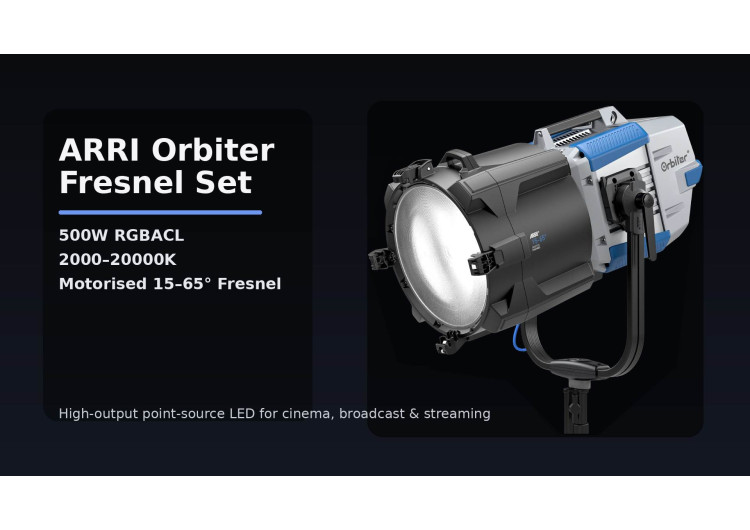
A 500W RGBACL LED spot with motorised Fresnel zoom and pro network control. Built for film sets, broadcast studios and live streaming.
When a production needs a single head that can punch like a compact daylight unit yet keep tight colour discipline across mixed sources, the ARRI Orbiter Fresnel Set (Bare Ends) sits in a very specific space: point-source character, motorised Fresnel beam geometry, and a control stack that integrates cleanly into studio DMX and IP networks.
In this kit, the ARRI Orbiter lamphead ships with the 15–65° Fresnel front end, a removable PoE Control Panel and a 15 m panel cable for handheld or remote placement, plus a 3 m powerCON TRUE1 TOP mains lead with bare ends and an in-line switch for custom termination in stages, OB vehicles, and fixed grids.

High power 500W.
Orbiter runs at 400 W nominal with 500 W maximum draw, fed from 100–240 V AC. For locations where mains distribution is constrained or noisy, the head also accepts 48–52 V DC via 3-pin XLR, which makes battery blocks and regulated DC systems a realistic option for controlled interviews, car rigs, rooftop installs, or night exteriors where silent operation matters.
Because this is a point-source aperture (42 mm without optics), it behaves like a classic hard unit in terms of shadow edge definition and specular response. That matters for product work, glass, chrome, and textured surfaces where a soft panel cannot generate the same crisp modelling. For reference, Orbiter photometric data published for the platform reaches 178,000 lx at 1 m at 5600 K with a reflector optic, and roughly 21,000 lx at 1 m with no optic; actual Fresnel output depends on zoom position and beam setting, but the numbers underline the headroom available for high-stop looks and distance throws.
In multi-camera TV or streaming, the extra wattage translates into practical margin: keeping exposure stable after diffusion and flags, holding contrast when talent moves, and retaining beam authority even when the Fresnel is set wide for a broader wash across a desk, couch or standing mark.
Interchangeable optics including motorised Fresnel.
Orbiter’s mount is a quick-change optical interface, so the lamphead can shift roles without swapping fixtures. In this configuration the core tool is the Orbiter Fresnel Lens 15–65°, delivering a controlled spot with a smooth field distribution and a single-shadow Fresnel signature that reads naturally on faces and set elements.
The zoom range is fully motorised. Instead of walking to the unit for every beam change, crews can position the angle precisely from the Control Panel or from the lighting desk via DMX/RDM or IP protocols. For repeatability, the optic reports its position, which helps when a show returns to the same “key at 32°” look across shooting days, episode blocks, or brand campaigns with tight continuity requirements.
Physical planning is part of the value for professionals. The Fresnel assembly is approximately 340 × 380 × 370 mm, weighs about 4.5 kg, and uses a 285 mm lens diameter, which is large enough to keep beam quality consistent across the range and to support clean cuts when barndoors are fitted. The lamphead mounts on a 28 mm spigot (junior pin) and supports ±90° tilt in dry locations; with a rain cover the wet-location tilt limit is specified separately, which matters for safe rigging in light rain or mist.
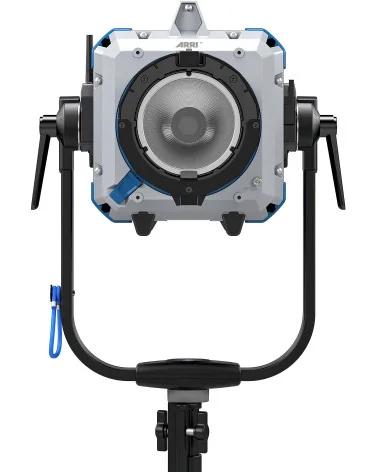
RGBACL engine with temperature range from 2000K to 20000K.
At the heart is ARRI Spectra in a six-colour RGBACL mix. For a professional buyer, the point is not “more colours”, it’s predictable camera response: stable whites across a wide range and controlled saturation without the colour breakups that can appear when LEDs run out of spectral content in deep ambers, cyans, or skin-tone corridors.
The calibrated 2000–20000 K span covers candle-like practical motivation through to cold daylight cues and VFX plates. Within the critical 3200–5600 K window, Orbiter’s high colour mode is specified at CRI > 98, TLCI > 95 and TM-30 > 94, which is the zone where broadcast pipelines, beauty keys, and corporate skin tones are least tolerant of drift.
Orbiter also supports workflows that DPs and gaffers actually use under time pressure: gel selection for fast recreation of legacy gel looks, x/y coordinate targeting for camera-matching, and source matching so an Orbiter can sit next to tungsten practicals, HMIs, or older LED heads without fighting green spikes. When the room goes off-axis, the green–magenta trim runs continuously from full minusgreen to full plusgreen, and ECC provides channel-level fine control for calibrations that need more than a single tint axis.
For high-speed cinematography and live exposure ramps, Orbiter’s dimmer runs smoothly down to 0% and offers multiple response curves (linear, exponential, logarithmic, S-curve). That’s useful when the lighting desk needs predictable fade timing, or when a camera operator wants to ride iris without stepping artefacts on a hard source.
Multiple control options.
On set, control matters as much as output. Orbiter supports DMX512 in 8-bit and 16-bit modes plus RDM (E1.20), enabling bidirectional fixture management and remote parameter verification. In venues and studios that lean on wireless, the head supports LumenRadio CRMX for DMX and RDM, keeping it compatible with common broadcast and rental ecosystems.
For networked infrastructures, Orbiter speaks Art-Net and sACN, with EtherCON in/thru for clean daisy-chaining. The removable Control Panel connects via PoE, which is practical when the head is boomed over a set, flown on a truss, or placed in a tight corner: put the interface where the operator can see it, while the lamp stays locked off. The Control Panel’s screen size is specified at about 10.2 cm, giving enough UI real estate for graphic beam and colour views without dragging out a console for every tweak.
A built-in web portal gives another access path for configuration and monitoring when the unit sits on a permanent grid and a technician wants control from a laptop on the network. USB and SD connectivity support firmware and profile handling, which is relevant in facilities that standardise looks across multiple stages.
Finally, the “Bare Ends” detail is not cosmetic. A powerCON TRUE1 TOP lead with bare ends and an in-line switch means the head can be landed directly into custom mains looms, power distro racks, or site-specific connectors without adapters that compromise strain relief. For B2B buyers, that reduces unknowns during commissioning and keeps the electrical path consistent with facility standards.
For interview keys, the motorised Fresnel makes it realistic to swap between a tight, contrasty key and a broader, softer key (after diffusion) without repositioning the stand. For multi-camera TV, it can act as a repeatable “special” on a host position or a back edge that survives blocking changes. For streaming stages, it can push through grids, eggcrates and flags while holding colour intent across scenes, especially when practicals and LED walls introduce mixed spectral content.
If you need a single head that behaves like a hard unit, carries the colour discipline of a modern cinema LED engine, and integrates into both legacy DMX and IP lighting control, the ARRI Orbiter Fresnel Set (Bare Ends) is a compact, technically coherent option for film production companies, broadcast studios, OB trucks, and high-end streaming facilities.
Comments
No comment at this time!
Leave your comment