


ZILR ZIPR E-Powered Production Carts.
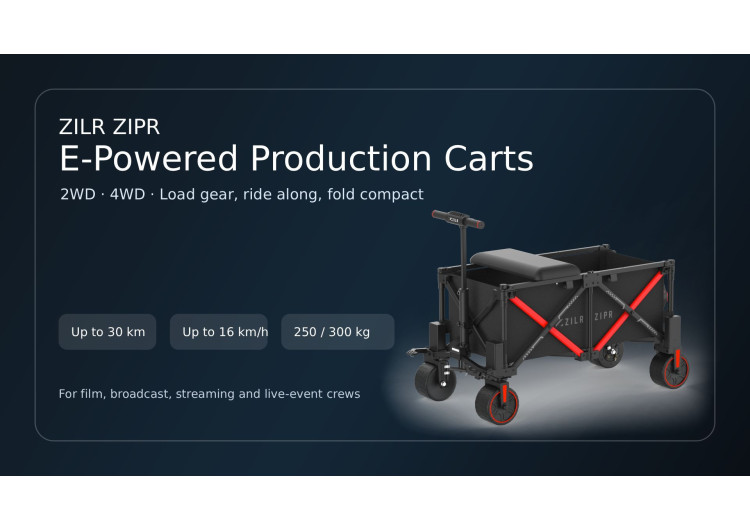
Two motorised ZILR ZIPR carts move up to 300 kg of production kit in one trip. They fold for the van, run near-silent and swap batteries fast.
Ask any crew what eats the most time on a shoot day and the answer is rarely the shoot itself. It is the load-in, the load-out, the walk back to the truck for the one case someone forgot. Two motorised carts from ZILR set out to shrink that dead time, and they do it without pretending to be something they are not. The ZILR ZIPR range is not a multi-tier trolley dressed up with a battery — it is a purpose-built electric transporter for moving heavy kit across long distances, fast, with one person instead of four.
The line splits into two machines with a shared philosophy. The ZIPR 2WD handles studio floors, exhibition halls and paved festival sites; the ZIPR 4WD takes the same load onto mud, grass and steep truck ramps. Both fold small enough to ride in a van and both run near-silent, which matters more than it sounds when a boom operator is rolling ten metres away. What follows is a plain look at what each one does on a working set.
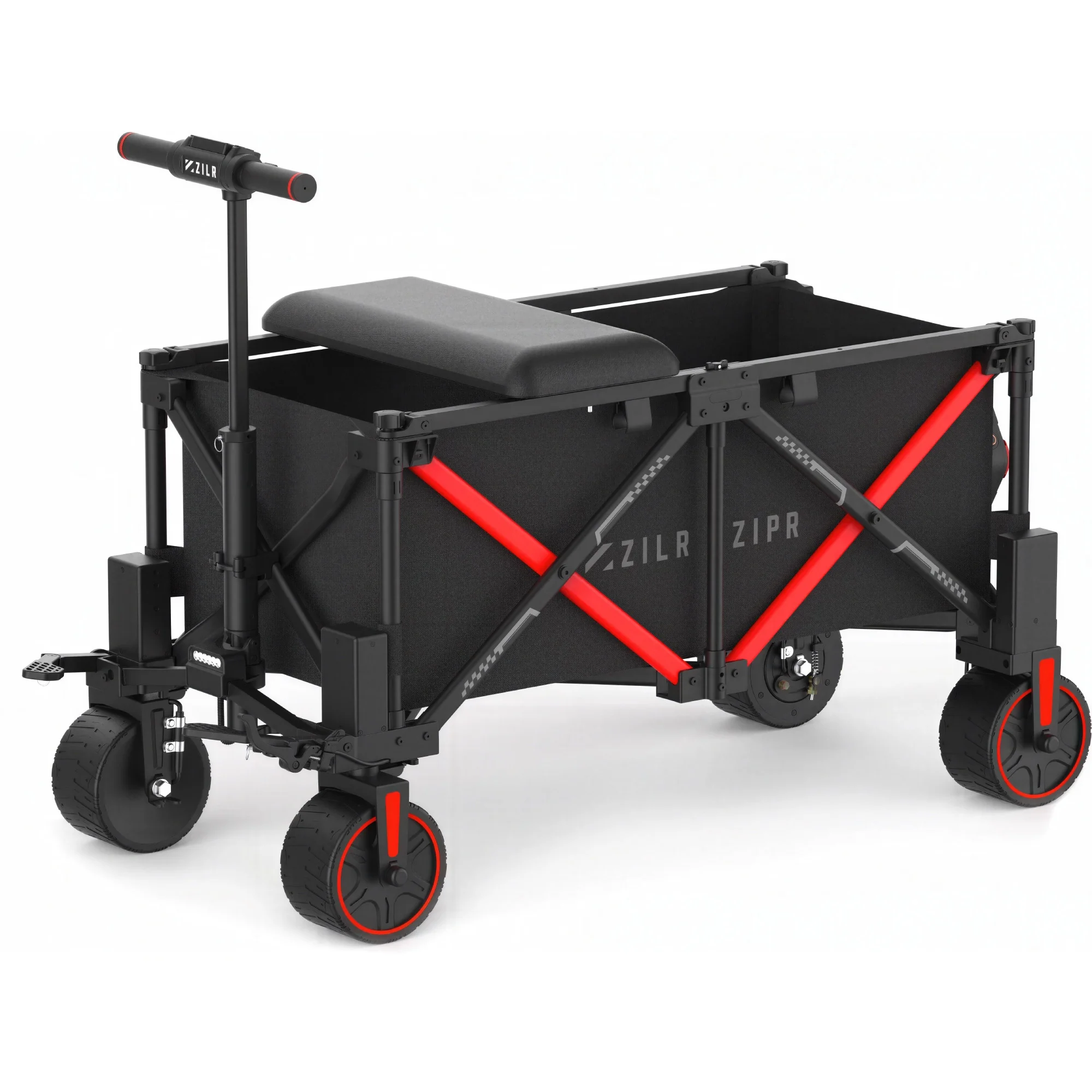
A brilliant solution for production and event crew support.
Think about the people who never appear in the credits reel: the AV technicians, the grips, the runners who spend half their day pushing flight cases from a loading dock to a stage that is always further than it looked on the floor plan. That repetitive haul is where bodies wear out and schedules slip. The ZIPR production cart was built around that specific problem rather than around a spec sheet.
The reasoning shows in how the machine behaves under load. A low deck keeps the centre of gravity down, so a stack of cases does not fight you when you turn. On the 2WD, a 1500 W front motor pulls up to 250 kg in one trip; on the 4WD, a 3000 W drive raises that to 300 kg. For context, a two-person team hauling the same weight by hand makes three or four round trips and finishes the day sore. One technician with a ZIPR makes one. Rental houses and production companies feel that difference in overtime and in injury claims, not just in convenience.
It is worth being honest about what the ZIPR is not. It carries a single cargo bay rather than stacked shelves, so it suits transport more than it suits acting as a rolling workstation. Once you accept that, the value is clear: this is the machine that gets the kit from A to B, and it does that one job better than a person ever could.
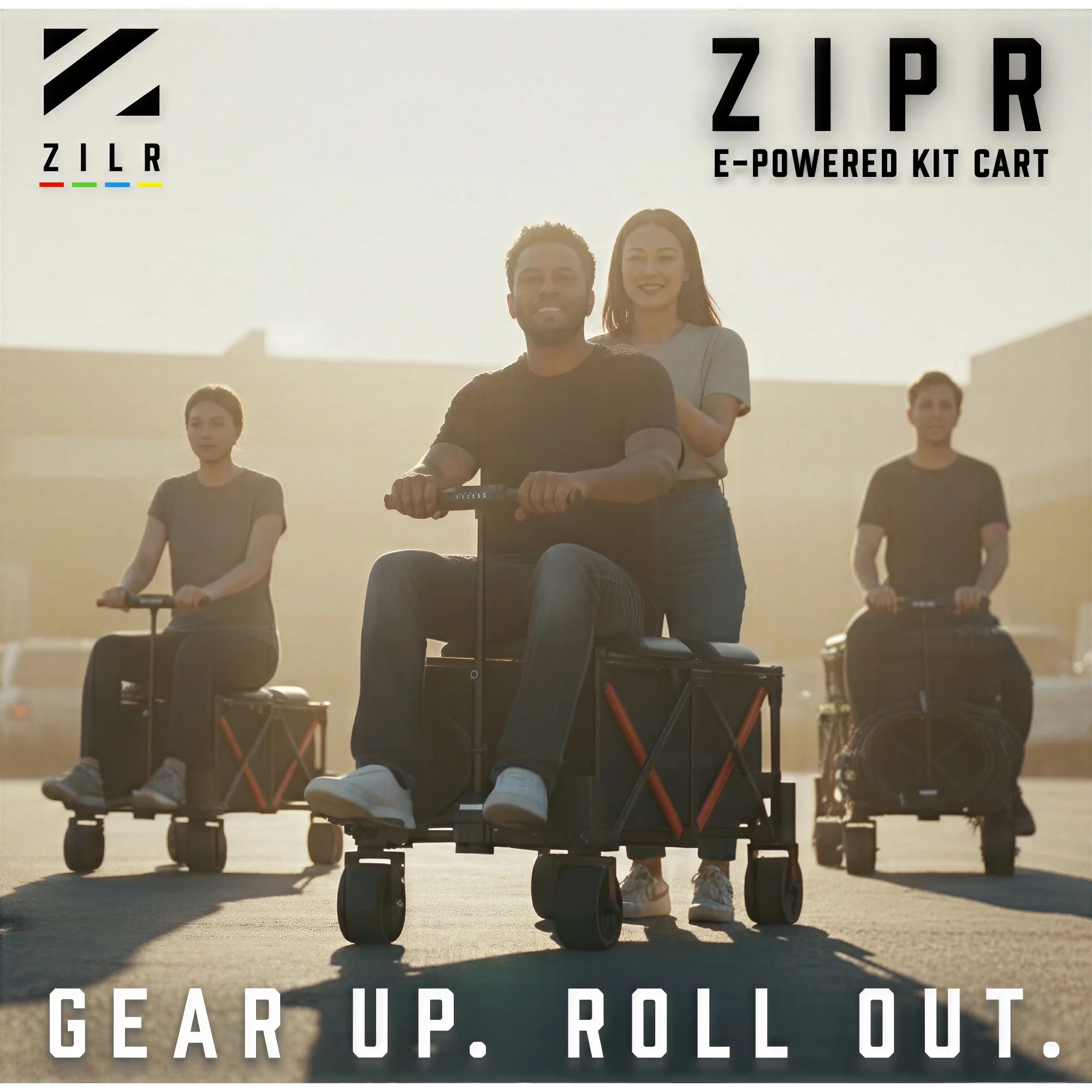
You will not only transport the equipment — you can ride along as well.
Three operating modes track the rhythm of a set, and the cart moves between them by reading what you do rather than by making you dig through a menu. Push it by hand down a tight corridor and it behaves like any well-balanced trolley. Extend the handle, drop it to towing height, and the ZIPR recognises the change on its own, rotates the display, and switches to e-assisted towing at a walking 5 km/h — the mode most crews will live in. In towing, both control levers act as the accelerator, so a smaller operator moves a fully loaded chassis up a gentle slope without straining a shoulder.
Fit the seat and fold out the adjustable footrests and the same cart becomes a ride-on shuttle for crossing a large site. There is a real creative bonus here too: with the optional second seat, camera teams use the ZIPR as a track-free dolly, rolling a tracking shot without laying a metre of rail. Reviewers who tested it on location confirmed the ride is genuinely useful for that, not a gimmick.
A word of caution belongs in the same breath, because this is a powered vehicle rather than a toy. Ride mode carries limits — it is meant for private land, seated use only, at low speed, with sensible weight distribution. The manufacturer advises keeping the rider under 65 kg on any significant incline to keep the front-weighted chassis planted. Treated with that respect, the ride function turns wasted walking minutes into fast transfers between stages or tents.
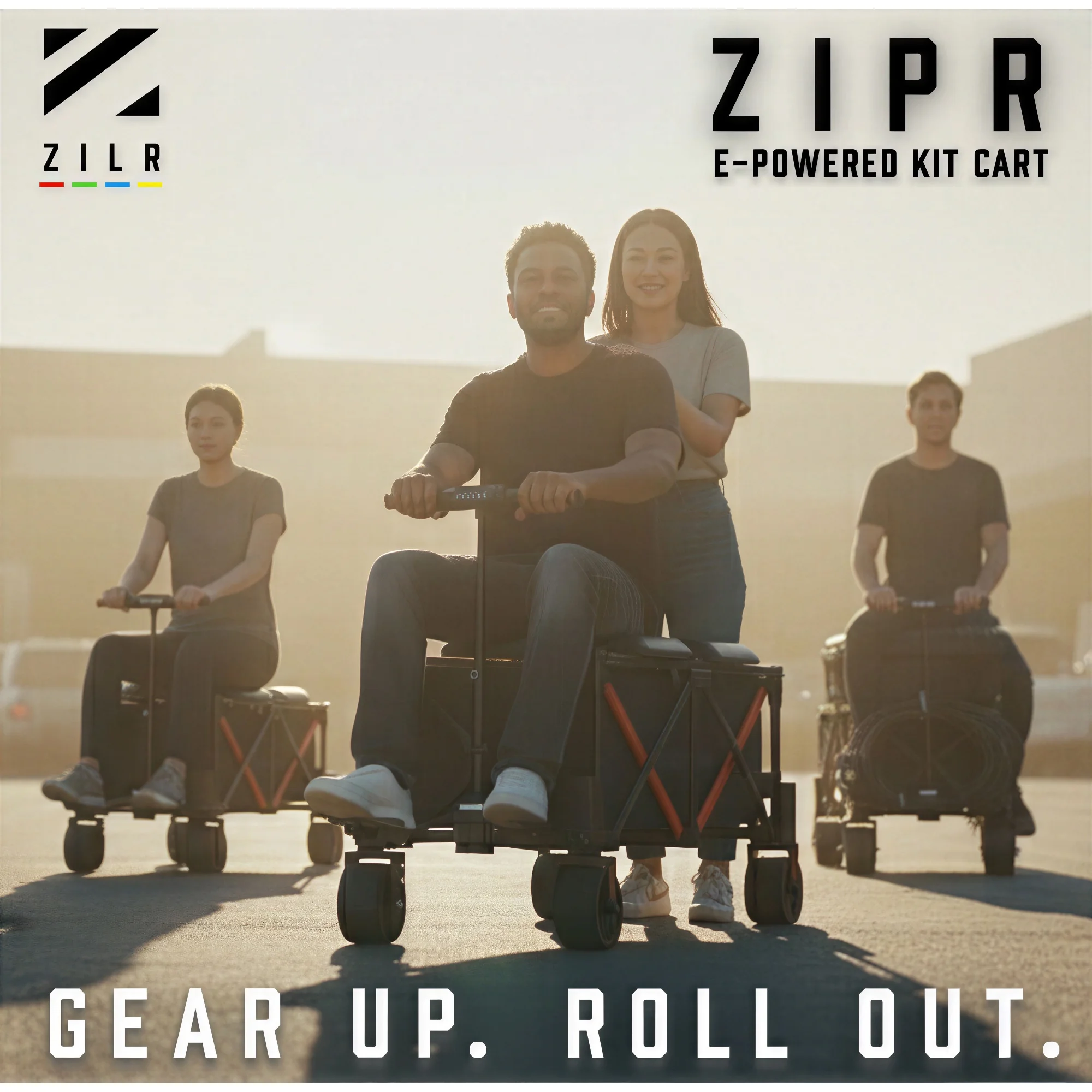
Range of up to 30 km on a battery and a speed of up to 16 km/h.
Distance and pace are where the two models separate. The ZIPR 2WD covers up to 30 km on a single charge and tops out at 16 km/h. On a corporate load-in that runs from a car park, through a service lift and across an exhibition floor several times over, that range comfortably outlasts the working day. As the Newsshooter reviewer put it, if you need to move a cart under power more than a few kilometres one way, the problem is your schedule, not the battery.
The ZIPR 4WD trades some range for grip and torque. Its 3000 W drive holds 16 km/h in four-wheel mode and covers around 15 km; switch it to two-wheel drive and range stretches to roughly 20 km while top speed eases to 14 km/h. That selectable behaviour is the point — you spend battery on traction only when the ground demands it, and conserve it when you are back on a hard floor.
Both carts run three speed modes, so a supervisor can cap acceleration and top speed for a nervous first-time operator or open it up for someone experienced. The power arrives instantly, the way it does in any electric vehicle, so the graduated modes are a safety feature as much as a convenience. A cruise setting holds a steady pace on long straight runs down a warehouse aisle.
High load capacity: 250 kg / 300 kg.
Payload is the number that justifies a cart like this, and here the figures are grounded in the confirmed specification rather than a marketing round-up. The ZIPR 2WD takes a static load of 250 kg; the ZIPR 4WD takes 300 kg. Both offer 183 litres of cargo volume in a bay measuring 116 × 63 × 50 cm when set up. In practice, reviewers noted you will run out of sensible ways to stack cases long before you reach those weight ceilings — which is exactly the margin you want on a demanding job.
Two caveats keep that capacity realistic. On an incline, the sensible working load drops well below the static maximum — the manufacturer flags around 120 kg on slopes for safety — because weight high on a gradient behaves very differently from weight on the flat. And because the bay is a single volume rather than a wide tray, oddly shaped cases need thought: a large Pelican-type case may have to go in lengthways or stand upright. The frame itself is rigid enough to strap long items across the top, which is how many crews carry stands and light kit.
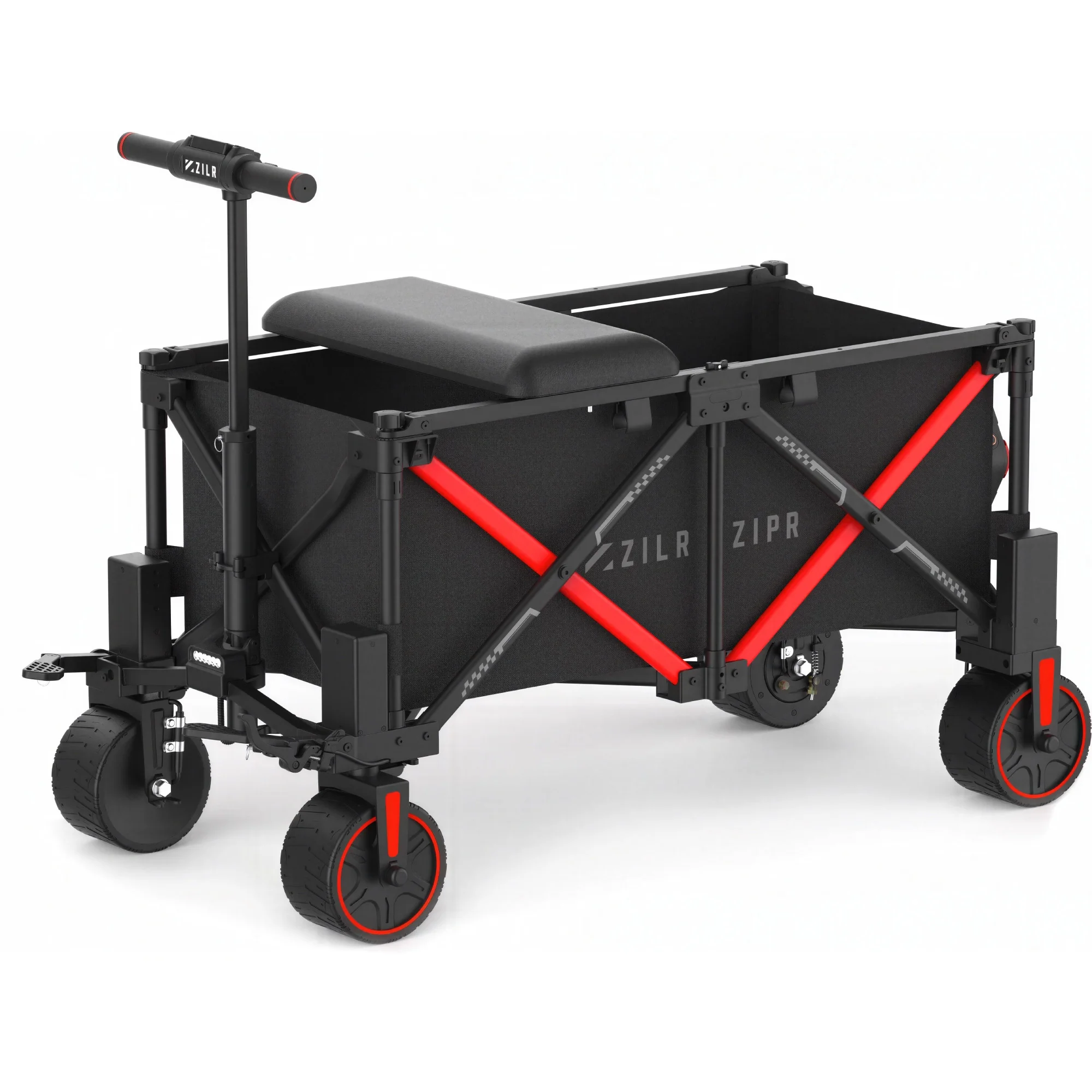
Perfect for video production crews and live event teams.
The ZILR ZIPR earns its keep in the settings where kit travels far and turnaround is tight. In a multi-camera television studio, it moves cameras, lens cases and lighting between a store and the floor without three people forming a chain. On an outside broadcast, the 4WD's traction and IPX5 weather rating mean a wet, rutted compound stops being a reason to carry everything by hand. At a trade show, it halves the reset time between striking one stand and building the next.
Streaming operations and live-event companies face the same maths from a different angle. A concert load-in means cable drums, distro, monitors and stage kit crossing a venue against the clock; a festival means the same over grass and gravel. Because the ZIPR runs quietly, it keeps working through a soundcheck or a live capture without bleeding motor noise into the mix — a detail that separates a professional tool from a hardware-store trolley. For a production house weighing this as a business decision, the return shows up as fewer bodies tied to logistics and more of the crew doing skilled work.
The comparison that matters is not against a beach cart but against the heavy motorised workstations from the established cart brands, which cost several times as much and weigh far more. The ZIPR sits deliberately below them: lighter, faster to deploy, and priced so a rental house can put several into a fleet rather than one into a corner.
Are you handling sound for a concert or festival, or working as a lighting technician? Load the gear, take a seat and go!
Picture the lighting technician at a festival with a case of fixtures, a bag of clamps and 400 metres of site between the store tent and the stage. The old routine is two trips and a sore back. The ZIPR 4WD turns that into one: load the bay, drop the handle, and let the drive do the climbing over grass and cable ramps that a hand trolley would fight the whole way.
The audio engineer's version is quieter but no less useful. Distro, stands and a rack of gear go in the bay; the near-silent motor means the cart can be moved during a line check without anyone flinching. Because the same machine can carry a passenger, a two-person team can move gear and a crew member together across a large site in a single run. The safety controls hold the whole thing steady while you work: hill-start assist and anti-rollback keep a loaded cart motionless on a ramp, gradient compensation meters the motor on the way down, and an electronic braking system engages the instant you release the throttle. On the 4WD a six-brake arrangement — four-wheel regenerative braking backed by twin mechanical drums at the rear — brings a heavy load to a controlled stop on a wet slope. The 2WD pairs front regenerative braking with rear drums for the same reassurance on smoother ground.
Easy battery replacement.
A single battery would tie the ZIPR to the length of one charge. A hot-swap system removes that ceiling. The pack is a LiFePO₄ 32700 11S unit, 36 V and 12 Ah, and at roughly 4.4 kg it lifts out in seconds. One pack drives the cart while a second sits on the charger, and a full charge takes about three hours — so a two-day event or a long broadcast never has to stop for want of power. An LED gauge on the battery reports remaining capacity at a glance, which spares you guessing halfway through a load-out.
The choice of lithium iron phosphate chemistry is deliberate and worth understanding. LiFePO₄ cells tolerate heat and repeated charge cycles better than many alternatives and hold up over a long service life — the traits a rental house wants in kit that gets handled hard by different operators every week. One honest note from field testing: in very cold conditions the release mechanism can stiffen and want a firmer push, so the first swap of a frozen morning takes a moment of deliberate effort. Once you know the feel of it, the swap is quick and repeatable.
Folds down to an exceptionally compact size.
Storage and transport are where many capable carts fall down, because a machine that carries 300 kg is usually a machine you cannot fit in a van. The ZIPR folds to 48 × 29 × 80 cm, small enough to slide onto a shelf or into a modest vehicle, and it stands upright in a corner between jobs. Given the payload and the extended working footprint, that folded size is the quiet headline of the whole machine.
The fold needs no tools. The manufacturer quotes about thirty seconds; a first-timer following the steps carefully takes closer to a few minutes, and that drops to two or three once the sequence is familiar — release the arms, extend and angle the handle, pull the frame open, drop in the floor insert and rotate the latches on both sides to lock it rigid. Breaking it down runs a little quicker than building it up. Worth planning for: the seat, the floor insert and the battery travel as separate pieces, so a crew that rides regularly will want a bag to keep them together. At 28 kg for the 2WD and 32 kg for the 4WD without the battery, the folded cart is a two-person lift into a vehicle — sensible, given what it replaces.
Around both machines sits an ecosystem of sixteen accessories that lets a company shape the cart to its own way of working: side saddles for extra outboard storage, kit crates and snatch bags for organised loadouts, a storage jacket and a UV-resistant rain cover, the second seat, foot pegs for a rear passenger, and a TUGR tow hitch — fitted at the factory — that lets one ZIPR pull a second trailer or link to another cart. AVGear supports production companies and rental houses across the EU with configuration advice, spare-parts supply and clear answers on lead times, because a machine that carries the show has to be as dependable as the crew running it. Both the ZIPR 2WD and the ZIPR 4WD are stocked as B2B purchases with VAT-free intra-community invoicing and EU-wide delivery.
Comments
No comment at this time!
Leave your comment