


Video switchers and portable production studios.
How video switchers really differ, from compact HDMI mixers to hybrid SDI consoles. A guide to choosing for reliable live production and streaming.
A live show forgives almost nothing. The camera feed that drops mid-keynote, the audio bed that clips when the second presenter walks on, the stream that buffers while three thousand people watch — these are the moments a switcher exists to prevent. For a production house, the box at the centre of the rack is not a gadget. It is the single point where reliability, signal integrity, and the clock all meet, and where a wrong choice shows up later as overtime, re-shoots, or an awkward call with the client. This guide walks through the way modern switchers are built, what separates a two-camera HDMI unit from a sixteen-input hybrid console, and where each machine earns its place on the truck.
A concise knowledge base on video switchers.
Strip away the marketing and a switcher does three jobs at once: it selects which source reaches the program output, it processes that source (scaling, keying, effects), and increasingly it encodes the result for the web. Everything else is a question of scale. A compact HDMI mixer handles the first job cleanly and leaves the rest to a laptop. A broadcast console does all three internally, on dedicated silicon, so nothing depends on an operating system that might decide to update itself during a service.
Two technical ideas underpin the whole category, and they are worth holding in mind as the products get heavier. The first is the frame synchroniser. Cameras and players rarely run in exact lock, and feeding unsynchronised sources into a cut produces a glitch on the seam. A switcher with frame synchronisation on every input quietly re-times each feed so transitions stay clean no matter what is plugged in. The second is scaling: a built-in scaler lets a 1080p laptop and a 4K camera share the same program without one of them being letterboxed or cropped. When you read that a unit scales on every input, that is the feature paying for itself the first time a guest arrives with an odd resolution on their slides.
The connector on the back tells you what the machine is for. HDMI is the language of cameras, consoles, and computers in a room where cable runs are short. SDI, carried on locking BNC, is what you reach for when the signal has to travel — across a stage, down a corridor, out to a camera position a hundred metres away — without the connector working loose or the picture falling apart. XLR audio means the box expects to sit beside a sound desk and take a clean, balanced feed rather than a consumer-level signal off a camera. The rest of this guide is organised by exactly this progression, from the simplest HDMI mixers to the consoles that speak all three fluently.
Simple multi-channel HDMI switchers.
Most production companies own at least one small HDMI switcher, and the reason is practical: a huge share of corporate, education, and house-of-worship work never needs anything more. Four cameras, a slide feed, a clean cut, a recording. The trick is buying a unit whose limits you actually understand, because the cheap end of this market hides its compromises in the spec sheet.

The Roland V-1HD is the reference point here, and it has earned that status by being almost boringly dependable. Four HDMI inputs, two outputs, a real T-bar under your hand, and a twelve-channel audio mixer built in — it switches up to 1080p, and the two effects knobs give an operator genuine control over a dissolve or a wipe rather than a menu dive. There is no network port, no scaler, and that is the point: it does one job, runs cool, and does not crash. For a two-camera interview or a product demo that has to be set up in ten minutes, it remains one of the most sensible boxes a crew can carry.
When the same job grows to five or eight sources, the Roland V-8HD picks up where the V-1HD leaves off. Eight HDMI inputs feed a five-layer effects and keying engine, a built-in multi-viewer shows every source on the 4.3-inch screen (about 11 centimetres), and a scaler now sits on the inputs so mismatched resolutions stop being a problem. What makes the V-8HD interesting for a busier operator is the automation underneath it: sequencing, macros, and preset memories mean a complex show can be programmed once and then run by someone less experienced, which is exactly the kind of delegation a production manager cares about.
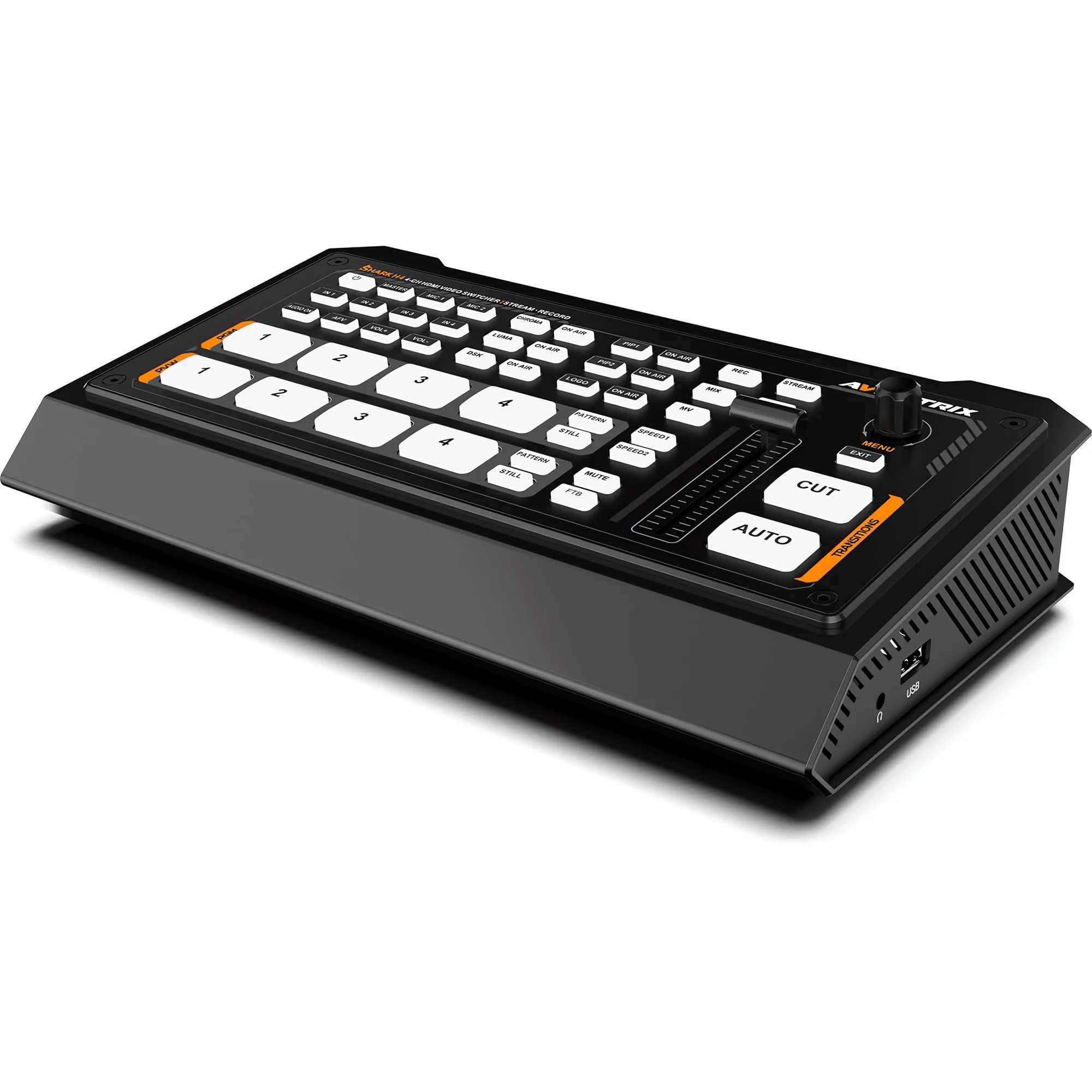
The AVMATRIX Shark H4 answers a different question — what if the switcher also handled the stream? In a compact metal housing it takes four HDMI sources and sends program straight out over Ethernet or USB, recording to a USB disk or SD card at up to 1080p and 32 Mbps. Chroma key, luma key, a downstream keyer, picture-in-picture, a logo store, and a media library all live inside it, which is a remarkable amount of capability for a unit this size. The configuration export is a small feature with a big payoff: a crew can save the entire setup for a recurring event and reload it next month instead of rebuilding from scratch. The H4 is the box for the operator who wants to leave the laptop at the office.
More advanced solutions with SDI inputs and capture cards.
The moment a job moves out of a single room — a stage with cameras forty metres from the rack, a multi-room conference, an outside broadcast — HDMI stops being enough. SDI is the dividing line, and the switchers that carry it open up a different class of work. The cabling locks, the runs get long, and the unit usually starts to behave like a small studio rather than an accessory.
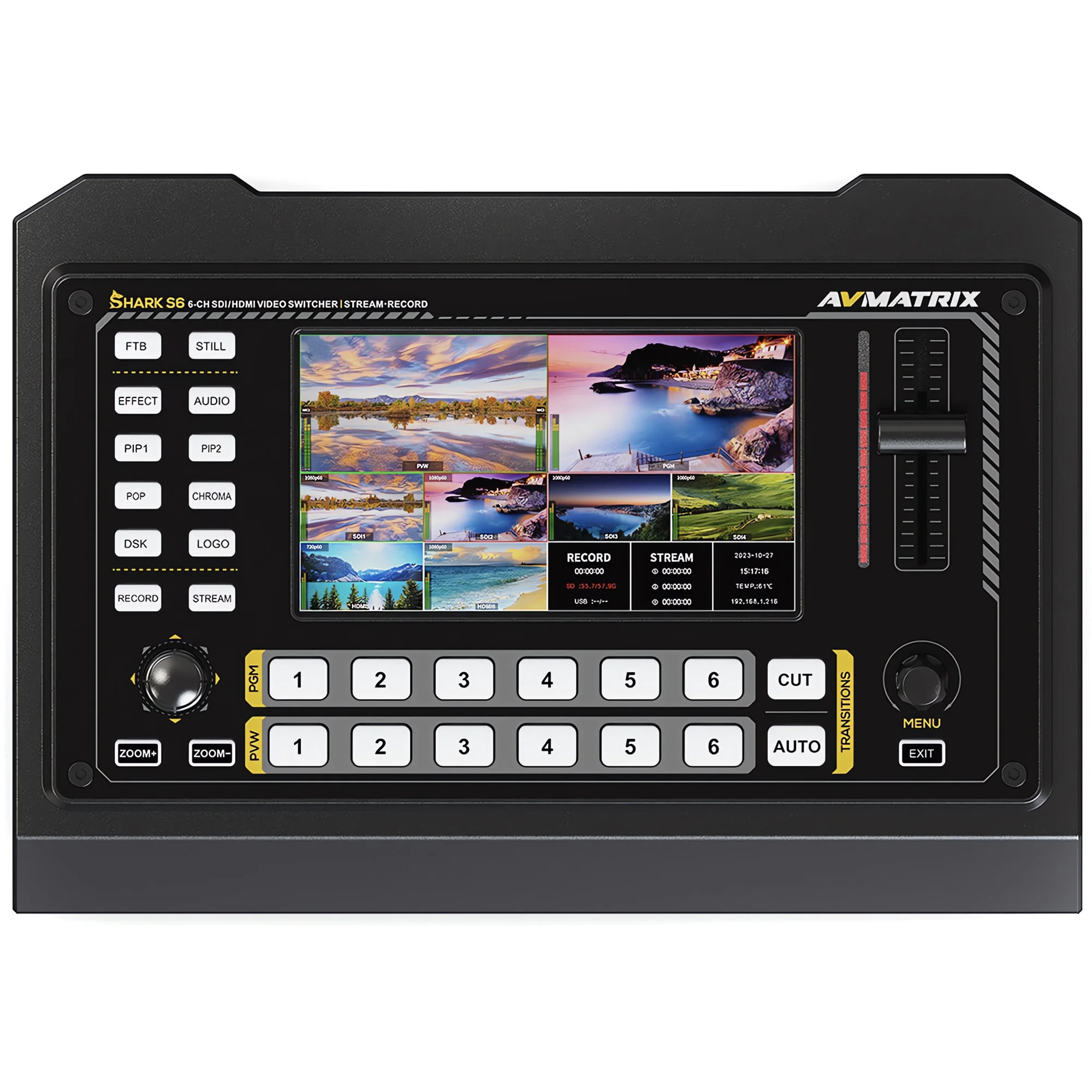
The AVMATRIX Shark S6 is a tidy first step into this territory. Six channels — four SDI and two HDMI — feed a unit with a five-inch display (about 13 centimetres), scaling on the inputs, and a healthy spread of outputs including dual SDI program, an HDMI multi-view, and a USB-C feed for streaming. It controls PTZ cameras over VISCA, VISCA-over-IP, Pelco and ONVIF, which matters because a small crew running robotic cameras can drive them from the same surface that cuts the show. The landscape-or-portrait layout is a quiet nod to the reality that a lot of this material now ends up on a phone screen.
For the operator who has settled into a 4K future without wanting to abandon HD gear, the Roland V-1-4K is a notably clever piece of design. Five HDMI inputs, each with its own scaler, let 4K and HD cameras share one program at 4K 60p with HDR, and a UVC-compatible USB-C port streams or records that program to a computer without a capture card in the chain. Its standout trick is ROI mode: the unit pulls up to four HD shots out of a single 4K camera's frame, turning one locked-off wide angle into what looks like a multi-camera shoot. For a lean crew covering a panel or a sermon, that is a real reduction in bodies and cabling on the day.
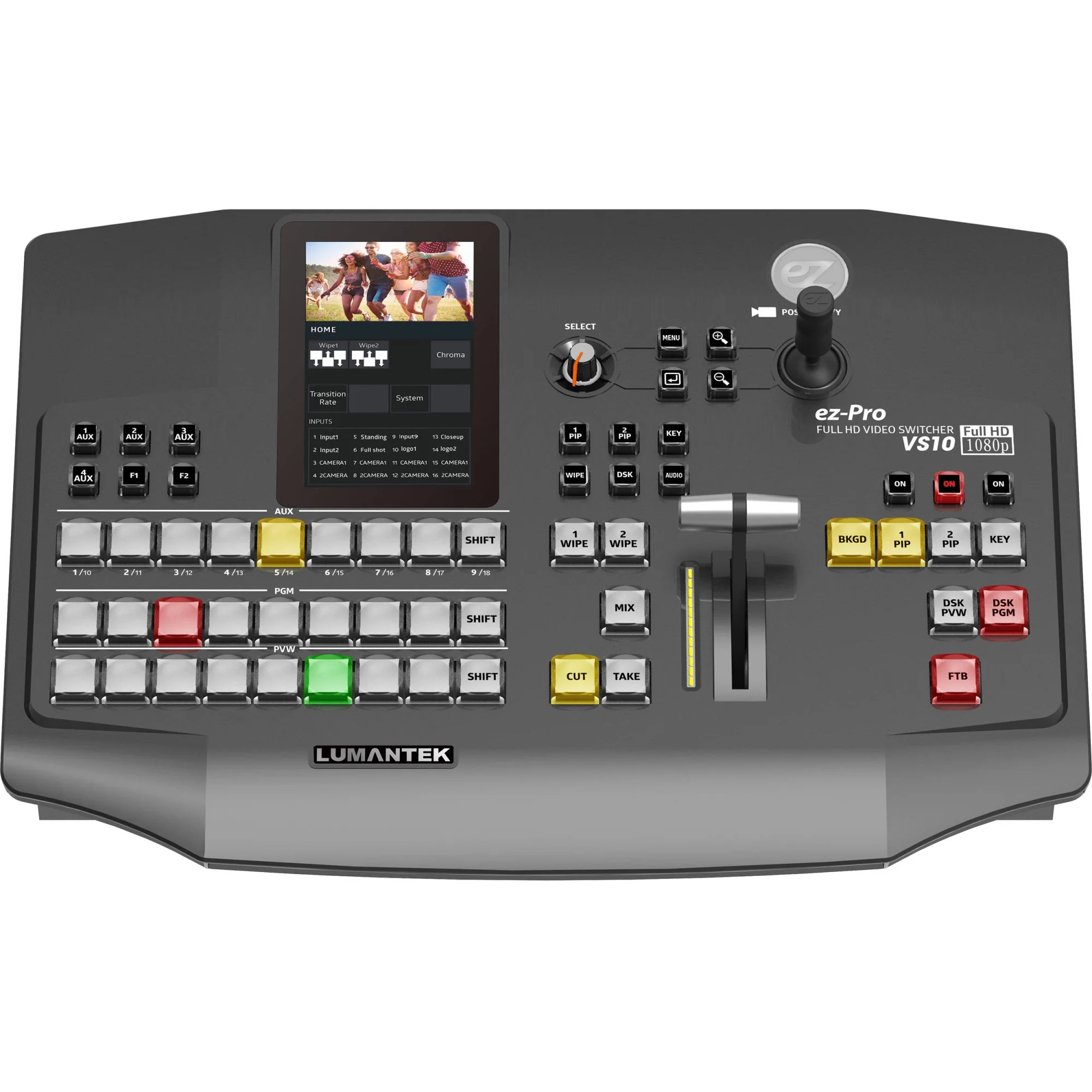
The Lumantek ez-Pro VS10 takes the touchscreen approach and pushes it to ten channels. Eight SDI and two HDMI inputs, scaling throughout, and a five-inch touch panel that an operator can lay out and label to taste — the layout saves to a USB stick and travels between units, so a multi-operator company can keep every surface identical. Its sharpest feature is fill-and-key handling: any SDI or HDMI port can be assigned as a fill or a key source, and paired with Lumantek's ez-CGER mini it becomes a live titling and graphics rig. That is broadcast-style lower-third work from a box that still fits in a flight case.
Expanded production systems with macros and professional audio interfaces for TV and demanding live productions.
Above the portable tier sits a class of console built for shows where failure is not an option and the audio is as important as the picture. These units integrate the video switch, a full audio mixer, and the streaming encoders into one chassis, and they add the production automation that lets a single operator run something that used to need a gallery full of people.
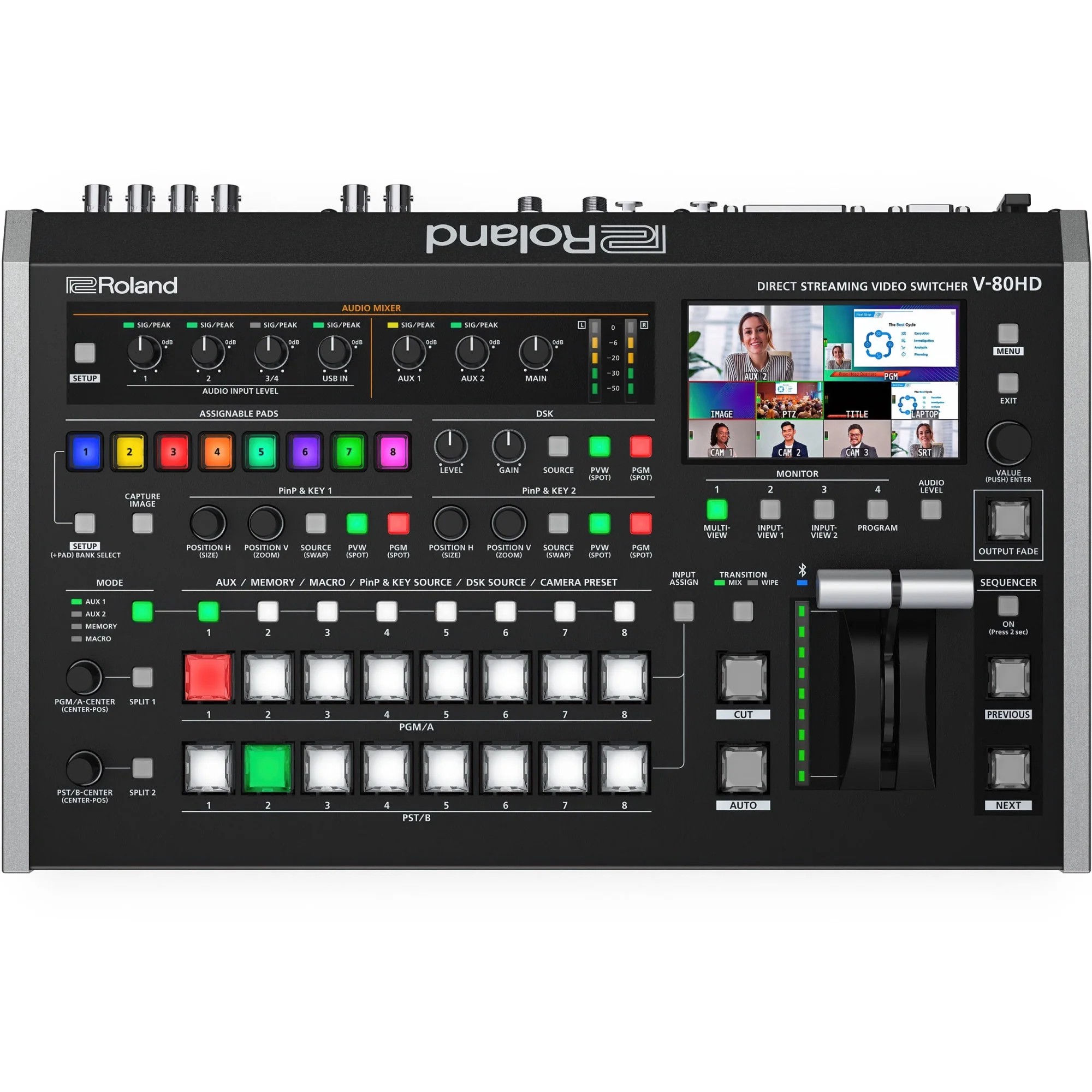
The Roland V-80HD is a hybrid event switcher in the truest sense. Four 3G-SDI and four HDMI inputs — two of the HDMI ports accept 4K sources and scale them down — combine with a 28-channel digital audio mixer, so the same surface that handles the cut also rides the levels for every microphone in the room. Connectivity runs to SDI, HDMI, USB 3.0, and LAN with both RTMP and SRT, the latter mattering whenever a stream has to cross an unreliable network and arrive intact. Integrated PTZ control, deep automation, and companion graphics software round it out. This is the console for a production house that wants one box to cover in-person events, studio days, and web streaming without re-rigging between them.
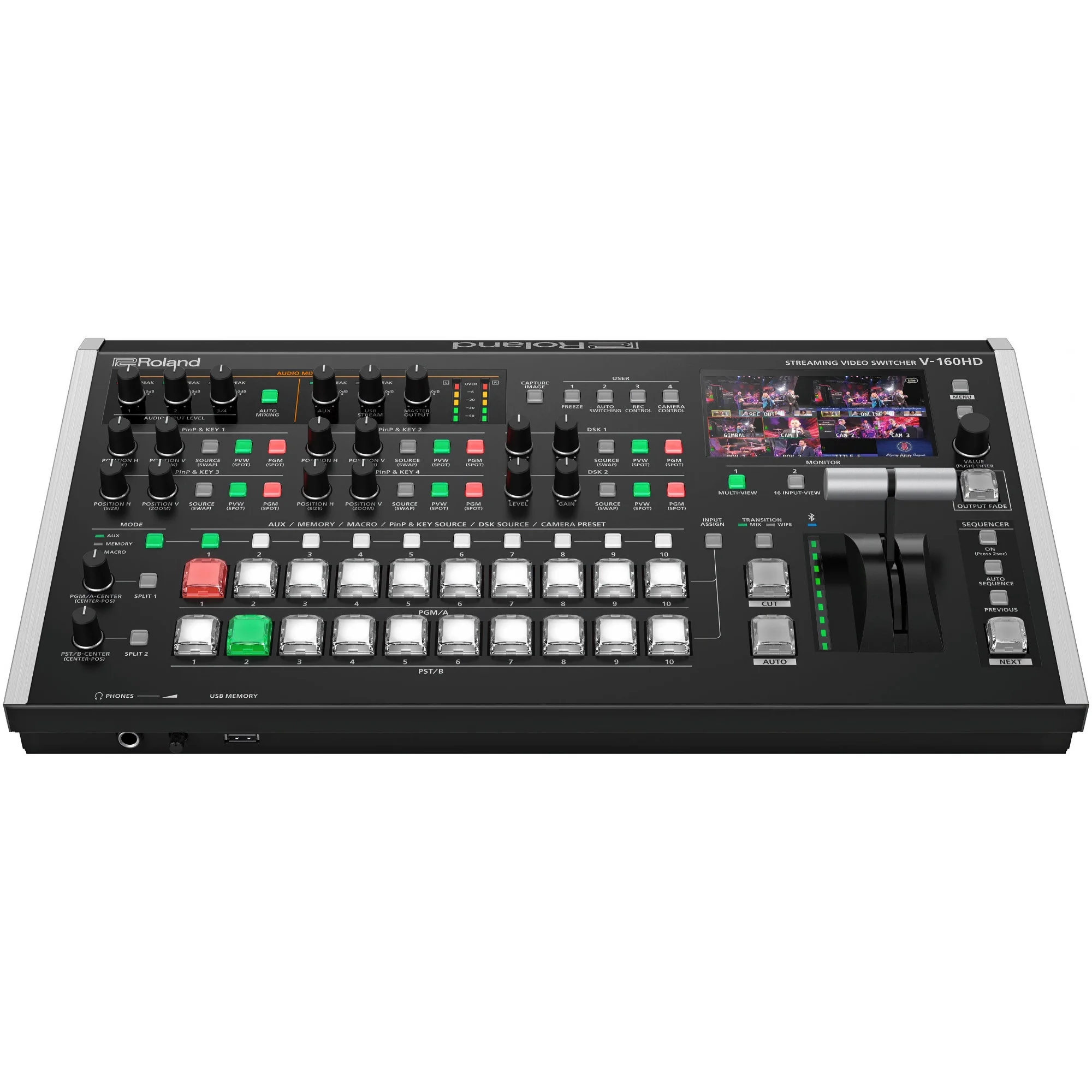
When the input count climbs, the Roland V-160HD sets the standard for hybrid event switching. Eight SDI and eight HDMI inputs, an eight-layer effects engine, and a 40-channel audio mixer with gain, de-esser, and noise reduction built in — this is a console that can take on a full conference stage and still stream to the web over USB-C. It drives up to sixteen PTZ cameras over IP or RS-232, and the cue management and show automation are mature enough that a complex multi-segment event can be rehearsed, stored, and then executed cleanly by one operator under pressure. Crucially for a touring company, all of this lives in a chassis a single person can carry and rig.
The V-8HD mentioned earlier shares much of this automation DNA in a smaller frame, which is part of why a company often owns both: the big console for the headline show, the compact one for the breakout room, and a consistent operating logic across the two so crew can move between them without relearning the surface.
SDI connections enable long-distance signal transmission, while XLR ensures high-quality audio.
There is a reason every serious console in this guide carries both SDI and XLR, and it comes down to the two failure modes that ruin live work: a picture that breaks up over distance, and audio that arrives thin, noisy, or out of level. SDI solves the first. A 3G-SDI signal travels reliably over coaxial runs that would defeat HDMI many times over, and the locking BNC connector does not fall out when a stagehand brushes the cable. For any production where the camera is more than a few metres from the rack, SDI is not a luxury — it is the only sensible choice.
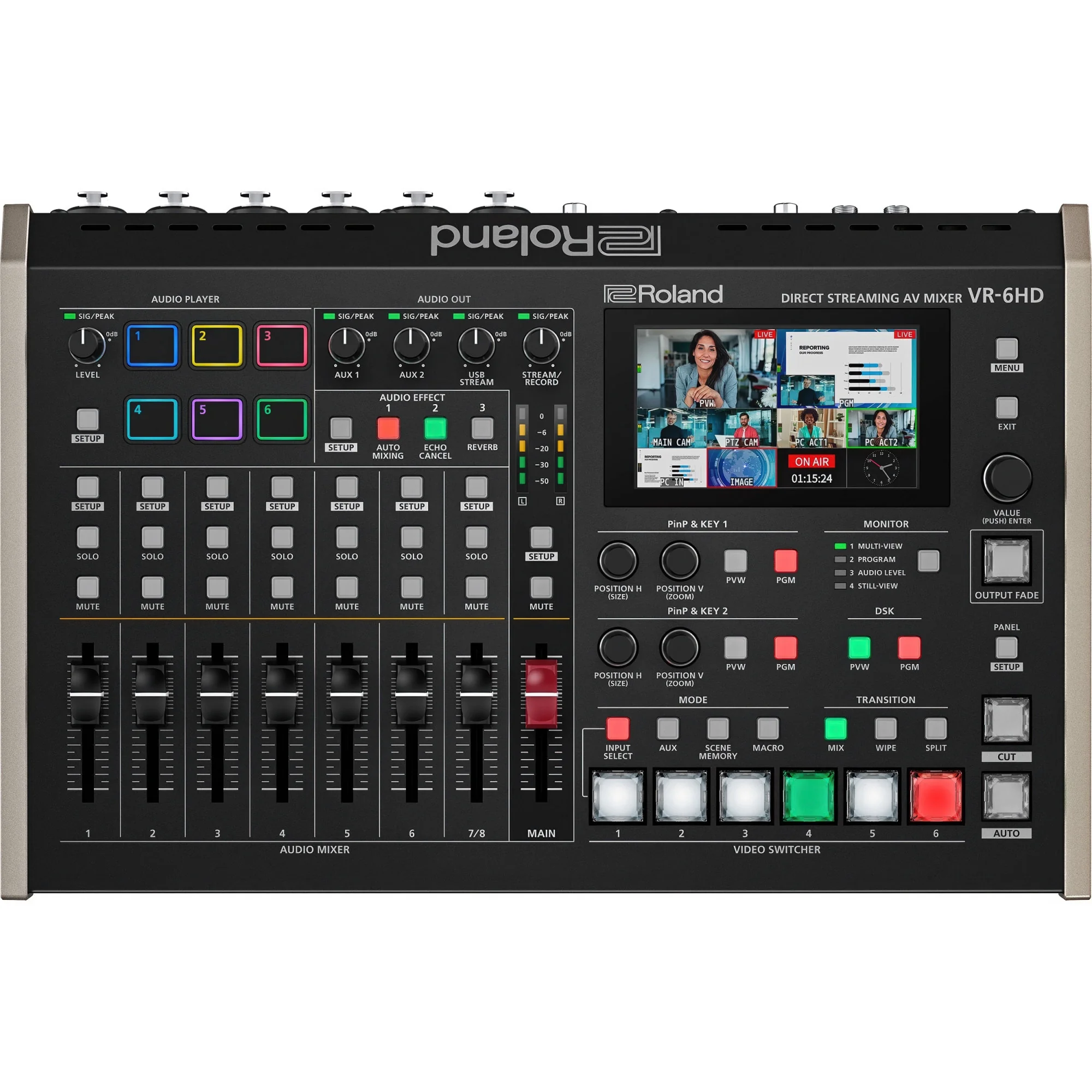
XLR solves the second, and the Roland VR-6HD shows why audio belongs inside the switcher rather than bolted on afterwards. Six HDMI inputs sit alongside a genuinely capable audio section — TRS and XLR inputs, a 28-channel mixer, balanced outputs — so a corporate livestream can take a clean board feed and the presenter's microphone into the same unit that cuts the cameras. Direct LAN and USB-C streaming encoders mean the program leaves the box already on its way to the platform. For everyday business streaming, worship, and sales presentations, the VR-6HD packs a surprising amount of audio-video integration into a chassis with a 4.3-inch touchscreen.
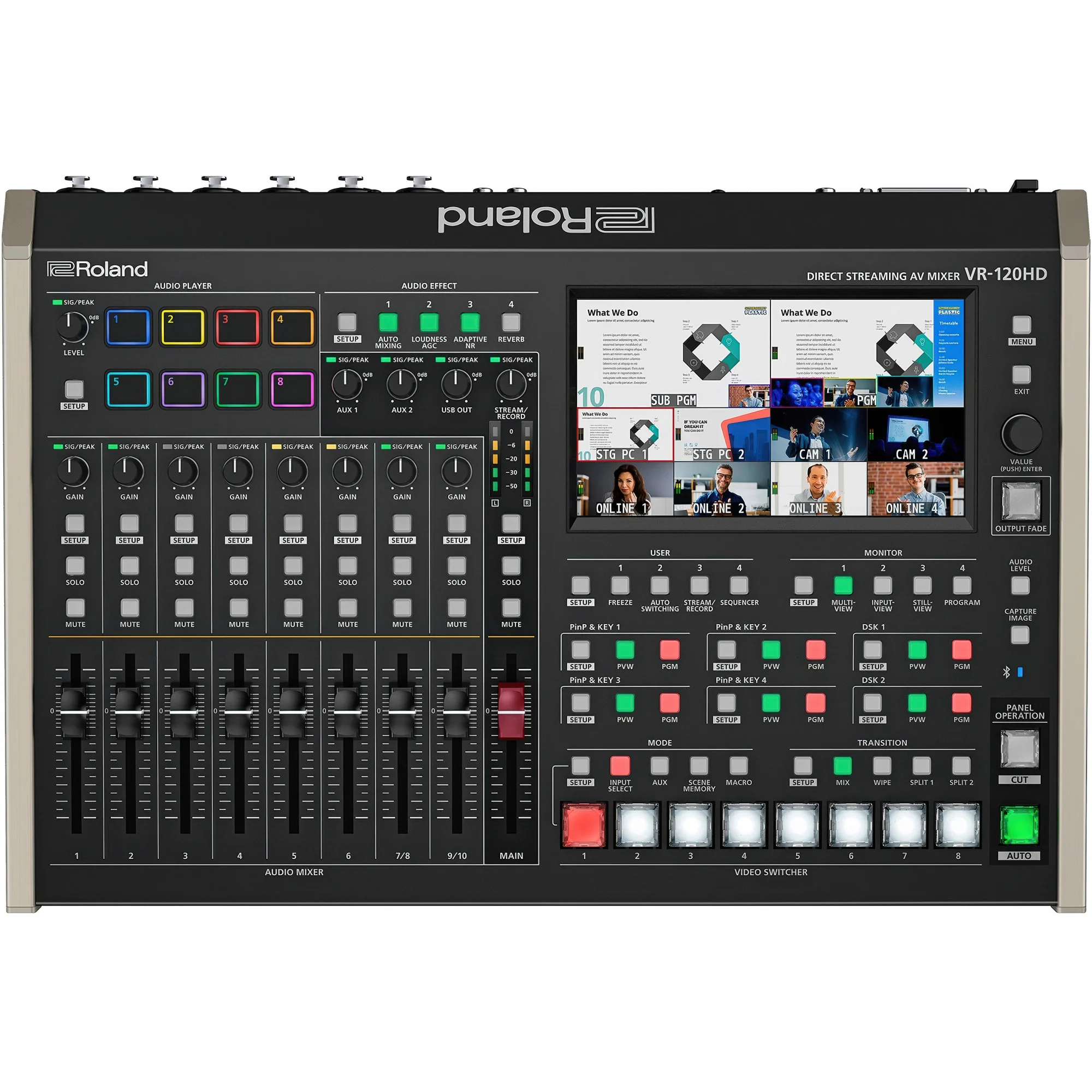
The Roland VR-120HD scales that same philosophy up. Six 3G-SDI and six HDMI inputs, every one with a frame-rate converter and scaler, feed a 42-channel audio mixer and a pair of streaming encoders that can push two separate 1080p60 livestreams at once — useful when a client wants the event on its own platform and a partner's simultaneously. It records straight to an SDXC card for archive and edit, drives PTZ cameras over IP, and lays everything out on a seven-inch touchscreen (about 18 centimetres). Where the VR-6HD is the room solution, the VR-120HD is the one you rig when the SDI runs get long and the audio routing gets complicated.
Specialised switcher solutions in the form of a touchscreen display with a top-mounted connector panel.
A distinct branch of this market is built around a different ergonomic idea: put a large monitor and a touch surface in front of the operator, and stand all the connectors up on a panel along the top edge. The result is a self-contained portable studio in a briefcase form, and for travelling production teams it removes an entire layer of setup — no separate multi-viewer, no external monitor, no rats' nest of patch cables to reseat at every venue.
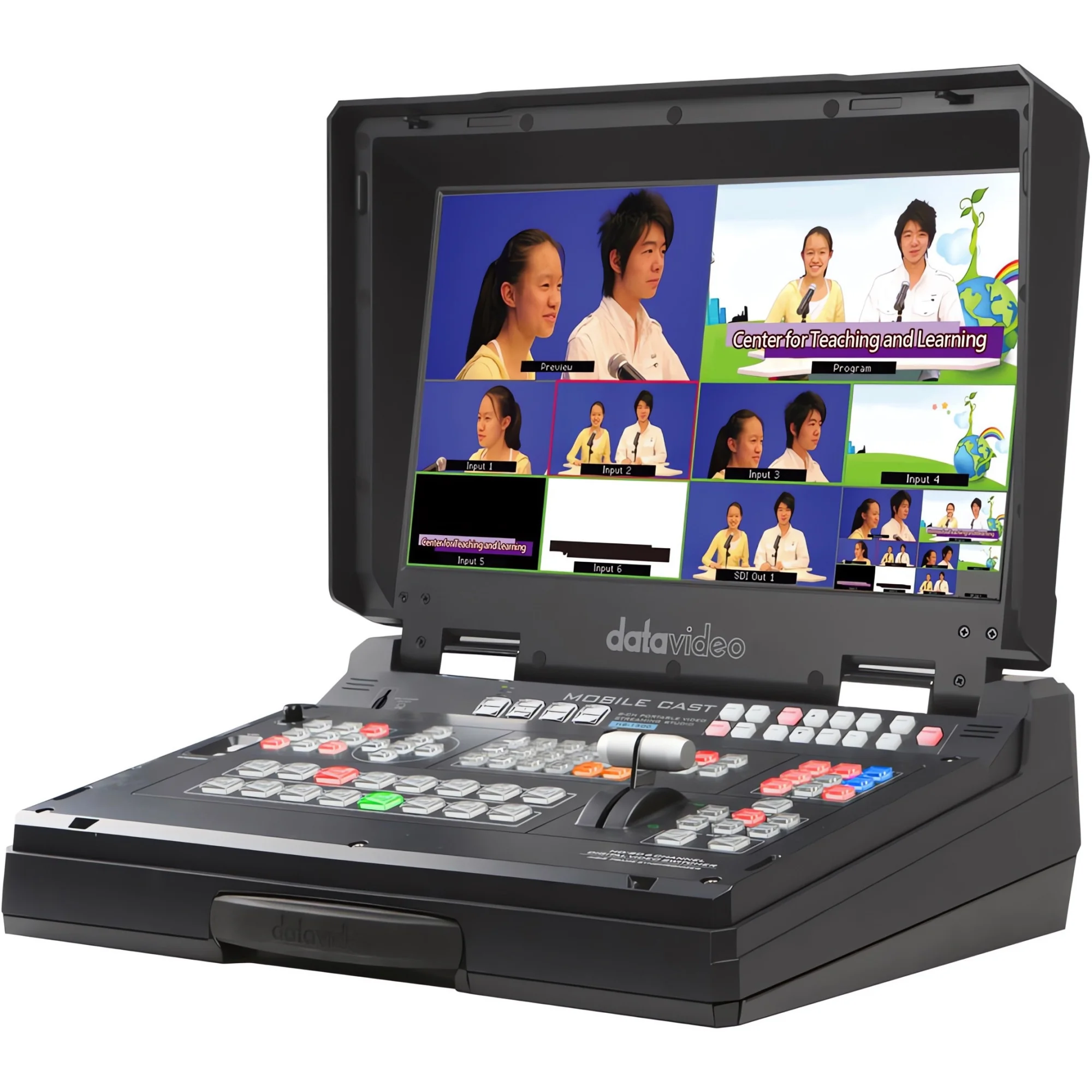
The Datavideo HS-1300 is the compact entry in this family. Six inputs across HDMI and SDI, five outputs, dual chroma key, a downstream keyer, picture-in-picture, and still stores — all of it monitored on a built-in 17.3-inch screen (about 44 centimetres) that folds into the case. XLR connections let it take master audio straight from a sound desk, and the H.264 encoder streams to YouTube, Facebook, or any CDN without an external box. For a medium-sized production that travels often, the briefcase design is the whole pitch: open the lid and the studio is already built.
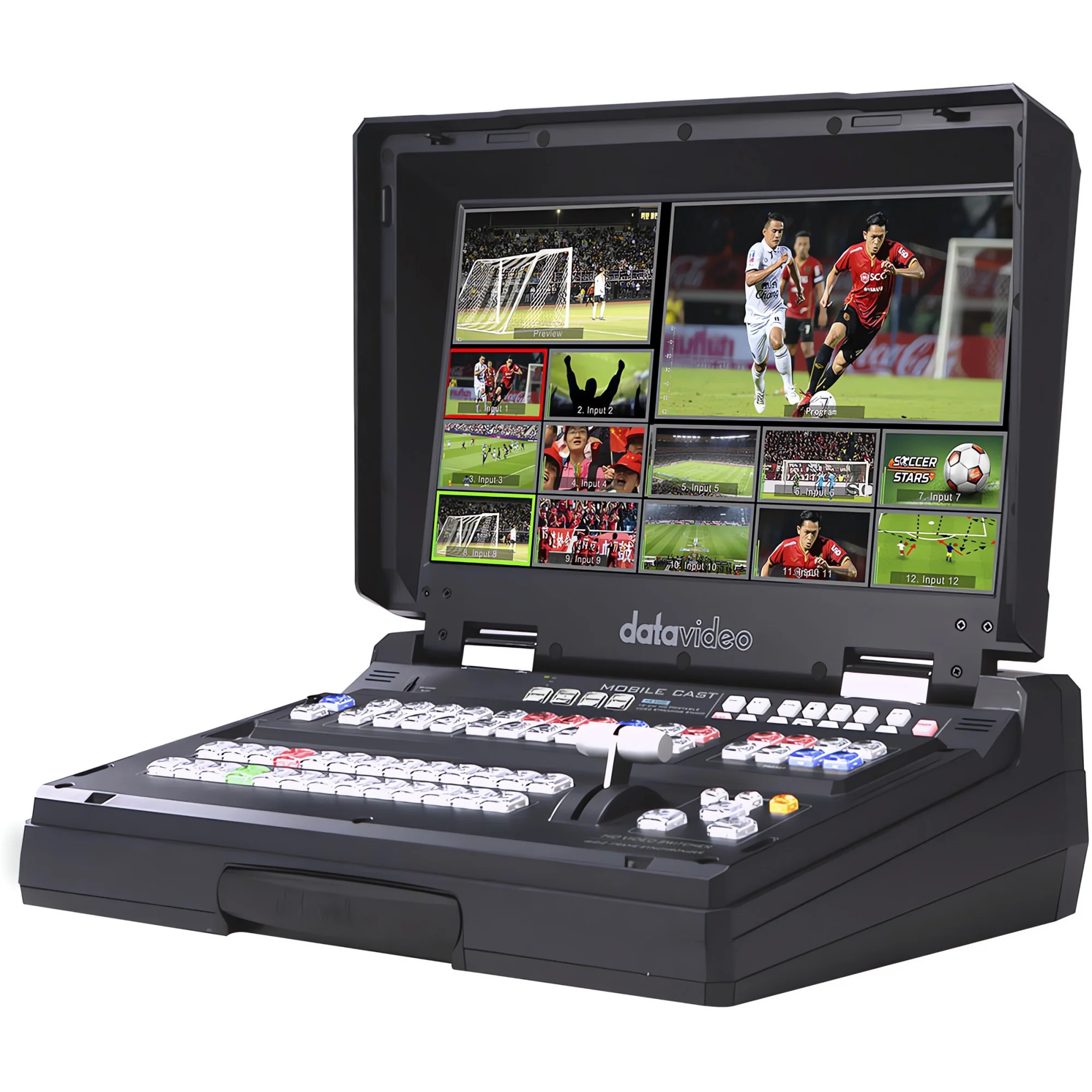
The Datavideo HS-3200 is the same idea at full strength. Twelve inputs — eight SDI and four HDMI — and nine outputs, with a built-in scaler on every input for up- and down-conversion, four upstream keyers for chroma, luma, and linear keying, two downstream keyers, eight picture-in-picture layers, and two independent animated logo stores. It holds full 1080p across the board and keeps the same 17.3-inch monitor and XLR audio. This is the console a production house reaches for when a job has too many sources for the portable tier but the crew still has to carry it in and set it up the same afternoon.
Video sampling and bit depth — important for image quality and keying.
Two numbers on a spec sheet decide whether a key looks clean or ragged, and whether a graphic survives the trip to the screen without banding: the chroma subsampling and the bit depth. They are easy to skip past and expensive to ignore. Chroma subsampling describes how much colour information is kept. A 4:2:2 signal keeps more colour than the 4:2:0 a consumer camera might output, and 4:4:4 keeps all of it. Bit depth — 8-bit versus 10-bit — sets how many gradations of each colour exist, which is the difference between a smooth gradient on a backdrop and visible stepping across it.
For keying, this is not academic. A chroma key cuts along colour edges, so the more colour detail and the finer the gradations, the cleaner the line between a presenter and the background. This is why the higher consoles in this guide quote 10-bit processing and richer sampling, and why a graphics-heavy or virtual-set show should be built on one of them.
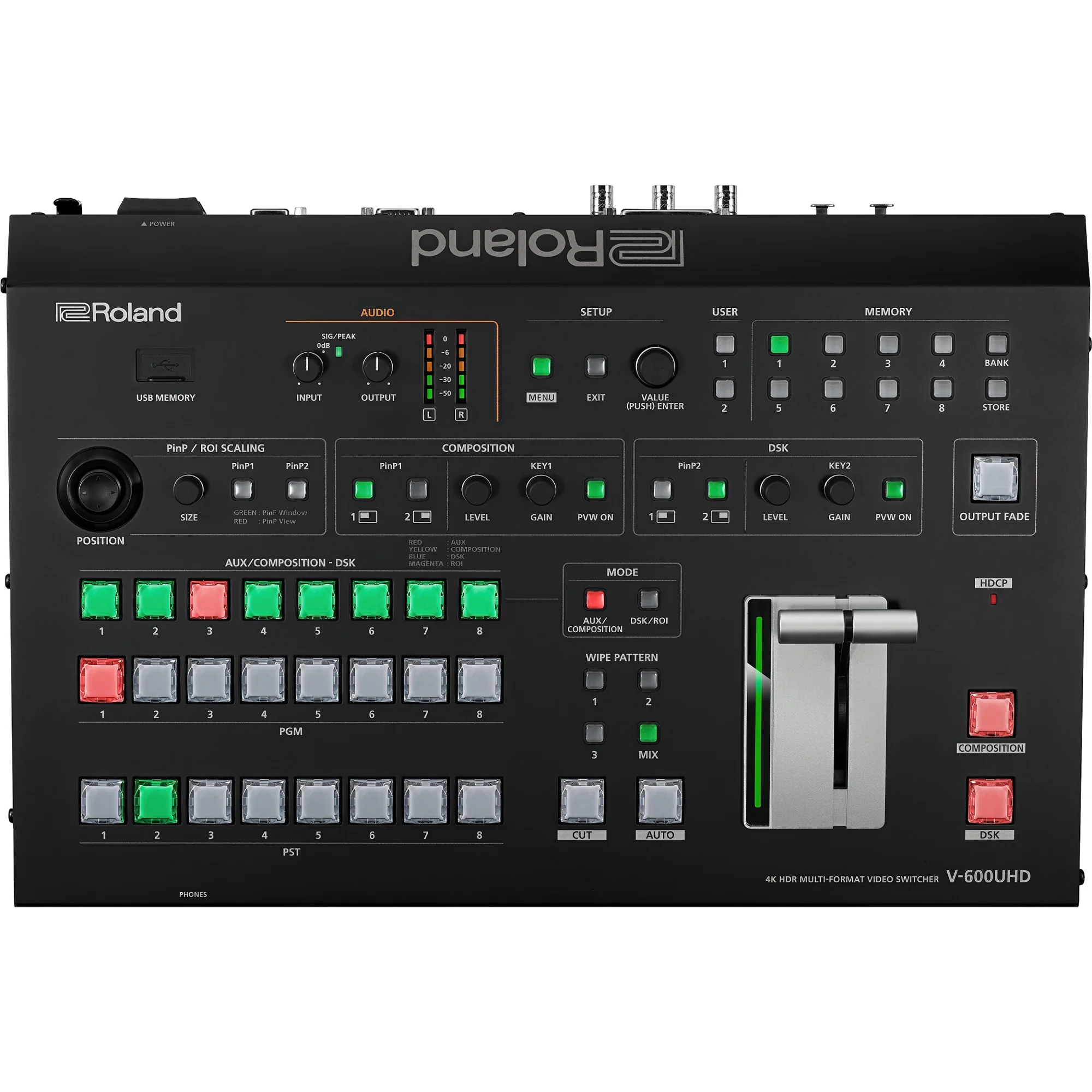
The Roland V-600UHD is the unit that takes this most seriously. A 4K HDR multi-format switcher, it processes at 10-bit 4:4:4 with BT.2020 colour, and Roland's Ultra Scaler sits on every one of its HDMI 2.0 and 12G-SDI inputs so HD and 4K sources mix freely and output at several resolutions at once. It handles DCI cinema 4K at the full 4096-pixel width rather than cropping to UHD, which matters to anyone finishing for cinema or premium corporate work. For a company whose clients are starting to demand 4K but whose existing inventory is HD, it is a bridge built specifically to let that transition happen one input at a time.
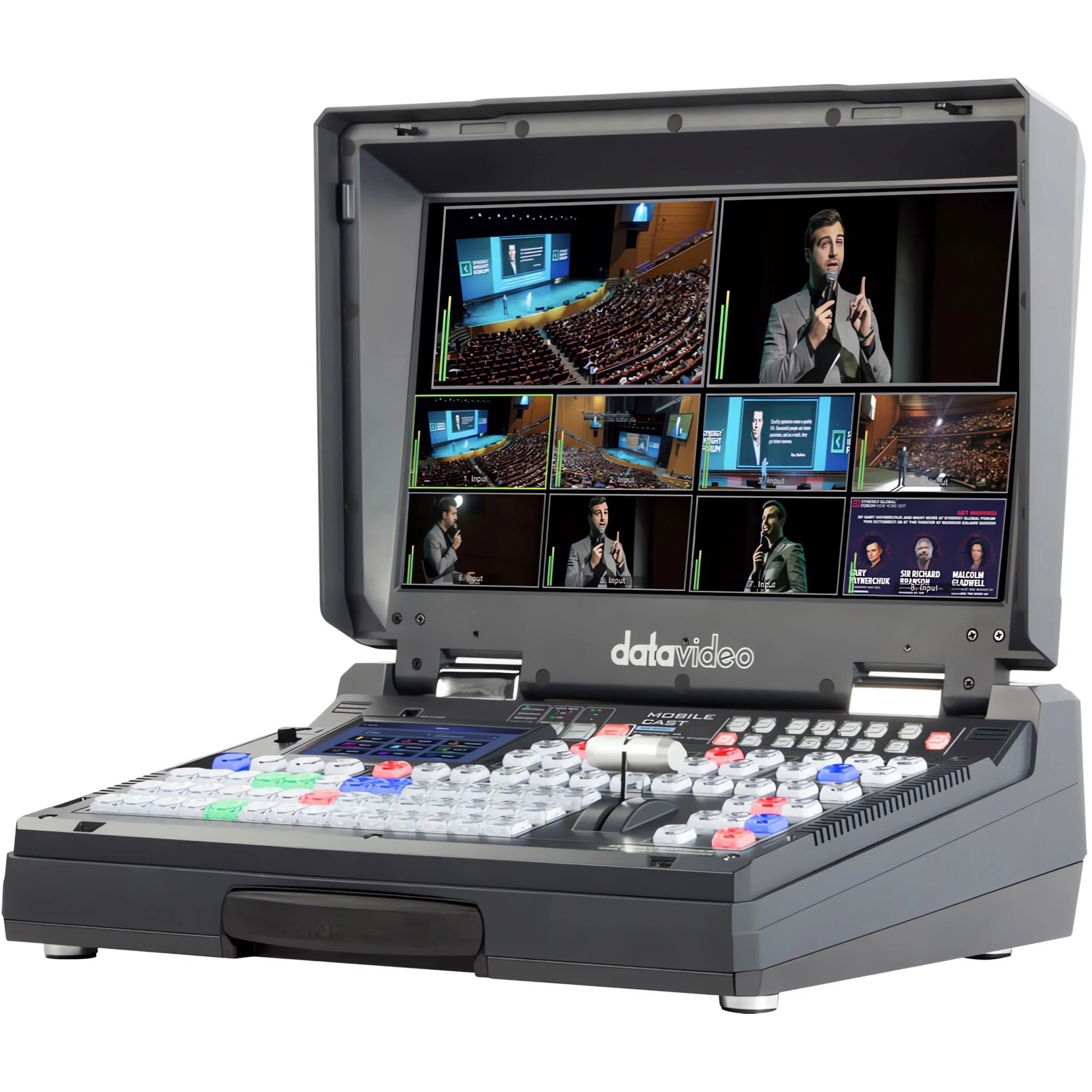
The Datavideo HS-4000 brings that same colour fidelity into the briefcase studio. It accepts HDMI 2.0 and 12G-SDI sources up to 4K 60p, processes at 10-bit with RGB 4:4:4 and 4:2:2 sampling, and shows everything on a 17.3-inch UHD monitor. A five-inch touchscreen handles transitions, chroma key, and custom icons, while the built-in encoders record a clean MP4 and stream over RTMP, RTSP, or SRT at the same time. It is the answer for a crew that needs genuine 4K keying and recording but still has to fly the whole studio to the venue as carry-on.
Direct LAN streaming from the switcher.
The last shift in this category is the most consequential for how shows are crewed. For years, streaming meant the switcher's program output ran into a separate encoder or a computer running streaming software, adding a box, a cable, and a piece of software that could fail. The current generation of units puts the encoder inside the chassis and a network port on the back, so program leaves the switcher already encoded and on its way to the platform. Fewer parts means fewer failure points, and that is the entire argument.
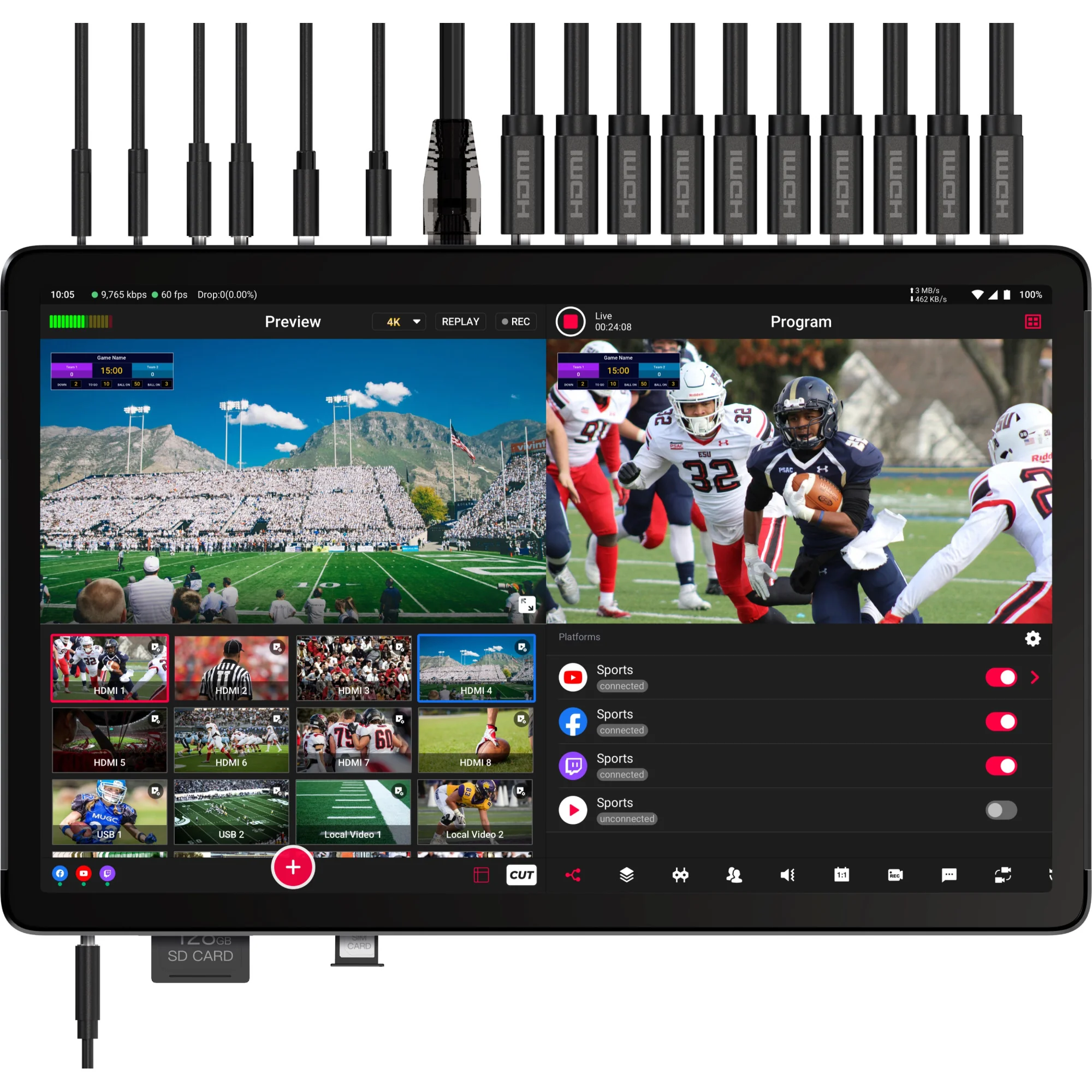
The YoloLiv YoloBox Extreme pushes this idea furthest. It is an encoder, switcher, recorder, and monitor in one slab the size of a large tablet, with eight HDMI inputs, USB and NDI sources, and a touchscreen that anyone who has used an iPad can drive within minutes. It streams in 4K at up to 60 fps, records each input separately for later editing, and reaches the network over Ethernet, Wi-Fi, or a built-in modem with the kind of battery life that gets a crew through a full day off-grid. For events that have to go live from a field, a parade route, or a venue with no rack space, it collapses an entire flight case of gear into something one person carries on a shoulder strap.
Direct streaming is not confined to the portable tier, of course. The VR-120HD running two simultaneous streams, the V-80HD reaching the platform over SRT, and the HS-1300 pushing H.264 to any CDN all build the encoder in. The practical takeaway for a production house is consistent across every tier in this guide: choose the connectivity your venues actually demand, insist on internal encoding and frame synchronisation, and match the audio interface to the way you really capture sound. Buy on those three axes and the switcher stops being a risk on the day and becomes the dependable centre of the rack it is supposed to be.
Comments
No comment at this time!
Leave your comment