


Canon CR-N500 – 1" Sensor, XLR Audio, NDI, ND Filters
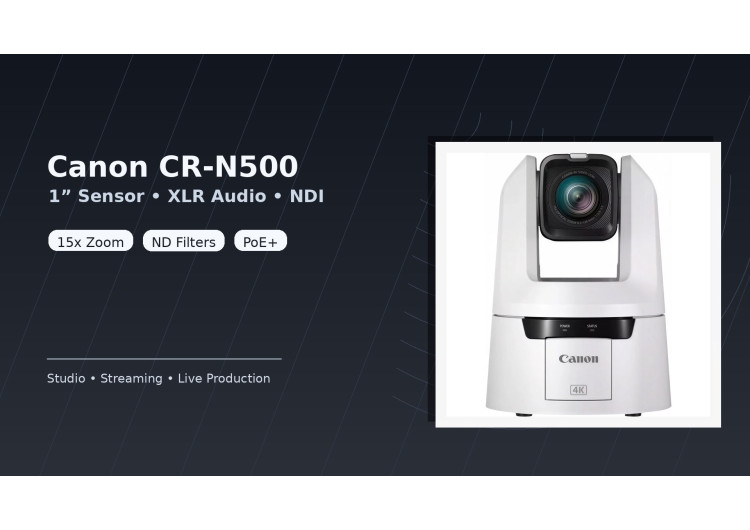
The Canon CR-N500 packs a 1-inch sensor, 15x zoom, XLR audio, NDI and PoE+ into one PTZ body. Broadcast picture and auto-tracking for smaller crews.
Most remote heads on the market carve their image from a sensor barely larger than a fingernail. The Canon CR-N500 takes a different route. It puts a full one-inch chip inside a pan-tilt-zoom body, and that single decision changes what a production house can trust a robotic camera to do. Low-light halls stop being a compromise. Grading suites get real latitude to work with. And a two-person crew can cover a stage that used to demand five. For studios weighing reliability against operating cost, the arithmetic starts to look very different once the picture holds up under pressure.
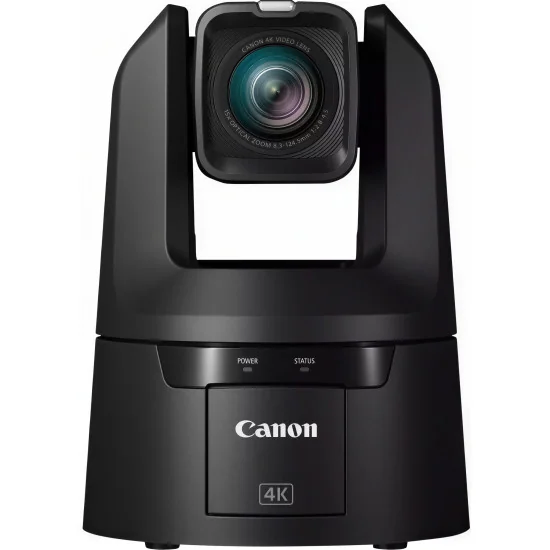
This piece walks through what the camera actually delivers on a live truck, in a fixed studio, or bolted to a lecture-theatre ceiling — the sensor, the glass, the audio path, the signal outputs, single-cable power, exposure control, and the two tiers of subject following that Canon ships with it. The goal is not a spec dump; it is a picture of how each capability earns its keep when the show has to go to air.
Premium video quality thanks to Canon's 1-inch sensor
The heart of the Canon CR-N500 PTZ camera is a 1.0-type single-plate CMOS sensor of roughly 8.29 effective megapixels, married to the DIGIC DV6 image processor. That pairing pulls native 4K UHD at 29.97p and upsamples clean Full HD at 59.94p through oversampled processing. The larger surface matters because each photosite gathers more light than the 1/2.3-inch and 1/3-inch chips still common in this class. In practice, minimum subject illumination drops to around 1.5 lux in 4K, so a dimly lit conference stage, an evening awards ceremony, or the back rows of a worship hall register with usable detail and low noise — no scramble to hang extra fixtures an hour before doors open.
Colour behaviour is where broadcast engineers tend to judge a camera, and here the CR-N500 gives them room to move. Canon Log 3 and a Wide Dynamic Range gamma stretch the capture to roughly 13 stops, enough headroom to protect highlights on a lit lectern while keeping shadow information alive for the grade. When the turnaround is tight and there is no time to colour-correct, the built-in image adjustments let an operator match the CR-N500 to other bodies on the rig so cuts between angles never jar. That kind of shot-to-shot consistency is exactly what a director-of-photography expects from a studio chain, and getting it from a robotic head is what makes this camera a serious tool rather than a convenience.
15x zoom lens
The integrated optic runs f=8.3 to 124.5 mm at F/2.8–4.5, a genuine 15x optical zoom backed by a further 20x in the digital domain. Translated to a 35 mm equivalent, that reach spans roughly 25.5 mm at the wide end to 382.5 mm at full telephoto. One ceiling-mounted body can therefore hold a broad establishing frame of an entire auditorium and, seconds later, punch into a tight head-and-shoulders of a single presenter. For two- and three-camera live shows, that range is money saved: fewer physical positions, fewer operators, and the same coverage a much larger rig would need.
At its widest, the lens opens to a 73° horizontal angle of view, wide enough to take in a full room from a corner mount, then narrows to under 6° at full telephoto for a tight portrait from the back of a hall. The head itself moves through ±170° of pan and from -30° to +90° of tilt, at speeds ranging from a crawl of 0.1° per second up to a brisk 100° per second — slow enough for an unhurried reveal on a live cut, fast enough to snap between preset positions before the next shot is called.
Reach is only useful if the frame stays steady and sharp. A nine-bladed iris renders out-of-focus areas smoothly for that clean subject separation clients associate with larger cameras, while Canon's four-axis image stabilisation absorbs the small vibrations that travel through a mounting arm or a mezzanine floor during an event. Holding critical focus across that zoom range falls to Dual Pixel CMOS AF, which tracks a face and stays locked as the shot pushes in or the subject drifts across the frame. During a panel discussion, a moving keynote speaker, or fast esports coverage, the autofocus does the anticipation an operator would otherwise have to ride by hand.
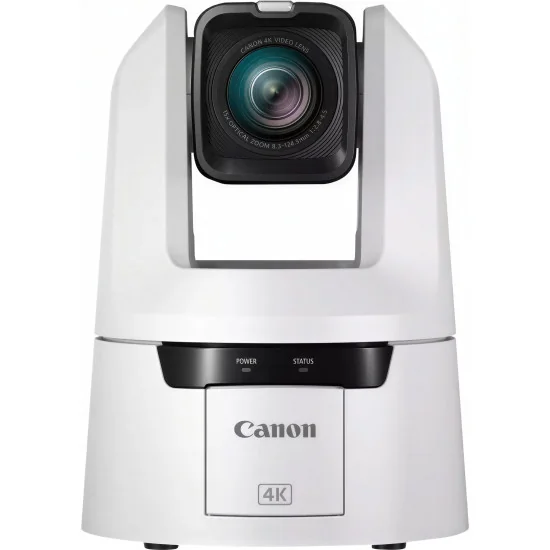
The camera also ships in a satin-white finish. The Canon CR-N500 White disappears against pale ceilings and light-toned architecture, which is why lecture theatres, corporate atriums, and modern houses of worship often specify it — a dark body reads as a distraction overhead, and on camera the audience should never notice the kit at all.
XLR audio input for microphone or line-level signal
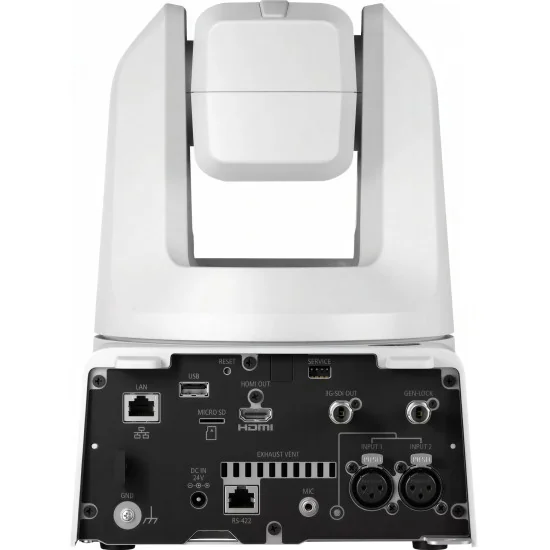
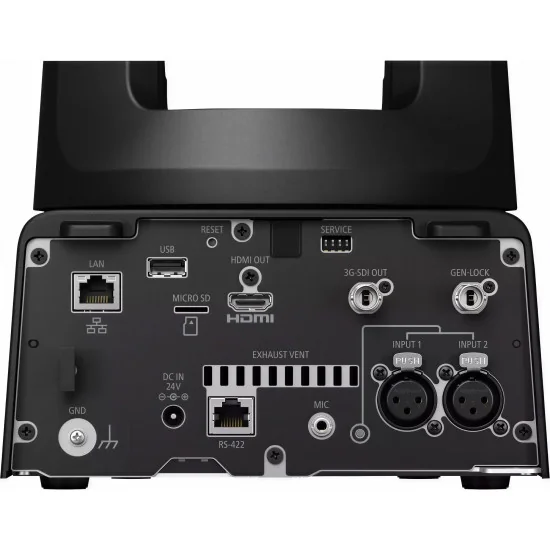
Vision is half the job; a live broadcast lives or dies on its sound. The Canon CR-N500 carries two balanced XLR inputs on three-pin connectors, each switchable between microphone and line level, with 48 V phantom power on tap for condenser capsules. A shotgun on the camera, a feed off the front-of-house desk, or a wireless receiver at the stage edge all land cleanly, and the balanced connection rejects the hum and interference that plague long unbalanced runs across a venue. Sensitivity settings cover -60 dBu at mic level and +4 dBu at line, so matching the camera to a house mixer is a quick, predictable job rather than a guessing game.
A 3.5 mm stereo mini-jack with plug-in power sits alongside for a scratch mic or a simpler source, and every audio channel embeds directly into the SDI, HDMI, and NDI streams. That means a single cable can carry synchronised picture and sound back to the switcher with no separate audio snake to lay, patch, or troubleshoot. For a small crew running a hybrid conference or a regional news insert, capturing broadcast-grade audio at the camera head removes an entire class of on-site problems and keeps the signal chain honest from stage to gallery.
HDMI, SDI with timecode, NDI outputs and various IP streaming protocols
Signal routing is where the Canon CR-N500 PTZ camera settles into an IP-first plant. A 3G-SDI BNC output complies with SMPTE 424, 425, and ST 299-2 and carries embedded audio alongside timecode as VITC or LTC — the detail that keeps multi-camera footage frame-aligned when an editor conforms the show in post. A full-size HDMI port outputs up to 3840×2160 at 29.97p in 4:2:2 10-bit for a local monitor or a capture card. One practical caveat worth planning around: SDI and HDMI share a single output format, and selecting 4K on HDMI suspends the SDI feed, so a facility should map its routing before load-in rather than during it.
Over the network, the camera speaks the languages a modern gallery expects. NDI|HX travels over the RJ45 connection, and direct streaming runs through RTMP, RTMPS, RTSP/RTP, and low-latency SRT, with Canon's own XC protocol and FreeD metadata on hand for augmented-reality and virtual-set productions. A dedicated BNC gen-lock input frame-locks the body to a master clock so every source in the rig shares the same timing reference — non-negotiable for clean vision mixing. Whether a studio is retrofitting one head into an existing SDI infrastructure or building a greenfield IP room, the CR-N500 slots into either topology without an adapter shopping list.
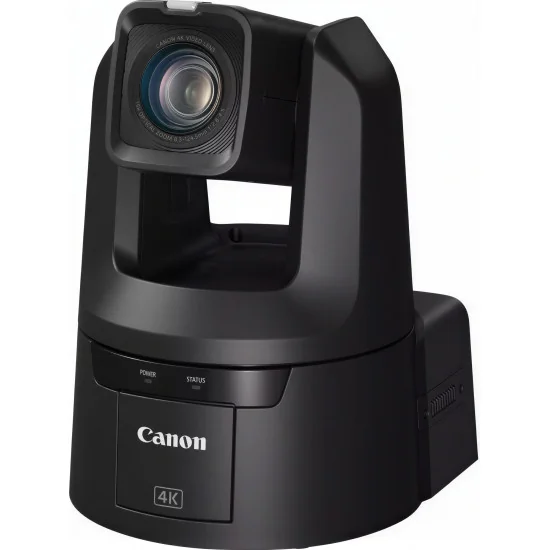
Command and control ride the same infrastructure. The camera answers over IP, RS-422, IR, or Wi-Fi, and pairs with Canon's RC-IP100, RC-IP300, and RC-IP1000 desks as well as the RC-SK5 and the Remote Camera Control application. Selected third-party controllers are supported too, so a house that has already standardised on a particular panel is not forced to change habits. Up to 100 storable presets — home position included — let an operator recall exact framings on cue, repeating the same shot precisely across rehearsal and live transmission.
PoE power supply – full camera operation with a single cable
The cabling story is one of the strongest arguments for the Canon CR-N500 in a permanent install. A single PoE+ (IEEE 802.3at) connection over Cat6 carries video, audio, camera control, tally, and power together, drawing around 19.6 watts at the head. One Ethernet run between the stage and the gallery replaces the bundle of separate video, audio, control, and mains cables a traditional position would demand. Across a large venue with long distances between camera and control room, that reduction in copper is a real saving in installation labour, in trunking, and in the number of things that can fail mid-show.
Where a network switch cannot supply PoE+, the camera accepts external 24 V DC through the supplied adaptor at a similar draw, so the installation is never boxed in by the capabilities of the existing infrastructure. For a production company costing a multi-camera fit-out, single-cable deployment shortens the rigging schedule and trims the bill of materials — the kind of practical economy that matters as much to the person signing off the budget as any headline specification does.
Built-in ND filters for professional image quality control
Exposure discipline separates a broadcast picture from a webcam grab, and the Canon CR-N500 PTZ camera hands the operator proper tools for it. A motor-driven neutral-density filter offers Off, 1/4, 1/16, and 1/64 steps, recalled electronically without anyone touching the body — essential for a ceiling-mounted head no one can reach once the room is dressed. With ND in the optical path, the camera can hold a wide aperture for shallow depth of field under bright stage lighting or large windows, instead of stopping down and flattening the very subject separation that makes the shot look expensive.
Around the ND filter sits a full exposure kit: a gain range from -6.0 dB to +33.0 dB, shutter speeds from 1/3 to 1/2000 of a second, and manual or automatic iris control. White balance spans automatic, two custom stores, presets for daylight at 5,600 K and tungsten at 3,200 K, and a manual range from 2,000 K to 15,000 K for mixed or coloured lighting. An engineer can match the CR-N500 to other cameras on a shared set or ride exposure shot by shot as the light shifts through a live event — the day-to-day control room work that keeps a programme looking consistent from the first cue to the last.
Multiple Canon auto-tracking options: Lite and Full
Subject following is where the Canon CR-N500 starts to reduce the crew a production actually needs, and Canon splits it into two tiers built on the RA-AT001 application. The tracking runs on the camera itself, with no external tracking box in the rack, which keeps latency low and the signal path simple. A firmware release from August 2025 pushed the feature set further, adding auto-framing behaviours and RTMP/SRT auto-reconnection that quietly restores a dropped stream without an operator noticing.
The Auto Tracking (Lite) tier ships free with firmware 1.1.0 or later. It automatically selects and follows a subject at a fixed sensitivity, with two subject-size options, a centre-locked frame, and one stored tracking setup — enough to keep a single lecturer or presenter comfortably in shot without a camera operator. It is a sensible baseline for a classroom capture or a modest streaming setup where the alternative is simply a locked-off wide.
The full Auto Tracking application, activated by a separately sold licence, opens the system up for demanding work. It allows automatic or manual subject selection, adjustable sensitivity across ten levels, five subject-size settings, and repositioning of the tracked subject anywhere in the frame rather than dead centre. Its auto-framing modes read a scene intelligently: Multi-Person Framing keeps several people in shot for a panel or talk show, Face Direction Framing opens space in the direction a speaker is looking, and Sit/Stand Framing re-zooms smoothly as a presenter rises or takes a seat. Up to five tracking configurations can be saved and recalled. For a studio covering hybrid conferences, houses of worship, higher-education lectures, or regional broadcast with a lean team, this is what turns a robotic head into a dependable extra operator — one that never loses concentration in the third hour of a live event.
Taken together, the specification tells a coherent story for a business, not just a spec sheet. The one-inch sensor buys picture quality and low-light confidence; the 15x lens and Dual Pixel AF buy coverage from a single position; XLR audio, timecoded SDI, HDMI, and NDI buy clean integration into whatever plant already exists; PoE+ buys a shorter rig and a smaller bill of materials; the ND filter and full exposure controls buy the consistency a broadcast demands; and the two-tier tracking buys back operator hours. Available in black or the ceiling-friendly white finish, the Canon CR-N500 is aimed squarely at production houses that measure equipment by reliability, return on investment, and the time it frees up — a professional B2B camera that keeps working long after the novelty of a robotic head has worn off.
Comments
No comment at this time!
Leave your comment