


E-Powered Cart – Not Only for Video Production
.jpg "E-Powered Cart – Not Only for Video Production")
An electric cart built for film crews turns out to suit far more than sets. Here is where the ZILR ZIPR earns its keep.
Ask a production manager where the schedule actually leaks and the answer is almost never the camera. It is the walk. Two hundred metres from the truck to the stage door, a lift that fits three cases at a time, a car park that sits below the venue and a crew that has already carried the same flight cases twice before the first shot. Multiply that by four unit moves and the arithmetic stops being about muscle and starts being about money.
That is the gap the ZILR ZIPR 2WD E-Powered Audio Video Production Cart was built to close. It is a motorised platform with a 183-litre bed, a folding steering column and a battery that slots out in seconds — a piece of kit that behaves like a hand cart when you want one and like a small utility vehicle when you do not. Set the seat and footrests and a technician rides it. Drop the handle and it tows at walking pace while the operator walks alongside. Push it by hand in a corridor and the motors simply stay out of the way.
What follows is less a product tour than a survey of where this class of machine has already turned up. The video industry got there first, which is unsurprising given who makes it. The interesting part is everything that came after.
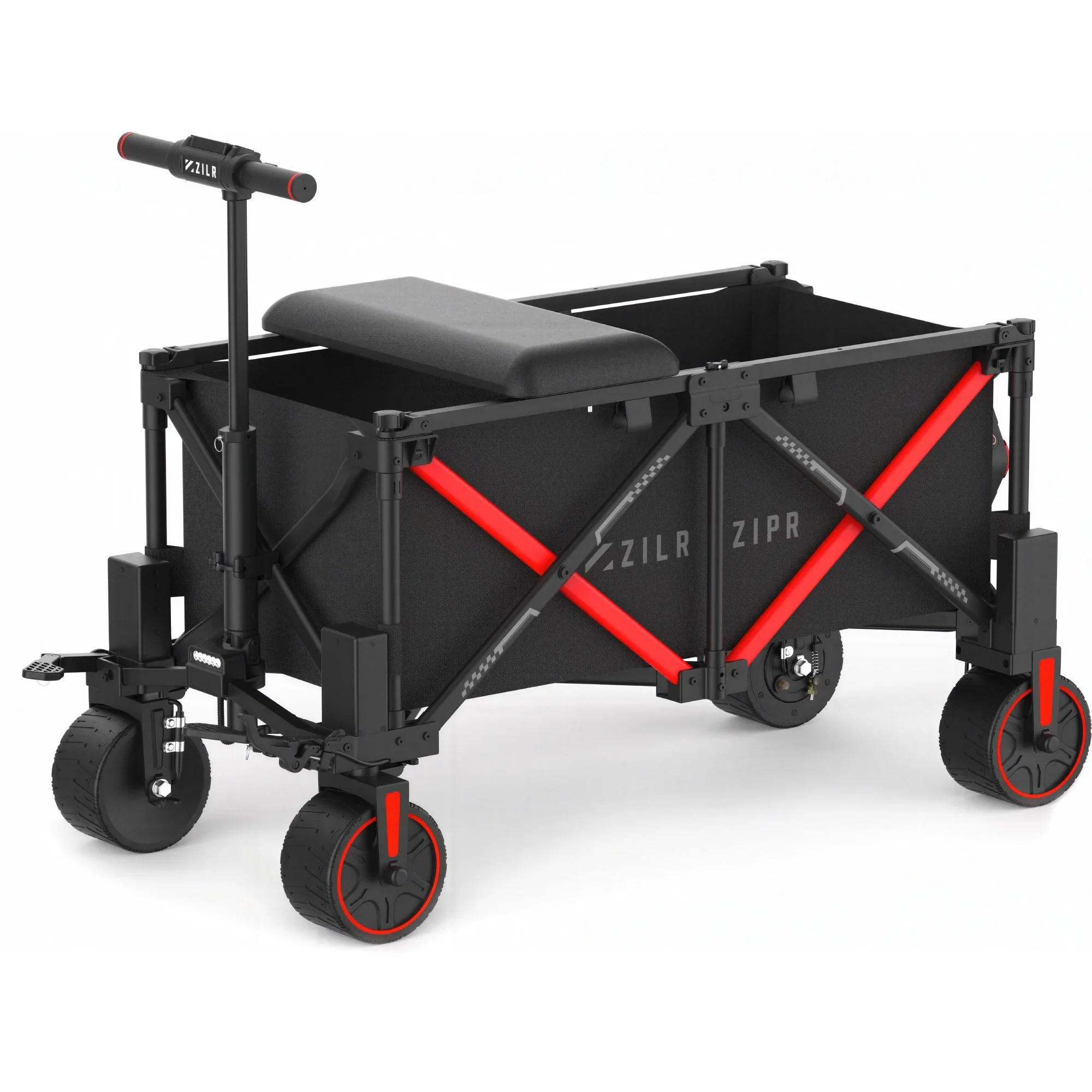
ZILR ZIPR – for the video industry, transport of video equipment, lighting gear and DIT setups
Start with the numbers that matter on a call sheet. The 2WD model carries 250 kg on a 1500 W front-wheel drive and covers up to 30 km on one charge of its 36 V, 12 Ah LiFePO₄ pack. The ZILR ZIPR 4WD E-Powered Audio Video Production Cart raises that to 300 kg behind four hub motors totalling 3000 W, trading range for grip: 15 km in full four-wheel drive, 20 km if you drop it back to two. Both top out at 16 km/h, which is brisk walking speed for the person beside it and slow enough that nobody on a live floor flinches.
Put a grip package on the bed and the picture sharpens. Two 2.5 kW heads with their ballasts, three combo stands, a distro box and a cable trunk sit comfortably inside 250 kg. A camera department run — body, three cine primes in a case, a fluid head, sticks, batteries and a monitor cage — barely troubles it. The bed swallows the awkward geometry that defeats a two-tier trolley: a folded 6 × 6 frame, a bag of grip arms, a rolled floor mat.
DIT and video village work is the quieter use case, and arguably the better one. A cart parked outside a stage becomes a rolling base for the transfer station: drives, a laptop, a small UPS, a monitor in a padded case, the tent and the sandbags that hold it down. Motors on the ZIPR run near-silent, so repositioning it during a take does not put a whine into the boom track. The backlit panel dims, the headlight covers the walk back to base at wrap, and the pack goes on charge overnight and is full again in roughly three hours.
Weather is the other reason production people take to it. IPX5 sealing and solid rubber tyres mean a wet backlot or a gravel access road is a routine surface rather than a decision point. There are no inner tubes to pinch on a stage floor full of screwheads, and no compressor in the truck to keep them up.
Small portable dollies for cameras
The optional second seat started as a passenger fitting. Camera operators found another use for it within weeks.
Bolt the seat on, sit an operator with a gimbal or a shoulder rig, and the cart becomes a track-free dolly. It is not a Fisher, and nobody should pretend otherwise — but for a corporate walk-and-talk, a factory-floor reveal or a documentary push down a corridor, it produces a move that handheld cannot and that laying twelve metres of track would price out of the day. The 6.5-inch (16.5 cm) solid rubber wheels roll over cable ramps and expansion joints without the jolt a hard caster transmits, and cruise control holds a constant creep so the operator concentrates on framing rather than on the throttle.
Three selectable speed modes matter here more than the top figure. In its lowest setting the machine crawls, which is the speed a dolly move actually needs. Gradient compensation trims motor output on a slope so a push down a ramp does not accelerate under its own weight, and the electronic braking system engages the moment the throttle is released — no lurch at the end of a take.
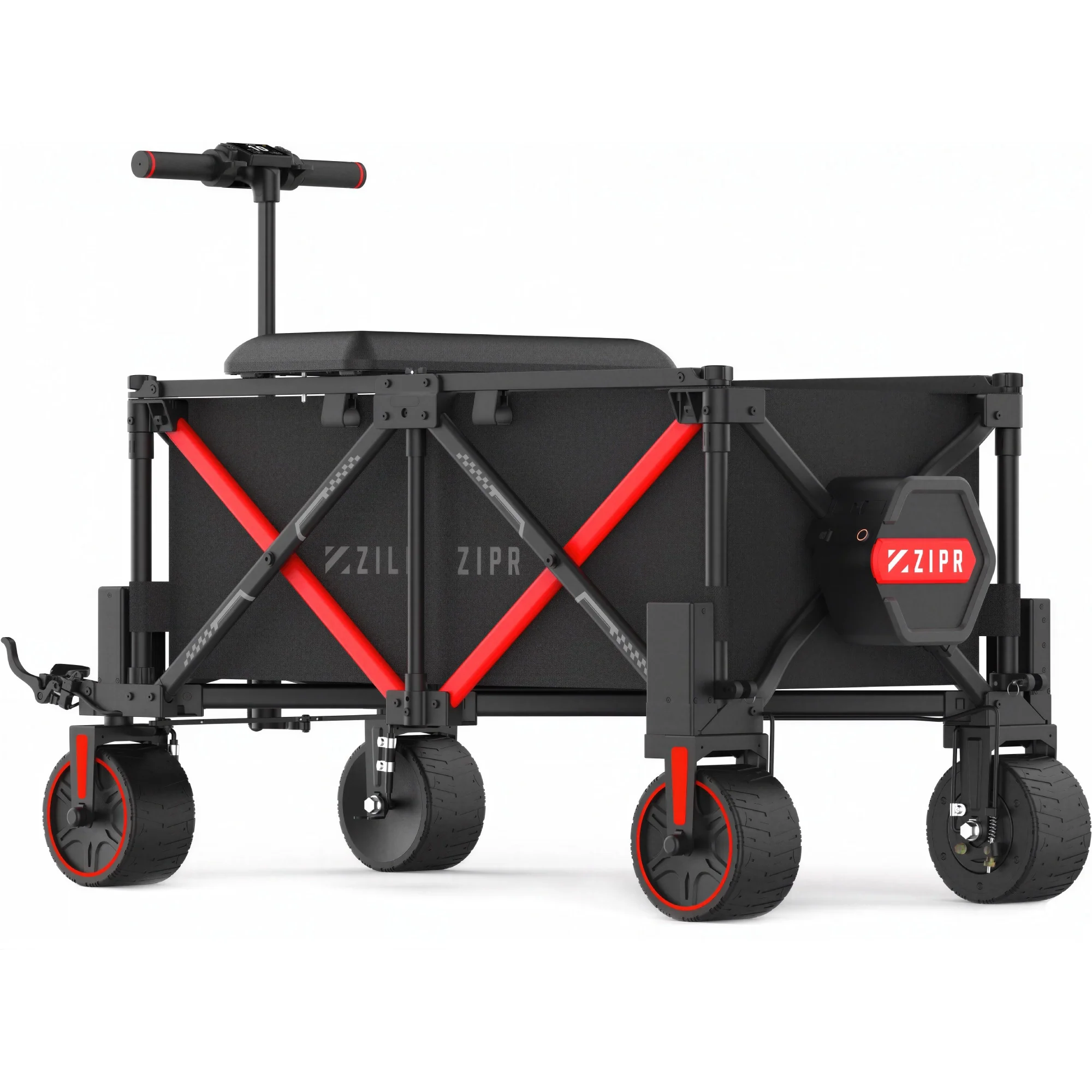
For anything with lateral movement over rough ground, the four-wheel-drive variant earns its extra weight. Independent hub motors and the differential control algorithm keep torque even when one wheel drops into a seam, which is what stops a shot from wobbling. Four kilos more in the cart, four kilos less in the shot.
Also used for cargo transport and technical operations at airports
Airside logistics is a world of long, flat, indoor distances — and of vehicles that are far too big for most of the jobs they are asked to do. A baggage tractor is the right tool for a train of dollies on the apron. It is entirely the wrong tool for moving a rack of test equipment from a maintenance store to a stand, or for shuttling spares along a pier.
This is where a compact e-powered platform slots in. It goes through a standard doorway, fits a service lift, and folds to 48 × 29 × 80 cm when a technician needs the floor space back. Ground-handling engineering teams use that footprint for tool crates and calibration gear; terminal facilities teams use it for signage, queue posts and lighting stock during an overnight reconfiguration.
The battery is the detail that decides whether a machine like this survives a shift pattern. A quick-release LiFePO₄ pack means the vehicle never queues for a charger — a spare comes off the rack, the flat one goes on, and the cart is out again inside a minute. Auto shut-off after ten minutes at the panel and sixty at the battery stops a unit that somebody walked away from draining itself before the next handover.
One limit deserves stating plainly, because airside operations are unforgiving about it: the ZIPR is rated for private land and airside service roads under an operator's own traffic regime, not for public highways. Any site assessment should start there.
Made for live events, concerts, trade shows and stadium operations
An arena load-in is the discipline in its purest form. Four hours, one loading dock, six departments and a floor that has to be clear before doors. Everyone is moving the same direction through the same tunnel, and the constraint is not lifting capacity — it is trips.
A cart that carries 300 kg turns four journeys into one. That is the whole argument. Audio moves stage boxes and cable looms; lighting moves fixture cases and truss hardware; broadcast moves camera positions, tripods and the drums of triax that always end up furthest from the truck. The factory-fitted TUGR tow hitch lets a second cart or a manual trolley trail behind the first, so a single operator can shift a train of gear down a service corridor at a controlled 16 km/h.
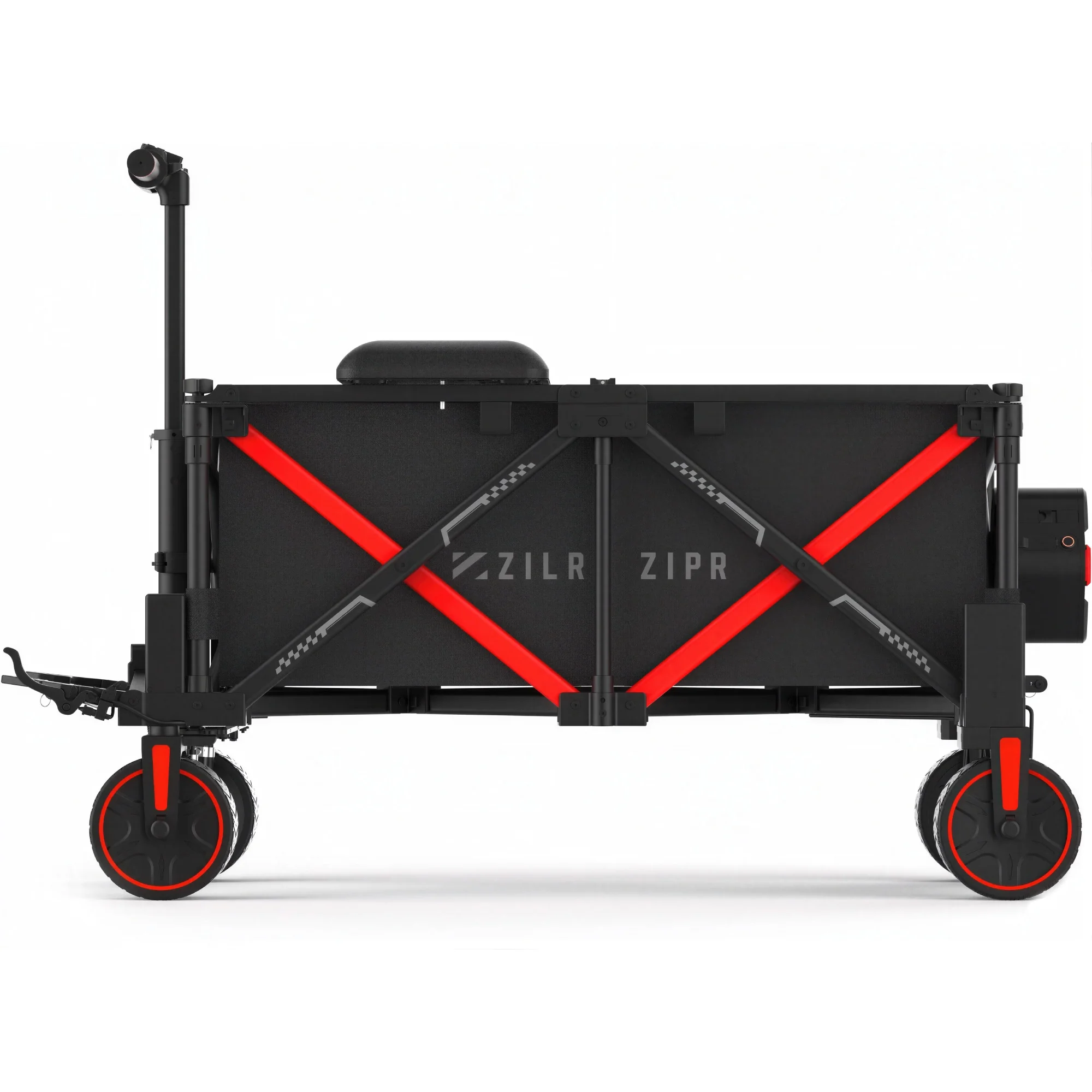
Stadium work brings gradients into it. Bowl ramps, tunnel inclines and the long pull up to an upper-tier camera platform are exactly the places where a loaded manual cart becomes a two-person job and a safety conversation. Hill-start assist and anti-rollback hold the load still on an incline; the 2WD handles grades of 12 to 21%, while the four-wheel-drive model takes on up to 30%. ZILR's own guidance is worth repeating: on a genuine slope, keep the load nearer 120 kg rather than pushing the ceiling figure. That is honest engineering advice, not a caveat to skim.
Exhibition halls are the flat-floor equivalent, with different pressure. Build-up runs to a clock, aisles fill with pallet trucks, and stand builders are carrying panels, flooring, AV brackets and toolboxes across distances that look trivial on a floor plan and cost twenty minutes each way in practice. Six-brake retardation on the four-wheel-drive version — four wheels regenerating, two mechanical drums at the rear — gives predictable stopping in a hall full of moving people.
For green space and park maintenance teams
Grounds crews carry an unglamorous problem: everything they need weighs a lot, and the surface they need to cross is the thing they are being paid to protect.
Turf does not forgive a utility vehicle with a loaded axle. It compacts, it ruts, and the repair costs more than the job that caused it. A 28 kg cart spreading a moderate load across four 100 mm-wide solid tyres puts a fraction of the ground pressure of a compact tractor into the same grass, which is why a machine this size keeps appearing in parks departments, botanic gardens and sports-turf teams. The pressure argument is not marketing; it is a straightforward function of contact patch and mass.
The practical loads are bags of topdressing, line-marking equipment, hedge trimmers and blowers, tool rolls, irrigation fittings, and the litter round that nobody wants to do on foot. Puncture-proof tyres are worth their own paragraph in this setting — thorns, glass and the wire ends of old fencing are the standard hazards of a green-space round, and a pneumatic wheel loses to all three.
Four-wheel drive changes the picture on soft ground and wet slopes. Selectable modes mean a crew can run in two-wheel drive on a path to preserve range and switch to the 4WD version of the drivetrain only when the ground demands it, which is how you make 20 km of battery last a full round rather than half of one.
Building maintenance work
Facilities teams live with a specific geometry problem. Their sites are vertical, their corridors are narrow, their lifts have a stated capacity, and the distance between a plant room and a fault is measured in stairwells rather than metres.
A folding electric cart answers that geometry better than a flatbed trolley does. Folded, it stands 80 cm tall on a 48 × 29 cm footprint — it rides in a passenger lift alongside people, tucks into a riser cupboard between jobs and goes into the back of a small van without a tail lift. Unfolded, the bed takes a full set of hand tools, a vacuum, replacement ballasts, filter stock or a couple of 20-litre drums.
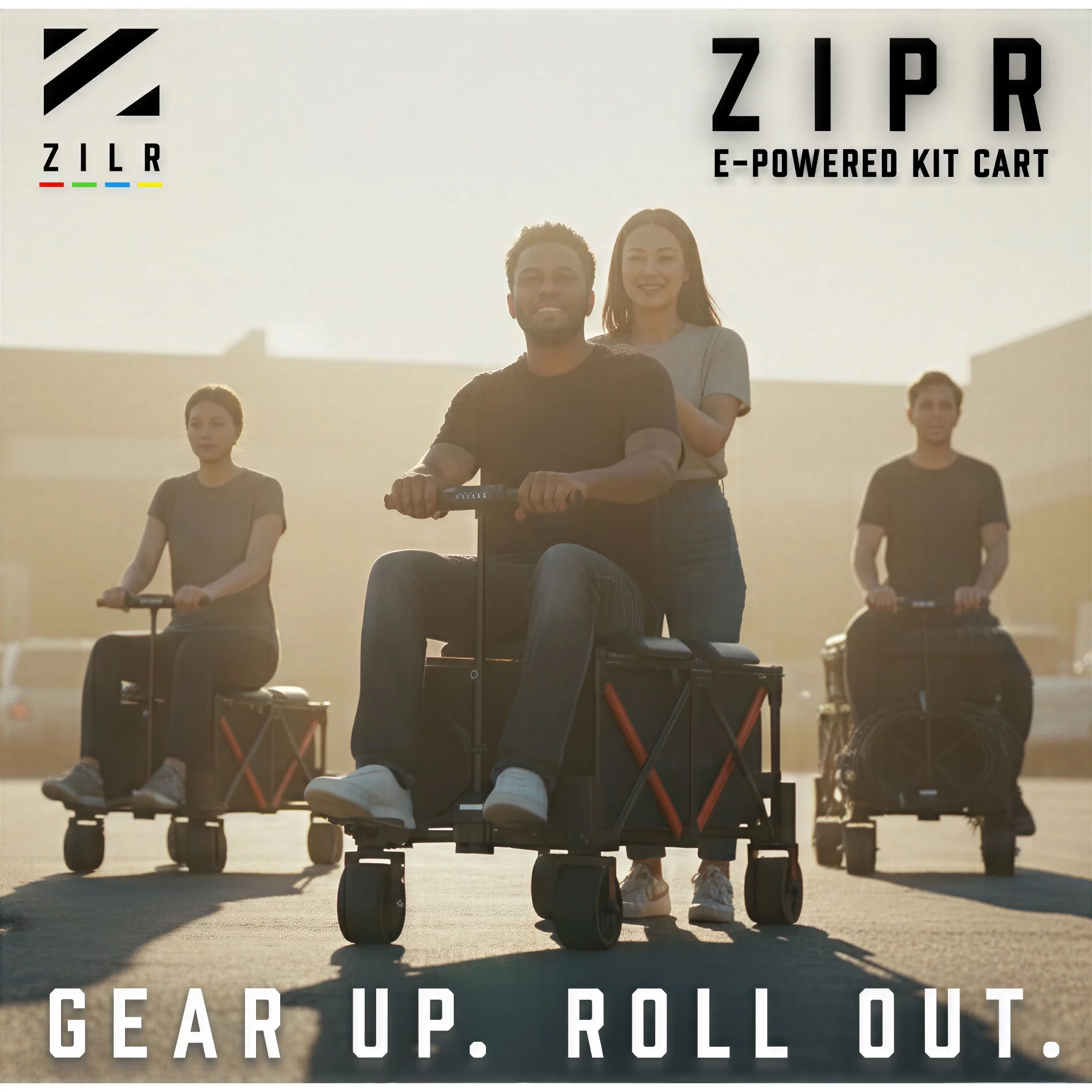
Indoors, the case rests on three things. Solid tyres leave nothing on a polished floor and pick nothing up from a service yard. The regenerative front brakes and rear drums give a loaded machine a short, controlled stop in a shared corridor. And the near-silent drive lets a maintenance round happen at seven in the morning in an occupied building without generating a complaint — a consideration that hotels, hospitals and offices treat as seriously as the work itself.
There is also the matter of who can operate it. A 300 kg manual push is a two-person task with a risk assessment attached. The same load on a motorised platform is one technician walking beside a machine that holds itself on a ramp. Over a year of tickets, that is the difference between a maintenance team and a maintenance team plus a labourer.
Support for courier and hotel operations
Last-mile delivery has quietly become a walking job. The van parks once, and the courier makes six trips into a campus, a business park or a residential block. Depot operations have the same shape in miniature: cages, roll containers and parcel stacks moving between a sorting line and a loading bay, over and over, all shift.
A 183-litre bed takes a meaningful stack of parcels, and 250 kg is well beyond what anyone should carry by hand. The value is not the single heavy run — it is the eliminated return trips. Towing mode suits this pattern particularly well: the courier walks their normal route with the cart following at walking pace under power, hands free for the parcel and the door entry code.
Hotels present the indoor version. Housekeeping trolleys, linen, minibar stock, banqueting furniture and AV kit for a conference room all move through back-of-house corridors that were never sized generously. A cart that fits a service lift, runs quietly past guest rooms and holds a full floor's linen in one journey removes a genuine bottleneck from a morning turnaround. Add the storage jacket and side saddles and small items stop migrating off the bed on a corner.
Battery discipline is what makes it work commercially. Three hours to a full charge, hot-swappable packs and a range figure that comfortably covers a shift mean the machine is available when the shift is, rather than tied to a socket during the busiest hour of the day. That is the same logic a production house applies to the 2WD ZIPR across a two-day shoot.
Applications in the leisure sector, camping and outdoor activities
The last category is the one the specification sheet reads like it was written for, even though it clearly was not.
Campsites, marinas, holiday parks, adventure centres and outdoor festival sites share a profile: long distances, mixed surfaces, no useful vehicle access at the far end, and a constant flow of heavy, awkward objects. Tents and pitch equipment. Coolers and water containers. Kayak trolleys, paddleboards, safety gear, event signage. Sand, gravel, boardwalk, wet grass and gentle dunes — the exact terrain that stops a wheeled cool box dead.
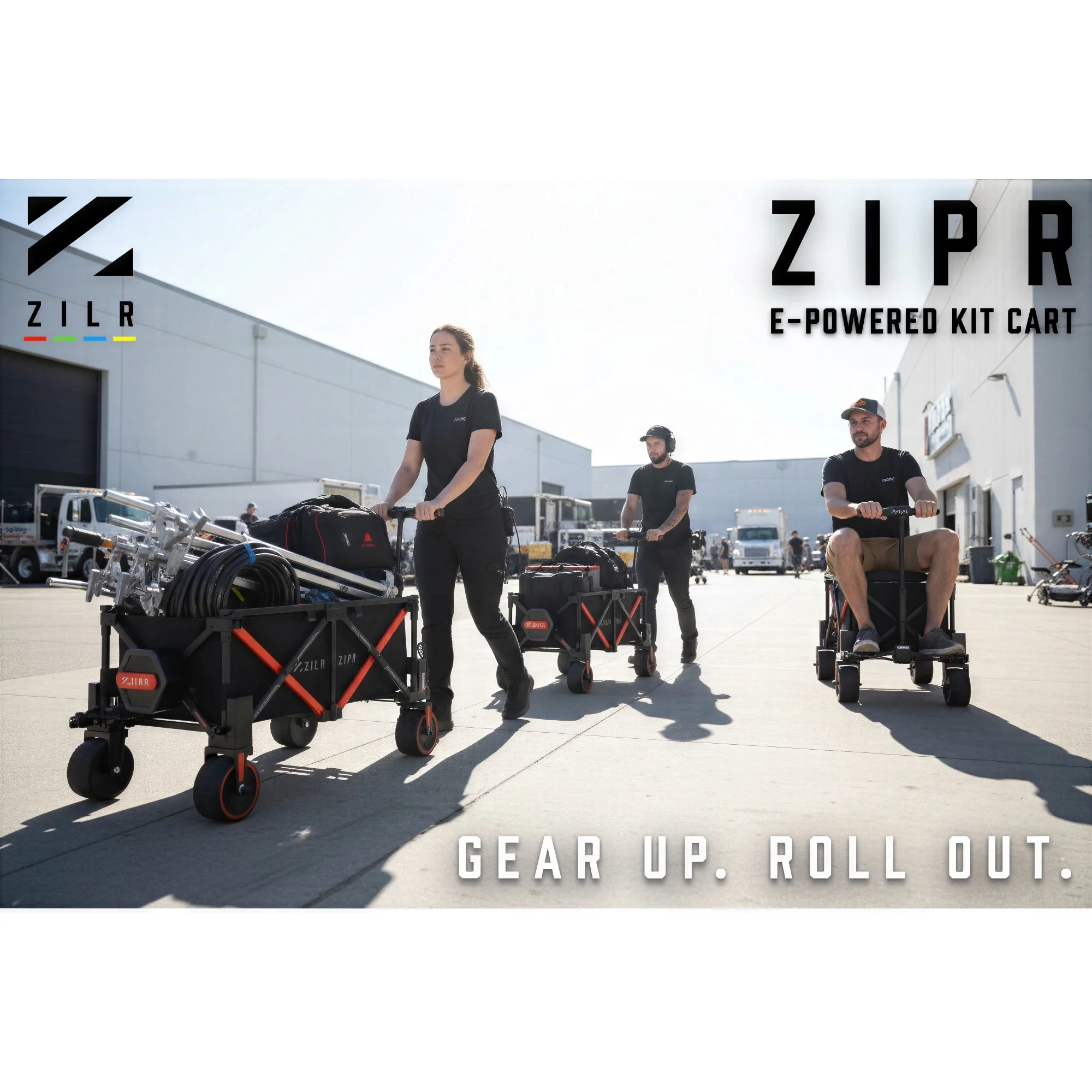
Wide solid tyres and four-wheel drive are the combination that matters on loose ground, and the rain jacket keeps a load dry on a site with no shelter between the car park and the pitch. Site teams at outdoor events use the same machine for two jobs in one day — build in the morning, guest logistics in the afternoon — which is precisely the kind of dual duty that justifies the purchase for an operator running seasonal capacity.
For rental houses and equipment hire businesses, the appeal is different again. A machine that folds to a quarter of its working size stores on a shelf rather than a floor, ships without a pallet and hands over to a customer with a five-minute briefing. Sixteen accessories — jackets, saddles, crates, hitches, spare packs, foot pegs — turn one chassis into several products across a hire catalogue.
A machine that outlives one department's budget
The commercial case for the ZILR ZIPR 2WD and the ZILR ZIPR 4WD rests on something simple: the same chassis solves a problem that recurs in a dozen unrelated industries, and it solves it with maintenance items — tyres, a battery, two drum brakes — rather than a service contract. For a production house, that means a cart bought for a drama shoot is still earning during the corporate season, on a trade stand build, or hired out to an events client.
Choose the 2WD if the ground is mostly hard and the priority is distance on a single charge. Choose the 4WD if slopes, grass, gravel or sand appear regularly, and accept the shorter range as the price of traction. Either way, treat the slope guidance seriously, keep a spare pack on the shelf, and remember that the machine is rated for private land — the rest is a matter of how many trips your team is currently making that it does not need to.
Comments
No comment at this time!
Leave your comment