


New Telycam Explore Gen2 (100 / 300 / 500) cameras
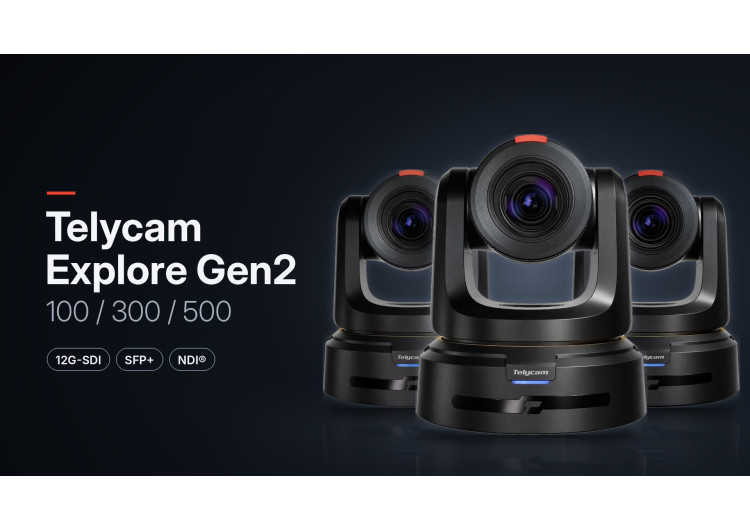
Three PTZ cameras, one chassis, three different rear panels. Here is what sets the Telycam Explore 100, 300 and 500 apart and where each one fits.
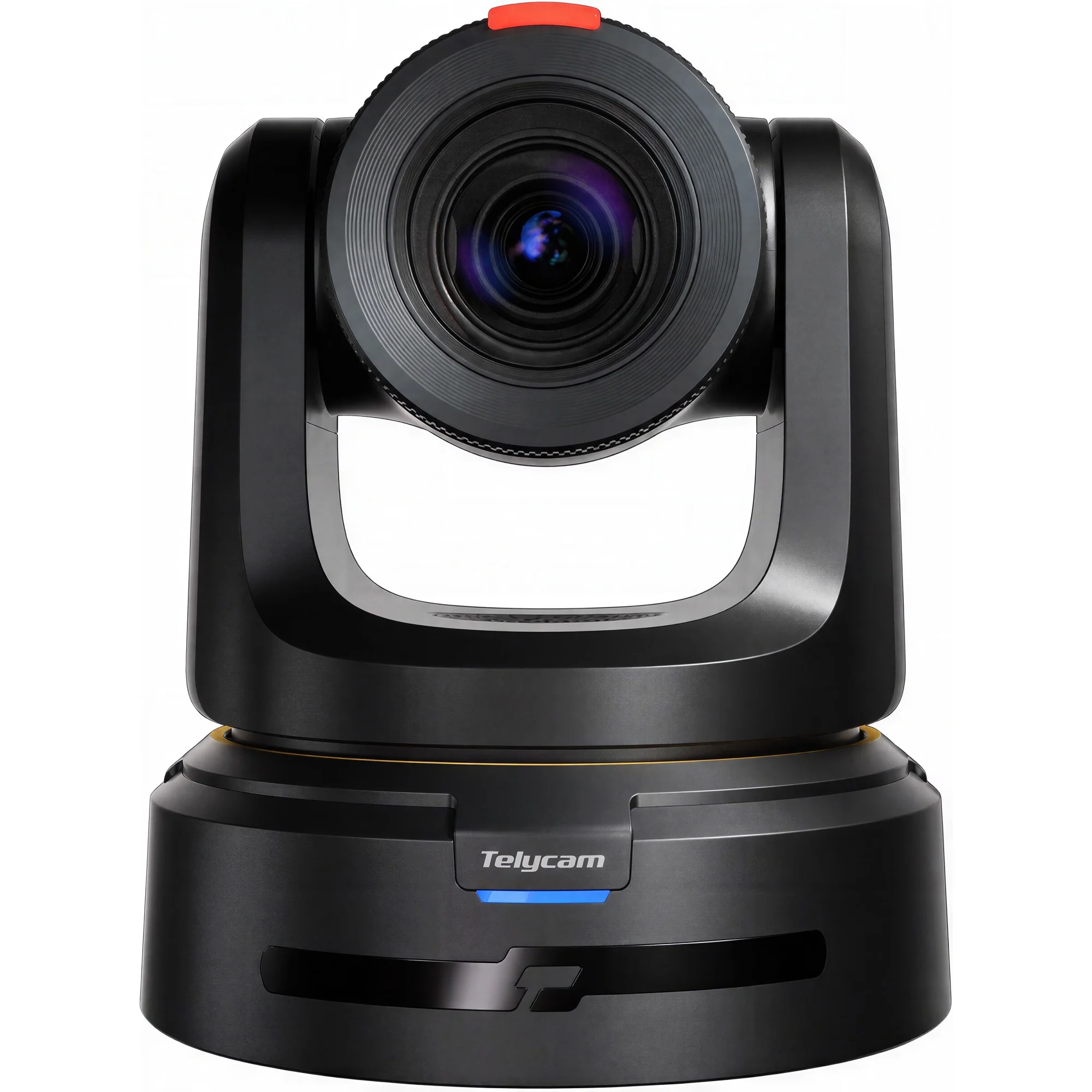
Bolted to the same truss, the three new Explore heads are hard to tell apart: identical black chassis, the same red tally cap on top, the same deep yoke. Walk round to the rear panel and the story changes. One camera is built for reach, one puts a large sensor into a mid-priced body, and the third pairs that sensor with a complete broadcast connector set.
Telycam unveiled this second generation of its broadcast-class series in June 2026 and showed it at InfoComm in Las Vegas. The Telycam Explore Gen2 family replaces three earlier models one for one – the Explore 100 succeeds the Explore SE, the Explore 300 takes over from the Explore XE, and the Explore 500 follows the original 1-inch Explore. List prices stayed at the level of the outgoing cameras. For anyone amortising a PTZ fleet over several seasons, that is the real headline: a bigger sensor, hybrid focus and new motors without a move into a higher price bracket.
Most of what sits below the lens is shared. All three use new brushless DC pan/tilt motors with three-axis synchronisation, AI auto-tracking and auto-framing, FreeD camera data, dual tally lamps, local recording and a rebuilt web interface that runs comfortably on a phone or tablet. The differences, in brief:
- Explore 100 – 1/1.8" sensor, 30x zoom, 12G-SDI, SFP+, NDI High Bandwidth and genlock. The long-throw camera for arenas, conference halls and sports venues.
- Explore 300 – 4/3" sensor, 20x zoom, hybrid autofocus, optical low-pass filter and ND, with HDMI 2.0, NDI HX3 and 3G-SDI. Large-sensor pictures for studios, lecture theatres and streaming sets.
- Explore 500 – the imaging of the 300 combined with the full broadcast I/O of the 100, for galleries, IMAG and virtual production.
Excellent image quality and specifications.
Each model reads a 9-megapixel Sony CMOS sensor and delivers 3840 × 2160 at up to 60 frames per second on its main outputs. The image pipeline gives a vision engineer the controls needed to match several heads on one stage: 2D and 3D noise reduction, white balance in auto, ATW, one-push or manual colour-temperature modes, and exposure in full manual or with shutter, iris or brightness priority. Anti-flicker settings for 50 Hz and 60 Hz mains stop LED fixtures from rolling bars through the frame, a routine annoyance on tours that mix lighting rigs from different suppliers.
Low-light sensitivity is quoted at 0.5 lux (50 IRE, maximum gain, 1/30 s). The Telycam Explore 100 reaches that figure at F1.35, its widest aperture. The 4/3" models match it at F2.8 – with a lens two stops slower – which says a great deal about how much light their larger photosites collect. The new web interface also stores four scene presets for image settings, so a keynote look under a tight stage wash and a Q&A look with house lights up can be swapped in seconds between sessions instead of being rebuilt by hand.
Movement matters as much as the picture once a PTZ goes on air. During a preset recall, the brushless motors start and stop pan, tilt and zoom together, and the camera lands on its next framing in one coordinated arc rather than panning first and zooming afterwards. Torque stays even across the speed range. That shows most at the slow end: a 0.1°/s creep during a product reveal or a closing number holds steady, without the stepping that gives cheaper heads away. Up to 256 presets are reachable over serial control, ten from the IR remote, each repeatable to 0.1°.
Control follows both broadcast and AV conventions – VISCA over serial and over IP (TCP and UDP), Pelco P/D and ONVIF – with RS-232 and RS-485 on every model and RS-422 added on the 100 and 500. Front and rear tally lamps respond to NDI, VISCA and VISCA over IP, so presenters and floor crew both know which camera is live. AI auto-tracking and auto-framing let a single operator hand a presenter shot to the camera while concentrating on other positions. FreeD, meanwhile, streams pan, tilt, zoom and focus data to virtual-set engines such as Unreal Engine, Vizrt, Zero Density, Aximmetry, Brainstorm and VSet3D, with no separate tracking encoder bolted to the head.
Exceptionally large image sensors.
The biggest change in this generation sits behind the lens of the Telycam Explore 300 and its bigger sibling, the Explore 500. Both move from a 1-inch chip to a Sony 4/3" sensor, whose active area of roughly 17.3 × 13 mm is about twice that of the 1-inch format. Spread nine million photosites over that surface and each one gathers more light. Shadows stay cleaner at the same gain, and depth of field at the long end becomes shallow enough to lift a speaker off a busy LED backdrop. Interviews start to look like cinema-camera footage rather than a feed from a box on a ceiling bracket.
Shallow focus punishes focus errors, so both cameras carry hybrid autofocus. Phase detection acquires the subject almost instantly; contrast detection then refines the final position. Together they keep a moving presenter sharp without the hunting that contrast-only systems tend to show in dim rooms. The 9.79–186.5 mm lens (F2.8–F4.5) spans 71° to roughly 4° horizontally – wide enough for a four-person panel table, long enough for a clean mid-shot from the back of a medium-sized hall.
Two optical tools deal with problems that usually turn up on site. A built-in ND filter cuts light transmission to 25%, 6.3% or 1.6% – roughly two, four and six stops. In daylight behind a glass façade or at an outdoor fixture, the iris can stay open and the shutter at 1/50 or 1/60 s. A thread on the lens takes an extra screw-in filter if needed. Then there is the optical low-pass filter. An LED wall is a grid of bright points, and a camera sensor is a grid too; if the two pitches come close to each other, moiré bands crawl across the screen behind the presenter. The OLPF softens detail just below the sensor's sampling limit and stops that interference before it reaches the image – much cheaper than re-angling cameras in the middle of a rehearsal.
The Explore 100 takes the opposite route. Its 1/1.8" sensor is smaller and its focus conventional rather than hybrid, but the 6.91–214.64 mm lens opens to F1.35 at the wide end and narrows the horizontal angle to about 2° at full telephoto. From 30 metres, that frames a strip of stage only about one metre wide – a genuinely tight shot – while the 4/3" models show roughly 2.1 metres from the same spot. For a position at the back of an arena or on a press riser, reach is the number that pays for the camera.
12G-SDI and SFP+ connectivity.
For galleries built around SDI routers and hardware switchers, the Explore 100 and the Telycam Explore 500 bring the interfaces that decide whether a PTZ joins the broadcast chain or sits beside it. 12G-SDI carries uncompressed 2160p at up to 60 frames per second over one coaxial cable, a job that used to take four 3G-SDI links. On popular 12G-rated mini coax, practical runs sit at around 30 metres. Heavier cable goes further, but long distances belong to glass.
That is where the SFP+ cage earns its place. Fitted with an optical transceiver, it sends the same SDI signal over fibre to a gallery on another floor, an OB truck in the car park or a control room across a campus. Common single-mode modules are rated for ten kilometres. Fibre is also immune to ground loops and electrical interference, a practical concern in stadiums and exhibition halls where video runs share cable trays with mains power.
Both cameras accept a genlock reference. Frame timing locks to house sync, cuts on a hardware vision mixer stay clean, and the PTZ can sit alongside studio and shoulder cameras on the same reference. A second output adds value of its own: the 3G-SDI port on the 100 and 500 delivers an HD crop of the 4K frame. One camera facing a lectern can therefore feed a wide 4K shot on 12G-SDI and a tighter HD angle on 3G-SDI – two switcher sources from a single head and a single rigging point.
The Explore 300 keeps a simpler panel. HDMI 2.0 carries 4K60, and its 3G-SDI port outputs the full picture at up to 1080p60, so the camera drops straight into an HD-SDI production system without converters. Genlock, 12G-SDI and SFP+ are left out, which is the trade-off for its price point. HDMI 2.0 at 4K60 is common to all three models.
NDI High Bandwidth up to 250 Mbps.
On IP the range splits the same way. All three stream NDI HX3, which compresses 4K60 to between 3 and 120 Mbps and suits networks that also carry office traffic, remote contribution links or wireless bridges. The Explore 100 and 500 add full NDI High Bandwidth at 90 to 250 Mbps. Its SpeedHQ intra-frame codec is visually lossless, survives several decode and re-encode passes inside a production chain, and keeps technical latency down to a handful of scan lines rather than whole frames. Operators notice the difference on IMAG screens and during live keying.
Bandwidth needs planning. Each camera connects through a gigabit port, and four 4K60 feeds at 250 Mbps fill a 1 Gb/s link on their own. A rig of six or eight High Bandwidth cameras calls for 10 GbE uplinks between switches, with roughly a quarter of capacity kept free as headroom. HX3 still makes sense for positions that do not need that quality – audience reverse shots, an overflow room, a web-only stream. The Explore 100 is the most economical route into full NDI at 4K60, with a 30x zoom on the front as a bonus.
Not every job runs through a vision mixer. H.264 and H.265 encoding with SRT, RTMP, RTMPS, RTSP, WebRTC, MPEG-TS and RTP multicast lets any of the three stream straight to a platform or a remote production hub, without a hardware encoder in the flight case. USB-C provides 4K30 in MJPEG, H.264 or H.265 to a laptop running conferencing or capture software, although USB and NDI cannot run at the same time.
Power travels on the same Ethernet run. The 100 and 500 accept PoE++ to IEEE 802.3bt, while the 300 runs on PoE+ to 802.3at; a 12 V DC input covers venues without suitable switches. Check the total switch budget, not just the per-port class: 802.3at delivers up to 30 W per port at the switch and 802.3bt 60 W or 90 W depending on type, and a fully populated switch can run out of power long before it runs out of ports.
XLR audio.
Every Explore Gen2 model carries a mini-XLR input with phantom power alongside a 3.5 mm stereo line input. Sound is embedded with the picture on SDI, HDMI, NDI and the IP streams, so it reaches the switcher or the streaming platform in sync, with no parallel audio path to line up afterwards.
A short condenser shotgun mounted on the camera gives a sports or exhibition feed genuine ambience instead of a silent wide shot. A line-level mix from the front-of-house desk, plugged into the 3.5 mm jack, turns a single Explore 300 into a self-contained streaming unit for a lecture or a company town hall – one Ethernet cable, finished picture, finished sound. On multi-camera shoots recorded inside each head, a reference track on every camera makes syncing the angles in the edit much faster.
On the practical side, most rigs need a short mini-XLR to full-size XLR adapter cable. Engage phantom power only for condenser microphones; line-level sources belong on the 3.5 mm input, where they will not overload the microphone preamp.
Internal recording to memory cards.
A microSD slot in each body records the camera's own feed locally. The card costs next to nothing, and the safety net it provides is real. If the venue network drops halfway through a stream, the camera keeps recording and the files are ready for the replay or the on-demand edit. The same card gives every position an ISO recording for post-production, so an editor can rebuild the programme with different cuts the next morning without renting a multichannel recorder. Clips can also be reviewed on site or uploaded to a cloud platform straight after the event.
Use high-endurance cards rated for continuous video writing, format them in the camera before each job and add free space to the line-up checklist – a card that fills at the 90-minute mark helps nobody.
Choosing between the three comes down to the rear panel and the throw distance. The Explore 100 brings full broadcast I/O and 30x reach at the lowest cost. The Explore 300 delivers 4/3" images, hybrid focus and moiré control for HDMI, NDI HX3 and HD-SDI venues. The Explore 500 combines that large-sensor image with 12G-SDI, SFP+, NDI High Bandwidth and genlock for galleries that accept nothing less. Because chassis, protocols and web interface are shared, a fleet can mix all three under one controller and one set of operating notes.
Adding Explore Gen2 heads to an existing fleet? Send us what your gallery already runs – switcher, sync generator, network core, PoE switches – together with the throw distance for each position. We will flag which model connects without extra hardware and where an SFP+ module or a larger power budget is needed, then quote the complete set for VAT-free intra-community delivery to registered businesses across the EU.
Comments
No comment at this time!
Leave your comment