


Roland VR-120HD - 12-channel video mixer with direct streaming
Run hybrid productions from one console. Switch sources, stream to the platform, and record a local master for post.
Run hybrid productions from one console. Switch sources, stream to the platform, and record a local master for post.
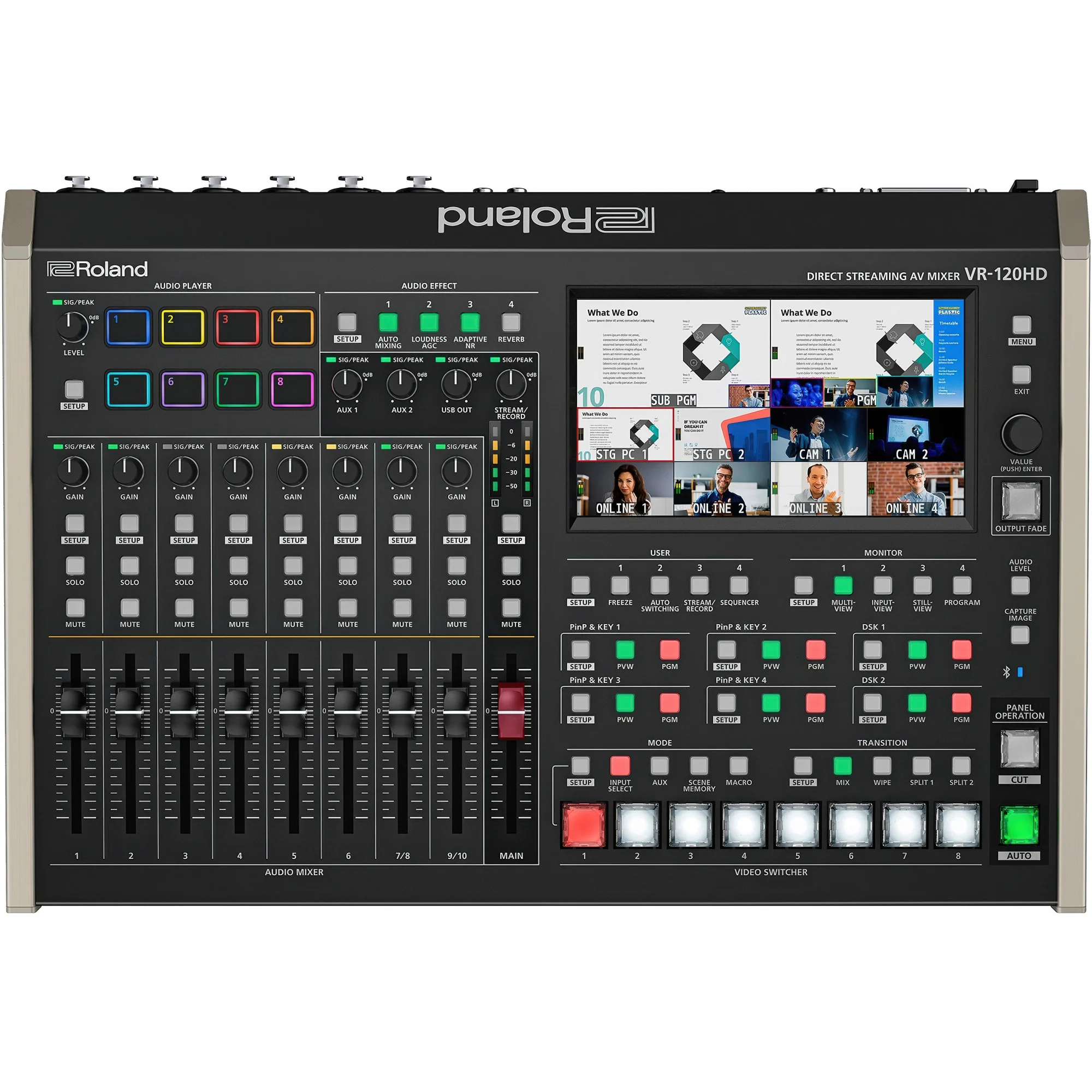
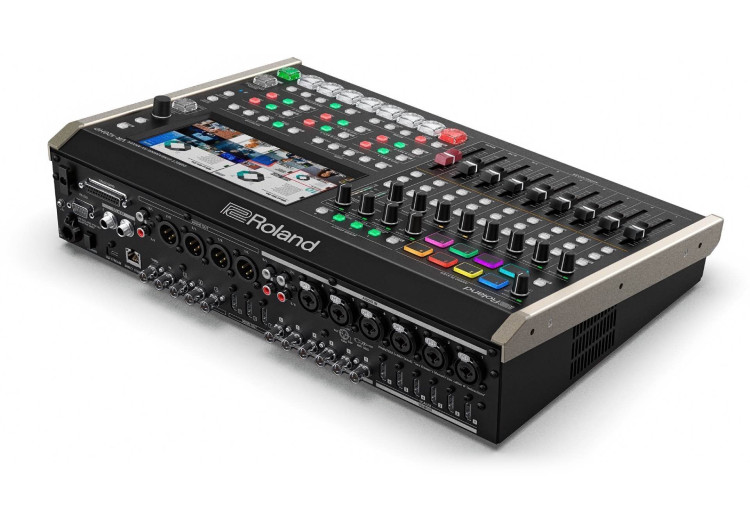
When routing, mixing, graphics, and delivery must stay coherent under pressure, the Roland VR-120HD functions as the show’s hub: 12 video inputs, multi-bus outputs, integrated network streaming, and local capture to SDXC. It fits workflows where a compact control position must still output multiple program variants for the room, the web, and technical monitoring, without stacking extra boxes.
Instead of treating “stream” and “in-room” as identical, the VR-120HD lets you build different buses for different audiences. You can run a clean Program for IMAG, keep a graphics-heavy Sub-Program for online viewers, and maintain Aux feeds for confidence monitors, overflow rooms, or a technical clean feed for recording and post. This separation is the difference between a feed that merely exists and a feed that meets a broadcast-style brief.
HDMI and SDI inputs.
The video section provides six 3G-SDI and six HDMI inputs, handling Full HD sources up to 1080p50/60. Each input includes conversion/scaling resources so mixed sources—cameras, laptops, media players, or handheld devices—can land in the same production without forcing an external scaler per feed. This reduces format friction in corporate venues where guest devices arrive without prior validation.
SDI coverage fits broadcast cameras and long-distance runs, while HDMI supports client AV. For crews that alternate between stage IMAG and webcast packaging, consistent input normalization keeps transitions predictable and avoids timing surprises when switching between cameras and computer content.
Input management is also relevant for rental and touring crews. HDMI sources often arrive with nonstandard resolutions or aspect ratios, and SDI cameras may be set to different frame families. With per-input processing, the mixer can keep the production output stable while still accepting those variations—useful when a client demands a fixed master for downstream distribution, LED processors, or simultaneous recording.
Built-in professional audio mixer with XLR.
Audio is handled by a 42-channel digital mixer that merges embedded audio from SDI/HDMI/USB with analog sources. The rear panel provides six XLR/TRS combo inputs with mic-level handling and phantom power for condenser microphones, plus RCA connectivity and Bluetooth contribution when a fast utility feed is needed.
Processing tools such as EQ, dynamics, reverb, anti-feedback, noise reduction, and auto mixing help maintain intelligibility when presenters rotate and stage mics change distance. Separate buses allow different mixes for the room and the stream—for example, stronger dialog focus online while preserving ambience and music in-venue.
The console also supports show-friendly audio playback. Trigger pads can fire stingers, walk-on music, countdown beds, or compliance messages without patching an external sampler. This can simplify single-operator productions where the same person handles switching, stream monitoring, and audio cues.
Direct streaming via Ethernet and USB video output.
Direct streaming runs over Ethernet with support for RTMP, RTMPS, and SRT, and the unit can transmit two streams in parallel (secondary destination or redundant profile). This is useful when a production must publish to a public platform while also sending a protected feed to an internal CDN, remote control room, or recording endpoint.
Stream management tools such as adaptive bitrate behavior and adjustable delay help handle unstable uplinks and give production teams a margin for editorial control when policies require a short hold before the public feed. For hybrid events that depend on venue internet, these controls can be the difference between a continuous webcast and a fragmented one.
For conferencing-centric workflows, the USB-C UVC/UAC output appears as a webcam and audio interface, allowing delivery into Zoom, Teams, or browser studios without an extra capture device. That dual-path approach—LAN encoders plus USB video—covers most enterprise streaming policies, including scenarios where IT accepts webcam devices but restricts third-party encoder software.
VISCA IP camera control.
Integrated VISCA IP control supports operation of up to 12 PTZ cameras, enabling one operator to cut and frame shots from the same surface. Presets can be recalled between speakers, and mixed camera fleets remain viable when they share compatible IP control behavior.
In practice, PTZ control pairs well with automation. A macro can recall a PTZ preset, switch to that camera, and open a microphone channel at the same cue point. For lecture capture, council meetings, worship, or corporate town halls, this reduces staffing while keeping the visual language consistent and repeatable.
Built-in 7-inch preview screen.
The built-in 7-inch (17.8 cm) touchscreen provides multiview monitoring and menu navigation without relying on an external display—useful in flypacks, ballroom builds, and compact control positions. It also accelerates troubleshooting when an input drops, when a key layer must be verified, or when an operator needs to confirm exactly which bus is routed to a particular output.
Because the screen is integrated, a minimal rig can stay compact: mixer, cameras, and networking hardware. For crews that travel with carry-on cases or must set up in confined FOH positions, removing an external multiview monitor can meaningfully reduce space and cabling.
Three independent video outputs.
Physical I/O includes three SDI outputs and three HDMI outputs. Because outputs are assignable, “independent outputs” means you can route Program, Sub-Program, Preview, individual Aux buses, or multiview to different destinations. Typical deployments send a clean feed to the room, a graphics feed to the webcast, and a multiview to the director, without external routing hardware.
Aux buses also cover specialist feeds: interpreter monitors, backstage confidence screens, sponsor displays, or a clean output for post workflows when the web version carries overlays not desired in the archival master. In installed systems, the mixer can act like a compact matrix for Full HD, simplifying signal flow in small studios and corporate briefing rooms.
Recording to SD cards.
A front-panel SDXC slot enables recording in H.264/MP4, producing an immediate file for rapid client delivery, VOD publication, or editorial ingest. When the show ends, the deliverable is already local, avoiding the delay of pulling files from a streaming platform.
The SD card also supports operational content. Still images and short clips can function as holding slates, sponsor bumpers, “we will return” cards, or emergency graphics if a presenter loses connection. With card-based assets available to the switcher, you can keep output continuity without patching another playback machine into an input.
Macros, scenes and layers.
For repeatable formats, the VR-120HD’s scene memories, macros, and sequencing automate multi-step cues. A single trigger can recall a bus layout, bring in a keyed lower third, route an Aux to a projector, and arm record/stream actions, reducing operator load during transitions. This is particularly valuable in productions with rapid speaker changes, sponsor reads, and timed segments.
Compositing is driven by an internal 8-layer video engine with PiP layouts and keying for titles and graphics. The mixer supports downstream key layers and still stores with alpha-capable graphics formats, enabling lower thirds, bugs, and branded frames that remain crisp across cuts.
Integration details for system engineers include a chassis footprint of 437 × 304 × 109 mm, Full HD output up to 1080p50/60, and 4:2:2 8-bit color sampling for robust SDI/HDMI distribution. For purchasing in the EU, the product page is here: Roland VR-120HD at AVGear.
One mixer, one operator, multiple deliverables x2+ per event.
Comments
No comment at this time!
Leave your comment