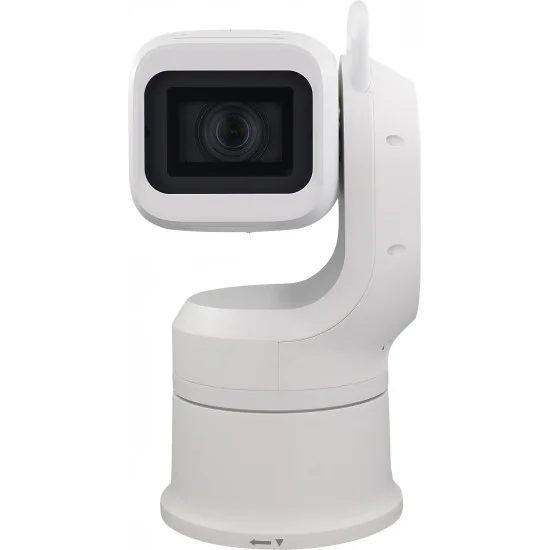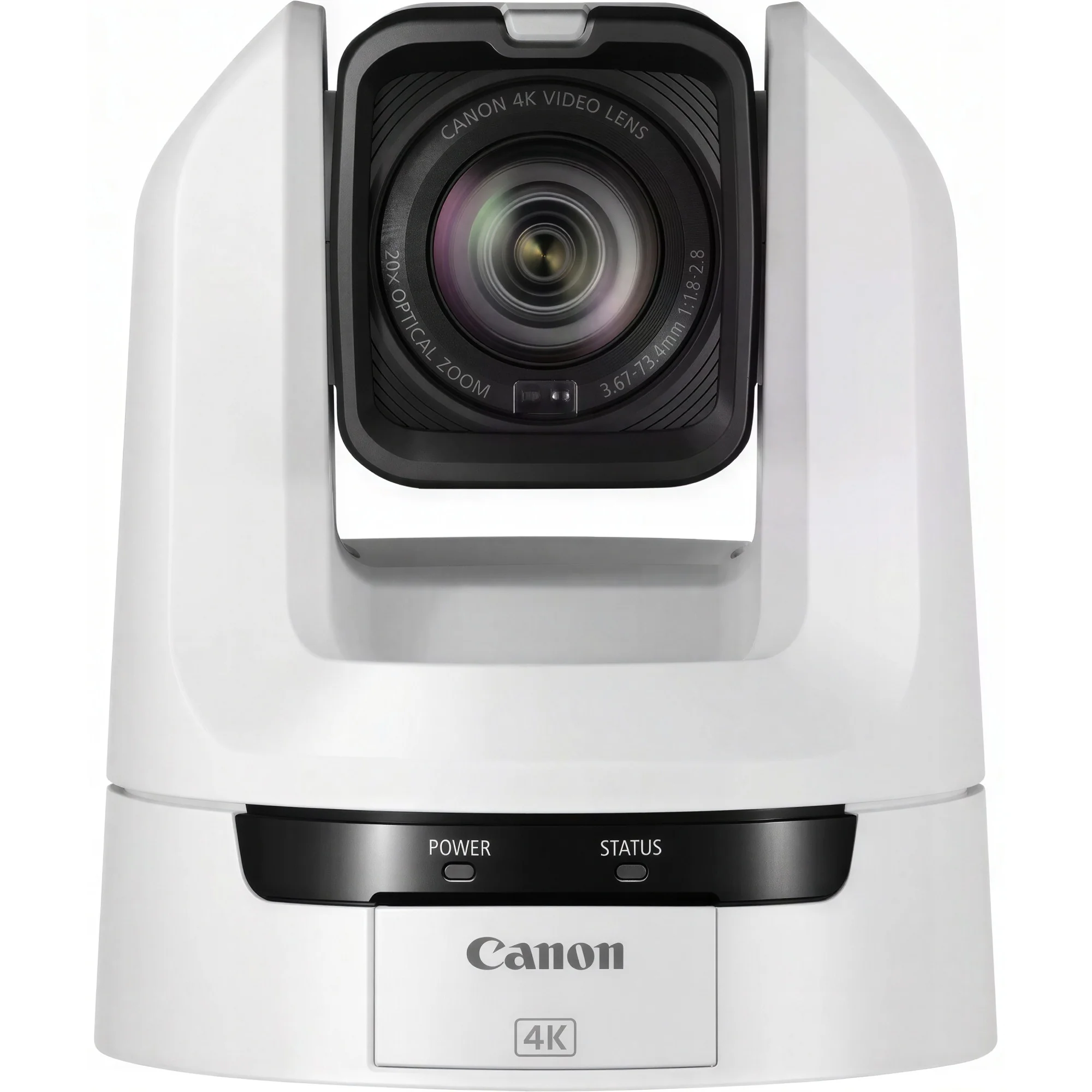
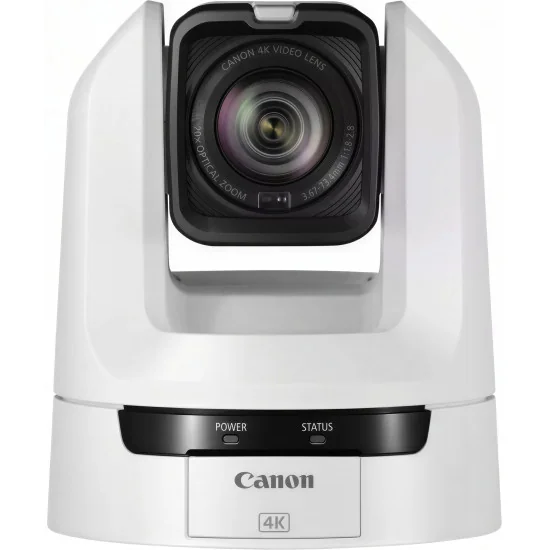
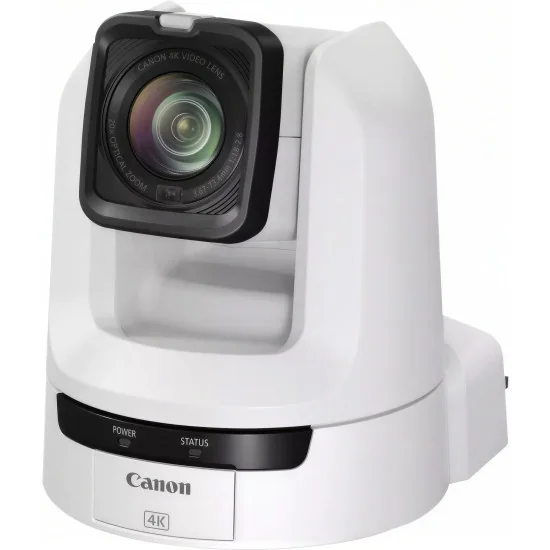
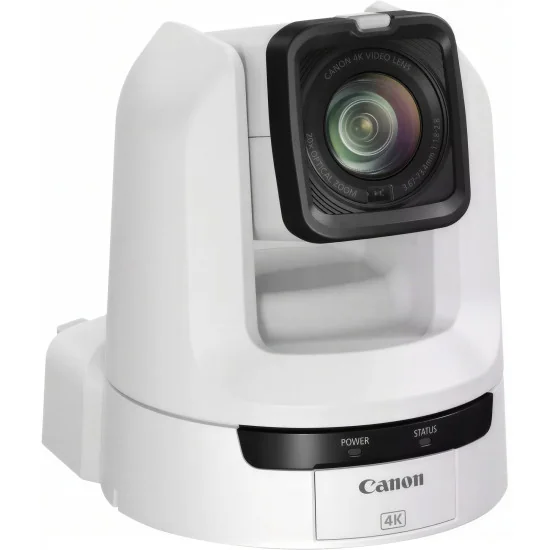
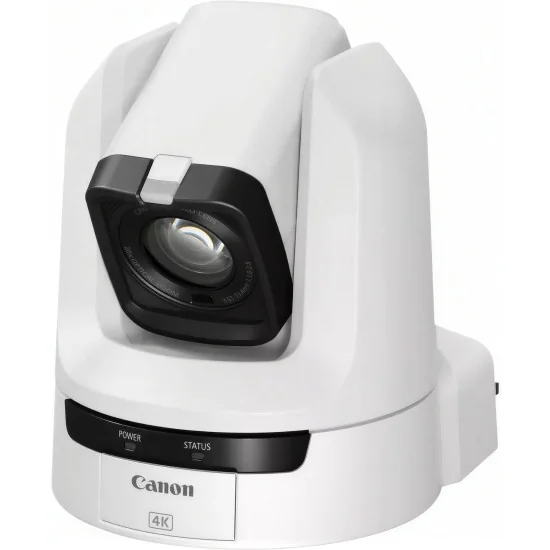
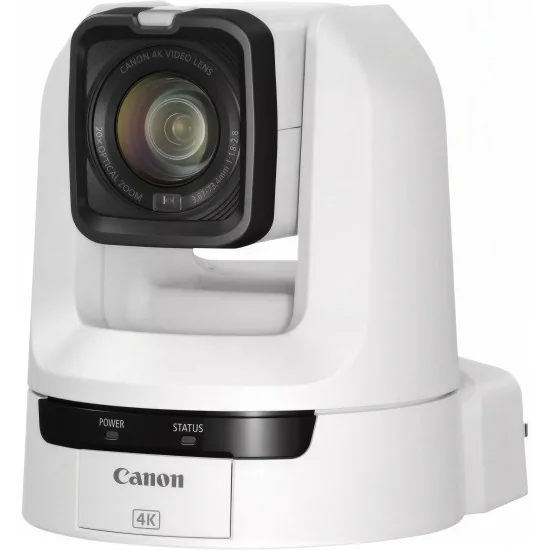
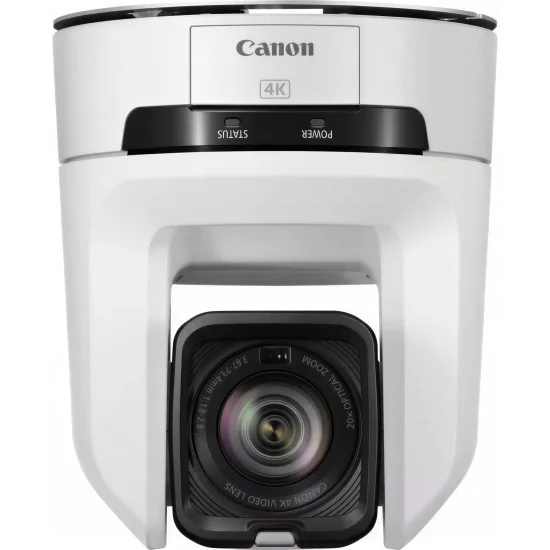
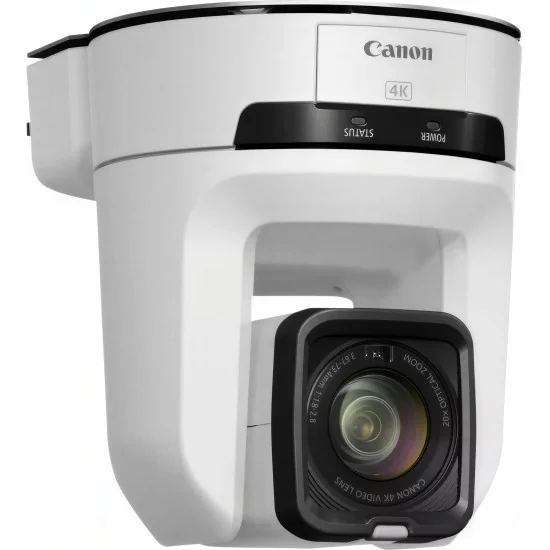
Ten adjustable tracking settings, five stored tracking profiles and three Auto Framing modes come with the Canon CR-N300 White Auto Tracking. This edition of Canon's 4K PTZ camera is supplied with the paid RA-AT001 licence, not the free Lite tier. Tracking runs inside the camera, with no PC or extra box between the head and the vision mixer. Underneath is the complete CR-N300 platform, 3G-SDI output included. A 1/2.3-type sensor of about 8.29 effective megapixels and the DIGIC DV6 processor give 4K UHD up to 29.97p and oversampled Full HD up to 59.94p.
Lite auto tracking selects the subject itself, centres it, offers two sizes and stores a single configuration. The licence hands those decisions back to the operator. A person can be pointed out by hand or left to the camera, responsiveness set anywhere from 1 to 10, and the subject shown at one of five sizes. The target can also sit off-centre, on the left third for instance, so a caption or a sign-language inset has room.
Zones deal with the awkward cases. An auto-select exclusion area stops the camera latching onto an interpreter next to the lectern. A limit area halts the pan before it reaches the house lights, and a pan/tilt halting area lets a presenter shift weight at the podium without the picture drifting. With a priority display area, the slide section of an LED wall stays in shot. A fixed-angle area cuts to a set framing as soon as the subject reaches a demo table, and an initial position gives the head a fallback if the subject is lost.
Auto Framing takes composition calls off the operator's desk. Multi-Person Framing holds two or more people together, so a two-host podcast or a three-seat panel stays balanced as guests lean in. Face Direction Framing offsets the shot toward where the speaker is looking, and Sit/Stand Framing opens to a mid-shot as a guest gets up from the table, then closes in once they sit again. On this PTZ camera, head and face detection keeps hold of the subject behind a lectern or while someone else crosses in front, at anything from a slow stroll to a brisk walk.
We ship across the EU for €20, free over €1,000.
B2B sales only, prices excl. VAT.
Official EU distribution and warranty.
Secure online payments via Stripe.
Send your enquiry via the form or email avgear@avgear.shop
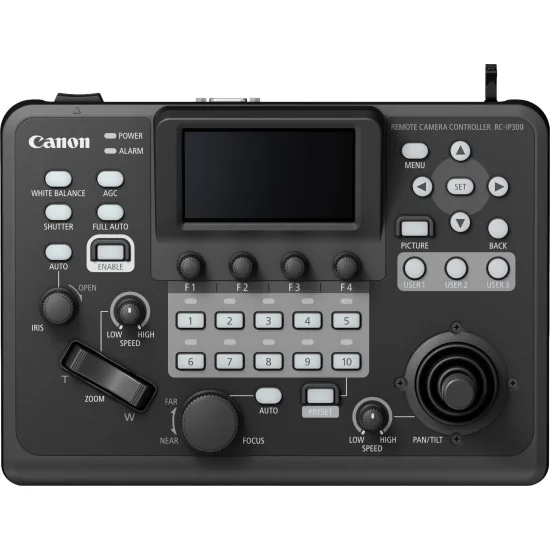
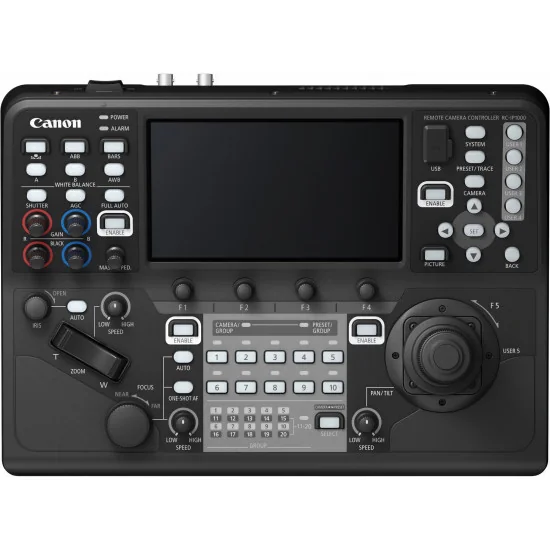
Firmware 1.8.0, released in October 2026, links tracking to presets: recalling a lectern position can switch tracking on, and recalling a wide of the room switches it off. That on/off command is also exposed through Standard Communication. A room-control processor or a macro on the vision mixer can therefore pass a council session or an AGM to automation. Since version 1.7.0, IP control over Standard Communication keeps working while USB delivers video to a meeting-room PC. The main tracking controls are within reach on the RC-IP1000 and in the Remote Camera Control Application.
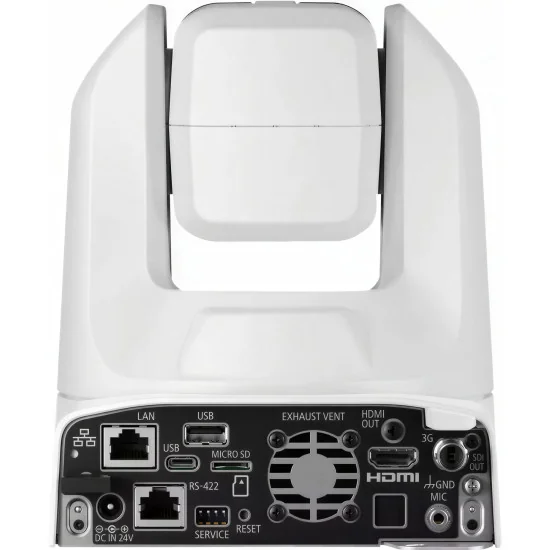
Galleries that still cut on baseband can take the tracked shot on 3G-SDI (SMPTE 424/425, ST 299-2), up to 1080p59.94, with VITC/LTC timecode and embedded audio. 4K UHD leaves the HDMI port at 23.98, 25 or 29.97p in 4:2:2 10-bit; both outputs share one video format, and choosing 2160p for HDMI turns SDI off. The network port handles NDI|HX, SRT, RTMP/RTMPS and RTSP/RTP, and as many as three IP streams run simultaneously; 4K over IP (4:2:0 8-bit) is unavailable at 50 or 59.94 Hz system frequencies. NDI 6, SRT adaptive bitrate and automatic SRT/RTMP reconnection all arrived as free firmware. At a hybrid conference, the tracked lectern shot can feed an SDI mixer in the gallery while SRT carries it to a remote hub.
Canon's 20x optical zoom, built from 12 elements in 10 groups with two aspherical, opens at f/1.8 and runs from roughly 29.3 mm to 601 mm equivalent in 4K. From 3 metres, the 65.6° wide end covers close to 4 metres, enough for a four-seat panel table. From 20 metres, the 3.6° tele end narrows to roughly 1.25 metres: a mid-shot of a keynote speaker. Optical-shift stabilisation settles truss vibration at that long end. Tracking is only as good as the focus behind it. Hybrid AF pairs an external distance sensor with contrast detection, so sharpness keeps pace as a presenter walks toward the lens. A gradation ND to 1/8, gain to 36 dB and a minimum illumination near 1.5 lux cover bright stages and dim lecture halls.
Pan travels ±170° with speeds from 0.2 to 300°/s, and tilt runs from −30° to +100°. Presets, 100 of them, are listed as thumbnails, and each can be given a travel time so multi-camera moves finish together. Canon's XC protocol links the camera to the RC-IP100 (up to 100 cameras) and to the RC-IP300 and RC-IP1000 (up to 200 each). The free Remote Camera Control Application drives 20 heads from a PC, and Canon's iOS app, Multi-Camera Control, works over Wi-Fi. Other makers' joystick panels and AV control systems connect over Standard Communication, on IP or serial RS-422. An IR remote is supplied, and FreeD sends camera data to as many as four virtual-studio or AR engines.
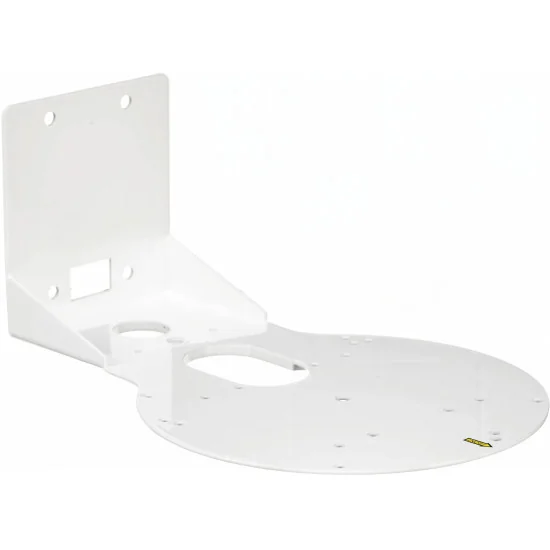
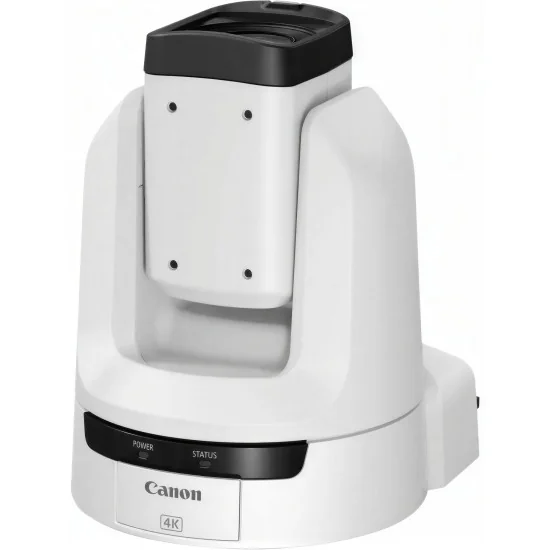
PoE+ power arrives over a single Gigabit RJ45 port (IEEE 802.3at, class 4, roughly 16.2 W), and the bundled 24 V adaptor steps in wherever a switch cannot supply class 4. Ceiling hardware and safety wires are packed with the camera, the white housing stays discreet on pale ceilings, and Canon's A-SWD5WB2-CR wall bracket comes in matching white. USB-C acts as a driver-free UVC webcam up to 1080p30. On Windows, Canon's free Webcam Driver exposes up to five Canon heads on the network as virtual webcams (4K30 maximum), and the Multi-Camera Management Application administers up to 200 Canon devices.
At Oxford's Saïd Business School, two CR-N300 heads supply alternative angles beside an auto-tracking CR-N700 under one RC-IP1000, wired into the school's existing SDI and Ethernet. Reliability was the AV team's main reason for choosing Canon. With the licence on board, a Canon CR-N300 White Auto Tracking can take on that tracking role itself in lecture-capture rooms that do not call for a 1.0-type sensor. Procurement stays simple too: one item per camera position and no licence to order later, while one technician supervises several automated shots.
This version has a full Canon RA-AT001 Auto Tracking App license.
| Feature | Auto Tracking Application (Lite) | Auto Tracking Application |
|---|---|---|
| Tracking subject | Auto-select only | Auto-/manual select possible |
| Tracking sensitivity | Fixed | Adjustable from 1 to 10 levels |
| Tracking subject display size | Can be set at two levels | Can be set at five levels |
| Tracking target display position | Fixed at center | Can be set to any area |
| Auto Framing | — | Multi-Person Framing, Face Direction Framing, Sit/Stand Framing |
| Priority display area | — | Can be set |
| Fixed angle of view | — | Can be set |
| Save tracking settings | One only | Up to five can be saved/recalled |
Specifications
| Camera | |
|---|---|
| Image Sensor | Type 1/2.3 (1/2.3 in.) single-plate CMOS sensor |
| Effective Pixels | approx. 8.29 megapixels (3840 x 2160) |
| Lens | f=3.67 – 73.4 mm, F/1.8 – 2.8, 20x optical zoom, 8-bladed circular aperture |
| Optical Zoom | 20x optical zoom |
| Digital Zoom | 20x digital zoom |
| Focal Length | f=3.67 – 73.4 mm, F/1.8 – 2.8, 35mm equivalent focal length: [4K UHD] approx. 29.3 (W) – 601 mm (T) [Full HD] approx. 30.5 (W) – 627 mm (T) Digital |
| Angle of View | [4K UHD] Horizontal: 65.6 (W) – 3.6° (T) Vertical: 39.8° (W) – 2.0° (T) [Full HD] Horizontal: 63.5 (W) – 3.4° (T) Vertical: 38.4° (W) – 1.9° (T) |
| Minimum Subject Illumination | Approx. 1.5 lux (shutter speed 1/30 sec., frame rate 59.947P (Programmed AE) shooting mode, auto slow shutter on) |
| Shutter Speed | 1/6 – 1/2000 sec. (specific values depend on the frame frequency and frame rate) |
| Iris | Manual/Automatic aperture |
| Gain | 0.0 dB – 36 dB |
| ND Filter | Built-in (1/8 at maximum, gradation ND), motor operate |
| White Balance | AUTO (AWB), Set A, Set B, preset settings (daylight: 5,600 K*, tungsten lamp: 3,200 K*), color temperature setting (2,000 K – 15,000 K), Manual * Color temperatures are given for reference purposes only. |
| Focus | Focus mode: Manual, Continuous AF, Face AF, Tracking AF type: Hybrid AF, Contrast AF |
| Gamma | Normal1 (Standard), Normal3 (BT.709) |
| Pan and Tilt | Pan operation range: Horizontal ±170° Pan operation speed: 0.2° – 300°/sec. Tilt operation range: Vertical -30° – +100° Tilt operation speed: 0.2° – 180°/sec. |
| Pan and Tilt Operation | |
| Protocol | XC (Canon's original), RTSP/RTP, NDI|HX, RTMP/RTMPS, Standard Communication (Serial), Standard Communication (IP), SRT, FreeD |
| Server | |
| Video Output Format: SDI | 1920 x 1080: 59.94P/59.94i, 50.00P/50.00i/25.00P, 29.97P/23.98P (4:2:2 10 bit) 1280 x 720: 59.94P, 50.00P (4:2:2 10 bit) – Same video format required for SDI and HDMI (cannot select different formats for SDI and HDMI) – When 3840 x 2160 is selected for HDMI, video will not be outputted to SDI. |
| Video Output Format: HDMI | HDMI 3840 x 2160: 29.97P, 25.00P, 23.98P (4:2:2 10 bit) 1920 x 1080: 59.94P/59.94i, 50.00P/50.00i/25.00P, 29.97P/23.98P (4:2:2 10 bit) 1280 x 720: 59.94P, 50.00P (4:2:2 10 bit) – Same video format required for SDI and HDMI (cannot select different formats for SDI and HDMI) – When 3840 x 2160 is selected for HDMI, video will not be outputted to SDI. |
| Video Output Format: IP | 3840 x 2160: 29.97 fps, 14.99 fps, 5.00 fps (4:2:0 8 bit) 1920 x 1080: 59.94 fps, 29.97 fps, 14.99 fps, 5.00 fps (4:2:0 8 bit) 1280 x 720: 59.94 fps, 29.97 fps, 14.99 fps, 5.00 fps (4:2:0 8 bit) 640 x 360: 59.94 fps, 29.97 fps, 14.99 fps, 5.00 fps (4:2:0 8 bit) – If 59.94/50.00 Hz is selected for the frame frequency, the 3840 x 2160 format cannot be selected. – A frame rate that exceeds the frame frequency cannot be selected. – JPEG has one pattern fixed depending on the frame frequency (format is fixed and cannot be selected) Resolution: 1280 x 720 When frame frequency is 59.94/50.00 Hz: 14.99 fps, when frame frequency is 23.98 Hz: 11.99 fps, when frame frequency is 29.97/25.00 Hz: 12.50 fps |
| Video Output Format: USB | Motion JPEG: 1920 x 1080 59.94 Hz: 30.00 fps, 15.00 fps, 5.00 fps 50.00 Hz: 25.00 fps, 12.50 fps, 5.00 fps 1280 x 720 59.94 Hz: 30.00 fps, 15.00 fps, 5.00 fps 50.00 Hz: 25.00 fps, 12.50 fps, 5.00 fps 640 x 360 59.94 Hz: 30.00 fps, 15.00 fps, 5.00 fps 50.00 Hz: 25.00 fps, 12.50 fps, 5.00 fps YUV: 640 x 360 59.94 Hz: 30.00 fps, 15.00 fps, 5.00 fps 50.00 Hz: 25.00 fps, 12.50 fps, 5.00 fps |
| Preset | Number of presets: Max. 100 (including home position) |
| Interface | |
| Communication Control | LAN, Wi-Fi, Serial, IR |
| Network Terminal | LAN x 1, RJ45, 1000Base-T |
| SDI OUT Terminal | BNC jack (output only) x 1, 0.8 Vp-p/75 Ω, unbalanced SMPTE 424, SMPTE 425, SMPTE ST 299-2 compliant Embedded audio, Time code (VITC/LTC) |
| GEN-LOCK Terminal | - |
| HDMI OUT Terminal | HDMI connector x 1, output only |
| RS-422 Terminal | RJ45 connector x 1 |
| Audio INPUT 1/INPUT 2 Terminals | - |
| MIC Terminal | ϕ3.5 mm stereo mini jack (unbalanced, plug-in power supported) Sensitivity (MIC): -72 dBV (Manual volume center, full scale -18 dB)/1 kΩ or more/Att.: 20 dB Sensitivity (LINE): -10 dBV (Manual volume center, full scale -18 dB)/1 kΩ or more Supply Voltage: 2.4 V DC (Bias resistance: 2.2 kΩ) |
| USB Terminal | Type-A (USB 2.0) x 1 (future expansion) Type-C (USB 3.0) x 1 |
| Physical Features | |
| Operating Environment | Temperature 0°C – +40°C (+32°F – +104°F) Humidity 10% – 90% (without condensation) |
| Power Supply | PoE: PoE+ power supply via LAN connector (IEEE802.3at compliant) – PoE cannot be used External power source: 24 V DC (using included AC adaptor) |
| Power Consumption | PoE+ Input: Approx. 16.2 W* max. (body only) DC Input: Approx. 15.0 W max. (body only) * Class 4 (25.5 W required) for power supply devices |
| Dimensions (W x H x D) | Approx. 154 x 178 x 164 mm (6.06 x 7.01 x 6.46 in.) (excluding protrusions) |
| Weight | Approx. 2.2 kg (4.86 lb.) (body only) |
| IP Rating | - |

Data sheet
Specific References