- Pack
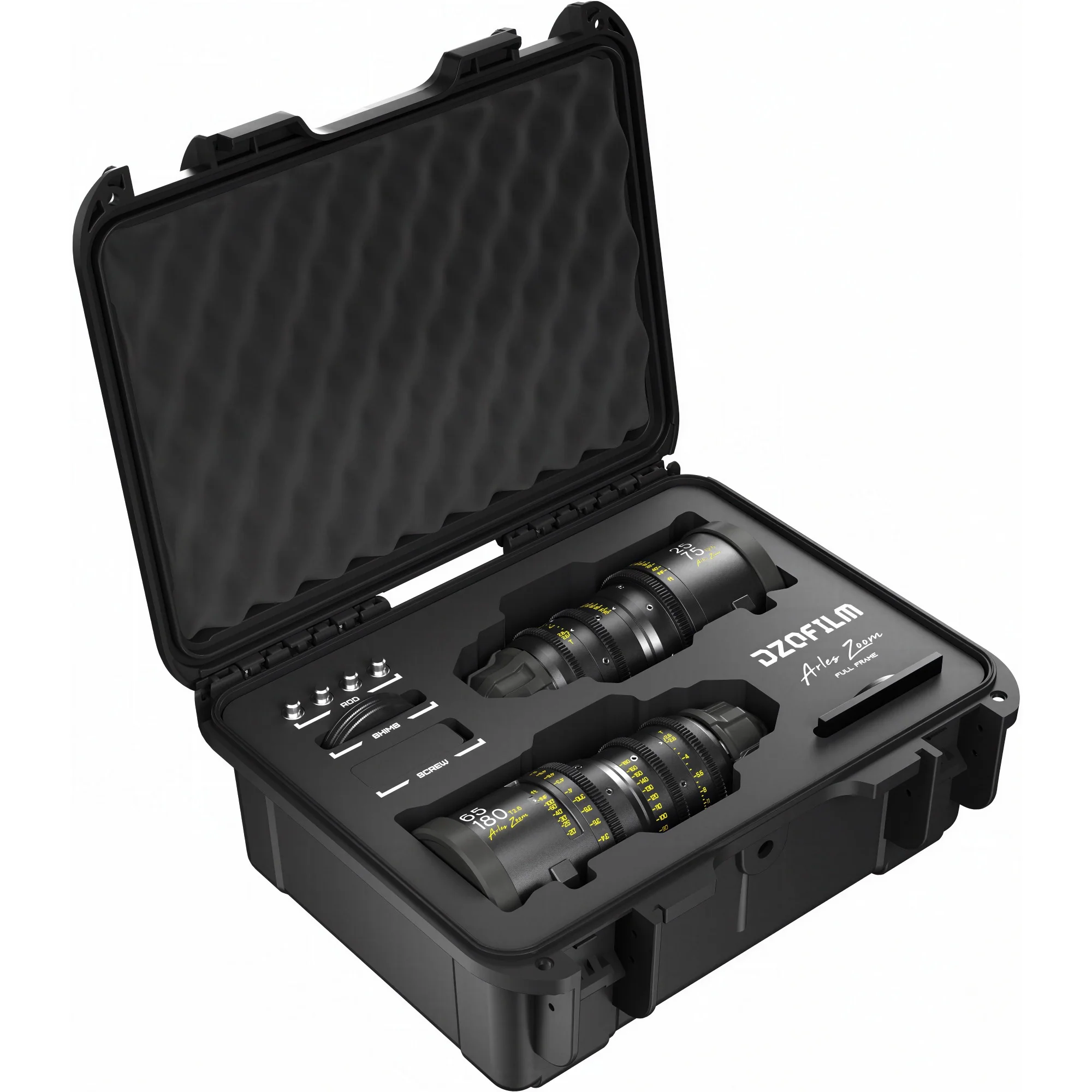
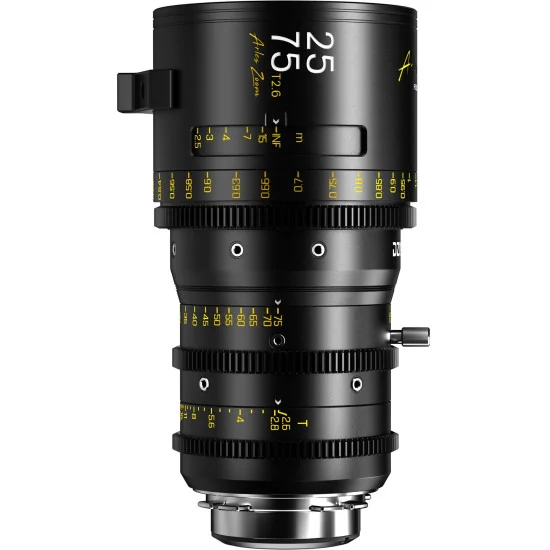
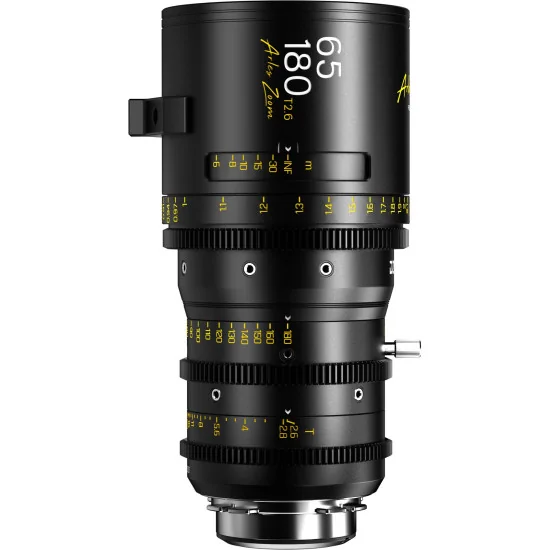
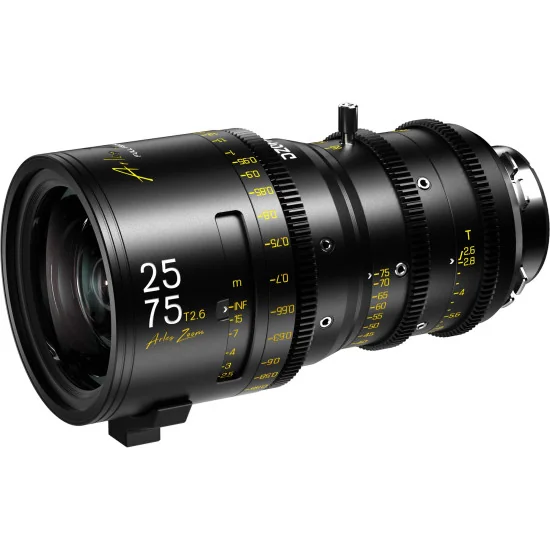
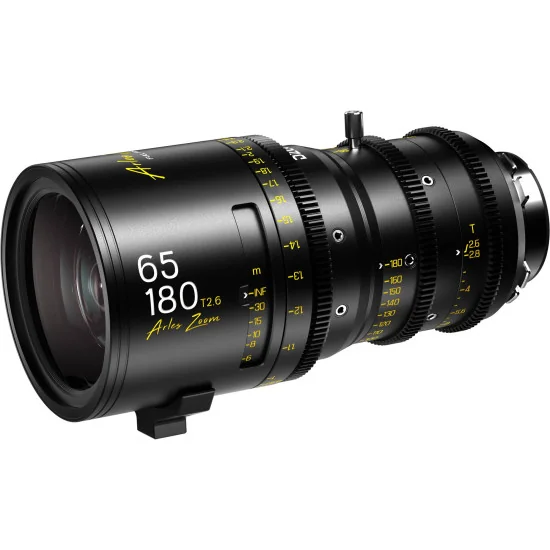
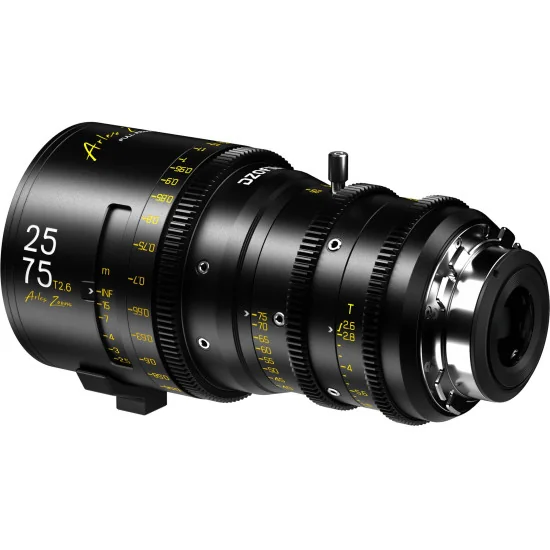
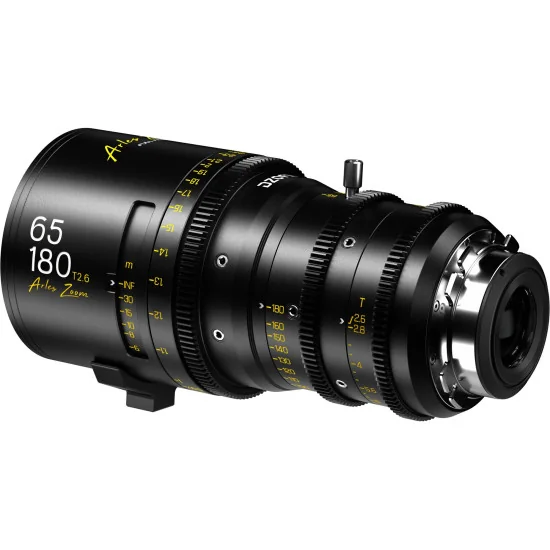
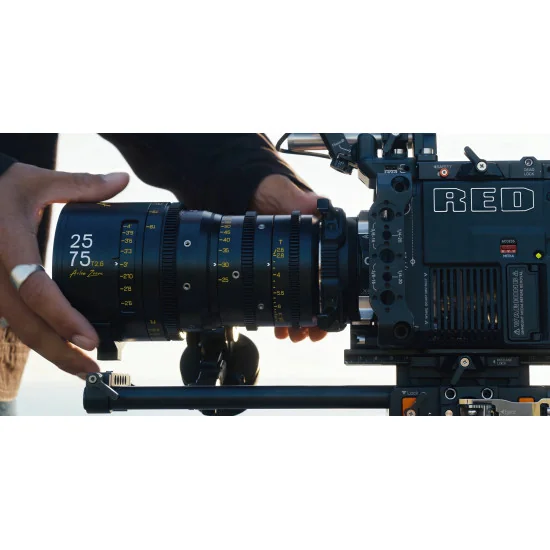
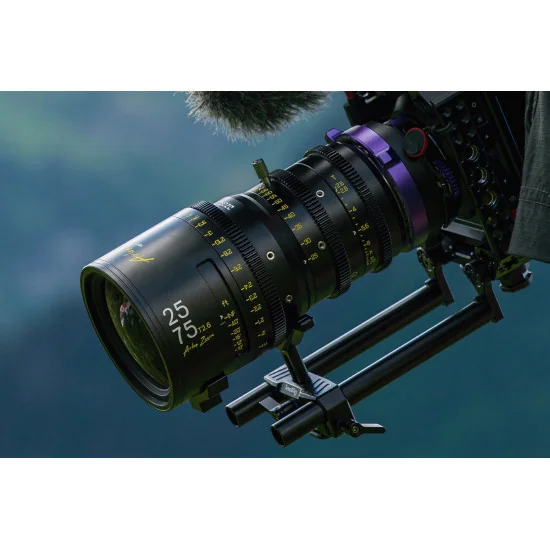
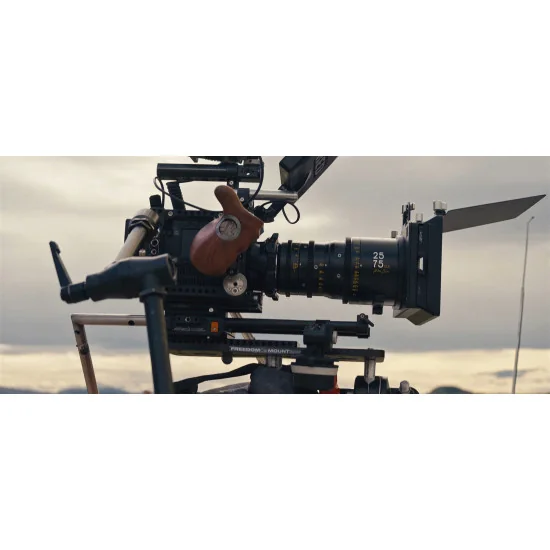
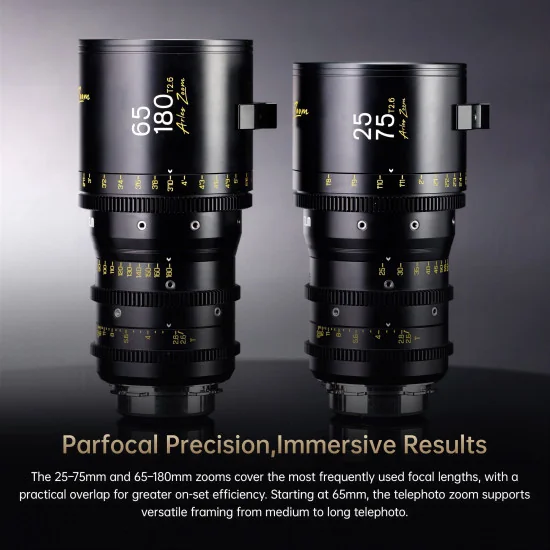
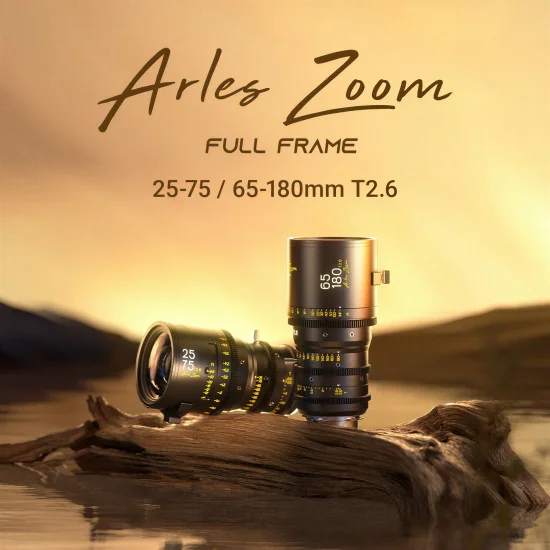
A 7.2:1 focal span at one constant stop, divided between two full-frame cine zooms that handle alike: that is the core of the DZOFilm Arles Zoom 25-75mm & 65-180mm T2.6 FF PL Mount. The wide lens runs from 25 to 75 mm (3x), the telephoto from 65 to 180 mm (2.8x), and both keep a constant T2.6 across their range before stopping down to T22. The two ranges meet in a shared 65–75 mm band, so a change of barrel happens at a common portrait focal length instead of across a gap. This is the metric edition, with distances engraved in metres for crews who tape their marks that way.
Each lens zooms internally through DZOFilm's quad-synchronised zoom system, a cam that moves four lens groups in step. The barrel never changes length through 100° of zoom rotation and the centre of gravity stays put, which pays off on rigs that punish a shifting load: a stabilised remote head on a tracking vehicle, a robotic arm, a jib on a dolly, a gimbal carried by hand. Take a camera car pacing a hatchback on a closed road, 8 m away. With the telephoto zoom at 65 mm, a 16:9 full-frame image spans roughly 4.4 m, close to the hatchback's whole flank; rolled to 180 mm, it tightens to about 1.6 m, front wheel and door mirror. Both zooms are parfocal, so the move holds focus without the focus puller chasing it, and the exposure set at the start of the run is still right at the end.
Optically, the wide zoom counts 22 elements in 8 groups, among them 7 ED and 5 HRI pieces, while the telephoto gets by with 20 (7 ED, 2 HRI). Glass with fluorite-like dispersion holds colour fringing, spherical aberration and coma down, distortion is inherently low according to DZOFilm, and in-house tests rate both zooms for 8K. Colour follows the low-saturation blue coating of the eleven Arles primes: skin tones read warm without looking pushed, flare and ghosting stay restrained, and a deep-matte treatment inside the barrel soaks up stray reflections from a practical lamp or a window at the edge of frame. Cinematographer Łukasz Glewicz, reviewing his footage on a large screen after a shoot, likened the zooms' depth and rendering to some of the best primes he knows. Sixteen iris blades keep defocused highlights round.
Instead of €4,798.00
A 7.2:1 focal span at one constant stop, divided between two full-frame cine zooms that handle alike: that is the core of the DZOFilm Arles Zoom 25-75mm & 65-180mm T2.6 FF PL Mount. The wide lens runs from 25 to 75 mm (3x), the telephoto from 65 to 180 mm (2.8x), and both keep a constant T2.6 across their range before stopping down to T22. The two ranges meet in a shared 65–75 mm band, so a change of barrel happens at a common portrait focal length instead of across a gap. This is the metric edition, with distances engraved in metres for crews who tape their marks that way.
Each lens zooms internally through DZOFilm's quad-synchronised zoom system, a cam that moves four lens groups in step. The barrel never changes length through 100° of zoom rotation and the centre of gravity stays put, which pays off on rigs that punish a shifting load: a stabilised remote head on a tracking vehicle, a robotic arm, a jib on a dolly, a gimbal carried by hand. Take a camera car pacing a hatchback on a closed road, 8 m away. With the telephoto zoom at 65 mm, a 16:9 full-frame image spans roughly 4.4 m, close to the hatchback's whole flank; rolled to 180 mm, it tightens to about 1.6 m, front wheel and door mirror. Both zooms are parfocal, so the move holds focus without the focus puller chasing it, and the exposure set at the start of the run is still right at the end.
Optically, the wide zoom counts 22 elements in 8 groups, among them 7 ED and 5 HRI pieces, while the telephoto gets by with 20 (7 ED, 2 HRI). Glass with fluorite-like dispersion holds colour fringing, spherical aberration and coma down, distortion is inherently low according to DZOFilm, and in-house tests rate both zooms for 8K. Colour follows the low-saturation blue coating of the eleven Arles primes: skin tones read warm without looking pushed, flare and ghosting stay restrained, and a deep-matte treatment inside the barrel soaks up stray reflections from a practical lamp or a window at the edge of frame. Cinematographer Łukasz Glewicz, reviewing his footage on a large screen after a shoot, likened the zooms' depth and rendering to some of the best primes he knows. Sixteen iris blades keep defocused highlights round.
We ship across the EU for €20, free over €1,000.
B2B sales only, prices excl. VAT.
Official EU distribution and warranty.
Secure online payments via Stripe.
Send your enquiry via the form or email avgear@avgear.shop
DZOFilm calls focus breathing barely perceptible and close to nil toward 180 mm. Since that claim concerns the telephoto side, a short chart test at 25 mm is worth running before a long rack focus. Measured from the sensor plane, minimum focus is 0.51 m on the wide zoom and 0.89 m on the telephoto, near enough for a dashboard instrument or a hand on the gear lever. The manufacturer also states that image quality holds at high frame rates, so slow-motion inserts sit comfortably beside normal-speed material.
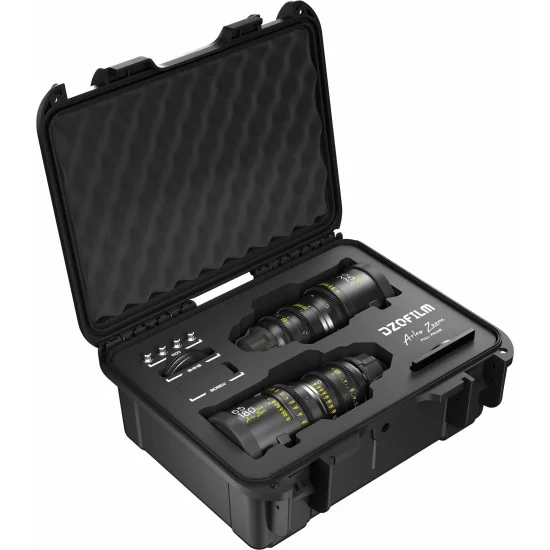
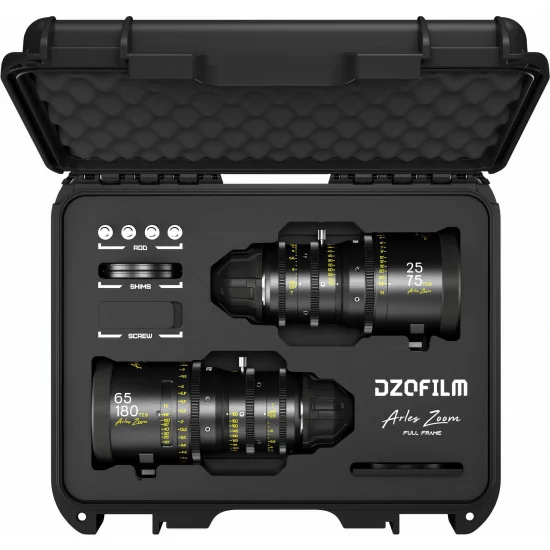
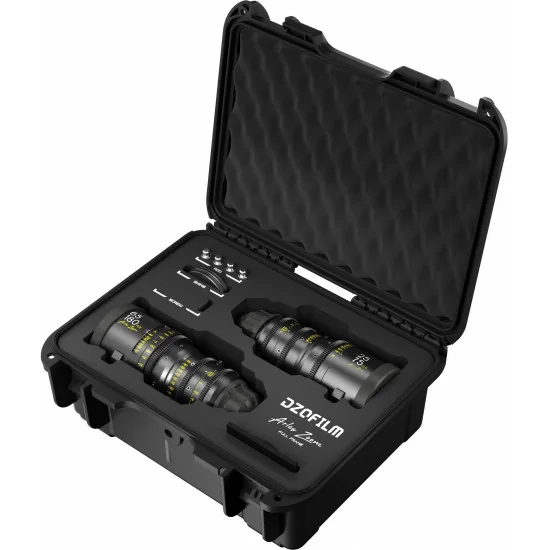
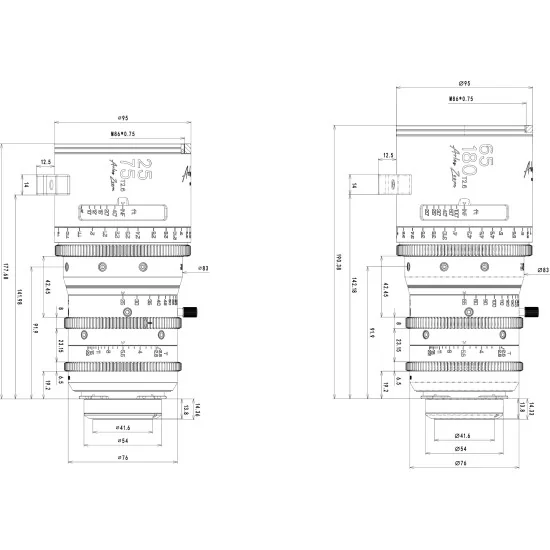
Focus turns through 270°, while iris rotation is 79.55° (25-75mm) or 82.4° (65-180mm). Focus, iris and zoom rings all carry 0.8 MOD gears, placed identically on both zooms, and the focus and iris gears also line up with those of the Arles primes. Swapping one zoom for the other, or for a prime, leaves the motor brackets exactly where the assistant set them. The 95 mm front matches the primes, so one matte-box clamp fits the family, while screw-in filters go on the M86 thread. PL comes fitted at the factory. Alongside the lenses, the hard case holds Y-style lens supports, zoom levers, extension rods, shims and a T6 screwdriver, which lets an in-house technician convert to the separately sold EF mount kit.
Coverage needs stating plainly. The image circle measures 43.5 mm, which is full frame, whereas the Arles primes project 46.5 mm for VistaVision, so a VV-capable body should record in a full-frame area while these zooms are mounted. Mirrorless cameras take them through DZOFilm's Octopus adapters (E, L, Z, RF, X, DX). The Marlin 1.4x converter, in its PL-to-E, L, Z or RF versions, turns the pair into 35-105 mm and 91-252 mm optics at around T3.6–T3.7, about one stop slower, still parfocal, and able to cover selected medium-format sensors. Housings are aluminium alloy, the front element carries a dirt-repellent coating and the barrels resist dust and splashes. Gravel dust at a rally stage or drizzle under a forest canopy is within their tolerance; sustained rain still calls for a cover.
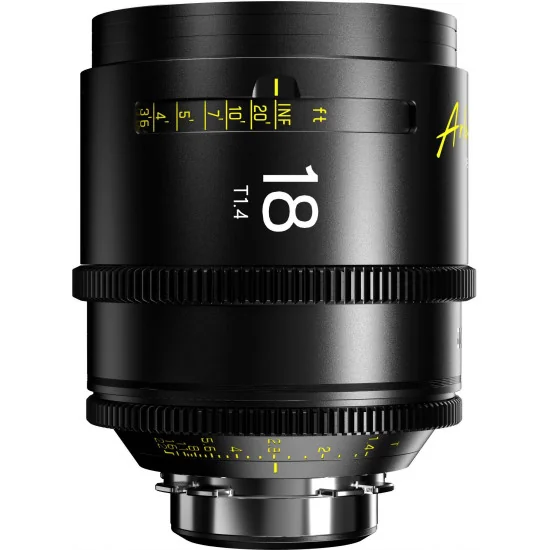
For a production company, the set can anchor a full-frame lens package. Documentary series, commercials, automotive films, drama and independent features can stay on the two zooms through most setups, while a few fast Arles primes, an 18 mm for cramped interiors or a T1.4 lens for night exteriors, take the shots that need more angle or more speed. With colour and gear positions already aligned, those primes can join later without a regrade or a re-rig, and a single case keeps the core of the kit ready for the next booking.
| Specification | 25-75mm | 65-180mm |
|---|---|---|
| Colour | Black | |
| Mount | PL/EF | |
| Aperture | T2.6-T22 | |
| Image Circle | ø43.5 | |
| Construction of Optics | 22 Elements in 8 Groups | 20 Elements in 8 Groups |
| Close Focus (from sensor plane) | 0.51m / 1 ft 8 in | 0.89m / 2 ft 11 in |
| Zoom Ratio | 3X | 2.8X |
| Iris Control | Manual (79.55°) | Manual (82.4°) |
| Focus Control | Manual (270°) | |
| Zoom Control | Manual (100°) | |
| Front Dia. | ø95 | |
| Length (from lens front to flange plane) | 178mm / 7.01” (PL) 185.4mm / 7.3” (EF) | 190.8mm / 7.51” (PL) 198.1mm / 7.8” (EF) |
| Iris Blade | 16 | |
| Filter Size | M86 | |
| Gear Pitch | M0.8 | |
| Material | Aluminum Alloy | |
| Weight (Product) | ≈1767g | ≈1782g |

Data sheet
Specific References