- Pack


A 7.5:1 focal span, 18 to 135 mm, comes in two pieces with the DZOFilm Catta Zoom 2-Lens Kit (18-35/70-135 T2.9) Black Sony E Mount: a wide 18-35 and a telephoto 70-135, both full-frame cine zooms with a 1.9x ratio and a 43.5 mm image circle. Each holds T2.9 through the zoom and stops down to T22. The 35–70 mm stretch between them belongs to the Catta 35-80, sold separately on the same gear layout.
On a streamed bouldering final, the 70-135 sits 20 m back and frames about 5.8 m of wall height at 70 mm in 16:9, then roughly 3 m at 135 mm: one climber at full reach. Shimmed to the body, it stays parfocal, so a push-in timed to a jump between holds stays sharp, while the constant T2.9 keeps brightness level through the move. At the mats, the 18-35 rides a gimbal on a Sony α7 IV, showing the whole boulder at 18 mm and, at 0.51 m from the sensor, chalked fingertips on the start holds. Breathing is low, so a rack from fingertips to face does not make the frame pulse.
Mechanically, the two barrels are twins. Zoom turns 100° and focus 270°, the iris 77° on the wide lens or 80° on the long one, with 0.8 MOD gears cut at matching points on every ring, so motors on a rigged camera engage at the same spot after a swap. Both carry an 80 mm front and an M77 thread, so a single matte box and the same screw-in NDs serve either zoom. Inside, 20 elements in 14 groups and 17 in 11 render skin naturally, with a slight warmth, and with sixteen iris blades the floodlights above the wall fall out of focus as smooth orbs.
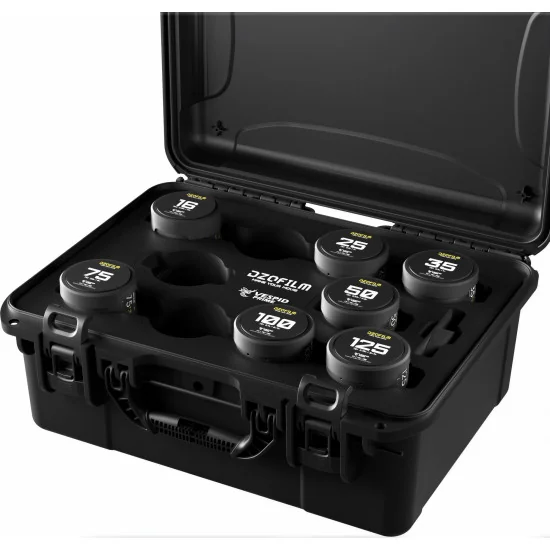
A plug-in tray near the mount accepts Catta COIN rear filters, sold as options (ND 0.6 to 1.2, Black Mist, streak, star), which spares the gimbal camera a front matte box. Each barrel, polycarbonate reinforced with glass fibre, keeps that gimbal's payload moderate. The factory-fitted Sony E mount comes off by hand, no tools, for an RF, L, X or Z bayonet sold separately. In the box: a shim set plus a support base and rod for each zoom, front and rear caps, and a hard case. For a production house, the widest and longest positions of a multicamera plan fit in one case, and the swappable mount keeps it working through the next change of camera body.
Instead of €2,669.00
A 7.5:1 focal span, 18 to 135 mm, comes in two pieces with the DZOFilm Catta Zoom 2-Lens Kit (18-35/70-135 T2.9) Black Sony E Mount: a wide 18-35 and a telephoto 70-135, both full-frame cine zooms with a 1.9x ratio and a 43.5 mm image circle. Each holds T2.9 through the zoom and stops down to T22. The 35–70 mm stretch between them belongs to the Catta 35-80, sold separately on the same gear layout.
On a streamed bouldering final, the 70-135 sits 20 m back and frames about 5.8 m of wall height at 70 mm in 16:9, then roughly 3 m at 135 mm: one climber at full reach. Shimmed to the body, it stays parfocal, so a push-in timed to a jump between holds stays sharp, while the constant T2.9 keeps brightness level through the move. At the mats, the 18-35 rides a gimbal on a Sony α7 IV, showing the whole boulder at 18 mm and, at 0.51 m from the sensor, chalked fingertips on the start holds. Breathing is low, so a rack from fingertips to face does not make the frame pulse.
Mechanically, the two barrels are twins. Zoom turns 100° and focus 270°, the iris 77° on the wide lens or 80° on the long one, with 0.8 MOD gears cut at matching points on every ring, so motors on a rigged camera engage at the same spot after a swap. Both carry an 80 mm front and an M77 thread, so a single matte box and the same screw-in NDs serve either zoom. Inside, 20 elements in 14 groups and 17 in 11 render skin naturally, with a slight warmth, and with sixteen iris blades the floodlights above the wall fall out of focus as smooth orbs.
A plug-in tray near the mount accepts Catta COIN rear filters, sold as options (ND 0.6 to 1.2, Black Mist, streak, star), which spares the gimbal camera a front matte box. Each barrel, polycarbonate reinforced with glass fibre, keeps that gimbal's payload moderate. The factory-fitted Sony E mount comes off by hand, no tools, for an RF, L, X or Z bayonet sold separately. In the box: a shim set plus a support base and rod for each zoom, front and rear caps, and a hard case. For a production house, the widest and longest positions of a multicamera plan fit in one case, and the swappable mount keeps it working through the next change of camera body.
We ship across the EU for €20, free over €1,000.
B2B sales only, prices excl. VAT.
Official EU distribution and warranty.
Secure online payments via Stripe.
Send your enquiry via the form or email avgear@avgear.shop
| Specification | 18-35 mm | 70-135 mm |
|---|---|---|
| Colour | Black | |
| Mount | Sony E | |
| T-Stop | T2.9-T22 | |
| Image Circle | φ43.5mm (FULL FRAME) | |
| Optical Construction | 20 Elements in 14 Groups | 17 Elements in 11 Groups |
| Flange Distance | 18mm (E) | |
| Close Focus (from sensor plane) | 0.51m/1ft8in | 0.76m/2ft6in |
| Zoom Ratio | 1.9X | |
| Iris Control | Manual (rotation angle 77°) | Manual (rotation angle 80°) |
| Focus Control | Manual (rotation angle 270°) | |
| Zoom Control | Manual (rotation angle 100°) | |
| Front Dia. | ø80mm/3.15" | |
| Length | 214.4mm/8.44” (E) | |
| Iris Blade | 16 | |
| Filter Size | M77 | |
| Gear Pitch | 0.8 Mod | |
| Material | PC+GF | |
| Weight | ≈1680g | ≈1597g |

Data sheet
Specific References