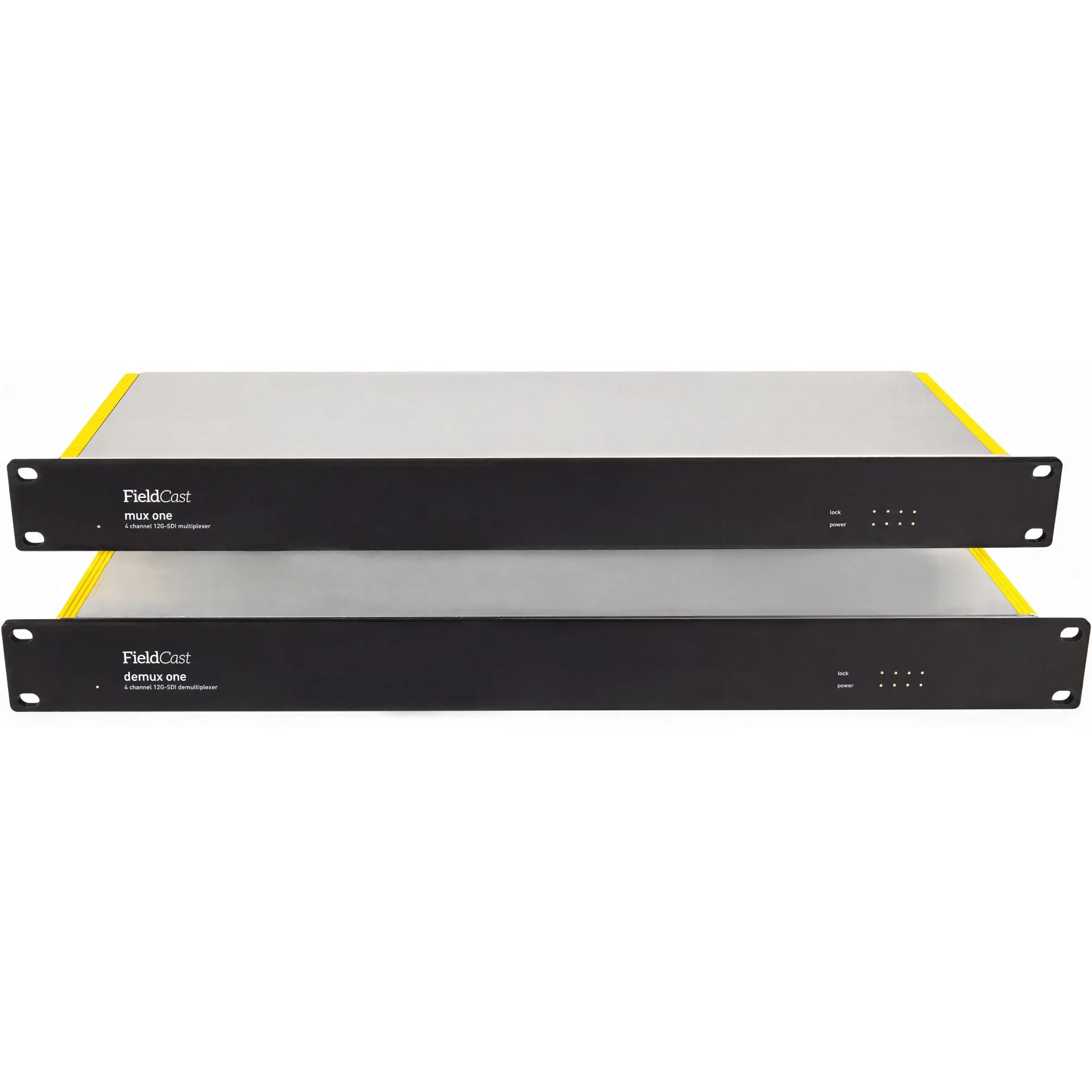
Venues rarely hand a production team more than one dark fibre between the camera positions and the gallery. The FieldCast Mux + Demux One 12G Plus works inside that limit: four independent 12G-SDI channels and a full-duplex 1 Gb Ethernet link travel together along a single 9/125 single-mode core. Thin-film xWDM multiplexing does the combining, and since nothing in the path touches the payload there is no compression: what reaches the gallery is what the camera put on the wire. Reach runs to 20 km on 12G-SDI, out to 40 km on 3G sources.
The multiplexer sits at the camera end, the demultiplexer in the control room. Every SDI input carries a reclocked loop-through, so a director's monitor or a backup recorder stays fed at the camera position without a separate distribution amplifier. Each channel then arrives on dual SDI outputs, feeding a switcher and a multiviewer at once. Confidence monitoring at both ends of a long run matters on a stadium build, or in an OB truck far from the pitch. Eight 75-ohm BNCs per chassis handle the copper side, and the pair accepts every SD, HD and UltraHD standard to 2160p60 under SMPTE 259M, 344M, 292M, 424M, ST 2081 and ST 2082.
The data path separates this set from the plain 12G model. One RJ-45 port per unit moves gigabit traffic both ways and behaves like a straight copper run between two switches, carrying camera control, RCP panels, PTZ commands or an engineer's laptop to the camera side without a second cable. Standard units run unidirectional, 4i/o from mux to demux; the factory builds splits such as 2i/2o or 1i/3o where a programme return forms part of the brief.
Channel count grows through the UPG port. Patched into the COM connector on a second four- or eight-channel pair, the system carries up to 16 SDI channels plus gigabit Ethernet on that same core, then breaks back into independent pairs when a job needs them apart. A simplex strand suffices, leaving the spare fibre on a two-core tactical reel free for a redundant path. Each 1RU aluminium unit draws under 40 W from a 110-240 VAC PowerCon inlet, and warm-white front-panel LEDs report power, channel activity and SDI input presence at a glance in a dark truck.
Venues rarely hand a production team more than one dark fibre between the camera positions and the gallery. The FieldCast Mux + Demux One 12G Plus works inside that limit: four independent 12G-SDI channels and a full-duplex 1 Gb Ethernet link travel together along a single 9/125 single-mode core. Thin-film xWDM multiplexing does the combining, and since nothing in the path touches the payload there is no compression: what reaches the gallery is what the camera put on the wire. Reach runs to 20 km on 12G-SDI, out to 40 km on 3G sources.
The multiplexer sits at the camera end, the demultiplexer in the control room. Every SDI input carries a reclocked loop-through, so a director's monitor or a backup recorder stays fed at the camera position without a separate distribution amplifier. Each channel then arrives on dual SDI outputs, feeding a switcher and a multiviewer at once. Confidence monitoring at both ends of a long run matters on a stadium build, or in an OB truck far from the pitch. Eight 75-ohm BNCs per chassis handle the copper side, and the pair accepts every SD, HD and UltraHD standard to 2160p60 under SMPTE 259M, 344M, 292M, 424M, ST 2081 and ST 2082.
The data path separates this set from the plain 12G model. One RJ-45 port per unit moves gigabit traffic both ways and behaves like a straight copper run between two switches, carrying camera control, RCP panels, PTZ commands or an engineer's laptop to the camera side without a second cable. Standard units run unidirectional, 4i/o from mux to demux; the factory builds splits such as 2i/2o or 1i/3o where a programme return forms part of the brief.
Channel count grows through the UPG port. Patched into the COM connector on a second four- or eight-channel pair, the system carries up to 16 SDI channels plus gigabit Ethernet on that same core, then breaks back into independent pairs when a job needs them apart. A simplex strand suffices, leaving the spare fibre on a two-core tactical reel free for a redundant path. Each 1RU aluminium unit draws under 40 W from a 110-240 VAC PowerCon inlet, and warm-white front-panel LEDs report power, channel activity and SDI input presence at a glance in a dark truck.
We ship across the EU for €20, free over €1,000.
B2B sales only, prices excl. VAT.
Official EU distribution and warranty.
Secure online payments via Stripe.
Send your enquiry via the form or email avgear@avgear.shop
4 channels of 12G SDI video plus Ethernet over one fiber core
Mux One Plus 12G and its twin brother Demux One Plus 12G, as a pair, allow you to transport four independent channels of 12G SDI video plus full duplex 1 Gb Ethernet over just one fiber optic channel.
Is your infrastructure such that you only have access to one single mode (simplex) fiber optic connection? Mux One Plus and Demux One Plus can help you to get this all done, plain and simple.
Or else, do you want to roll out a minimum number of cables in live event environments? Just use Mux One Plus and Demux One Plus, multiplex up to four channels of video plus Ethernet, and get all data from A to B using only one strand of fiber!
No hidden processing involved! All 12G video signals preserve full data integrity! What goes in comes out, unchanged.
And the Ethernet connection simply behaves like a Cat5 cable connecting your hubs!
Features
Transport over long distance
The mux/demux pair can transport video over distances of up to 20 km/12 mi for 12G SDI and up to 40 km/24 mi for 3G SDI. The mux is typically placed at the camera side, and the demux at the control room side.
4 independent video channels with loop-through and dual output
The set supports 4 independent SDI video channels. The SDI inputs have a reclocked loop-through. The SDI outputs are dual. Hence, monitoring on both sides (input and output) is possible. The SDI input is typically connected to the camera’s SDI output. The SDI output is generally connected to the SDI input of a monitor or switcher.
4 independent bidirectional Ethernet channels
Both the Mux and Demux units contain one full-duplex 1Gb Ethernet port. The 1Gb Ethernet port is typically used to transport camera control data between the camera and the camera controller or switcher. Connect the cameras’ Ethernet ports to a hub, then connect the hub to the Mux’s Ethernet port. On the other side, connect the Demux’s Ethernet port to the camera controller/switcher’s Ethernet port, or connect to a hub if more data controller devices are needed, for instance, a camera controller and a laptop.
Transport over one fiber optic core
All information for up to 4 SDI video channels and their corresponding control data, back and forth, runs over a single fiber optic core. This means a simplex fiber-optic cable is sufficient to bridge the distance between mux and demux, saving on fiber-optic cable costs. Alternatively, if you have a fiber optic cable with 2 cores, you have 1 core (or channel) left for other fiber optic transport. You might, for example, use the free fiber optic core to connect to a second, similar Mux/Demux pair to add redundancy to your setup.
No compression
There is no signal processing involved, so there is no compression; full data integrity is guaranteed.
Unidirectional video by default
The standard model is unidirectional, meaning that 4 SDI signals go from mux to demux; it’s denoted as 4i/o, where ‘i’ stands for input and ‘o’ stands for output.
Upgrade (UPG) port to add more channels
Start with the channels you need today and scale up as demand grows. The UPG Port lets you add more channels without replacing your existing hardware. Simply connect the UPG port of your existing Mux/Demux pair to the COM port of a secondary 4-channel or 8-channel Mux/Demux pair, supporting up to 16 SDI video channels plus full-duplex 1Gb Ethernet. When connected, the cascaded systems will still carry all information over a single fiber-optic core. Cascaded systems can be easily split into two independent Mux/Demux systems and then recascaded as needed, making them ideal for environments requiring staged or modular network builds.
specifications
mux one plus 12G
• 4 channel SDI input to 1 channel fiber optic output multiplexer, plus 1Gb Ethernet fiber extender
• 1RU all aluminum enclosure design
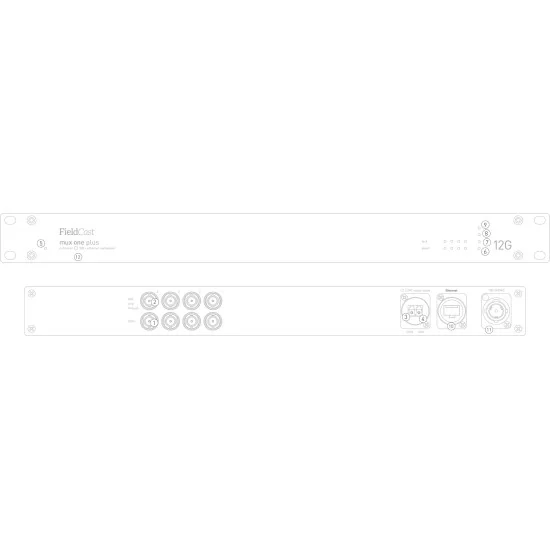
• four 12G (11.88Gb) SDI input channels (1), each with SDI loopthrough (2), 75 Ohm BNC connectivity
• complies with SMPTE 259M, SMPTE 344M, SMPTE 292M, SMPTE 424M, SMPTE ST 2081 and ST 2082
• accepts all SD, HD and UltraHD standards up to 2160p60
• 9/125 single mode fiber optic technology
• one LC single mode (UPC) fiber optic channel (COM) for all SDI signals and ethernet (3)
• one LC single mode (UPC) fiber optic upgrade channel (UPG) (3)
• Ethernet protocol: IEEE802.3U IEEE802.3z 1000Base-TxFx
• UTP RJ-45 connector for Ethernet, full duplex or half duplex (10)
• black front panel with 2 mm warm white LED indicators
• one LED indicator for connection to AC power (12)
• one LED indicator for power (5)
• LED indicators for channel module activity (6), input activity (7), TP/LNK (8) and 1Gb (9)
• power consumption < 40W
• proprietary hybrid WDM multiplexing technology for ultra low dispersion
• minimum distance between Mux and Demux → 10 km, for all wavelengths
• 110–240 VAC input with PowerCon connector (11)
• dimensions: 482 (W) × 155 (D) × 43 (H) mm
• weight: 1800 grams
• comes with manual and local power cord
demux one plus 12G
• 1RU all aluminum enclosure design
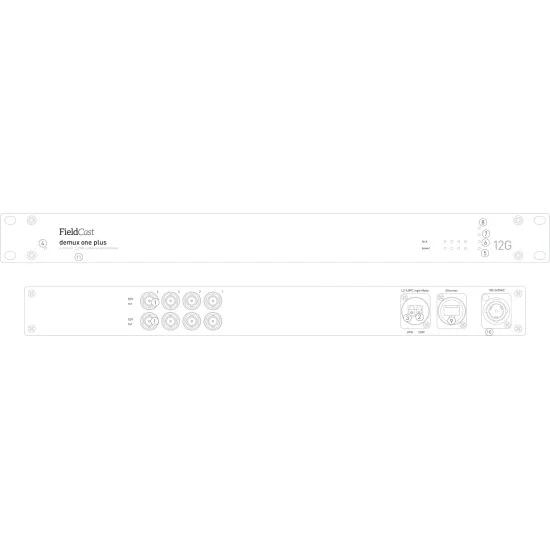
• four 12G (11.88Gb) SDI channels with dual output, 75 Ohm BNC connectivity (1)
• complies with SMPTE 259M, SMPTE 344M, SMPTE 292M, SMPTE 424M, SMPT ST 2081 and ST 2082
• accepts all SD, HD and UltraHD standards up to 12160p60
• 9/125 single mode fiber optic technology
• one LC single mode (UPC) fiber optic channel (COM) for all SDI signals and ethernet (2)
• one LC single mode (UPC) fiber optic upgrade channel (UPG) (3)
• Ethernet protocol: IEEE802.3U IEEE802.3z 1000Base-TxFx
• UTP RJ-45 connector for Ethernet, full duplex or half duplex (9)
• black front panel with 2 mm warm white LED indicators
• one LED indicator for connection to AC power (12)
• one LED indicator for power (5)
• LED indicators for channel module activity (5), input activity (6), TP/LNK (7) and 1Gb (8)
• power consumption < 40W
• proprietary hybrid WDM multiplexing technology for ultra low dispersion
• minimum distance between Mux and Demux → 10 km, for all wavelengths
• 110–240 VAC input with PowerCon connector (10)
• dimensions: 482 (W) × 155 (D) × 43 (H) mm
• weight: 1780 grams
• comes with manual and local power cord

Data sheet
Specific References