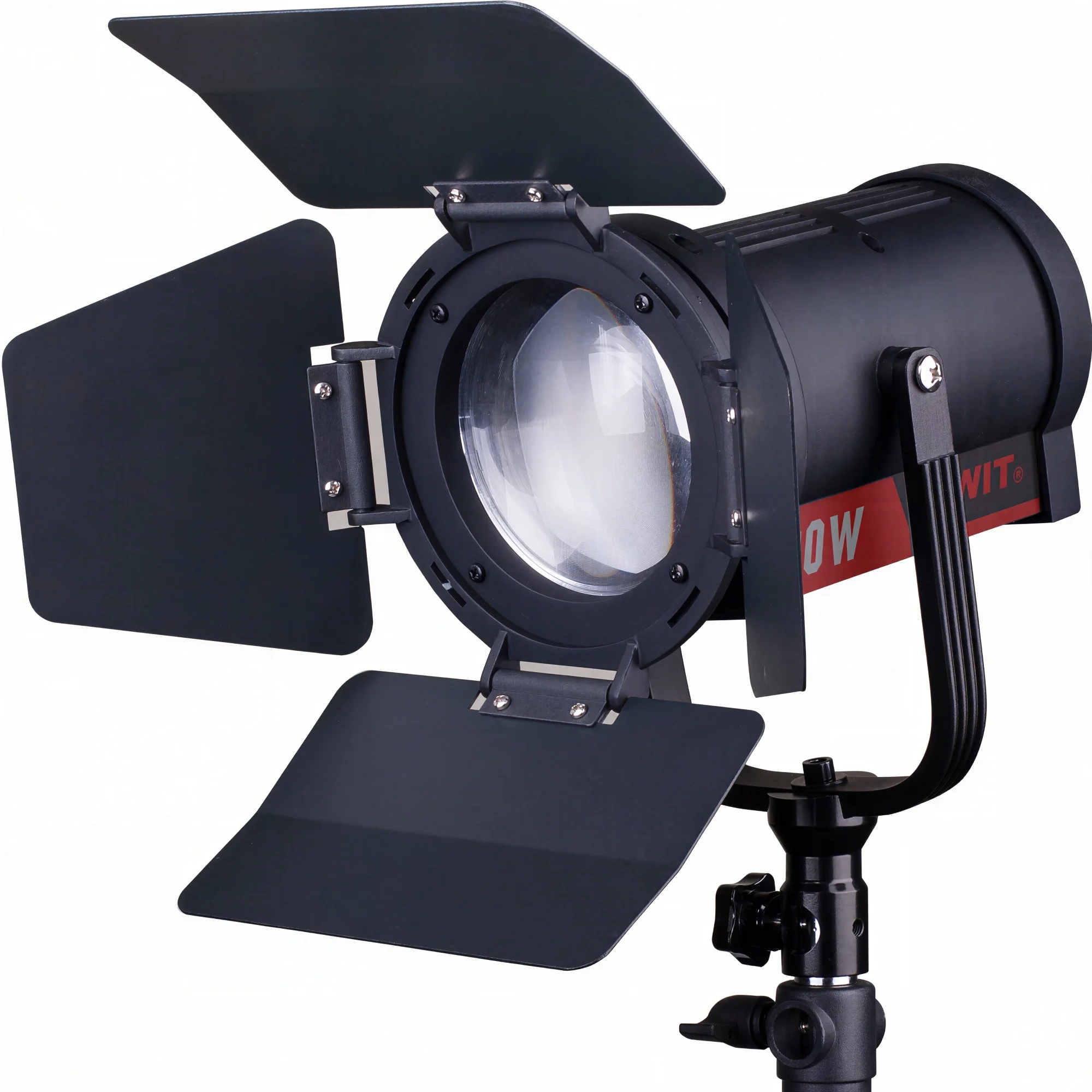
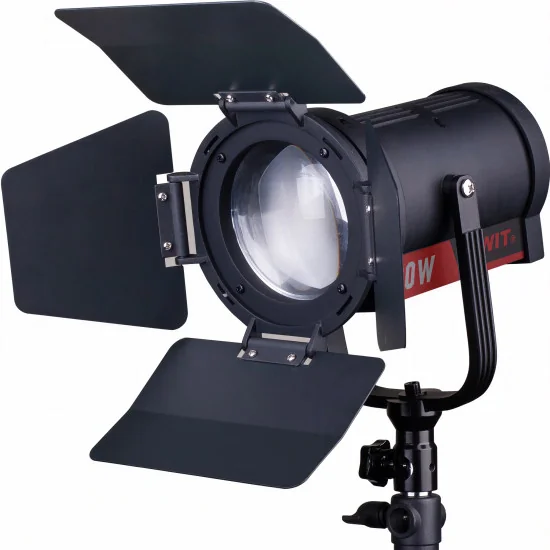
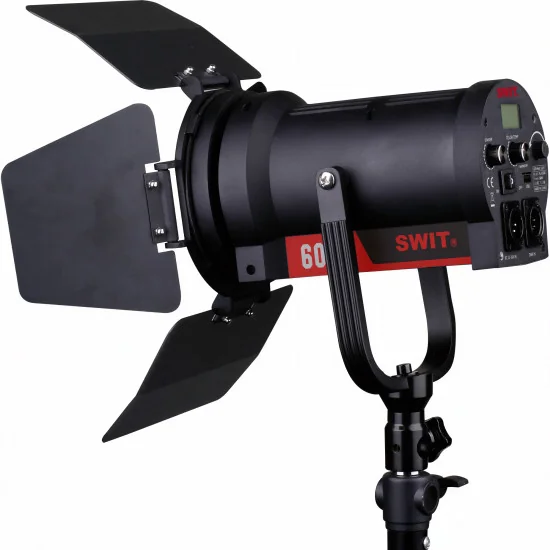
Motorised spot/flood, a bi-colour COB source and a three-channel DMX map, all in a head that runs happily from a camera battery: the SWIT FL-C60D brings the controls of a studio Fresnel down to a 60 W bi-colour LED Fresnel spotlight that one crew member can rig, refocus and power without hunting for a wall socket.
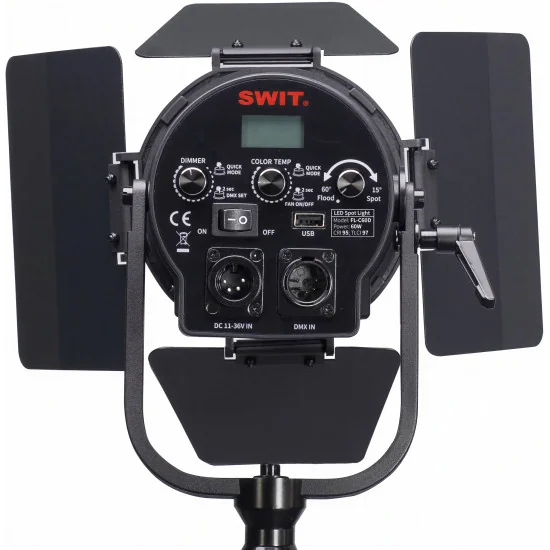
Start with power, since that decides where the light can actually go. Current comes in through a four-pin XLR connector that takes any DC voltage between 11 and 36 V. The box holds an AC-DC adaptor with its mains lead, an S-7101 cable with a D-tap plug at one end and a 4-pin XLR at the other, and SWIT's S-7200S plate for V-mount batteries, which carries its own stand clamp. Fix the plate to the light stand, mount a pack and the head keeps working in a hotel ballroom with every outlet taken, an underground car park or a forest clearing. Back in the studio, the adaptor takes over.
SWIT's manual lists 25,000 lux at 1 m with the beam fully spotted and 4,000 lux at full flood, the two ends quoted as 15° and 60° half-intensity beam angles. At 2 m the spot still gives about 6,250 lux, against 1,000 lux in flood. At 3 m the readings fall to roughly 2,700 and 445 lux.
In practice, a narrow key two or three metres from a presenter holds its own in a reasonably bright room. Opened to 60° and brought closer, the same unit becomes a broad fill or a background wash.
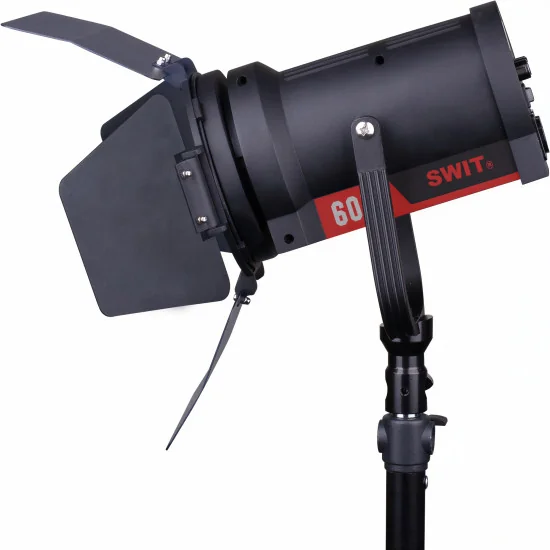
Focus has its own knob. Clockwise narrows the beam towards spot, anticlockwise opens it to flood. Because beam width is also mapped to DMX, a gaffer can resize a pool of light from the desk while the fixture sits out of reach, raised high on a stand or tucked behind a set flat. The four-leaf barn doors then trim the edges, keeping light off a projection screen, a green screen or a glossy table top. A U-shaped yoke tilts the head for a steep backlight or a low, raking angle across a textured wall.
We ship across the EU for €20, free over €1,000.
B2B sales only, prices excl. VAT.
Official EU distribution and warranty.
Secure online payments via Stripe.
Send your enquiry via the form or email avgear@avgear.shop
The 2700–8000 K range runs from warm tungsten to the cold blue of open shade on a clear day. In normal mode the colour knob moves in 100 K increments and the dimmer in 1 % steps from 0 to 100 %. A short press switches either knob to fast mode: colour then jumps between 2700, 3200, 4500, 5600, 6500, 7200 and 8000 K, and brightness moves in 10 % blocks. Swapping a set from a 3200 K stage look to a 5600 K daylight balance between sessions takes a couple of clicks rather than a long scroll.
SWIT gives the source a CRI of 95 and a TLCI of 97. Broadcasters weigh the second figure more heavily, since it is calculated on a camera's response instead of human vision, and it shows up directly in how close skin tones sit to correct before grading starts. Dimming is flicker-free across the whole range, so slow-motion inserts and high frame-rate B-roll stay clean.
On a lighting desk the head behaves predictably. Its DMX512 input, on a standard 5-pin XLR connector, takes three consecutive channels: dimmer, colour temperature and spot/flood. Set the start address to 005 and the light answers on 005, 006 and 007. Addressing (001–512) is done on the fixture itself: hold the dimmer knob for roughly two seconds, dial each digit, confirm with a press. For a streaming studio or a conference room with a small console, that means level, colour and beam width can all live inside stored cues.
Where cable runs are impractical, the 5 V USB output (600 mA) feeds the LA-WR8-R receiver, an optional SWIT accessory. It plugs into the DMX input and listens to SWIT's LA-WR8 handheld controller over 2.4 GHz, with SWIT quoting up to 400 m line of sight.
Two fan modes deal with noise. Normal mode keeps the full dimmer range available. A two-second hold on the colour knob engages silent mode, which stops the fan and caps output at 50 %, a fair trade for filmed podcasts or seated interviews with a boom hanging close to the fixture.
The LCD reports the DMX address, dimmer percentage, kelvin value and fan state, and it flags a supply voltage that is too low or too high. If the COB gets too hot, thermal protection pulls the dimmer to zero, leaves the colour value untouched and lets the light resume normal operation as soon as temperatures recover. SWIT specifies use between −10 °C and 40 °C.
From a rental-house or production-company angle the sums are simple. The light draws on V-mount packs the camera team already charges every night, it tolerates anything from a 14.4 V brick to higher-voltage batteries as long as they stay under 36 V, and SWIT rates the COB source for 50,000 hours. That is a fixture that stays on the inventory list for many seasons without needing its own power ecosystem.
On real jobs the SWIT FL-C60D tends to land in a handful of roles. It works as a hard key for corporate and documentary interviews or as an accent that picks out a product or label on a tabletop set. It also serves as a backlight separating a streaming presenter from a dark backdrop, a dedicated pool of light on the speaker at panel discussions and award evenings, and a battery-run source for news-style setups in places with no power at all. Its modest 60 W draw is also easy on venue circuits where house power is limited.
| Model | FL-C60D |
|---|---|
| Beam angle | 15°- 60° |
| Max illuminance | 1m: Spot 25000Lux,Flood 4000Lux 2m: Spot 6250Lux,Flood 1000Lux 3m: Spot 2700Lux,Flood 445Lux |
| Color temperature | 2700K~8000K |
| CRI | 95 |
| TLCI | 97 |
| USB out | 600mA |
| Power | Approx. 60W |
| Working voltage | DC11V~36V |
| Net weight(without packaging) | 2.1kg |
| Product dimensions(without packaging) | 111×120×235mm |
| Gross weight(with packaging) | 6kg |
| Package dimensions | 370×260×390mm |

Data sheet
Specific References