


How to transmit 4K video over extremely long distances?
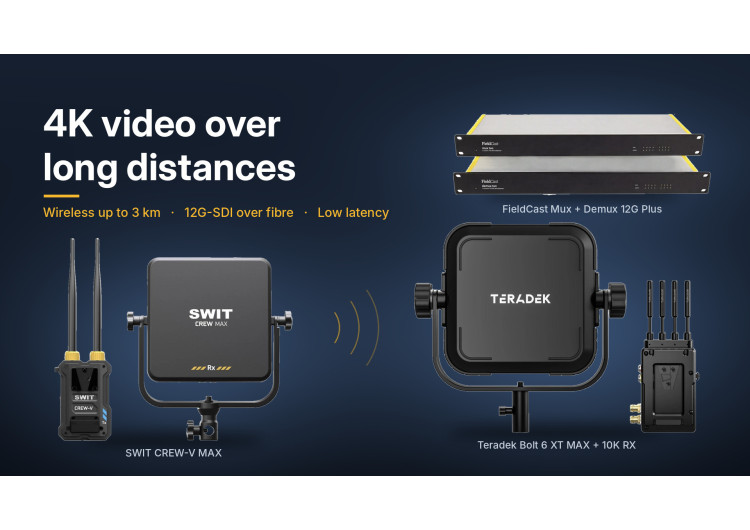
Radio links and fibre multiplexers compared for long 4K runs. See what limits range and delay, and how to plan a link that holds on show day.
Copper runs out of road surprisingly early. A quality RG-6 class coax carries a 12G-SDI signal for roughly 60 to 100 metres, depending on the cable grade and on how strictly the run is certified. Beyond that, CRC errors start to strip out audio, ancillary data and, finally, the picture itself. A camera on the far side of a motor-racing circuit, a finish-line position at the bottom of a ski slope, or a second building on a university campus usually sits hundreds or thousands of metres past that limit. Only two media are left to bridge the gap: radio and glass.
This guide covers both routes for sending 4K video over long distances. It looks at long-range wireless video links rated for 1.5 km and 3 km, at the delay each technology adds, and at single-mode fibre multiplexing that carries uncompressed 12G-SDI up to 20 km. It also goes through the planning work that decides whether a link that works on paper still works on show day: Fresnel zones, loss budgets and connector hygiene. The figures come from manufacturer specifications and published standards, and the advice reflects the questions production companies bring to us when they cost out a long cable plan.
Wireless transmission up to 3000m
Three kilometres of radio path is a different discipline from wireless monitoring on a film set. At that distance the receiving antenna matters more than the transmitter, the height of both ends matters more than either unit, and the format you need, UHD or HD, decides the price class of the kit.
For full 4K60 10-bit 4:2:2 HDR, the Teradek Bolt 6 XT MAX Set with 10K RX V-Mount is the longest-reaching zero-delay option in the Teradek line-up. Its receiver has no external antennas. Instead, a directional array sits inside a panel housing mounted on a yoke, and its receive pattern narrows as the distance grows. It is effectively omnidirectional at 300 metres, about 104° wide at 2.5 km and 55° wide at 3 km, while the vertical window stays at 20°. In practice, a camera can roam freely near the receiver, but at full range the panel has to be aimed. A compass bearing taken during the recce saves a lot of guesswork when the stand goes up.
The 3 km rating depends on Broadcast Mode, a feature of the MAX transmitters. With it enabled, the transmitter stops relying on the return uplink and simply broadcasts. That extends the reach and lets any number of previously paired receivers lock on. Two conditions come with it: Broadcast Mode runs on non-DFS channels only, and Bolt 6 XT 750 and 1500 receivers will not join it. With Broadcast Mode switched off, the same set behaves as a conventional two-way link of about 1.5 km that serves up to six receivers.
The receiver has two 12G-SDI outputs and one HDMI 2.0 output, so a switcher, a recorder and a client monitor can all be fed in parallel. It also includes a de-interlacer, a scaler, a frame-rate converter and 17×17×17 3D LUTs. A 2160p50 camera can therefore arrive as 1080p50 on an HD router while a graded preview goes to the director. Timecode, run/stop flags and ARRI or Sony metadata travel with the picture. Typical jobs include a camera on the back straight of a circuit feeding the OB compound, a ski-jump in-run relayed to the valley, or a summit position at a cycling stage finish.

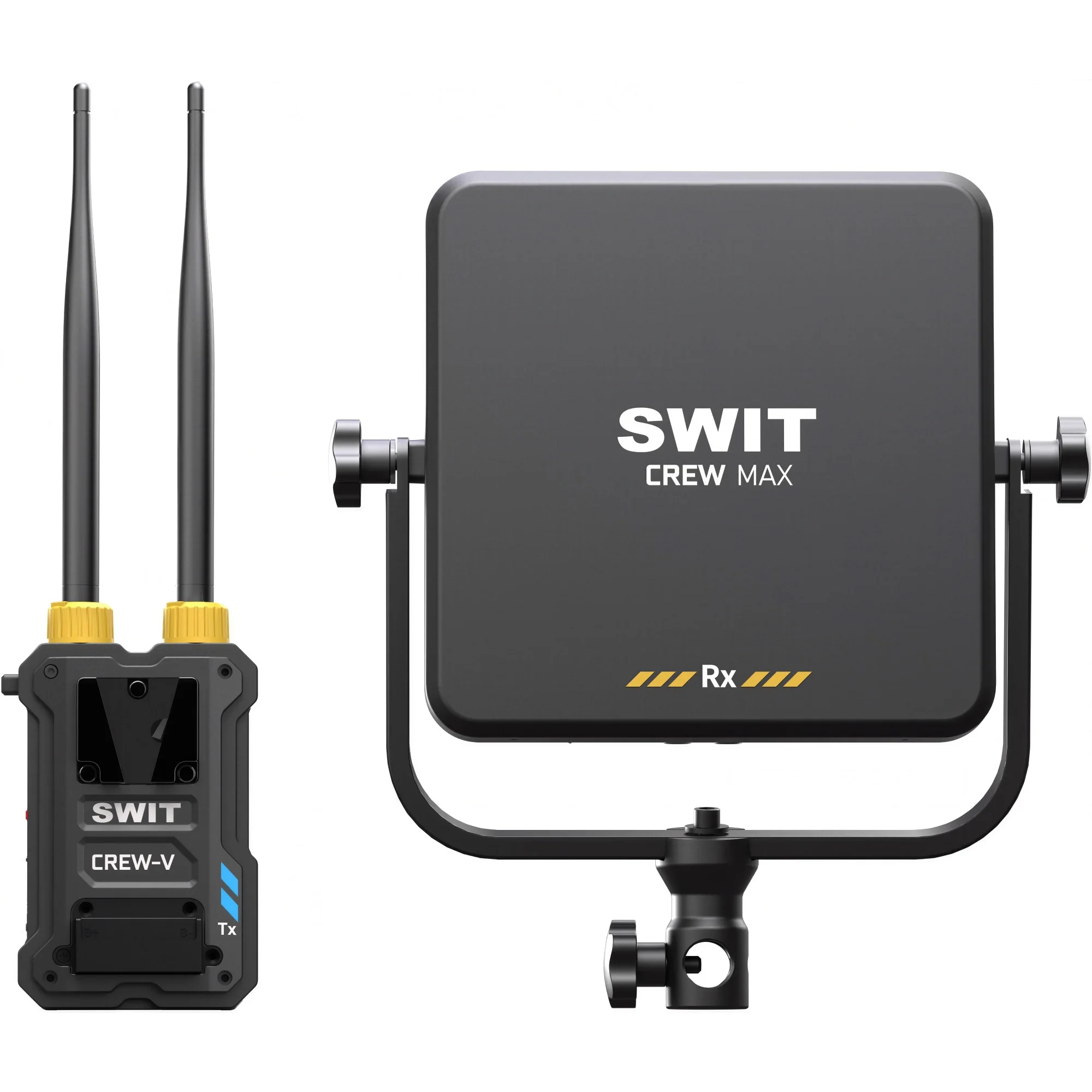
Not every long throw needs UHD. Live streams, conference relays, IMAG screens at outdoor events and the director's monitoring feed usually run at 1080p. For those jobs, the SWIT CREW-V MAX Wireless Video Transmission System 3000m covers the same 3 km of line of sight in a different price class. SWIT pairs a compact transmitter with a panel receiver that houses a high-gain directional antenna. The radio is SWIT's own KUWI 2.0 Pro chipset working in the 5.1–5.9 GHz band, a proprietary protocol rather than Wi-Fi. The receiver constantly reports its reception quality, so the transmitter can trim RF output (up to 23 dBm) and bitrate to the real distance.
The trade-offs are clear. The CREW-V MAX tops out at 1080p60, encodes in H.265 at up to 26.8 Mbps and holds a fixed latency of 32 ms. In return, it does several things the zero-delay systems do not:
- The receiver's USB-C port is recognised as a driver-free UVC webcam, so OBS, vMix or a video-call app sees the camera directly, with no capture hardware in between.
- Embedded timecode, the record trigger, cine-camera metadata and two audio channels all cross the link.
- One transmitter feeds up to four receivers.
- The dual-sided V-mount transmitter slots between the camera plate and the battery, so a single V-mount pack runs camera and transmitter together. On a multi-day event, that takes one pack per camera out of the charging rotation.
With a 4K camera, the usual practice is to send the down-converted HD output from its second SDI connector and keep UHD for the recorder on board.
Transmitters with a range of up to 1500m
Most long-distance shots fall well short of 3 km. A stadium bowl, a festival field, a riverside location with the video village parked behind a hedge, an airfield used as a car-commercial set: 1.5 km of clear path covers the majority of them with margin to spare.
The Teradek Bolt 6 XT MAX TX/RX Set V-Mount is the standard-format kit for that distance. The transmitter carries four external antennas and the receiver carries five. Both units sit on V-mount plates and accept 6–28 V through a locking 2-pin connector. The set moves 4K60 10-bit 4:2:2 HDR over 12G-SDI or HDMI 2.0 with less than a millisecond of delay, using visually lossless compression rather than packet-based streaming. The transmitter loops its 12G-SDI input, so the camera's EVF or an on-board recorder stays on the same feed, and an HDMI source is cross-converted to SDI on the way through. On the receiver, 17×17×17 LUT support and resolution and frame-rate scaling help when a monitor or router expects something other than the camera format.
Frequency agility is where this generation separates itself from older 5 GHz kits. Bolt 6 adds twelve 40 MHz channels in the 6 GHz band to the familiar 5 GHz channels, and its 6 GHz mode has been approved for the EU and the UK since 2023. On a dense site, with press Wi-Fi, 5 GHz intercom and other video links all competing, doubling the pool of usable channels is often the difference between a stable picture and constant channel hopping. The spectrum analyser in the Bolt App shows which channels are crowded before the first rehearsal, not halfway through the show.

One detail matters to anyone running a rental fleet. The MAX transmitter in this set is the same model that ships with the 10K receiver. A company can buy the 1.5 km kit today and add the long-range panel receiver when the first 3 km job is booked, without replacing the transmitters already on its cameras. Bolt 6 also stays compatible with Bolt 4K receivers already in stock. In standard mode one transmitter serves up to six receivers, so the focus puller, the director, the DIT and the client can each have their own picture.
Video latency considerations
Range is half of the specification. Delay is the other half. Every stage in the chain adds time: the camera's own processing, the transmission, any frame synchroniser and the display. Engineers call the total glass-to-glass latency, and it is easiest to judge in frames: one frame lasts 40 ms at 25p, 20 ms at 50p and 16.7 ms at 59.94p.
| Link type | Delay added by the link | Equivalent at 50p |
|---|---|---|
| Zero-delay wireless (Teradek Bolt 6 XT) | under 1 ms | well under 0.1 frame |
| H.265 wireless (SWIT CREW-V MAX) | 32 ms, fixed | about 1.6 frames |
| Typical packet-based wireless | 2–4 frames | 40–80 ms |
| Uncompressed fibre, 20 km | about 0.1 ms of propagation | negligible |
Below one frame, nobody can see the delay. That threshold is the whole point of the zero-delay chip in the Teradek Bolt 6 XT MAX TX/RX Set V-Mount: at under a millisecond, the frame on the receiving monitor is the frame the sensor has just captured. For a focus puller working wide open on a moving subject, or an operator framing from a remote monitor, nothing slower is acceptable.
A fixed 32 ms works out at about 0.8 of a frame at 25p and 1.6 frames at 50p. For a vision mixer cutting a live show, a stream or an IMAG screen, that is comfortable. For comparison, sound needs about the same 32 ms to travel 11 metres through the air. What matters more than the absolute value is that the SWIT CREW-V MAX keeps it constant. A stable offset can be compensated once, in the audio desk or a frame sync. A delay that wanders with RF conditions cannot.
Three practical rules follow:
- Mixed sources: when a zero-delay camera and a codec-based camera feed the same switcher, delay the faster path or the audio so that cuts stay in sync.
- Lip sync: audiences tolerate sound arriving up to roughly 45 ms early or 125 ms late. Add up the camera, the link and the display, not the link alone. Many cameras add a frame or more of their own processing before the signal even leaves the body.
- Return paths: talkback and programme return travel the other way and bring their own delay. On a 3 km wireless link, intercom normally runs on a separate system.
Fibre is the quiet winner in this comparison. In standard single-mode glass, light covers a kilometre in about 4.9 µs, so even 20 km adds only around a tenth of a millisecond. A multiplexer that does not compress or buffer frames adds nothing measurable on top of that.
Wired transmission over fibre optic cable
Glass takes over when the path leaves line of sight, when the venue's radio spectrum is already saturated, or when sixteen cameras need to reach a gallery in another building. Standard single-mode fibre loses about 0.35 dB per kilometre at 1310 nm and about 0.2 dB at 1550 nm. Over coax, a 12G-SDI signal is spent after roughly a hundred metres, while over fibre the same budget stretches across tens of kilometres. Glass is also immune to electrical interference and ground loops, which are a constant headache on temporary sites powered by several generators.
The classic approach is one fibre per signal, with converters at both ends. Wavelength-division multiplexing changes the arithmetic. The FieldCast Mux + Demux Two 12G Plus places eight independent 12G-SDI channels and a full-duplex 1 Gb Ethernet link onto a single 9/125 core. Each signal travels on its own wavelength. Nothing is compressed, scaled or frame-stored, so a 2160p60 feed arrives bit for bit. The pair is rated for up to 20 km at 12G-SDI and up to 40 km at 3G-SDI.
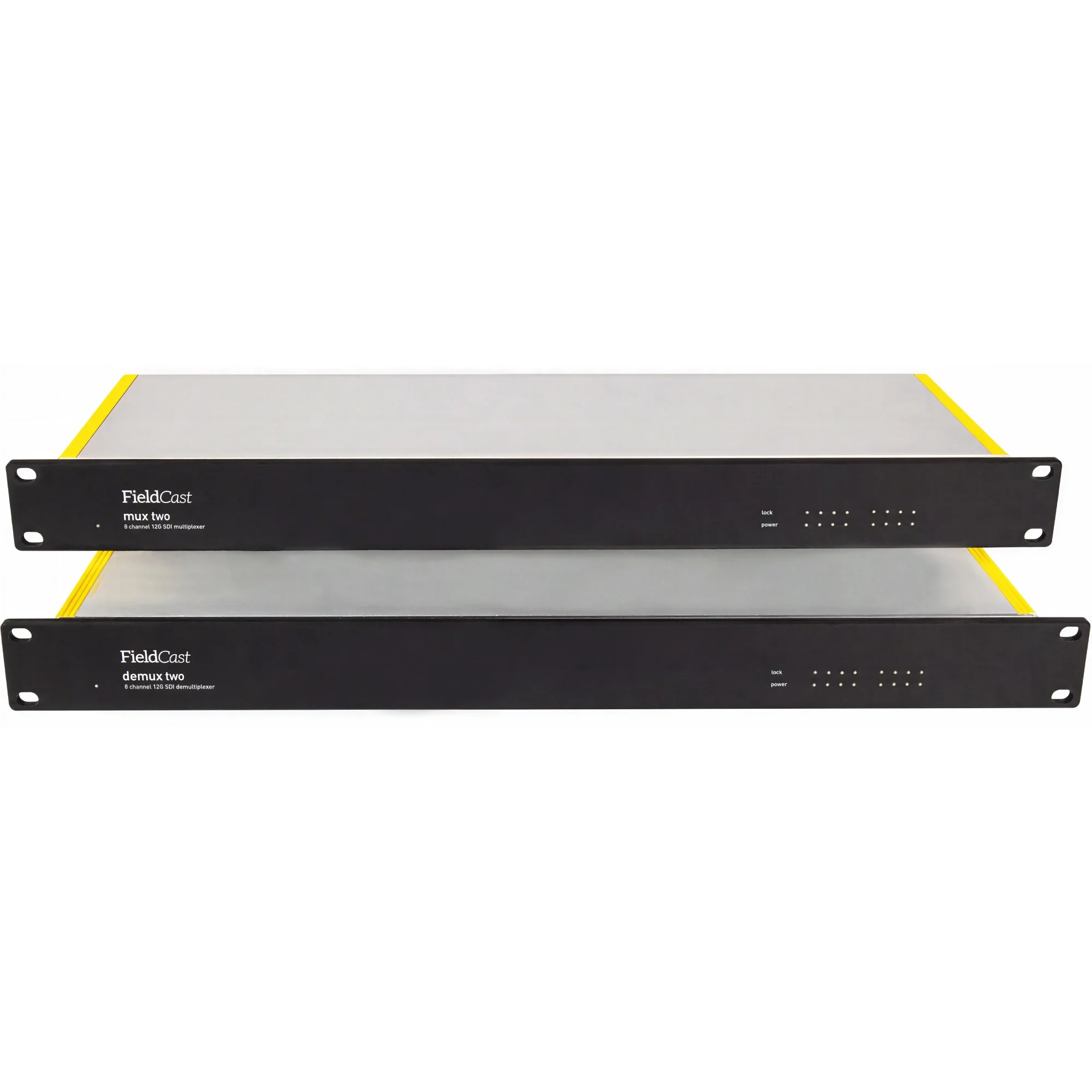
The details pay off in daily use:
- Every multiplexer input has a reclocked SDI loop-through, so the camera position keeps a local confidence monitor without a distribution amplifier.
- Every demultiplexer channel has two outputs, one for the switcher and one for a multiviewer or recorder.
- Think of the RJ-45 port as an Ethernet patch lead that happens to be up to 20 km long. RCP camera control, PTZ commands, tally or an engineering laptop share the core with the pictures, so no second cable is needed for data.
- Both units are 1RU aluminium chassis that draw under 40 W from 110–240 VAC through a locking PowerCon inlet.
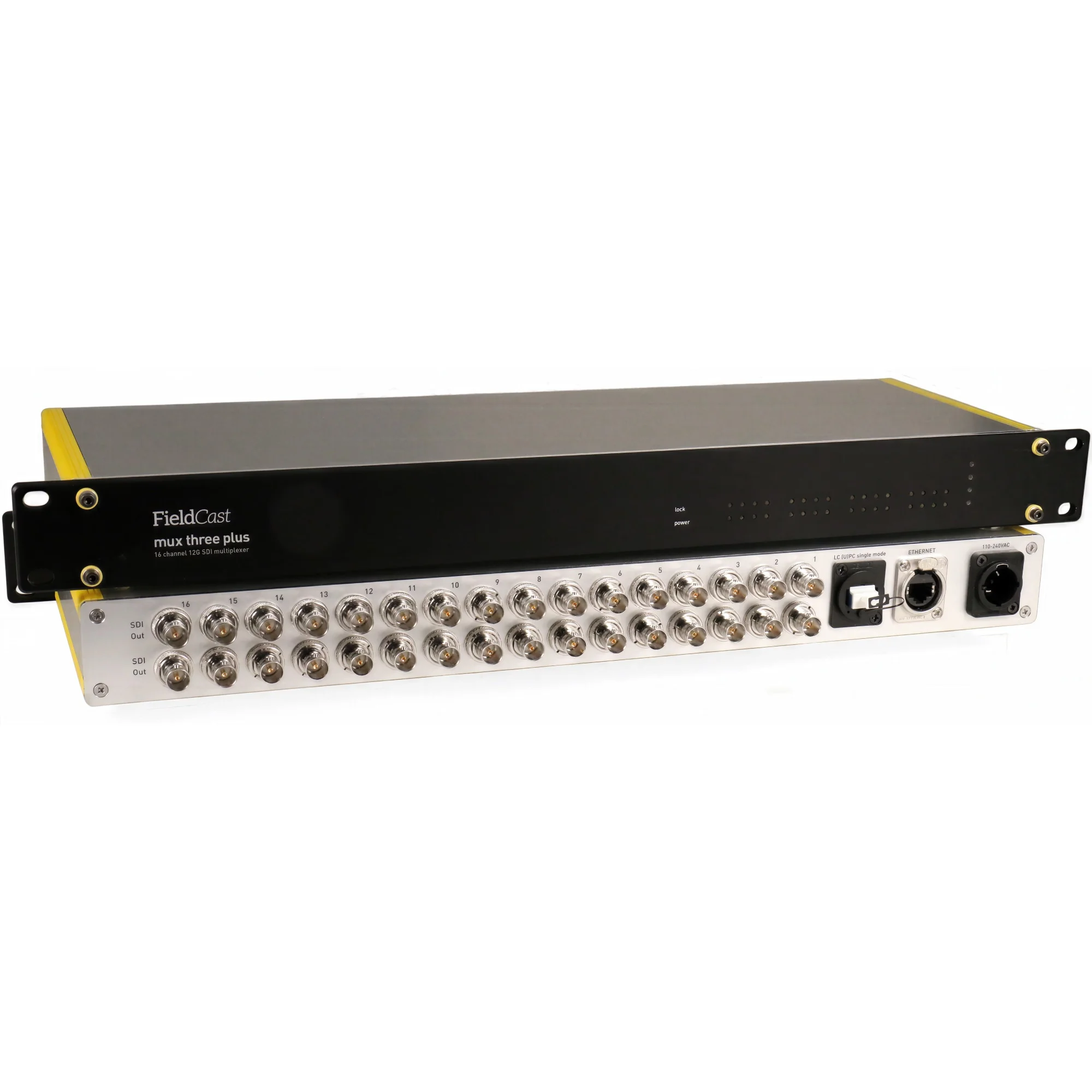
Larger camera plans call for the FieldCast Mux + Demux Three 12G Plus. It doubles the count to sixteen 12G-SDI channels, still with gigabit Ethernet and still on one core, at under 50 W per unit. FieldCast pairs also have a second optical port, marked UPG, for cascading. The Two 12G Plus, for instance, can chain to another four- or eight-channel pair and reach sixteen channels on one strand. On a two-core tactical cable, the spare strand can carry a redundant system. For an OB provider, the real saving shows up in the fibre plan: one strand to book, patch and test per camera group instead of one per signal.
Planning a long radio path: line of sight, Fresnel zone and antenna height
"Line of sight" on a datasheet means more than being able to see the receiver. Radio energy travels inside an ellipsoid around the direct line, called the first Fresnel zone, and anything that intrudes into it costs signal even when the visual path looks clear.
The radius at any point is r = 17.32 × √(d1 × d2 / (f × D)), with distances in kilometres, frequency in gigahertz and the result in metres. At the midpoint of a 3 km link at 5.8 GHz this gives about 6.2 m; for a 1.5 km link it is about 4.4 m. Radio planners aim to keep at least 60% of that radius clear, which is about 3.7 m and 2.6 m respectively. Teradek's guidance for the 10K receiver is stricter: no more than 20% of the path obstructed. Over a few kilometres the curvature of the Earth barely registers, at about 13 cm in the middle of a 3 km path. Height is really about crowds, vehicles, trees and terrain.
A handful of habits separate a reliable link from a lucky one:
- Raise both ends: put the receiver on a mast, a gantry or a roof edge, and the transmitter above head height wherever the shot allows. A dense crowd absorbs 5 GHz energy very effectively.
- Walk the path during the recce: check the midpoint, where the zone is widest. Remember that spectators, parked trucks or summer foliage may appear after the test.
- Respect the distance law: free-space loss rises by about 6 dB each time the distance doubles, to roughly 111 dB at 1.5 km and 117 dB at 3 km at 5.8 GHz. The last kilometre is always the hardest.
- Read the spectrum first: both the Bolt App analyser and SWIT's automatic scan show congestion. Lock a clean channel before rehearsals rather than during the show.
- Know the DFS rules: in Europe, a 5 GHz DFS channel must be monitored for 60 seconds before transmitting, or 10 minutes in the 5600–5650 MHz weather-radar segment, and a radar detection forces a change of channel. Broadcast Mode on the Teradek Bolt 6 XT MAX Set with 10K RX V-Mount stays on non-DFS channels for exactly that reason.
- Check the 6 GHz conditions: EU rules for 5945–6425 MHz distinguish low-power indoor use from very-low-power portable use. Confirm what applies to an outdoor long-range shot in the country of operation before relying on the 6 GHz channels.
Fibre link budget: what decides whether 20 km works
A fibre run is planned on a loss budget, not on a distance. The method is simple. Add up the cable loss per kilometre, every mated connector and splice, and a reserve for ageing and the inevitable extra coupler, then compare the total with the optical budget stated for the equipment.
Take a 12 km route over standard G.652.D cable. At about 0.35 dB/km in the 1310 nm window, the glass accounts for roughly 4.2 dB. Four mated pairs (a patch panel, two drum couplers and a chassis connector) at up to 0.35 dB each add about 1.4 dB more. That puts the total near 5.6 dB before the reserve. The same logic explains why the FieldCast pairs quote 40 km for 3G-SDI but 20 km for 12G-SDI: a lower bit rate tolerates more loss and dispersion.
Wavelength multiplexing borrows directly from telecom networks. The ITU-T G.694.2 grid, for example, defines 18 coarse wavelengths between 1271 and 1611 nm, spaced 20 nm apart, and low-water-peak fibre makes the full spread usable. The FieldCast Mux + Demux Three 12G Plus uses its own hybrid WDM scheme, but the principle is the same: sixteen SDI channels, each on a wavelength of its own, sharing one core without interfering. LC connectors come as standard, and SC or ST terminations or bidirectional channel splits can be specified when ordering. That helps when the link has to plug into existing stadium or campus infrastructure rather than a fresh install.
The weak point is rarely the cable itself. Industry studies attribute more than three-quarters of optical faults to dirty connectors. A single-mode core is only 9 µm across, so one dust particle can block a large share of it, and dirt trapped between two mated connectors can become embedded in both end faces. A few rules keep the link healthy:
- Inspect every end face with a fibre scope before mating.
- Clean only when the inspection fails; IEC 61300-3-35 sets the pass criteria.
- Cap each connector the moment it is unplugged.
- Keep tactical cable on drums rather than in tight loops on the ground.
Wireless or fibre? Matching the link to the job
The choice rarely comes down to one specification. It depends on whether the camera moves, how long the rig stays in place, the format the gallery expects and how much risk the production can accept.
| Situation | Suitable route | Main reason |
|---|---|---|
| Moving 4K camera, clear path up to about 1.5 km | Teradek Bolt 6 XT MAX TX/RX Set V-Mount | Zero delay, 4K60, six receivers |
| Fixed or semi-fixed 4K position up to 3 km | Teradek Bolt 6 XT MAX Set with 10K RX V-Mount | Panel receiver plus Broadcast Mode |
| HD stream, IMAG or laptop capture up to 3 km | SWIT CREW-V MAX | 1080p60, UVC output, four receivers |
| 4 to 16 cameras, multi-day rig, no line of sight | FieldCast Two or Three 12G Plus | Uncompressed 12G-SDI and Ethernet over up to 20 km |
Many productions end up combining both. Roaming cameras go wireless to a rack at the edge of the field, and fibre carries everything from that rack to the gallery. The 12G-SDI output of a Bolt receiver can go straight into a FieldCast multiplexer input, so the radio hop stays short and robust while the long haul runs on glass. Looked at as an investment, the wireless kits pay back on events where cable runs are impossible or slow to rig. The multiplexers pay back wherever the same venues, campuses or OB routes recur season after season.
If you are costing a long link, our team can go through the path, the channel plan or the fibre budget with you before you order, so the kit arrives matched to the venue rather than to the brochure.
Frequently asked questions about long-distance 4K transmission
How far can 12G-SDI travel over coaxial cable?
Roughly 60 to 100 metres. The exact figure depends on the cable grade, the connectors and how strictly the run is certified for error-free operation. Longer runs need fibre or a wireless link.
Can 4K video be sent wirelessly over 3 km?
Yes, with a clear line of sight. The Bolt 6 XT MAX Set with 10K RX carries 4K60 10-bit video up to 3 km in Broadcast Mode, with under 1 ms of delay. HD-only systems reach the same distance at 1080p.
Does a 20 km fibre link add latency?
Only about 0.1 ms, which is the time light needs to cross 20 km of single-mode glass. An uncompressed multiplexer such as the FieldCast Mux + Demux Two 12G Plus adds no frame delay of its own.
What limits wireless range in practice?
The height of the antennas and obstructions inside the Fresnel zone, more than transmitter power. Crowds, vehicles and foliage near the midpoint of the path shorten a link far more than the distance on the datasheet suggests.
Comments
No comment at this time!
Leave your comment