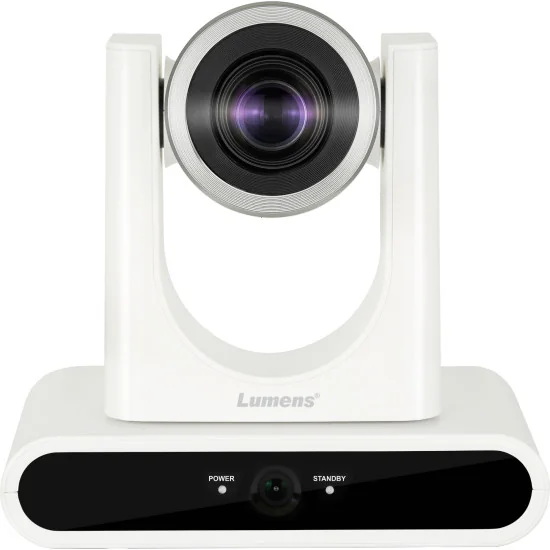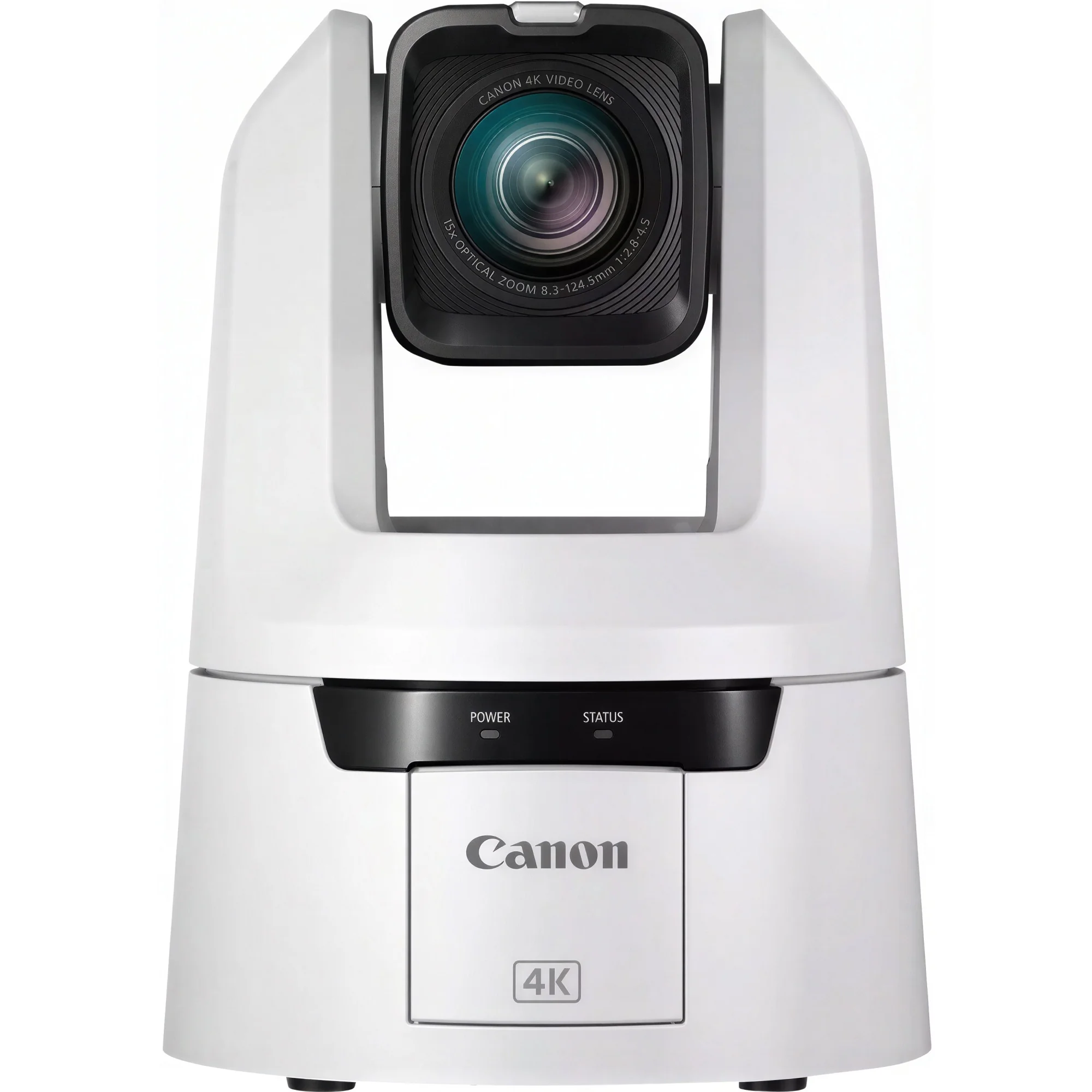
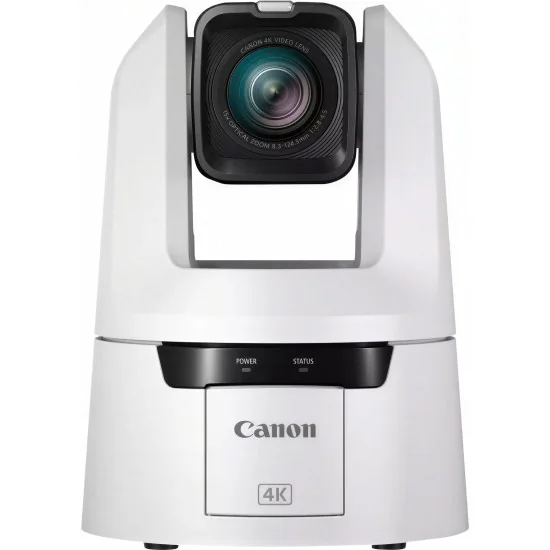
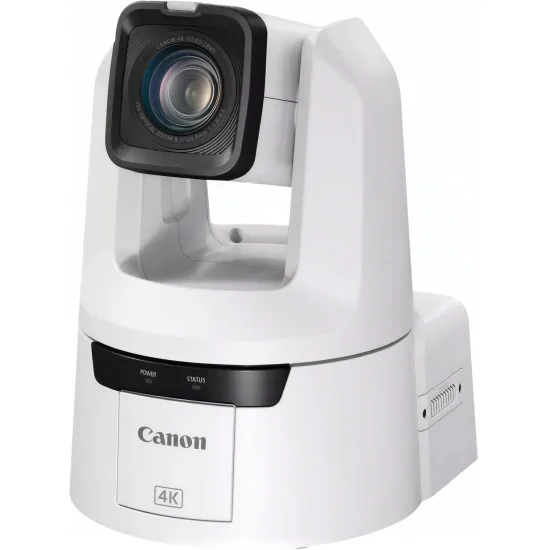
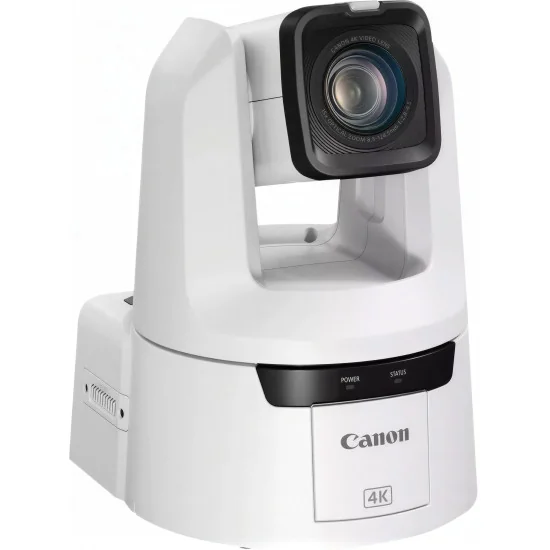
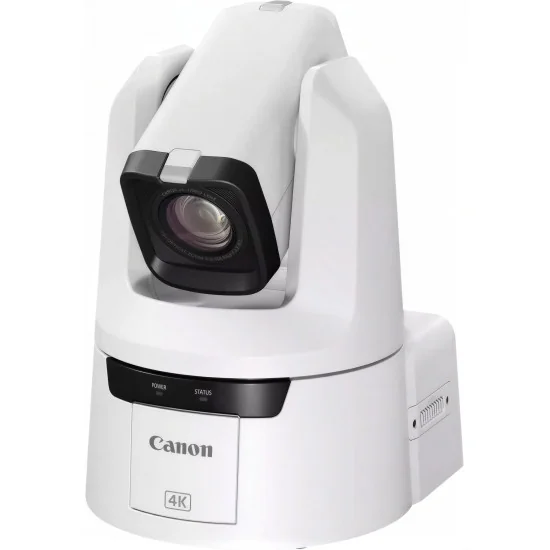
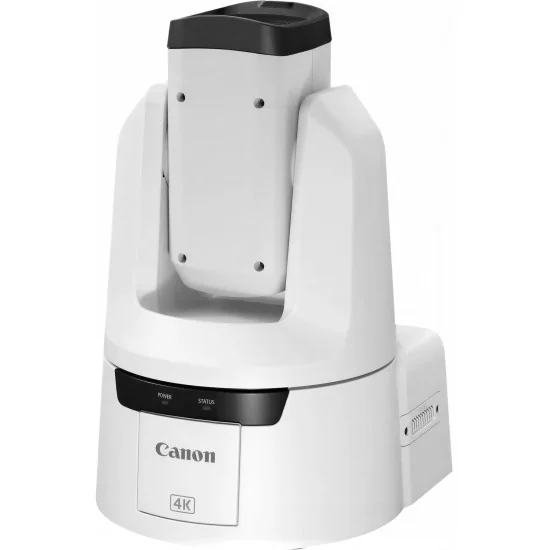
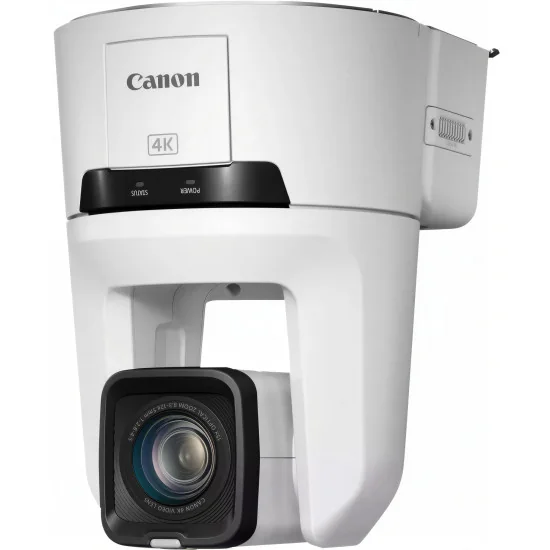
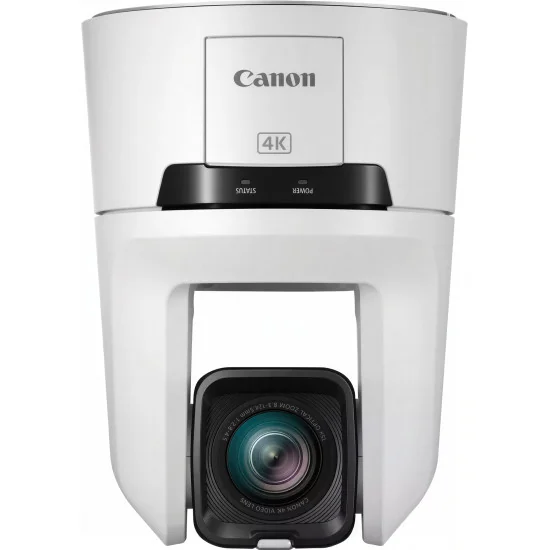
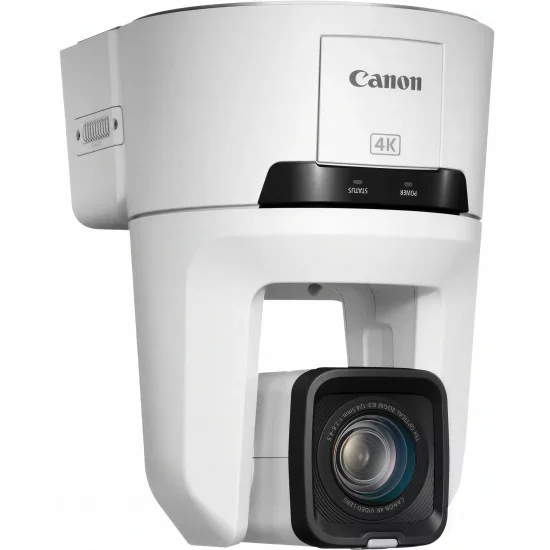
Large-sensor imaging and licensed auto tracking arrive together in the Canon CR-N500 White Auto Tracking. This titanium-white 1.0-type 4K PTZ camera comes licensed for the paid, full-feature tier of Canon's Auto Tracking Application RA-AT001. The same head that records low-noise 4K finds the presenter, follows them and resets the framing by itself. Image analysis happens in the camera; no tracking server needs a slot in the rack.
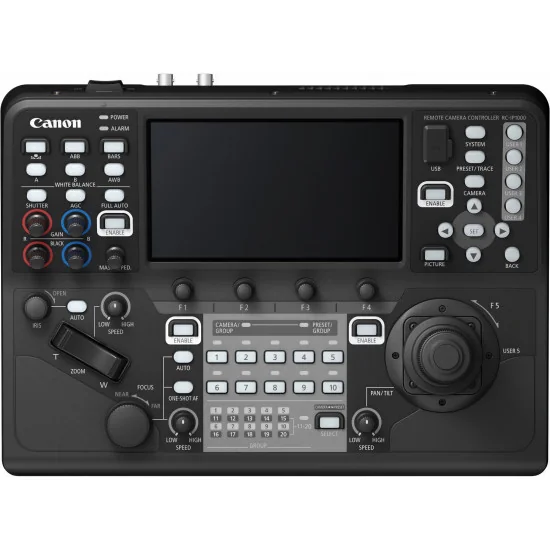
Any CR-N500 on firmware 1.5.0 or later carries the free Lite tier, but Lite leaves the operator almost no say. It picks the person, pins them to the centre, offers two sizes and keeps a single setup. The licence hands those choices back. A target is selected manually, for example by touching the presenter on an RC-IP1000 screen, or left to automatic detection. Reaction speed sits on a ten-level scale, and since Canon's October 2026 update of the application, subject size on this model is set in 17 steps instead of five. The subject can also be pushed off-centre so a slide or lower-third graphic has space. Five complete configurations are stored, one per event format: keynote, seated panel, lab demo.
Zone tools define where the automation may act. An auto-select area confines detection to the stage, while an exclusion area keeps the camera from latching onto someone in the front rows. A projection screen flagged as a priority display area stays in frame even if the speaker wanders off. A fixed angle-of-view area cuts to a pre-composed wide of a whiteboard as the lecturer steps up to write. Inside a halting area, a presenter can pace a step or two without setting off a pan. Movement limits keep the head inside the set, and a fixed-tilt lock stops the picture bobbing as someone leans over a laptop. Should the presenter vanish from view, an initial position returns the camera to a safe framing.
We ship across the EU for €20, free over €1,000.
B2B sales only, prices excl. VAT.
Official EU distribution and warranty.
Secure online payments via Stripe.
Send your enquiry via the form or email avgear@avgear.shop
Auto Framing takes over composition as well. Multi-Person mode widens to include everyone in a group. Since October 2026 the operator also sets how fast that recomposition happens, so a second guest joining a sofa interview produces a gentle zoom-out rather than a jump. Face Direction leaves looking room on the side the speaker faces; Sit/Stand opens up as someone rises from a chair and tightens again once they settle. Canon rates the tracking for full-body, upper-body and head-and-torso framings at slow and normal walking pace, and for full or upper body at a brisk walk.
Camera firmware 1.8.0, published on 15 October 2026, links each preset to a tracking state. A preset for the stage-left entrance can start tracking as the host walks on, and a Q&A wide can stop it in the same recall. A Standard Communication command now switches tracking on or off too, so a building's AV control panel can run a recurring board meeting or lecture series from scene buttons.
Everything the software sees comes through the hardware of the standard CR-N500. Its 1.0-type CMOS (8.29 megapixels effective) and DIGIC DV6 processor deliver native 4K UHD up to 29.97p, plus Full HD up to 59.94p built from the 4K image by oversampling. Minimum illumination is about 1.5 lux in 4K. At full telephoto on the 15x zoom (8.3–124.5 mm, F2.8–4.5, roughly 25.5–382.5 mm in full-frame terms), depth of field gets shallow. That is where Dual Pixel CMOS AF earns its place: on-sensor phase detection keeps a walking subject sharp while the head pans. From 12 m, the 5.7° telephoto angle frames a strip about 1.2 m wide; at 3 m, the 73° wide end covers roughly 4.4 m of set. Four-axis optical stabilisation, roll included, absorbs vibration from a balcony rail or truss.
A motorised ND filter (1/4, 1/16, 1/64), gain from −6 to 33 dB and a 2,000–15,000 K white-balance range keep exposure in hand. Gamma choices run from BT.709 for straight-to-air SDR through Wide DR to Canon Log 3, so a corporate film cut against Cinema EOS cameras keeps Log material for the grade.
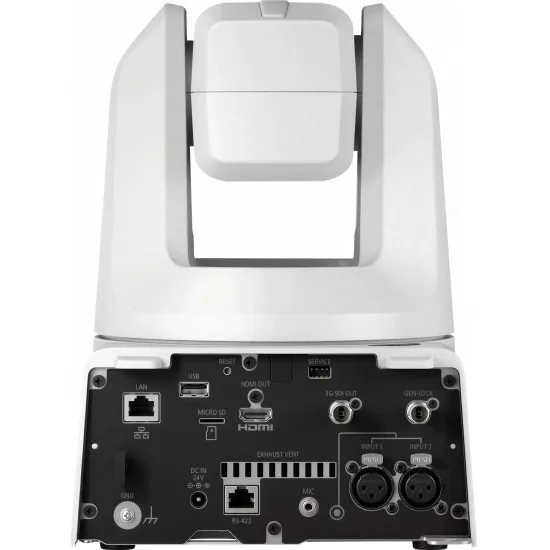
The BNC 3G-SDI output carries up to 1080p59.94 in 4:2:2 10-bit, with embedded sound and LTC/VITC timecode; HDMI provides 2160p at 23.98, 25 or 29.97 frames per second. One format applies to both, and setting HDMI to 2160p leaves SDI without signal. A genlock input ties the camera to the studio's reference signal. Over Gigabit Ethernet, up to three 4:2:0 8-bit streams run in parallel: NDI|HX2 (NDI 6 support arrived with firmware 1.7.0), SRT and RTMP with automatic reconnection, plus RTMPS and RTSP/RTP. 4K over IP needs a 29.97, 25 or 23.98 Hz setting. FreeD feeds virtual-set engines, and two XLR inputs (mic or line, 48 V phantom) plus a 3.5 mm jack put sound into every output.
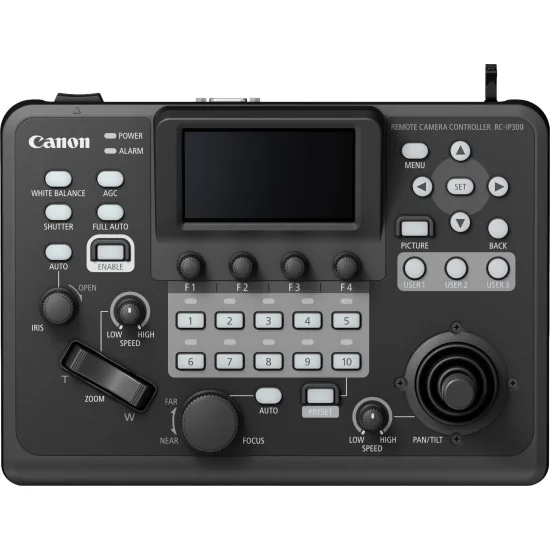
PoE+ (IEEE 802.3at) needs a Class 4 port on the switch; plain PoE won't do, and the supplied 24 V adapter covers weaker switches. Commands arrive via Canon XC, Standard Communication on IP or serial RS-422, Wi-Fi and the WL-N01 infrared remote. Both RC-IP100 and RC-IP1000 joystick panels support the camera directly, while Canon offers its Remote Camera Control Application at no cost for running up to 20 heads from one PC.
Helsinki AV company Suomen Videoviestintä (SVV) shows what single-cable CR-N500 heads change on site. Canon's case study describes ten streams produced at once across five meeting rooms. Rigging and de-rigging took half as long after three cables per camera gave way to one Ethernet run for power, control and picture. Canon presents licensed tracking as the next step, freeing the operator for switching and streaming while the head holds the shot.
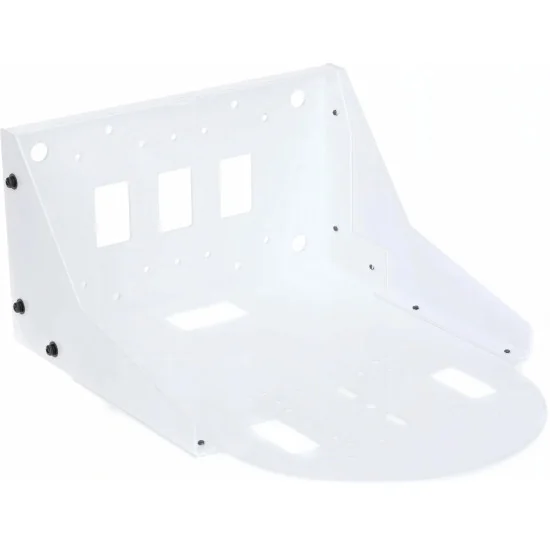
Two safety wires and a ceiling plate plus screws ship with the camera, along with the mains adapter and IR remote. Titanium white blends into university auditoriums, conference centres and bright TV sets; operating range is 0–40 °C, indoors. For multi-room projects, send us room dimensions and mounting points. We can check zoom reach to each lectern, Class 4 capacity on your switches and where an RC-IP1000 is worth adding to a Canon CR-N500 White Auto Tracking PTZ setup.
| Feature | Auto Tracking Application (Lite) | Auto Tracking Application |
|---|---|---|
| Tracking subject | Auto-select only | Auto-/manual select possible |
| Tracking sensitivity | Fixed | Adjustable from 1 to 10 levels |
| Tracking subject display size | Can be set at two levels | Can be set at five levels |
| Tracking target display position | Fixed at center | Can be set to any area |
| Auto Framing | — | Multi-Person Framing, Face Direction Framing, Sit/Stand Framing |
| Priority display area | — | Can be set |
| Fixed angle of view | — | Can be set |
| Save tracking settings | One only | Up to five can be saved/recalled |
Specifications
| Camera | |
|---|---|
| Image Sensor | Type 1.0 (1.0 in.) single-plate CMOS sensor |
| Effective Pixels | approx. 8.29 megapixels (3840 x 2160) |
| Lens | f=8.3 – 124.5 mm, F/2.8 – 4.5, 15x optical zoom, 9-bladed iris diaphragm |
| Optical Zoom | 15x optical zoom |
| Digital Zoom | 20x digital zoom |
| Focal Length | f=8.3 – 124.5 mm, F/2.8 – 4.5, 35mm equivalent focal length: approx. 25.5 (W) – 382.5 mm (T) |
| Angle of View | Horizontal: 73.0 (W) – 5.7° (T) Vertical: 45.2° (W) – 3.2° (T) |
| Minimum Subject Illumination | 3840 x 2160: Approx. 1.5 lux (shutter speed 1/30 sec., Frame Rate 29.97P, Gain 33.0 dB) 1920 x 1080: Approx. 3 lux (shutter speed 1/60 sec., Frame Rate 59.94P, Gain 33.0 dB) |
| Shutter Speed | 1/3 – 1/2000 sec. (specific values depend on the frame frequency and frame rate) |
| Iris | Manual/Automatic aperture |
| Gain | -6.0 dB – 33.0 dB |
| ND Filter | Built-in (Off, 1/4, 1/16, 1/64), motor operated |
| Optical Low-Pass Filter | Yes |
| White Balance | AUTO (AWB), Set A, Set B, preset settings (daylight: 5,600 K*, tungsten lamp: 3,200 K*), color temperature setting (2,000 K – 15,000 K), Manual * Color temperatures are given for reference purposes only. |
| Focus | Focus mode: Manual, AF-boosted MF, Continuous AF, Face AF, Tracking AF type: Dual Pixel CMOS AF, Contrast AF |
| Gamma | Normal1 (Standard), Normal2 (x4.0), Normal3 (BT.709), Normal4 (x5.0), Wide DR, Canon Log 3 |
| Pan and Tilt | Pan operation range: Horizontal ±170° Pan operation speed: 0.1° – 100°/sec. Tilt operation range: Vertical -30° – +90° Tilt operation speed: 0.1° – 100°/sec. |
| Pan and Tilt Operation | |
| Protocol | XC (Canon's original), RTSP/RTP, NDI|HX, RTMP/RTMPS, Standard Communication (Serial), Standard Communication (IP), SRT, FreeD |
| Server | |
| Video Output Format: SDI | 1920 x 1080: 59.94P/59.94i, 50.00P/50.00i/25.00P, 29.97P/23.98P (4:2:2 10 bit) 1280 x 720: 59.94P, 50.00P (4:2:2 10 bit) – Same video format required for SDI and HDMI (cannot select different formats for SDI and HDMI) – When 3840 x 2160 is selected for HDMI, video will not be outputted to SDI. |
| Video Output Format: HDMI | 3840 x 2160: 29.97P, 25.00P, 23.98P (4:2:2 10 bit) 1920 x 1080: 59.94P/59.94i, 50.00P/50.00i/25.00P, 29.97P/23.98P (4:2:2 10 bit) 1280 x 720: 59.94P, 50.00P (4:2:2 10 bit) – Same video format required for SDI and HDMI (cannot select different formats for SDI and HDMI) – When 3840 x 2160 is selected for HDMI, video will not be outputted to SDI. |
| Video Output Format: IP | 3840 x 2160: 29.97 fps, 14.99 fps, 5.00 fps (4:2:0 8 bit) 1920 x 1080: 59.94 fps, 29.97 fps, 14.99 fps, 5.00 fps (4:2:0 8 bit) 1280 x 720: 59.94 fps, 29.97 fps, 14.99 fps, 5.00 fps (4:2:0 8 bit) 640 x 360: 59.94 fps, 29.97 fps, 14.99 fps, 5.00 fps (4:2:0 8 bit) – If 59.94/50.00 Hz is selected for the frame frequency, the 3840 x 2160 format cannot be selected. – A frame rate that exceeds the frame frequency cannot be selected. – JPEG has one pattern fixed depending on the frame frequency (format is fixed and cannot be selected) Resolution: 1280 x 720 When frame frequency is 59.94/50.00 Hz: 14.99 fps, when frame frequency is 23.98 Hz: 11.99 fps, when frame frequency is 29.97/25.00 Hz: 12.50 fps |
| Video Output Format: USB | - |
| Preset | Number of presets: Max. 100 (including home position) |
| Interface | |
| Communication Control | LAN, Wi-Fi, Serial, IR |
| Network Terminal | LAN x 1, RJ45, 1000Base-T |
| SDI OUT Terminal | BNC jack (output only) x 1, 0.8 Vp-p/75 Ω, unbalanced SMPTE 424, SMPTE 425, SMPTE ST 299-2 compliant Embedded audio, Time code (VITC/LTC) |
| GEN-LOCK Terminal | BNC jack x 1, 1.0 Vp-p/75 Ω, input only |
| HDMI OUT Terminal | HDMI connector x 1, output only |
| RS-422 Terminal | RJ45 connector x 1 |
| Audio INPUT 1/INPUT 2 Terminals | XLR/Audio Input (3-pin jack) (pin1: shield, pin2: hot, pin3: cold), 2 sets, balanced Sensitivity (MIC): -60 dBu (Manual volume center, full scale -18 dB)/600 Ω/Att.: 20 dB Sensitivity (LINE): +4 dBu (Manual volume center, full scale -18 dB)/1 kΩ or more Supply Voltage: 48 V DC (Bias resistance: 6.8 kΩ) |
| MIC Terminal | ϕ3.5 mm stereo mini jack (unbalanced, plug-in power supported) Sensitivity (MIC): -72 dBV (Manual volume center, full scale -18 dB)/1 kΩ or more/Att.: 20 dB Sensitivity (LINE): -10 dBV (Manual volume center, full scale -18 dB)/1 kΩ or more Supply Voltage: 2.4 V DC (Bias resistance: 2.2 kΩ) |
| USB Terminal | Type-A (USB 2.0) x 1 (future expansion) |
| Physical Features | |
| Operating Environment | Temperature 0°C – +40°C (+32°F – +104°F) Humidity 10% – 90% (without condensation) |
| Power Supply | PoE: PoE+ power supply via LAN connector (IEEE802.3at compliant) – PoE cannot be used External power source: 24 V DC (using included AC adaptor) |
| Power Consumption | PoE+ Input: Approx. 19.6 W* max. (body only) DC Input: Approx. 18.6 W max. (body only) * Class 4 (25.5 W required) for power supply devices |
| Dimensions (W x H x D) | Approx. 200 x 269 x 208 mm (7.87 x 10.59 x 8.19 in.) (excluding protrusions) |
| Weight | Approx. 4.1 kg (9.04 lb.) (body only) |
| IP Rating | - |

Data sheet
Specific References