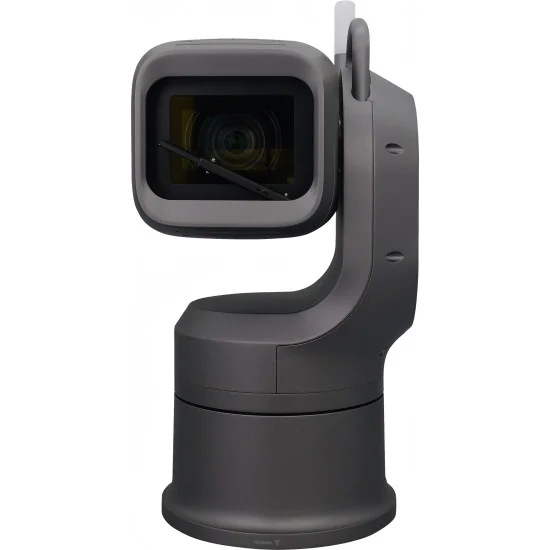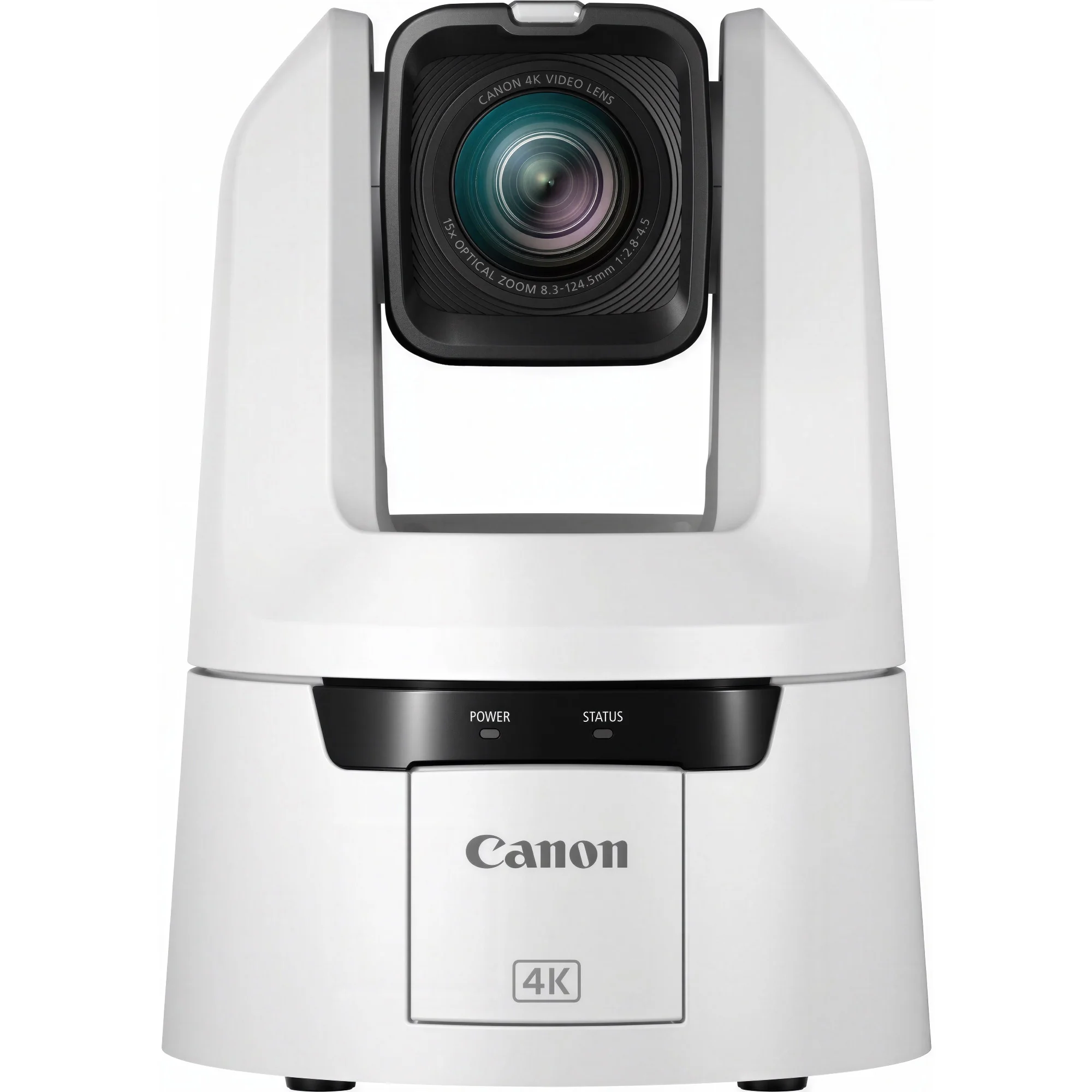
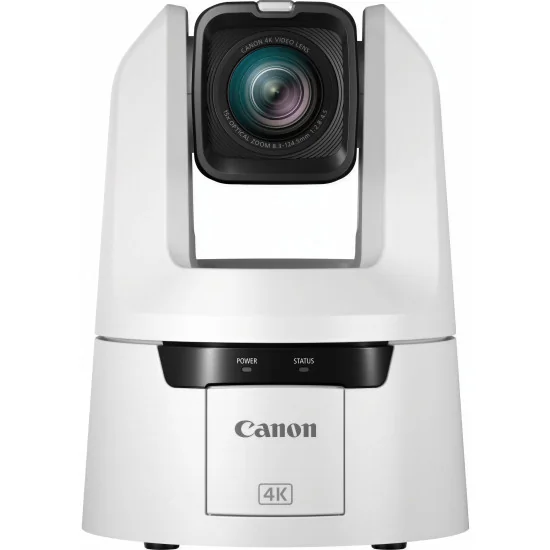
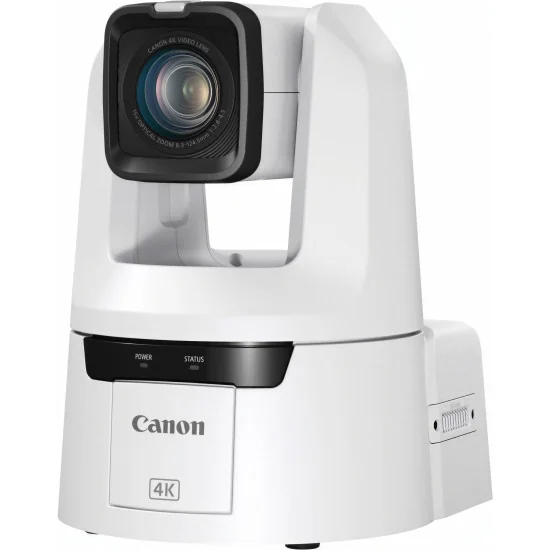
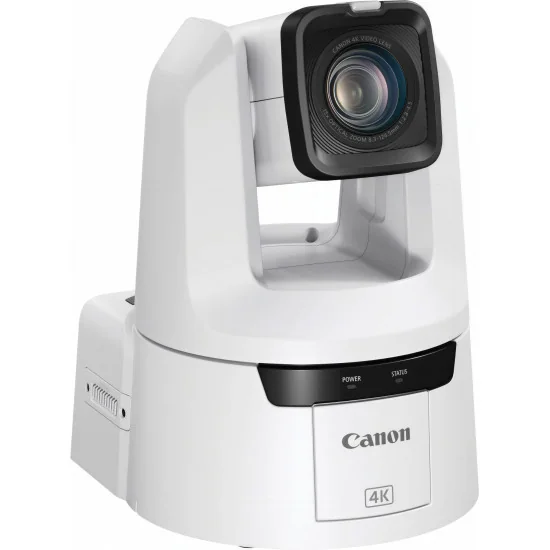
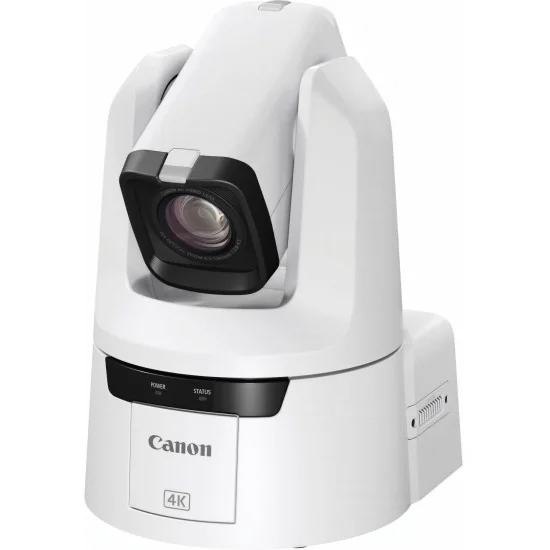
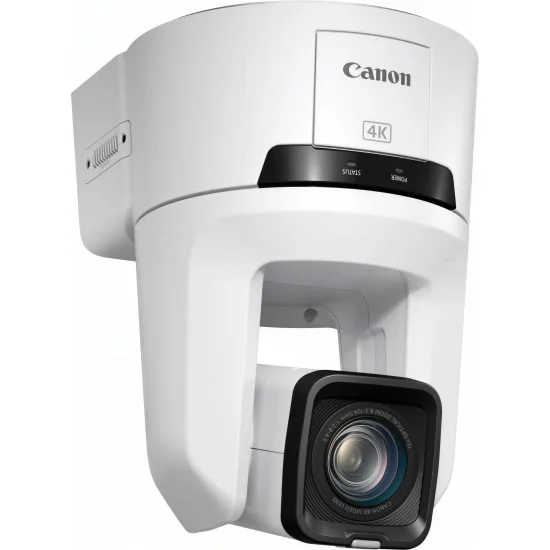
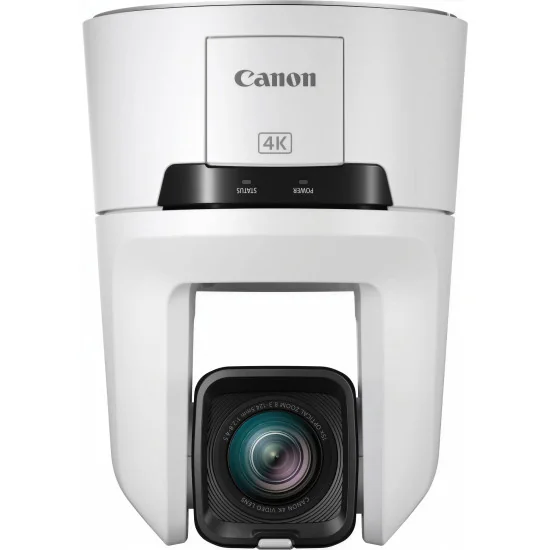
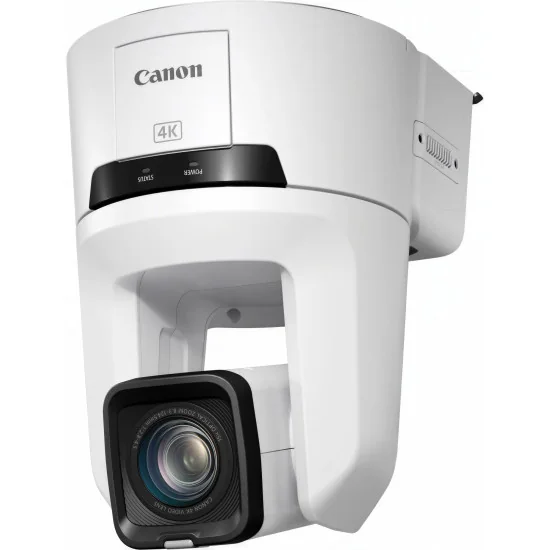
Recalling a preset on the Canon CR-N700 White Auto Tracking can now bring back the tracking behaviour tuned for that position, not only its pan, tilt and zoom values. Canon's top-tier indoor 4K PTZ camera arrives here in titanium white, together with a licence that unlocks the complete RA-AT001 Auto Tracking application, so none of the limits of the free Lite mode apply. Since the October 2026 firmware, each preset can carry its own tracking configuration: a lectern, a panel table and an open stage zone get separate framing rules, and one technician switches scenes instead of rebuilding settings between sessions.
Image analysis runs inside the camera. Once the application is installed and activated, no computer or tracking server has to stay connected. The head frames a full-body, waist-up or head-and-shoulders shot of someone walking at a normal pace, and holds full-body or waist-up compositions at a brisk pace. The CR-N700 also keeps following a presenter who turns their back to the lens, for example to point at a projected slide.
Sensitivity has ten levels, auto zoom holds the person at a constant size, and the target's position in the picture is adjustable instead of locked to the centre. The latest firmware also gives the CR-N700 a subject-size setting with 21 increments, four of them extra-small, so someone standing near the back wall of a long hall can still be followed. Up to five complete setups are stored and recalled on demand.
Room geometry is handled with drawn zones. Flag a projection screen or whiteboard as the priority display zone and it stays in shot while the speaker moves beside it. Inside a fixed-angle zone the framing holds still as long as the presenter stands at the board, while excluded sectors prevent the camera from choosing a target among the audience or students. Pan and tilt limits keep the lens away from parts of the set viewers should not see. A halting area suppresses small corrective moves, tilt can be locked, and after a chosen delay the head returns to its starting framing if the subject leaves the tracked area.
We ship across the EU for €20, free over €1,000.
B2B sales only, prices excl. VAT.
Official EU distribution and warranty.
Secure online payments via Stripe.
Send your enquiry via the form or email avgear@avgear.shop
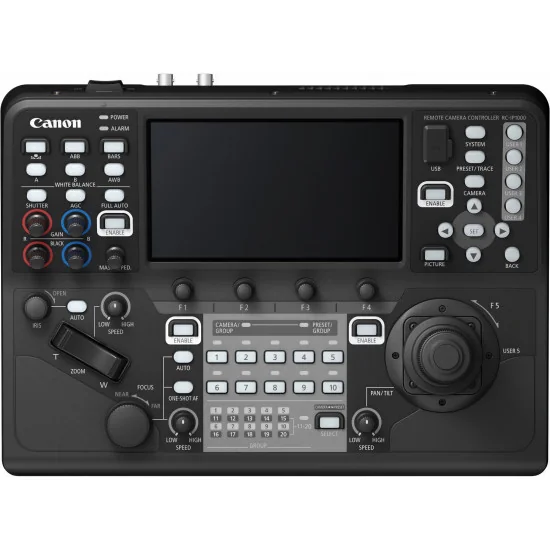
Auto Framing adds three behaviours. Multi-Person widens or tightens the shot to hold everyone on a panel, with an adjustable composition transition speed; Face Direction leaves space in front of the face; Sit/Stand recomposes as a guest rises from a chair. Registered Face Tracking keeps a ranked list of up to seven people and begins following automatically as soon as one of them is detected. Each face can be enabled or disabled as a target, which suits a weekly webcast with the same host and rotating guests. Tracking can be switched on or off over Standard Communication from external control systems, and RC-IP1000 users can now assign Auto Tracking, Trace or Auto Loop to Stream Deck keys.
Tracking moves the head; holding focus is a separate job. Here it falls to EOS iTR AF X, running on Canon's Dual Pixel CMOS AF, which gives priority to the eyes, falls back to the face and finally locks onto the head. Imaging relies on a 1.0-type CMOS chip of 3840 x 2160 effective pixels, working with a DIGIC DV7 engine and outputting 4K UHD up to 59.94p in 4:2:2 10-bit. Optically stabilised, the 15x zoom spans 25.5–382.5 mm in 35 mm terms at f/2.8–4.5 and reaches 30x in Full HD. A motorised ND filter (1/4, 1/16, 1/64), roughly 2.5 lux minimum illumination at 50 Hz and an infrared Night Mode cover difficult light. HLG, PQ, Canon Log 3 and the Wide DR variant of BT.709 keep the tracked angle in step with the main cameras at the grading stage.
London live-streaming company Kinura used exactly this pairing for the UK Climate Change Committee, where three speakers each delivered an address of at least ten minutes in a single take. DoP Max Elgar operated a Canon XF605 as the front camera and left a CR-N700 with Auto Tracking as the unmanned B-camera, controlled from a browser with its feed going into vMix. Because tracking kept a slightly swaying speaker centred, he could place the PTZ closer and frame it tighter than he would normally risk with an unattended camera. In budget terms, that is a usable second angle without a second operator on the day's call sheet.
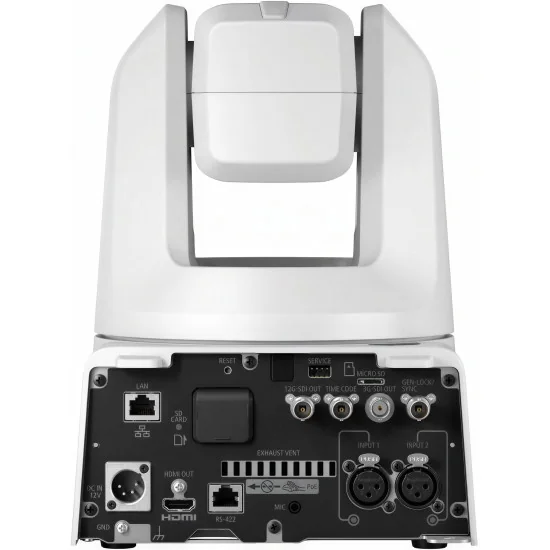
On the gallery side, 12G-SDI and HDMI output 2160p59.94 in 4:2:2 10-bit, a second 3G-SDI output feeds HD monitoring, and genlock, timecode in/out and RS-422 sit alongside. Network output covers NDI|HX, SRT, RTMP/RTMPS and RTP/RTSP, plus FreeD camera data for virtual sets. Two XLR inputs supplying 48 V phantom power accept lavalier receivers directly. Firmware 1.7.0 also enables SD card recording in XF-AVC or MP4 up to 4K 60p at 600 Mbps, so every tracked angle keeps its own ISO file. The same release opens the crop function to IP streams; it takes as many as two 1080p windows out of the UHD picture and sends one of them out as a main or secondary feed.
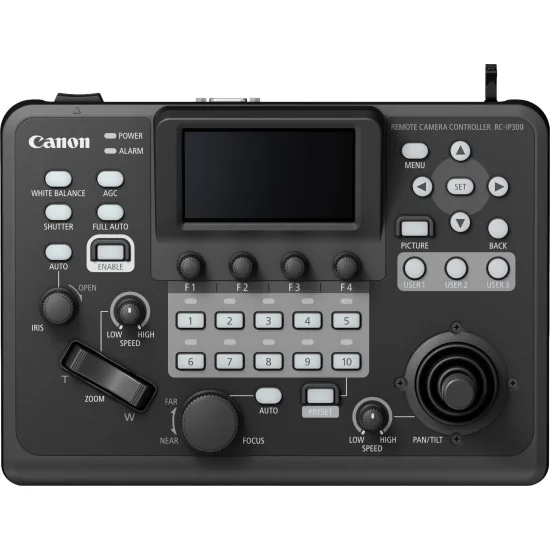
A single cable does the rest on a PoE++ switch (IEEE 802.3bt, Class 5); PoE and PoE+ ports cannot power it, and a 12 V DC input is available. Pan reaches ±170° and tilt −30° to +90°, at 0.1–100°/s. Its 100 presets can be driven from RC-IP1000 or RC-IP100 desks, from the Multi-Camera Control app on iPhone and iPad, or from a computer running Remote Camera Control Application software. The carton holds a ceiling plate, two safety cables (one of them running from camera to mount) plus the WL-N01 infrared handset with its battery. Ask our team for a tracking profile built around your venue plan, or for a check of your network switches, before the Canon CR-N700 White Auto Tracking goes up on the rig.
| Feature | Auto Tracking Application (Lite) | Auto Tracking Application |
|---|---|---|
| Tracking subject | Auto-select only | Auto-/manual select possible |
| Tracking sensitivity | Fixed | Adjustable from 1 to 10 levels |
| Tracking subject display size | Can be set at two levels | Can be set at five levels |
| Tracking target display position | Fixed at center | Can be set to any area |
| Auto Framing | — | Multi-Person Framing, Face Direction Framing, Sit/Stand Framing |
| Priority display area | — | Can be set |
| Fixed angle of view | — | Can be set |
| Save tracking settings | One only | Up to five can be saved/recalled |
Specifications
| Camera | |
|---|---|
| Image Sensor | Type 1.0 (1.0 in.) single-plate CMOS sensor |
| Effective Pixels | approx. 8.29 megapixels (3840 x 2160) |
| Lens | 15x optical zoom, 9-bladed iris diaphragm |
| Optical Zoom | 15x optical zoom (30 x with advanced zoom) |
| Digital Zoom | 20x digital zoom |
| Focal Length | 8.3 – 124.5 mm, f/2.8 – 4.5, 35mm equivalent focal length: approx. 25.5 (W) – 382.5 mm (T) |
| Angle of View | Horizontal: 73.0 (W) – 5.7° (T) Vertical: 45.2° (W) – 3.2° (T) |
| Minimum Subject Illumination | Approx. 3.0 lux (with 59.94 Hz frame frequency, 1/60 sec. shutter speed, 59.94P frame rate, and 21 dB gain) Approx. 2.5 lux (with 50.00 Hz frame frequency, 1/50 sec. shutter speed, 50.00P frame rate, and 21 dB gain) |
| Shutter Speed | 1/3 – 1/2000 sec. (specific values depend on the frame frequency and frame rate) |
| Iris | Manual/Automatic aperture |
| Gain | -6.0 dB - 36.0 dB |
| ND Filter | Built-in (Off, 1/4, 1/16, 1/64), motor operated |
| Night Mode (IR Cut Filter Off) | Yes |
| Optical Low-Pass Filter | Yes |
| White Balance | AUTO (AWB), Set A, Set B, preset settings (daylight: 5,600 K, tungsten lamp: 3,200 K), color temperature setting (2,000 K – 15,000 K), Manual |
| Focus | Focus mode: Manual, AF-boosted MF, Continuous AF, Face AF, Tracking AF type: Dual Pixel CMOS AF, Contrast AF Detection: Face Detection, Eye Detection |
| Minimum Focusing Distance | 1 cm at wide end, 60 cm across entire zooming range |
| Gamma | BT.709 Normal, BT.709 Wide DR, BT.709 Standard, Canon Log 3, Canon 709, PQ, HLG |
| Pan and Tilt | Pan operation range: Horizontal ±170° Pan operation speed: 0.1° – 100°/sec. Tilt operation range: Vertical -30° – +90° Tilt operation speed: 0.1° – 100°/sec. |
| Server | |
| Video Output Format: SDI | [12G-SDI] 3840 x 2160: 59.94P/29.97P/23.98P/50.00P/25.00P (4:2:2 10 bit) 1920 x 1080: 59.94P/59.94i/29.97P/29.97PsF/23.98P/50.00P/50.00i/25.00P/25.00PsF (4:2:2 10 bit) 1280 x 720: 59.94P/50.00P (4:2:2 10 bit) 720 x 576: 59.94i/50.00i (4:2:2 10 bit) [3G-SDI] 1920 x 1080: 59.94P/59.94i/29.97P/23.98P/50.00P/50.00i/25.00P (4:2:2 10 bit) 1280 x 720: 59.94P/50.00P (4:2:2 10 bit) 720 x 576: 59.94i/50.00i (4:2:2 10 bit) |
| Video Output Format: HDMI | 3840 x 2160: 59.94P/29.97P/23.98P/50.00P/25.00P (4:2:2 10 bit) 1920 x 1080: 59.94P/59.94i/29.97P/23.98P/50.00P/50.00i/25.00P (4:2:2 10 bit) 1280 x 720: 59.94P/50.00P (4:2:2 10 bit) 720 x 576: 59.94i/50.00i (4:2:2 10 bit) |
| Video Output Format: IP | [Frame frequency 59.94 Hz] 3840 x 2160, 1920 x 1080, 1280 x 720, 640 x 360: 59.94 fps, 29.97 fps, 14.99 fps, 5.00 fps (4:2:0 8 bit) [Frame frequency 29.97 Hz] 3840 x 2160, 1920 x 1080, 1280 x 720, 640 x 360: 29.97 fps, 14.99 fps, 5.00 fps (4:2:0 8 bit) [Frame frequency 50.00 Hz] 3840 x 2160, 1920 x 1080, 1280 x 720, 640 x 360: 50.00 fps, 25.00 fps, 12.50 fps, 5.00 fps (4:2:0 8 bit) [Frame frequency 25.00 Hz] 3840 x 2160, 1920 x 1080, 1280 x 720, 640 x 360: 25.00 fps, 12.50 fps, 5.00 fps (4:2:0 8 bit) [Frame frequency 23.98 Hz] 3840 x 2160, 1920 x 1080, 1280 x 720, 640 x 360: 23.98 fps, 11.99 fps, 5.99 fps (4:2:0 8 bit) *59.94 fps/50.00 fps is only when H.265. – JPEG has one pattern fixed depending on the frame frequency (format is fixed and cannot be selected) Resolution: 1280 x 720 59.94/29.97 Hz: 14.99 fps, 50.00/25.00 Hz: 12.50 fps, 23.98 Hz: 11.99 fps |
| Video Output Format: USB | No |
| Video Transmission Protocol | Canon XC, RTSP/RTP, NDI|HX, RTMP/RTMPS, Standard Communication (Serial), Standard Communication (IP), SRT, FreeD |
| Preset | Number of presets: Max. 100 (including home position) |
| Interface | |
| Communication Control | LAN, Wi-Fi, Serial, IR |
| Network Terminal | LAN x 1, RJ45, 1000Base-T |
| SDI OUT Terminal | 12G-SDI OUT Terminal BNC jack (output only) x 1, 0.8 Vp-p/75 Ω, SMPTE ST 2082, 2081, 424, 425, 292, 259, 299, 272 compliant Embedded audio, Time code (VITC/LTC) 6G-SDI OUT Terminal No 3G-SDI OUT Terminal BNC jack (output only) x 1, 0.8 Vp-p/75 Ω, SMPTE ST 424, 425, 292, 259, 299, 272 compliant Embedded audio, Time code (VITC/LTC) |
| GEN-LOCK Terminal | BNC jack (also serves as the SYNC OUT terminal) |
| TIME CODE Terminal | BNC jack (for both input/output) |
| HDMI OUT Terminal | HDMI connector (Type A), both video and audio are output only |
| RS-422 Terminal | RJ45 connector x 1 |
| Audio INPUT 1/INPUT 2 Terminals | XLR 3-pin jack (balanced) ((1) shield, (2) hot, (3) cold), two lines Sensitivity (MIC): -60 dBu (manual volume center, -18 dB full scale) Sensitivity (LINE): +4 dBu (manual volume center, -18 dB full scale) Supply Voltage: 48 V DC (Bias resistance: 6.8 kΩ) |
| MIC Terminal | ϕ 3.5 mm stereo mini-jack (unbalanced; supports plug-in power) Sensitivity (MIC): -72 dBu (manual volume center, -18 dB full scale) Sensitivity (LINE): -10 dBV (manual volume center, -18 dB full scale) Supply Voltage: 2.4 V DC (Bias resistance: 2.2 kΩ) |
| USB Terminal | No |
| Physical Features | |
| Operating Environment | Temperature 0°C – +40°C (+32°F – +104°F) Humidity 10% – 90% (without condensation) |
| Power Supply | PoE: PoE++ power supply via LAN connector (IEEE802.3bt compliant) – PoE and PoE+ cannot be used External power source: 12 V DC |
| Power Consumption | PoE++ Input: Approx. 37.4 W/1.2 A max. (body only) DC Input: Approx. 36.7 W/3.5 A max. (body only) * Class 5 (40.0 W required) for power supply devices |
| Dimensions (W x H x D) | Approx. 200 x 269 x 208 mm (excluding protrusions) |
| Weight | Approx. 4.4 kg (9.7 lbs) [Body Only] |
| Noise | NC 30 or less |

Data sheet
Specific References