- Pack


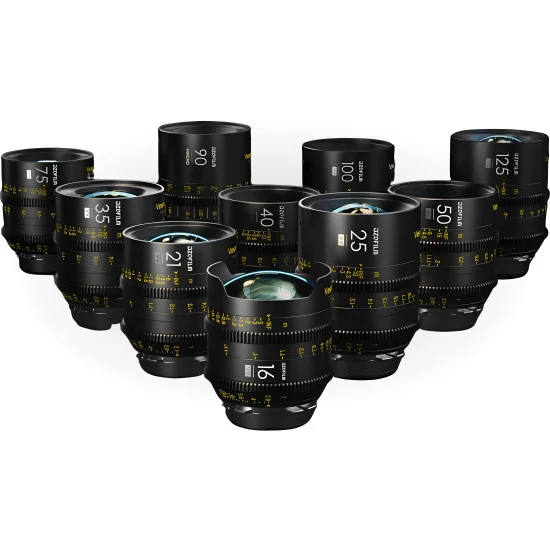
Both of DZOFilm's three-lens Pavo sets, the A set (28, 40 and 75 mm) and the B set (32, 55 and 100 mm), are combined in the DZOFilm Pavo 2x Anamorphic 6-Lens Kit (28/32/40/55/75/100mm T2.1/T2.4) PL & EF Mount Neutral, which ships as six lenses in two hard cases. Every lens squeezes the horizontal axis by a constant 2x and projects a 31.5 mm image circle matched to Super 35. Five of them open to T2.1. The 100 mm stops at T2.4, about two-fifths of a stop slower, so a crew that settles on T2.4 or deeper as its working stop can cut from the widest lens to the longest with the same exposure throughout.
How much of that circle a camera actually uses depends on its recording mode. A RED Ranger Gemini in 5K Full Height 6:5 reads a 21.6 × 18 mm window, roughly 28 mm on the diagonal, which stays inside the circle and de-squeezes to 2.4:1; the full-width 1.7:1 area, nearer 36 mm diagonally, does not. Through that 6:5 window the kit spans about 75° horizontally on the 28 mm and narrows to about 24° on the 100 mm. Cinematographer Christian Wolf, in an interview published by DZOFilm, described running Pavos on a Gemini in its 18 mm-tall 6:5 mode for a Merchant Capital commercial. The director wanted several aspect ratios inside one film, so the cart also carried spherical primes and zooms. Wolf then wrapped a four-month drama series for Showmax shot on Pavo anamorphics alone, the kind of long booking where owning the whole set, rather than hiring it week after week, shows up directly in the production budget.
Instead of €18,444.00
Both of DZOFilm's three-lens Pavo sets, the A set (28, 40 and 75 mm) and the B set (32, 55 and 100 mm), are combined in the DZOFilm Pavo 2x Anamorphic 6-Lens Kit (28/32/40/55/75/100mm T2.1/T2.4) PL & EF Mount Neutral, which ships as six lenses in two hard cases. Every lens squeezes the horizontal axis by a constant 2x and projects a 31.5 mm image circle matched to Super 35. Five of them open to T2.1. The 100 mm stops at T2.4, about two-fifths of a stop slower, so a crew that settles on T2.4 or deeper as its working stop can cut from the widest lens to the longest with the same exposure throughout.
How much of that circle a camera actually uses depends on its recording mode. A RED Ranger Gemini in 5K Full Height 6:5 reads a 21.6 × 18 mm window, roughly 28 mm on the diagonal, which stays inside the circle and de-squeezes to 2.4:1; the full-width 1.7:1 area, nearer 36 mm diagonally, does not. Through that 6:5 window the kit spans about 75° horizontally on the 28 mm and narrows to about 24° on the 100 mm. Cinematographer Christian Wolf, in an interview published by DZOFilm, described running Pavos on a Gemini in its 18 mm-tall 6:5 mode for a Merchant Capital commercial. The director wanted several aspect ratios inside one film, so the cart also carried spherical primes and zooms. Wolf then wrapped a four-month drama series for Showmax shot on Pavo anamorphics alone, the kind of long booking where owning the whole set, rather than hiring it week after week, shows up directly in the production budget.
We ship across the EU for €20, free over €1,000.
B2B sales only, prices excl. VAT.
Official EU distribution and warranty.
Secure online payments via Stripe.
Send your enquiry via the form or email avgear@avgear.shop
Close as they are in focal length, the 28 and 32 mm are not duplicates. The 28 combines a 14-blade iris with the slight barrel distortion typical of the short end, and wide open its background swirls a little toward the edges; the 32 switches to the 16-blade iris shared by the other five lenses, for smoother ovals behind the subject. Optical formulas vary as well: 15 elements in 13 groups on the 28 and 32, 15 in 14 on the 40 and 75, 14 in 13 on the 55 and 100, while DZOFilm tunes the series for one consistent rendering. Close focus, measured from the sensor, steps from 0.4 m on the two widest lenses to 0.45 m on the 40, 0.6 m on the 55, 0.84 m on the 75 and 0.95 m on the 100 mm. At 32 mm, a barber's clippers tracing a fade fill the frame for a grooming-brand spot; on the 75, a goalkeeper's eyes above the gloves become an extreme close-up, with no diopter in the matte box. With the neutral coating, flare colour simply follows the source: amber pendant lamps in a bar streak amber, and a cyan LED strip under a kitchen island streaks cyan. Because the anamorphic cylinders sit mid-barrel, after the focusing group, stray light is reined in, and it takes a hard source in the lens axis, a low sun or a stage backlight, to pull a streak across the frame. A hotel corridor lined with wall sconces can be filmed without a single flare unless the cinematographer goes looking for one.
On the rig, the six behave as one family. One 95 mm matte-box adapter ring suits every front, M86 filters thread onto all six, focus rotates 270°, and the 0.8 MOD gear rings keep their positions from lens to lens, so follow-focus motors and brackets stay put through a change. Only the iris throw differs, from 58° on the 40 mm to 79° on the 28 mm, so a wireless iris motor should keep a separate calibration for each lens. Each lens arrives on a PL mount. Its own EF bayonet and EF rear cap travel with it in the kit, alongside six shim sets, screw packs and a screwdriver, and the DZOFilm manual lists no shim adjustment as part of the swap. A back-focus ring at the rear of each barrel then trims infinity within ±0.2 mm; checking a new body takes a star chart, T4 and a few minutes. Scales read in metres, and with no contacts on the mount, nothing is passed to the camera's metadata. Compact enough for gimbal, Steadicam and drone builds, the set also moves up to full-frame and VistaVision bodies through the separately sold Marlin 1.6x Expander, behaving there as roughly a 45, 51, 64, 88, 120 and 160 mm at a cost of about one and a half stops. The 65 mm macro, 135 and 180 mm Pavos can join later. For a production house, that adds up to one anamorphic lens kit serving PL and EF cameras today and larger sensors tomorrow.
| Specification | ||||||||||||
|---|---|---|---|---|---|---|---|---|---|---|---|---|
| Focal Length | 28mm | 32mm | 40mm | 55mm | 75mm | 100mm | ||||||
| Colour | Space Grey+Black | |||||||||||
| Flare Option | Neutral | |||||||||||
| Mount | PL | EF | PL | EF | PL | EF | PL | EF | PL | EF | PL | EF |
| T-Stop | T2.1-T22 | T2.4-T22 | ||||||||||
| Image Circle | ø31.5mm (S35) | |||||||||||
| Optical Construction | 15 Elements in 13 Groups | 15 Elements in 14 Groups | 14 Elements in 13 Groups | 15 Elements in 14 Groups | 14 Elements in 13 Groups | |||||||
| Flange Distance | 52mm (PL) | 44mm (EF) | 52mm (PL) | 44mm (EF) | 52mm (PL) | 44mm (EF) | 52mm (PL) | 44mm (EF) | 52mm (PL) | 44mm (EF) | 52mm (PL) | 44mm (EF) |
| Close Focus (from sensor plane) | 0.4m/1ft4in | 0.45m/1ft6in | 0.6m/2ft | 0.84m/2ft9in | 0.95m/3ft1in | |||||||
| Squeeze Factor | 2X | |||||||||||
| Iris Control | Manual (79°) | Manual (59°) | Manual (58°) | Manual (63°) | Manual (67°) | Manual (69°) | ||||||
| Focus Control | Manual (270°) | |||||||||||
| Front Dia. | ø95mm/3.74" | |||||||||||
| Length | 106.3mm/4.19" | 105.7mm/4.16" | 107.6mm/4.24" | 108.4mm/4.26" | 126.9mm/4.99" | 143.1mm/5.63" | ||||||
| Iris Blade | 14 | 16 | ||||||||||
| Filter Size | M86 | |||||||||||
| Gear Pitch | 0.8 Mod | |||||||||||
| Material | Aluminum Alloy | |||||||||||
| Weight | ≈1203g | ≈1278g | ≈1300g | ≈1262g | ≈1466g | ≈1654g | ||||||

Data sheet
Specific References