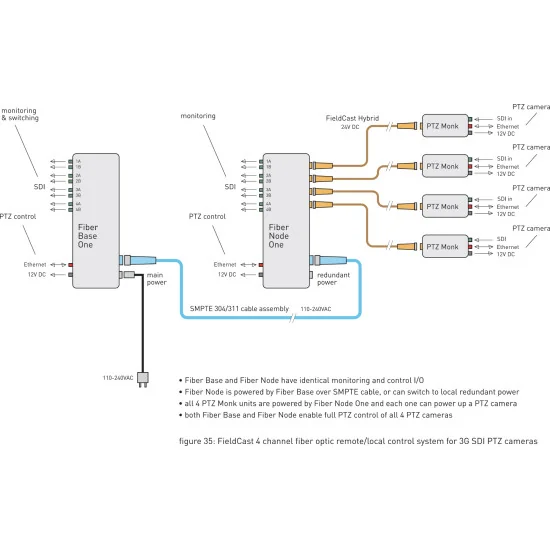
Alternating current survives a two-kilometre cable run in a way that DC cannot, and that piece of physics explains the architecture around the FieldCast Fiber Base One. This 1RU converter is where power for a four-camera PTZ rig starts: a 110–240 V AC PowerCon inlet, redundant supplies inside, and mains sent down one SMPTE 311M/304 hybrid cable to a Fiber Node One at the camera end. The node puts 24 V DC on each hybrid connector, and every PTZ Monk hands its camera a clean 12 V. One socket in the OB van feeds the lot.
Signals arrive on the same cable: two single-mode 9/125 cores, one bringing the four camera feeds home, the other tying both chassis into one gigabit network. An SMPTE 304 FXW connector lands the fibre at the rear panel, and the unit demultiplexes it into four 3G-SDI channels with dual outputs across eight 75-ohm BNCs, so a switcher and a multiviewer, or two recorders, are fed at once without a distribution amplifier. Rates run to 2.97 Gb/s, compliance covers SMPTE 259M, 344M, 292M and 424M, and every SD and HD standard up to 1080p60 passes. Nothing is rescaled on the way, so what the camera sends is what the gallery cuts.
Camera control travels back along the second core. The front-panel RJ-45 port joins the optical Ethernet switch inside Fiber Node One, putting a controller in the truck and a second panel at the node on the same subnet — either can drive any camera in the network, which earns its keep at rehearsal, framing set at the camera position and trimmed from the van. Throughput follows 1000Base-T and 1000Base-SX/LX, IEEE 802.3ab and 802.3z, full or half duplex.
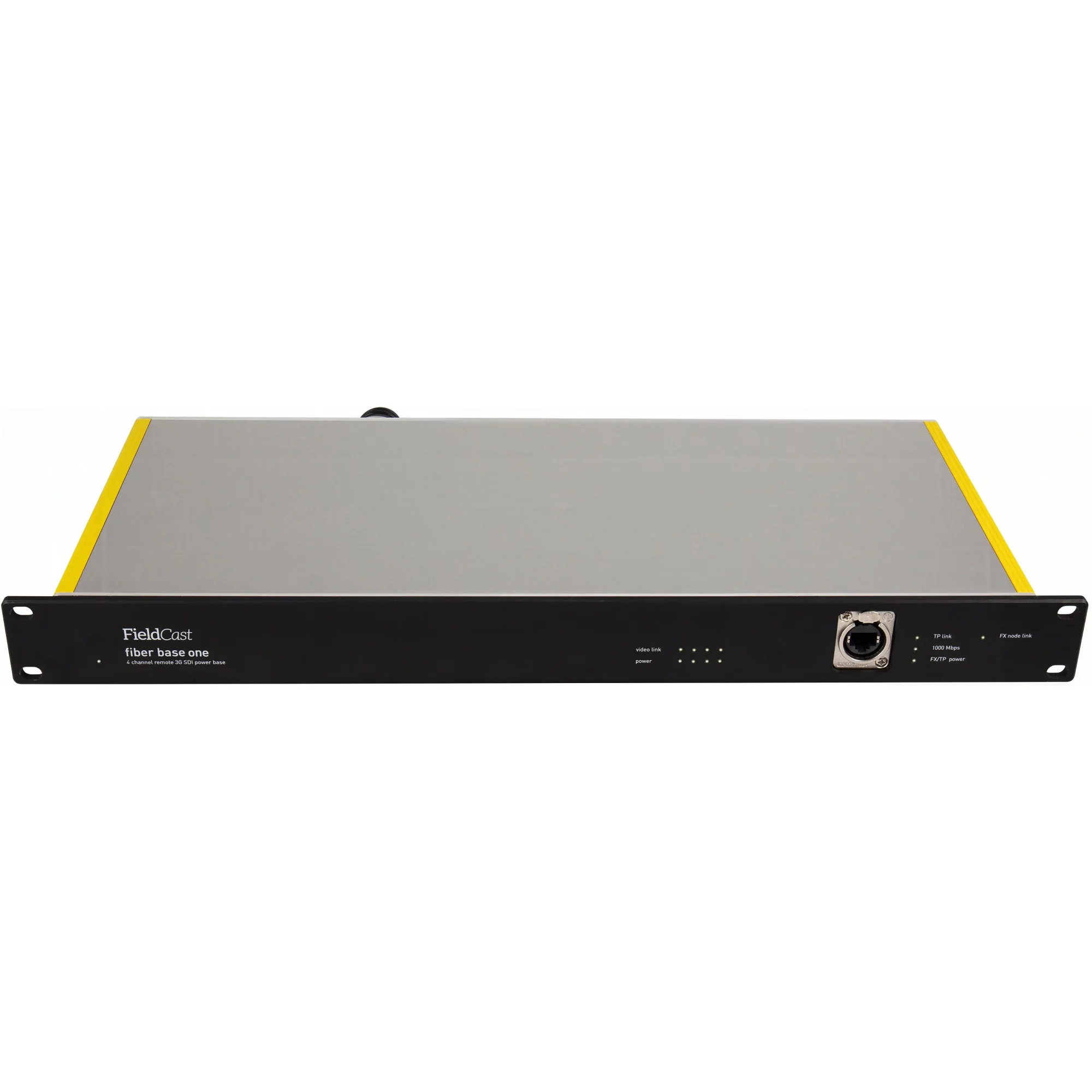
The aluminium 19-inch enclosure stays inside one rack unit; 2 mm warm-white LEDs on a black front panel report AC input, per-channel SDI and Ethernet activity over fibre, local Ethernet and gigabit link detection, so faults are narrowed by reading the panel, not pulling BNCs. Because the SDI outputs at both ends carry identical signals, one kit covers a motorsport compound well back from pit lane, a velodrome infield, an exhibition-hall keynote or campus lecture capture. For a rental operation: one cable to run, no local power to arrange, four boxes to maintain.
Alternating current survives a two-kilometre cable run in a way that DC cannot, and that piece of physics explains the architecture around the FieldCast Fiber Base One. This 1RU converter is where power for a four-camera PTZ rig starts: a 110–240 V AC PowerCon inlet, redundant supplies inside, and mains sent down one SMPTE 311M/304 hybrid cable to a Fiber Node One at the camera end. The node puts 24 V DC on each hybrid connector, and every PTZ Monk hands its camera a clean 12 V. One socket in the OB van feeds the lot.
Signals arrive on the same cable: two single-mode 9/125 cores, one bringing the four camera feeds home, the other tying both chassis into one gigabit network. An SMPTE 304 FXW connector lands the fibre at the rear panel, and the unit demultiplexes it into four 3G-SDI channels with dual outputs across eight 75-ohm BNCs, so a switcher and a multiviewer, or two recorders, are fed at once without a distribution amplifier. Rates run to 2.97 Gb/s, compliance covers SMPTE 259M, 344M, 292M and 424M, and every SD and HD standard up to 1080p60 passes. Nothing is rescaled on the way, so what the camera sends is what the gallery cuts.
Camera control travels back along the second core. The front-panel RJ-45 port joins the optical Ethernet switch inside Fiber Node One, putting a controller in the truck and a second panel at the node on the same subnet — either can drive any camera in the network, which earns its keep at rehearsal, framing set at the camera position and trimmed from the van. Throughput follows 1000Base-T and 1000Base-SX/LX, IEEE 802.3ab and 802.3z, full or half duplex.
The aluminium 19-inch enclosure stays inside one rack unit; 2 mm warm-white LEDs on a black front panel report AC input, per-channel SDI and Ethernet activity over fibre, local Ethernet and gigabit link detection, so faults are narrowed by reading the panel, not pulling BNCs. Because the SDI outputs at both ends carry identical signals, one kit covers a motorsport compound well back from pit lane, a velodrome infield, an exhibition-hall keynote or campus lecture capture. For a rental operation: one cable to run, no local power to arrange, four boxes to maintain.
We ship across the EU for €20, free over €1,000.
B2B sales only, prices excl. VAT.
Official EU distribution and warranty.
Secure online payments via Stripe.
Send your enquiry via the form or email avgear@avgear.shop
The long-distance hub for PTZ control over fiber
Fiber Base One is a four-channel converter and the final hub for professional, long-distance monitoring and control of 3G SDI PTZ cameras equipped with Ethernet for control data.
Where to place Fiber Base One in the setup?
Installed at the farthest point from the camera setup—typically in an OB van or studio located up to 2 kilometers from the live event—Fiber Base One connects to Fiber Node One via a single SMPTE 311M/304 hybrid cable. Through this connection, it not only delivers power all the way to the stage but also manages video and control signals from the cameras.
Fiber Base One offers the following key functionalities:
Signal Demultiplexing. Fiber Base One separates the incoming fiber signal from Fiber Node One into four SDI channels and Ethernet control data. This allows for direct connection to an SDI switcher, monitoring equipment, and camera controller.
Integrated Power Delivery. Equipped with redundant power supplies, Fiber Base One sends AC power through the SMPTE 311M/304 cable to Fiber Node One. From there, DC power is distributed to the FieldCast Hybrid main cable, PTZ Monk converter, PTZ camera, and any other connected devices—eliminating the need for local power adapters.
When used in combination with PTZ Monk(s), Fiber Node One, FieldCast Hybrid main cable(s), and a single SMPTE 311M/304 connection, Fiber Base One becomes the core control station for reliable, long-distance PTZ camera operation over fiber.
Features
Robust 19″ rack mount aluminum enclosure, 1RU in height, to be placed in OB van or studio.
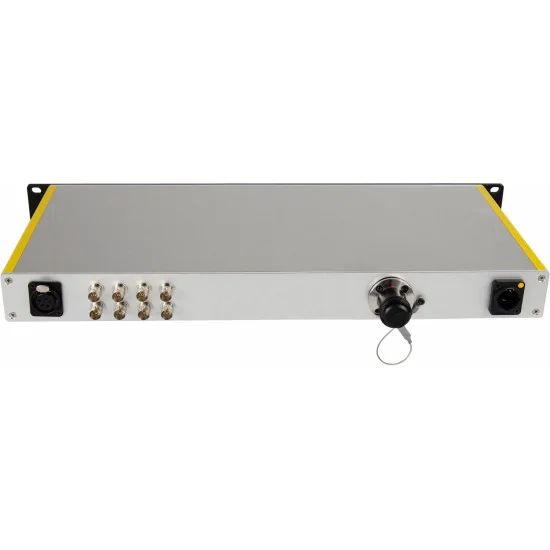
Four BNC SDI connectors with dual SDI output on the backside to connect to your SDI switcher or monitor.
One RJ-45 Ethernet connector on the front side to connect to your PTZ camera controller.
One SMPTE FXW connector to connect to SMPTE 311M/304 hybrid cable.
Converts four fiber channels to four SDI channels.
Converts fiber to Ethernet and Ethernet to fiber.
| Specifications | |
|---|---|
| Material | Aluminum enclosure design |
| Form Factor | 1RU design with a depth of 205 mm |
| Channel Count | – 1x 2-core fiber input – 4x SDI output (each with dual output) – 4x Ethernet i/o over fiber SDI + Ethernet |
| Fiber Conversion | – 1x fiber input to 4x SDI output – 4x Ethernet i/o over fiber |
| Fiber Connector | One SMPTE 304 FXW connector on the back side |
| Fiber Type | Single mode 9/125 |
| SDI Connector | 8x 75-ohm BNC on the back side |
| Ethernet Connector | 1x UTP RJ-45 connector on the front side, full duplex or half duplex |
| Supported Video Format | – Up to 3G (2.97Gb) SDI – All SD and HD standards up to 1080p60 – Complies with SMPTE 259M, SMPTE 344M, SMPTE 292M and SMPTE 424M |
| Supported Data Format | 1 Gigabit Ethernet (1000Base-T and 1000Base-SX/LX), compliant with IEEE 802.3ab and IEEE 802.3z |
| LED Indicators | Black front panel with 2mm warm white led indicators containing: – led indicator for AC power input – led indicators for channel module activity: SDI signal over fiber, Ethernet over fiber – led indicators for local Ethernet and for detection of 1 Gb signal level |
| Transmission Distance | Up to 2km, 1.2mi between Fiber Base One and Fiber Dock One |
| Power Out | 110-240VAC |
| Power Consumption | 300W |
| Power In | 110-240VAC input with PowerCon connector |
| Weight | 3.1 kg |
| Dimension | Standard 1RU panel size, 482 (W) x 43 (H) x 205 (D) mm |
| Packing List | Fiber Base One, country-specific power cord, manual |

Data sheet
Specific References