


Telycam Mix One – The perfect all-in-one solution
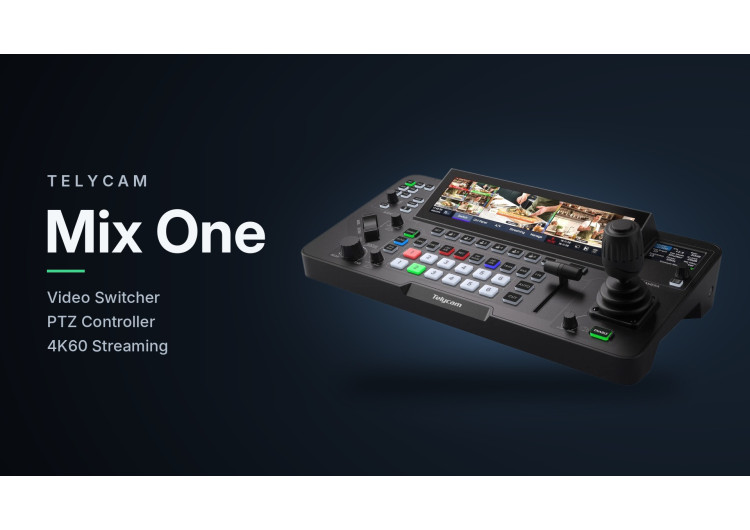
One desk to cut cameras, steer PTZ heads, stream and record. Here is how the Telycam Mix One fits into real multicam productions.
Switcher, PTZ Controller, Streamer and much more
Count the hardware on a typical three-camera PTZ desk and the list grows quickly: a joystick controller, a hardware switcher, an NDI decoder or capture card, a streaming encoder, a recorder, a preview monitor and a tangle of power supplies. Every extra box is one more firmware to keep current, one more cable to fail during a show and one more line on the client's quote.
The Telycam Mix One folds that stack into a single desk unit. Put simply, it is a six-source video switcher that also drives PTZ cameras, encodes and decodes IP video over NDI HX3, SRT, RTMP and RTSP, mixes audio from a phantom-powered XLR input and records the programme to USB drives or SD cards. For a production house, the value is less about any single feature and more about what disappears from the kit list – and from the setup time at every venue.
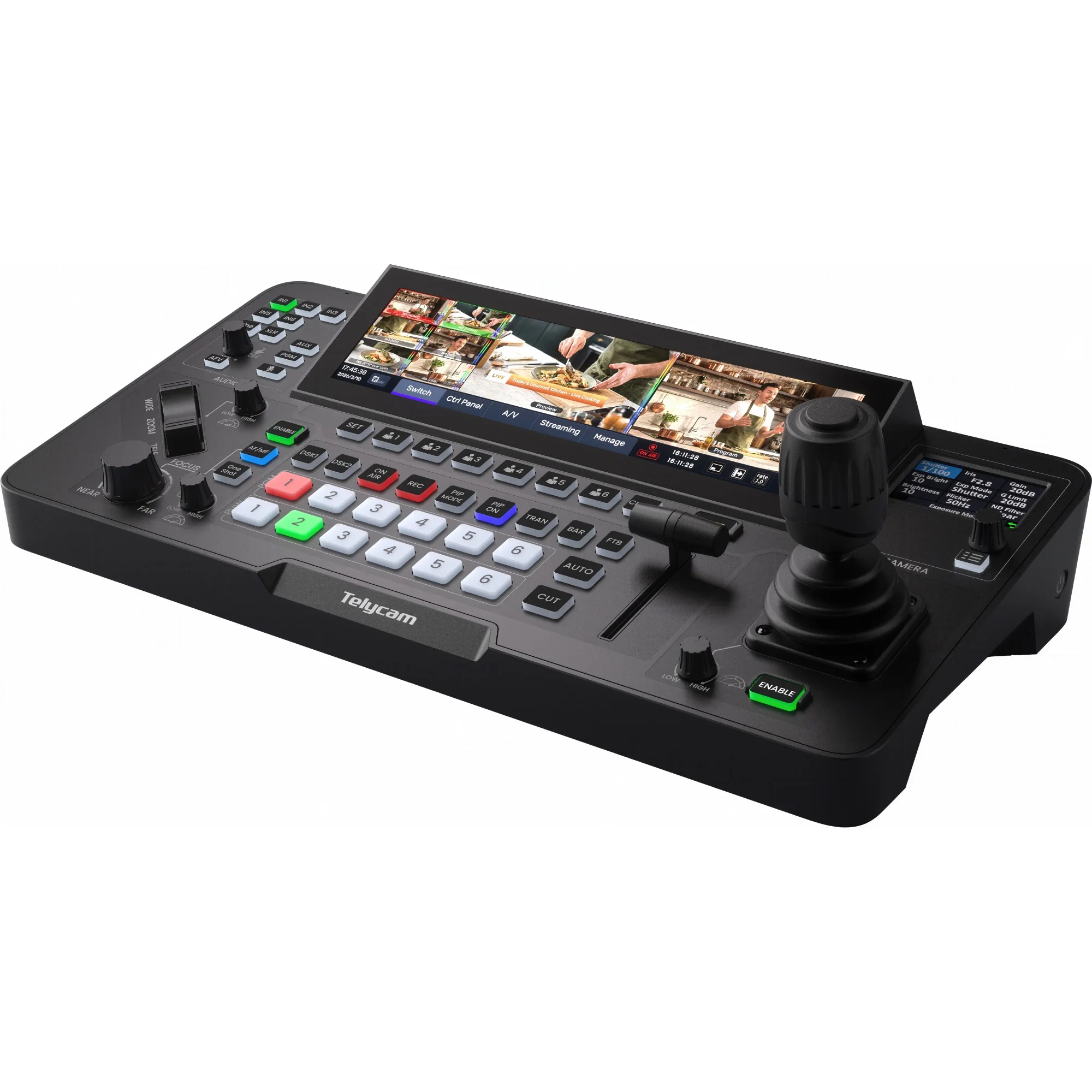
The switching engine runs six processing layers plus overlays. Eight transitions are built in, including cut, cross dissolve and fade, with dedicated CUT and AUTO keys and an adjustable effect duration. Upstream and downstream keyers handle chroma, luma, linear and pattern keys, with masking, edge smoothing and foreground colour correction for green-screen sets or branded virtual backgrounds. Input 1 can sit as a picture-in-picture window anywhere in frame – the classic presenter-over-slides layout for webinars and investor updates. Titles, lower thirds, digital clocks and rolling subtitles live in an onboard graphics library, four still-image buffers hold logos or holding slates, and finished layer groups can be exported and loaded onto another unit, so a second studio starts with the same look.
Monitoring happens on a 22.4 cm (8.8″) touchscreen at 1920 × 480, which shows preview, programme, input thumbnails, audio levels and system status in one strip. A browser-based WebUI mirrors the controls across the network, so a technical director can prepare graphics from a laptop while the operator rehearses camera moves. There is even an auto-polling mode that cycles sources at a set interval – useful for an unattended overflow-room feed or a lobby screen.
6 Input Channels
Six simultaneous sources is the working number for most corporate and podcast productions. A realistic channel map might look like this: three PTZ cameras over NDI, a presenter's laptop through the USB-C DisplayPort input, a fixed HDMI camera holding the wide shot and a remote guest arriving over SRT. That covers a panel discussion, a product demo or a two-host video podcast without a second switcher or an external converter.
Any mix of physical and network sources is allowed, and Telycam specifies format conversion on every input, so sources running different supported formats can share one programme. The pairing works especially well with Telycam PTZ cameras: the brand has shipped NDI HX as standard on its IP-enabled Explore, Vision+ and Drive+ models since September 2025, which means every camera on the network can be both a video source and a controllable device on one cable.
A practical tip for repeat clients: build the channel map once, then save the complete configuration. Recalling a profile brings back sources, layers and audio routing in one step, so when the same quarterly town hall comes round again, the line-check starts from a known-good state rather than a blank desk.
HDMI, USB and IP Inputs
The two HDMI inputs are not identical, and the difference matters when planning a 4K job. HDMI 1 accepts up to 4K60 as well as 1080p, 1080i and 720p formats; HDMI 2 tops out at 4K30/25 for UHD while still taking the same HD range. Put the 4K60 camera or media server on HDMI 1 and keep HDMI 2 for a 1080p source or a 4K30 feed.
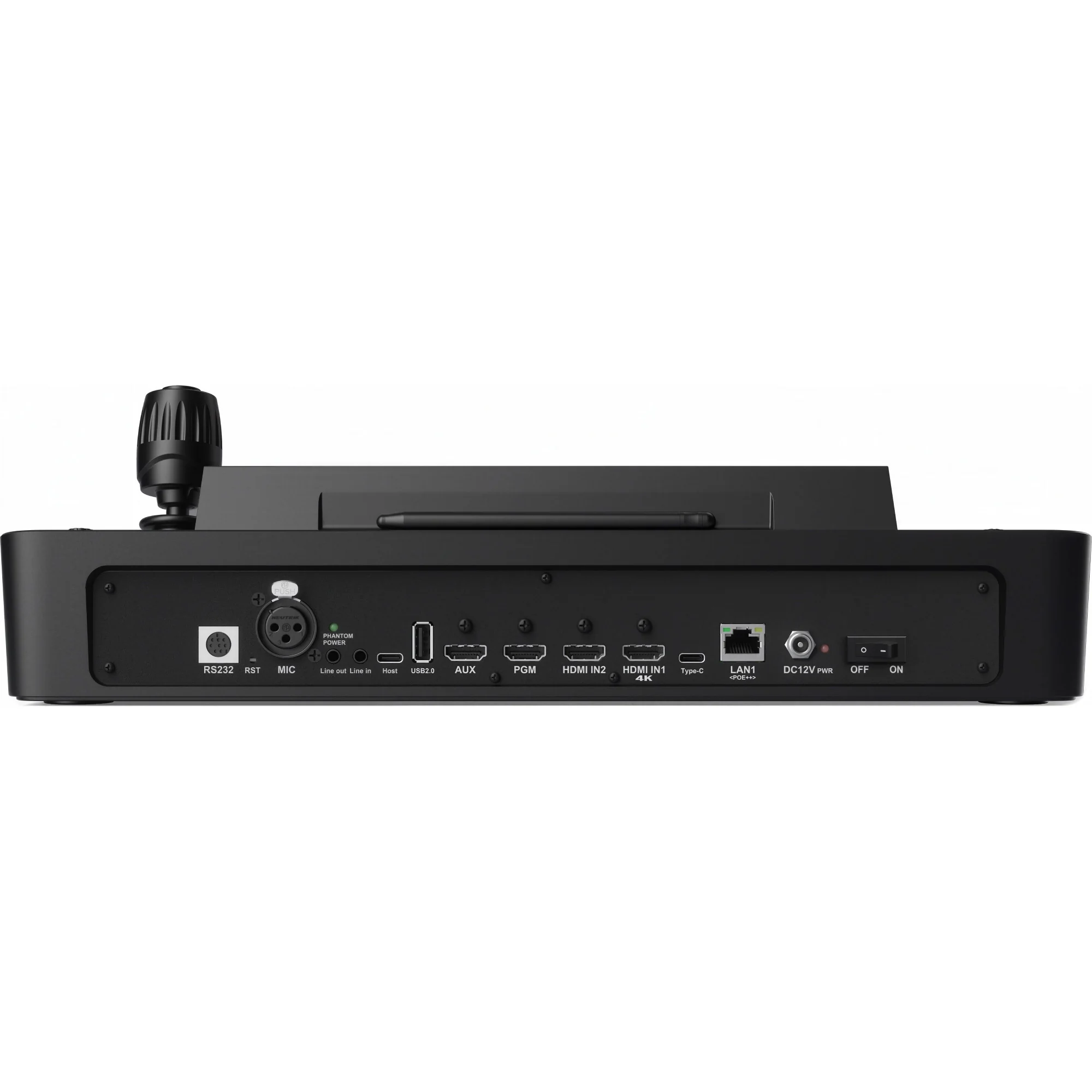
USB is more capable than the single "USB-C" mentioned in most launch coverage. There are three USB video inputs in total: two UVC ports (USB-C 3.0 and USB-A 2.0) for webcams or UVC capture devices, plus a Type-C multifunction port that takes a DisplayPort signal up to 1080p60. In practice, a presenter plugs a laptop straight in and the slides appear as a source – no HDMI dongle, no capture stick. A separate Type-C host port can drive a docking station or Type-C display and supplies 5 V at 1.5 A to small peripherals, while USB 2.0 ports take a keyboard, mouse or storage.
On the output side, two HDMI connectors split the jobs: programme up to 4K60, and an AUX output at up to 1080p60 carrying multiview or preview for a director's screen or a confidence monitor at the front of the stage. A USB UVC output (MJPEG, 1080p60) presents the finished programme to a computer as a webcam, so the mixed show drops straight into Teams, Zoom or OBS for a hybrid meeting. A DisplayPort output at 1080p60 rounds things off.
Support for RTSP, SRT and NDI Protocols
Network inputs are where the Telycam Mix One earns its "IP-first" label. Each protocol solves a different problem:
NDI HX3 is the local-network workhorse. Sources announce themselves, so cameras appear without typing addresses, and the compressed format keeps bandwidth modest. NDI's own bandwidth tables put an HX3 stream (H.265) at a maximum of around 50 Mbit/s for 1080p60 and roughly 84 Mbit/s for 2160p60 – six HD sources fit comfortably inside a single gigabit link with headroom left for outputs.
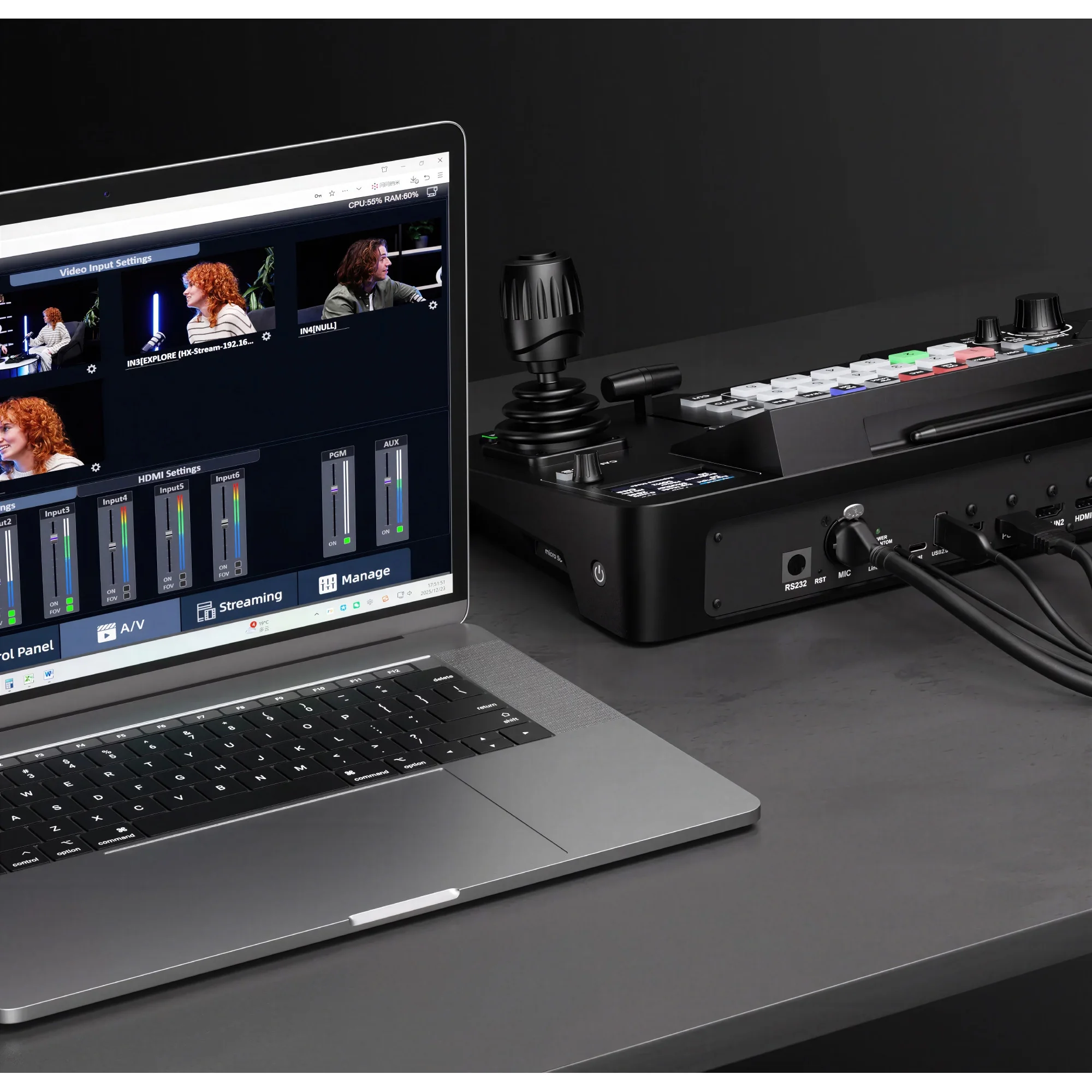
SRT handles the open internet. Built for point-to-point contribution, it encrypts the stream and recovers lost packets, which makes it the right choice for a guest joining from another city, a feed from a second venue or a contribution link to a broadcaster's decoder. RTSP pulls streams from IP cameras and encoders – think of a fixed overview camera in an exhibition hall or a feed from an existing room-camera installation. RTMP is accepted on the input side too.
Telycam describes the network side as a dual-NIC design that keeps the production network apart from the general building network. For integrators installing the unit in a corporate meeting floor, that separation is welcome: camera traffic stays off the office LAN and the IT department stays relaxed.
PTZ Control via VISCA IP and NDI
Camera control is built into the desk rather than bolted on. The PTZ controller speaks three dialects: VISCA over IP (UDP or TCP), NDI PTZ, and serial VISCA over RS-232 or RS-485 for cameras that predate network control. VISCA, originally a Sony protocol, is supported by most PTZ manufacturers, so mixed fleets are rarely a problem. With NDI PTZ the control channel travels with the video source itself – select the camera and move it, with no separate control address to configure.
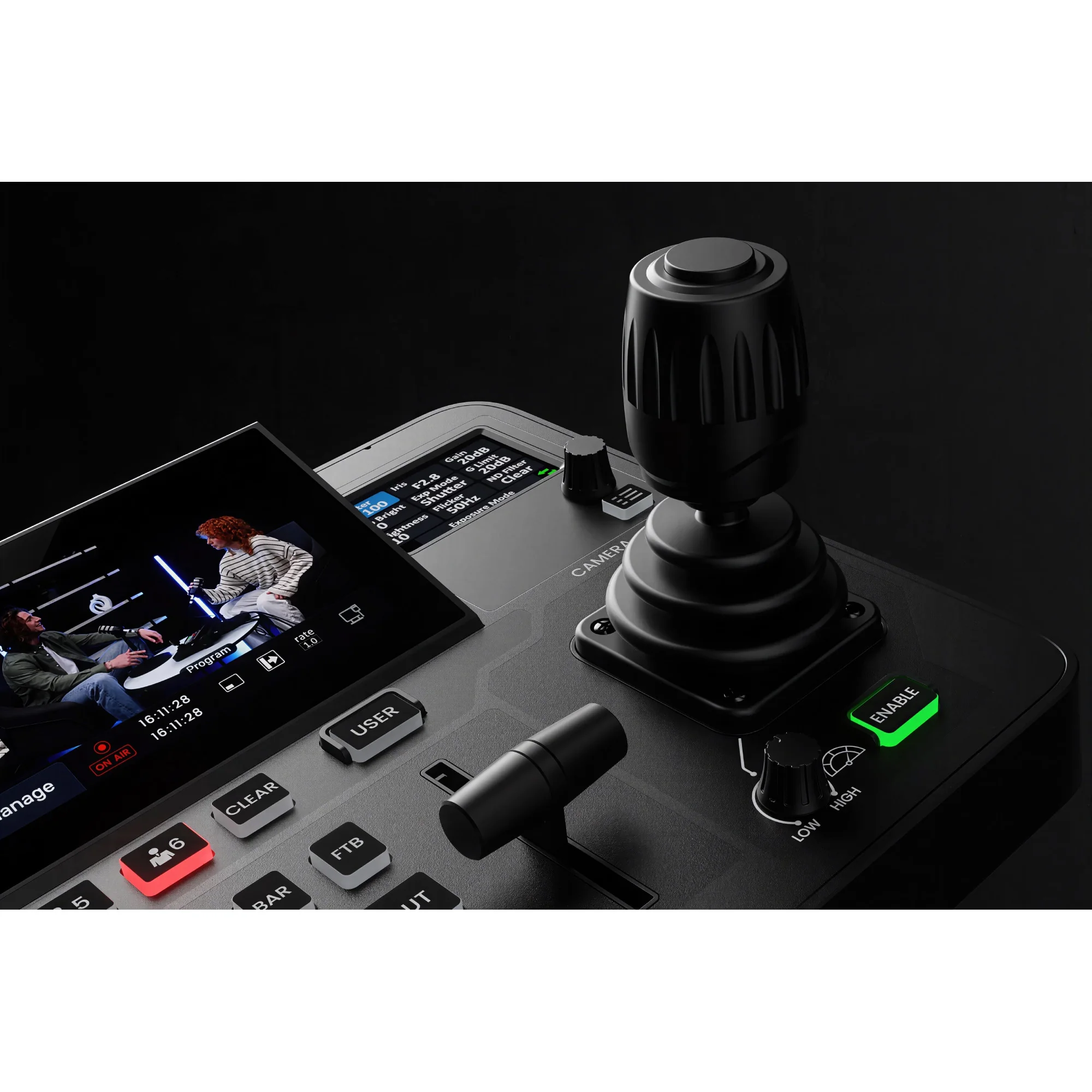
The hardware is what an operator notices first. A Hall-effect 4D joystick handles pan, tilt and zoom; because it senses position magnetically rather than through a sliding contact, there is no wiper to wear down – the usual cause of drift on older potentiometer sticks after years of daily shows. Zoom can also be driven from a rocker or knob, and an independent focus knob has its own speed adjustment – slow, steady push-ins on a speaker are much easier when the speed curve suits the lens. Up to six presets per camera cover the standard shots of a talk format: host close-up, guest close-up, two-shot, wide, product table and screen.
Exposure, colour, white balance and detail can be trimmed from the switcher, alongside image and tracking settings. Matching three cameras before a live interview no longer means opening three browser tabs. A separate 6.1 cm (2.4″) control screen shows camera parameters, so the main touchscreen stays dedicated to the programme.
XLR Audio
A single host or narrator can plug a condenser or dynamic microphone straight into the XLR input with 48 V phantom power – no external preamp and no extra mixer for a one-voice show. A stereo line input on 3.5 mm jack takes a music bed, a playback machine or the output of a small external mixer, and a stereo line output feeds headphones, a PA or a backup recorder.
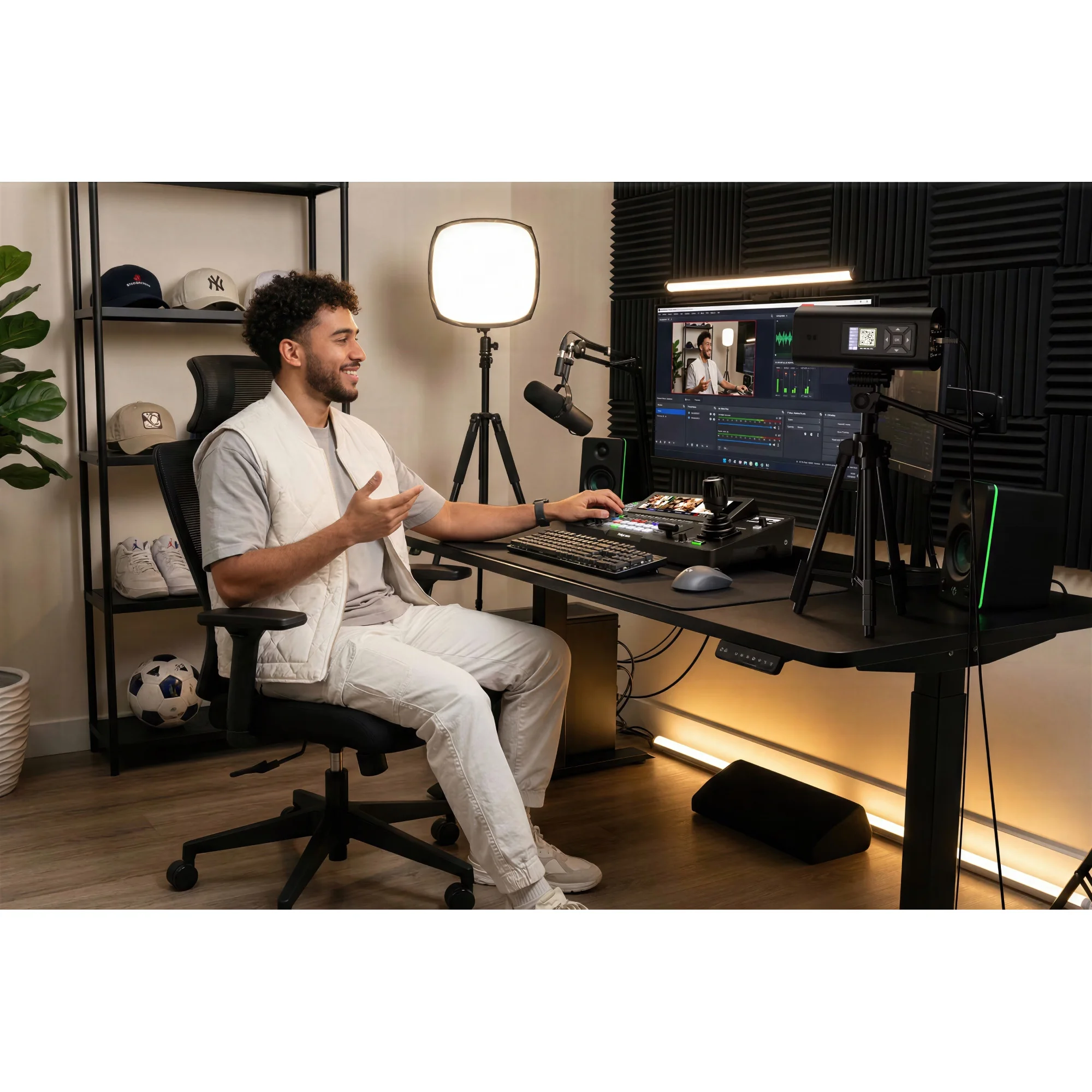
As many as six embedded audio channels from HDMI and IP sources follow their video inputs, with Audio Follow Video available and still independently adjustable. Each input has level, mute and routing, gain control sits alongside, and real-time meters run on the multiview. Recordings carry 48 kHz AAC audio.
Worth knowing at the planning stage: with one XLR input, a two- or three-microphone podcast needs a compact mixer feeding the line input. That is a common, inexpensive pairing, and it keeps the main desk uncluttered while the Mix One takes care of picture, camera control and distribution.
Multi-Protocol Streaming
The same four protocols work in the outbound direction, at up to 4K60. RTMP pushes straight to YouTube, Twitch, Facebook or your own ingest server, with no PC encoder in the chain. SRT sends a protected contribution feed to a broadcaster, a cloud production platform or a remote decoder at a client's headquarters. NDI HX3 puts the finished programme back on the local network, where it can feed a recording workstation, an overflow room, a digital signage player in the lobby or a larger gallery switcher – in which case the Mix One works as a self-contained sub-mixer for a breakout room. RTSP gives control rooms and monitoring players a simple stream to watch.
Physical outputs keep running in parallel with the IP output: HDMI programme to a projector or LED processor, AUX multiview to the director, UVC into a conferencing laptop. Telycam's resolution table confirms that HDMI and NDI can both carry 4K60 at the same time. One unit, several destinations – that is what turns a single operator into a complete hybrid-event crew for corporate launches, conferences and training sessions.
4K 60p Resolution
The programme HDMI output and the IP stream both reach 4K60, and recordings can be made in UHD. Inputs deserve a closer look, because the manufacturer is precise about the limits: 4K sources are supported with layer effects disabled, up to three at once – two over IP (NDI, SRT or RTSP) plus one HDMI. Everything at 1080p and below works on every HDMI, USB and IP input with the full graphics and keying toolset.
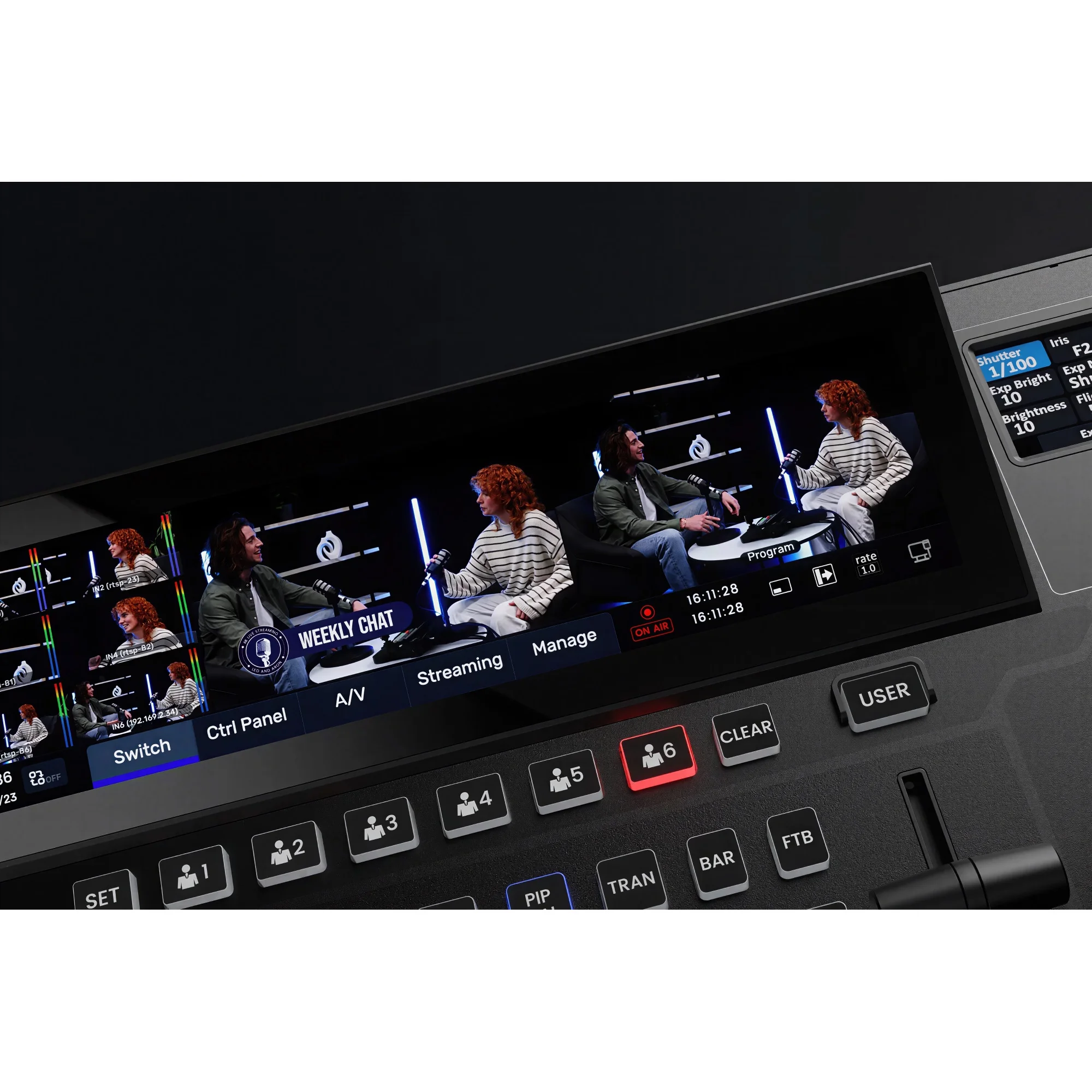
What does that mean on a real job? A clean 4K recording of a keynote or product launch – one 4K60 camera on HDMI 1 and two 4K NDI PTZ cameras, cut live – is well within reach and gives the editor a sharp master for social cut-downs. A six-camera talk show with lower thirds, keyed logos and picture-in-picture runs at 1080p, which is also what most live platforms and conferencing tools deliver to viewers anyway. Knowing this before the quote is written avoids promising a client something the format plan cannot hold.
Recording to Memory Cards or USB Storage
Programme recording is built into the Telycam Mix One, which saves MP4 files with H.264 video and AAC audio at resolutions from 720p up to 4K. Targets include SD cards, USB flash drives and external hard drives or SSDs. Long sessions split automatically into segments of 5 to 60 minutes – a full-day conference becomes a tidy set of files that are easy to upload, hand to an editor or publish session by session to a learning platform. If a file ever gets damaged, only one segment is affected, not the whole day.
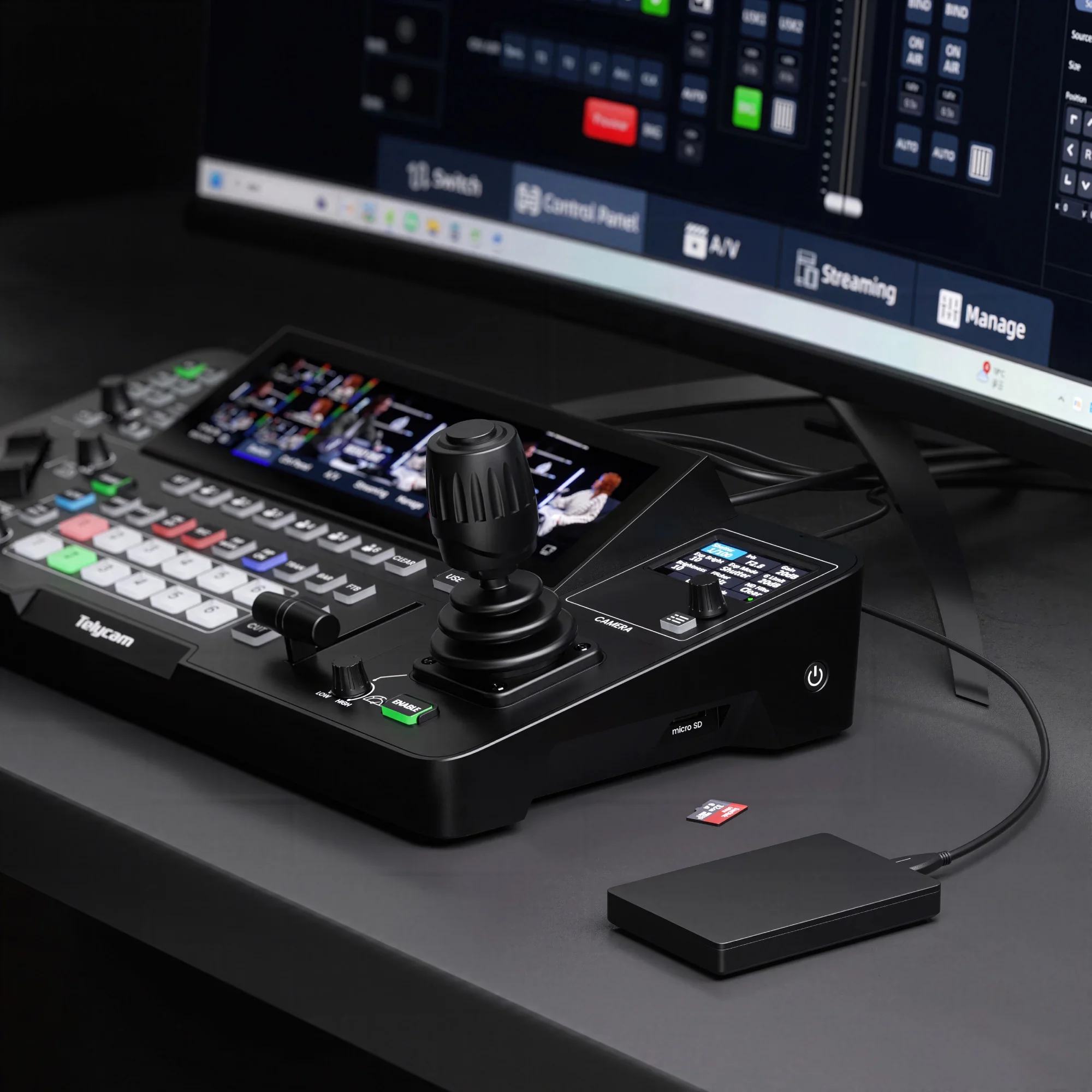
Two practical notes. First, the Mix One records the programme only – ISO recording of individual cameras is not supported, so if editors need clean angles, record them in the cameras or on an NDI recorder elsewhere on the network. Second, for 4K recordings, choose cards rated V30 or higher, which guarantees a sustained write speed of at least 30 MB/s; slower cards are a frequent cause of dropped frames on long takes.
Recording and streaming from the same box also gives a ready-made backup: if the live platform has a hiccup, the local master is still there for a clean on-demand upload an hour after the event.
PoE++ Power
The gigabit Ethernet port accepts PoE++, and Telycam rates it at 72 W – territory of the IEEE 802.3bt Type 4 class, which delivers up to 90 W at the switch port. A standard PoE+ port (30 W) will not run the desk, so check the switch or injector specification before installation. Idle draw is around 22 W; the remaining budget covers the screens, controls and peripherals powered from the Type-C host port.
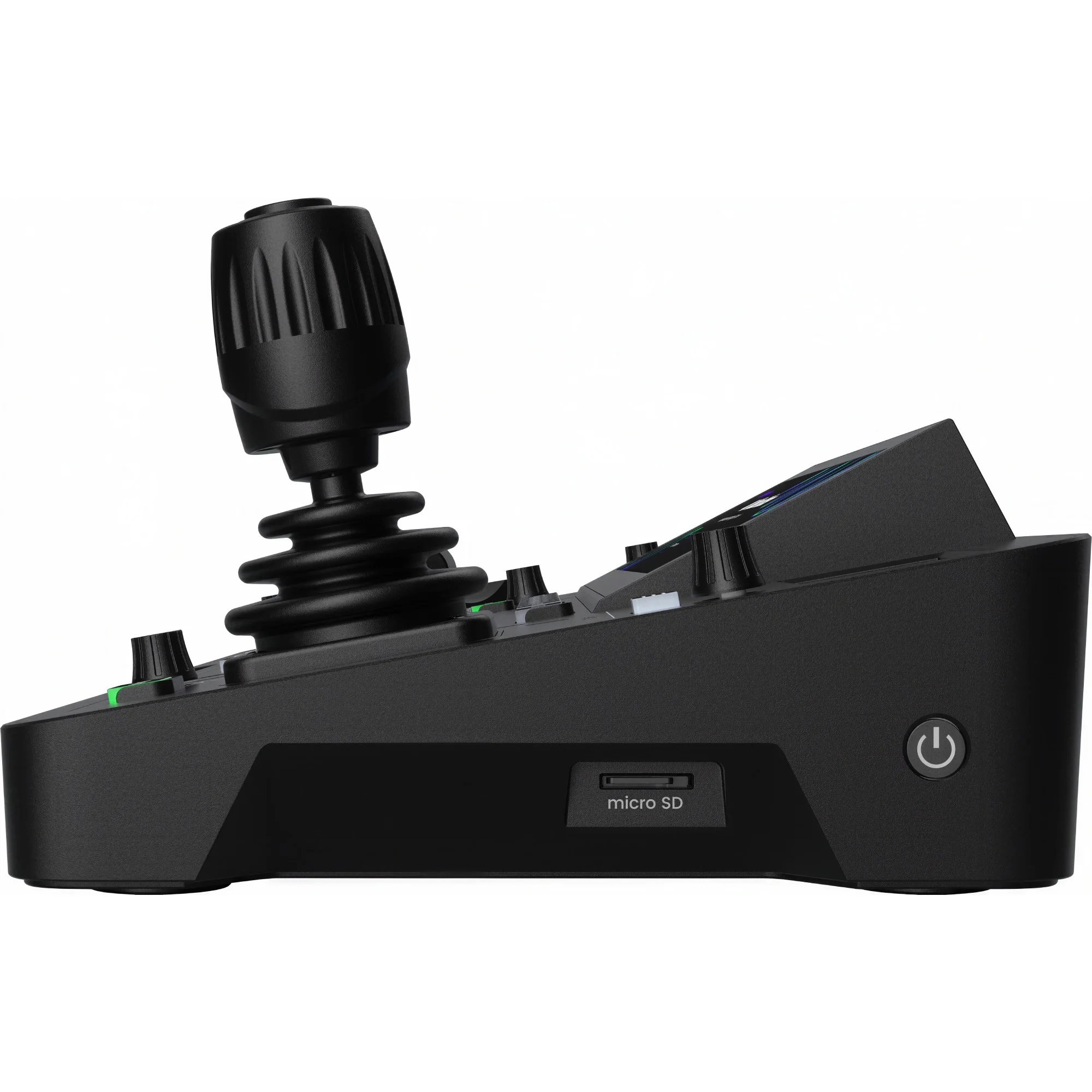
For fixed installations the benefit is real: one cable carries power, video and control, the desk can sit up to 100 m from the rack, and if that switch is on a UPS, the switcher rides through a short power dip together with the cameras. For touring kits and venues without a suitable switch, the supplied 12 V / 5 A DC adapter does the same job.
Taken together, the Telycam Mix One replaces four or five separate devices with one desk, one configuration file and one power source. For production companies running in-house studios, corporate streams, video podcasts or lecture capture, that translates into faster setups, fewer points of failure and a system that a single operator can drive with confidence. Matching cameras and controllers are available across the Telycam range, which makes it straightforward to specify a complete, compatible PTZ production chain from one supplier.
Comments
No comment at this time!
Leave your comment